

We research everything we recommend. When you buy through our links, we may earn a commission. Learn more

Buying guide · 11 min read · Updated October 2, 2026

6 Best Budget RV Water Filter Systems in 2026: A Practical RV Guide

Budget RV water filter systems from $19.99 to $149.99: sediment-plus-carbon setups, a 0.01 micron kit and a refill pair, and when a second stage pays off.

Bowen HigginsBy Bowen HigginsRV Editor at RV Gear Lab6 products comparedSpec-sheet researched

At a glance

Our top picks

A second filter stage earns its money when the water you fill from is murky, hard or untrustworthy, and it is wasted when you fill from clean municipal supply. Systems and refill cartridges in this guide run from $19.99 to $149.99, built around the same idea at different price points: catch the sediment first so the carbon behind it can do its job. The spread is wide, from a single 10 inch compound filter at $35.99 to a kit with a 0.01 micron ultrafiltration stage at $149.99, and every step along the way adds a stage, a seal or a tool that the cheaper picks do without.

The budget end of this market sells stages, not brands. Two stages, such as the 0.5 micron carbon block paired with a 5 micron element on the OKBA, cost $53.99. That pairing splits the job into coarse and fine, which is the logic of every multi-stage design. A pair of two-stage hose filters costs $69.98. A 3 gpm unit with a stated 125 psi ceiling costs $93.01, and the ultrafiltration kit costs the most because it adds a membrane stage. A $19.99 pair of refill cartridges rounds out the list, and the order of the picks shows how each extra stage or part changes the bill.

Stopping at $150 makes sense for owners who want real two-stage protection without a whole-house price. Seasonal campers who fill from varied sources, full-timers who move between regions and anyone who has watched a cheap hose filter clog in a single trip all fit here, because each of them gains a lot from a proper first stage. Owners who need a certified microbial standard should keep looking, because several listings here make claims without naming one, and the water-filter guides at higher prices are the better place to search for a named standard.

RV Gear Lab field notes

The Rig Fit Check

Start with the job
Caredear RV Water Filter System leads this shortlist for Owners wanting an ultrafiltration stage and a full tool kit.. Use that fit as a reference point, then compare the alternatives against your own space and workload.
Specs that separate the picks
The first details to compare are PP, carbon, 0.01 micron UF, 20 to 125 psi range, 1 micron two-stage media in a two-pack. Confirm the exact model and included components before ordering.
Trade-off to plan for
No flow rate stated

Before you buy

What Matters Before You Choose a Budget RV Water Filter System

Key buying criteria so you get the right fit the first time.

  1. 01

    Stage order and purpose

    A two-stage system works because the first stage protects the second. Sediment is caught first so that carbon is not clogged, and the carbon then handles chlorine, taste and odor. The OKBA pairs a 5 micron element with a 0.5 micron carbon block, a coarse-and-fine combination. Check the listing for the order of the stages and for what each one is meant to catch.

  2. 02

    Ultrafiltration claims

    The Caredear lists a 0.01 micron ultrafiltration stage after its polypropylene sediment and carbon stages. No test standard is named, so the figure is the seller's description rather than a verified result. A fine membrane stage can be a reasonable extra layer, but it remains a claim. Confirmed pathogen removal calls for a named standard.

  3. 03

    Pressure rating

    A housing has to withstand the pressure coming from the spigot. The Caredear states a housing tested to 125 psi and the VEVOR states an operating range of 20 to 125 psi. A pressure rating on a filter is a limit, not protection, so it does not replace a regulator ahead of the rig. Find the psi figure on the listing and install a regulator upstream of it.

  4. 04

    Flow rate

    A fine filter that chokes the flow turns a shower into a trickle. A stated 3 gpm is enough to feed a shower on the VEVOR, while the Caredear and most others state no flow figure. Multiple stages in series reduce flow more than a single stage does. Prefer a printed gpm and compare it with the fixtures you actually run at the same time.

  5. 05

    Housings, O-rings and wrenches

    A canister system is only as reliable as its seals. The 10-Inch System ships with double O-rings and a positioning mark, the Caredear includes spare O-rings and two wrenches, and the OKBA includes a wrench. Plastic housings need careful hand tightening each time, and over-tightening cracks them. Prefer a kit that lists its seals and tools, because a missing wrench stops a cartridge change.

  6. 06

    Cartridge format and refills

    Refills decide how cheap a canister setup really is. The PUREPLUS combo pack lists a 5 micron polypropylene and a 1 micron CTO KDF cartridge in the standard 10 by 2.5 inch format, the 10-Inch System replaces just an inner core, and the SpiroPure pair is thrown away whole. Standard sizes keep refills easy to source. Check the cartridge format in the listing before choosing a housing.

Our standards

Why You Can Trust RV Gear Lab

At RV Gear Lab, we compare products based on rig fit and power or hookup compatibility, verified specifications, usability, setup requirements, weight, durability, and real-world trade-offs. We do not rank products purely on marketing claims or commission rates.

We have not personally tested every product listed. Where hands-on testing is not available, recommendations are based on verified manufacturer specifications, product documentation, use-case fit, and comparative research.

How we review RV gear →

Detailed reviews

The 6 best budget rv water filter systems, explained

01

Best Three-Stage Kit · 1 of 6

Caredear RV Water Filter System

Caredear RV Water Filter System
  • PP, carbon, 0.01 micron UF
  • Housing tested to 125 psi
  • Wrenches, O-rings, adapters
Check price on Amazon for Caredear RV Water Filter System (opens in a new tab)
Best for: Owners wanting an ultrafiltration stage and a full tool kit.

Our take

Full-time travelers, owners who fill from varied sources and anyone who likes a kit that arrives ready to service will find the most value.

Why it made the shortlist

The Caredear system costs $149.99, the top of this guide, and stacks polypropylene sediment, carbon and a 0.01 micron ultrafiltration stage in one kit. The housing is tested to 125 psi per the listing, and the box includes spare O-rings, two wrenches and adapters. It fits 1 inch or 3/4 inch hookups, which covers most campground spigots.

Against the $93.01 VEVOR, the extra $56.98 buys the finest filtration claim in this guide and a complete tool set. That makes it the lowest-priced ultrafiltration kit among the picks, and the 0.01 micron figure is two orders of magnitude finer than the 1 micron media in the SpiroPure pair. The ultrafiltration stage is the one the listing names after the sediment and carbon stages.

The spare O-rings and wrenches save an emergency trip to the hardware store, and the dual-size hookup support avoids adapter hunting. Households that want the strongest stated filtration under $150 should start here.

What works

  • Housing tested to 125 psi per listing
  • Spare O-rings and two wrenches included
  • Fits 1 inch or 3/4 inch hookups

Watch out for

  • No flow rate stated
  • No standard named for the UF claim
02

Best Flow and Pressure Range · 2 of 6

VEVOR RV Water Filter System

VEVOR RV Water Filter System
  • 20 to 125 psi range
  • 3 gpm flow rate
  • 4,500 gallon capacity
Check price on Amazon for VEVOR RV Water Filter System (opens in a new tab)
Best for: Rigs with showers that need a stated 3 gpm and a wide psi range.

Our take

Rigs that run a shower, a dishwasher or two taps at once benefit from a unit that states its flow.

Why it made the shortlist

The VEVOR system costs $93.01 and prints the flow and pressure figures that many cheaper kits skip: a 20 to 125 psi operating range, 3 gpm of flow and a 4,500 gallon capacity. It is portable and light enough to carry between sites, and the listing describes a two-stage design. A stated 3 gpm is enough to feed a shower without a visible drop in pressure.

Falling $56.98 below the Caredear, it keeps a two-stage layout and a stated pressure ceiling at the same 125 psi, while dropping the ultrafiltration stage. Beyond the OKBA at $53.99, it adds a published flow rate and a capacity figure, which makes it easier to judge when the media needs changing. That printed detail is its core advantage.

Seasonal campers who want a mid-priced, lightweight system get an easy carry, and anyone planning a filter-change schedule can plan around the 4,500 gallon figure. Mid-priced and well documented, it suits owners who like to see the numbers.

What works

  • Stated pressure range is wide
  • 3 gpm flow suits showers
  • Portable and lightweight

Watch out for

  • Capacity lower than PUREPLUS kits
  • Microbe claim names no standard
03
SpiroPure SP-RV100-2PK RV Water Filter 2-Pack Multi-Stage Marine Inline
  • 1 micron two-stage media in a two-pack
  • Salt-free descaler stage
  • Standard 3/4 inch garden hose fit
Check price on Amazon for SpiroPure SP-RV100-2PK RV Water Filter 2-Pack Multi-Stage Marine Inline (opens in a new tab)
Best for: Seasonal campers who want two disposable filters and no housing to service.

Our take

Weekend and seasonal campers who dislike plumbing chores will like the screw-on design.

Why it made the shortlist

The SpiroPure 2-Pack costs $69.98 and delivers two complete inline filters, each with a 1 micron two-stage media. A salt-free descaler stage targets mineral buildup in the lines, and the standard 3/4 inch garden hose thread means no tools and no adapters. The listing describes a season-long life for each filter, so a pair covers a long run of travel.

Next in price below the VEVOR, this pair swaps a reusable housing for two throwaway bodies, which removes every maintenance step. There are no O-rings to lubricate, no wrenches to find and no cartridge to source. Two filters also mean one is always a spare, so a camper never faces a season with a spent unit and no replacement. Each filter's description promises a full season of use.

The descaler stage helps in hard-water regions where scale builds up in the lines, and the pair spreads cost across two filters rather than one. Call it a plug-in answer for owners who want better water without touching a canister, and the screw-on format needs no storage space for a housing.

What works

  • Two filters come in the pack
  • Descaler stage targets mineral buildup in the lines
  • Standard hose thread, no tools needed
  • Season-long life per filter per the listing

Watch out for

  • 1 micron is five times coarser than 0.2
  • Disposable units generate more waste each season
04
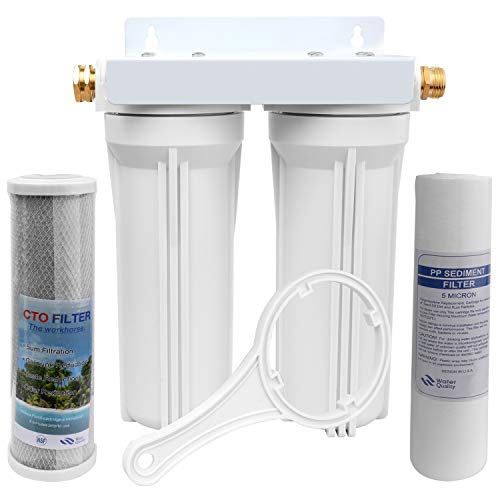
OKBA External RV Dual Water Filter System for RVs Camper Boats Marine
  • 0.5 micron carbon block with a 5 micron element
  • Brass fixture and sturdy mounting bracket
  • Housing wrench included in the box
Check price on Amazon for OKBA External RV Dual Water Filter System for RVs Camper Boats Marine (opens in a new tab)
Best for: Buyers comparing capacity, compatibility, included components and storage needs

Our take

Owners who want a real sediment-then-carbon setup, mounted to a wall or a bay and left alone, are the target.

Why it made the shortlist

The OKBA Dual costs $53.99 and splits the work across two canisters: a 0.5 micron carbon block and a 5 micron element. A brass fixture and a sturdy mounting bracket hold the assembly in place, and a housing wrench is included in the box. For a dual-canister setup the price is low, and the kit is complete enough to install on the day it arrives.

Running $18 above the 10-inch compound filter, it adds a second housing and a finer 0.5 micron media, which is the cheapest way in this guide to get genuinely separate stages. A coarse 5 micron element paired with a fine carbon block splits the job between rough and polished filtering. Each canister can be changed on its own schedule, which keeps cartridge costs sensible.

The bracket supports a permanent install, and the brass fixture resists the fatigue that plastic fittings suffer. For anyone moving up from a hose filter, it is the most accessible step into a canister system.

What works

  • Two separate stages in one kit
  • Brass fixture and sturdy bracket for mounting
  • Wrench is included for loosening the housings
  • Low cost for a dual-canister setup

Watch out for

  • Finest media is 0.5 micron, not 0.2
  • Plastic housings need careful hand tightening each time
05

Best Entry System · 5 of 6

RV Water Filter System

RV Water Filter System
  • 10 inch compound filter, polypropylene over carbon
  • 3/4 inch lead-free brass fittings, O-ring sealed
  • Double O-rings and a positioning mark
Check price on Amazon for RV Water Filter System (opens in a new tab)
Best for: First-time buyers wanting one complete housing with brass fittings.

Our take

First-time buyers, owners upgrading from a hose filter and anyone who wants a proper canister without a big outlay get a clear path.

Why it made the shortlist

This 10 inch system costs $35.99 and arrives ready to use, with a compound filter of polypropylene over carbon. Lead-free brass 3/4 inch fittings with O-ring seals connect to the hose, and a second set of O-rings plus a positioning mark on the housing help assemble it without leaks. Replacing just the inner core keeps refills affordable, since the body stays in service.

Costing $18 less than the OKBA, it is a single housing instead of two, and that is the whole difference. The compound filter stacks sediment and carbon in one cartridge, which keeps the cost and the plumbing simple. Replacing the core instead of the entire body also lowers the cost of each refill, and one housing means one set of seals to look after.

Brass fittings last longer than plastic and the marked housing position reduces assembly mistakes. As the cheapest complete system in the guide with a refillable housing, it adds brass fittings as a quality touch at this price.

What works

  • Ready-to-use complete system in one box
  • Brass fittings with O-rings for a firm seal
  • Replace only the inner core, not the whole body
  • Marked housing position helps leak-free assembly

Watch out for

  • Plastic shell may crack if frozen
06
PUREPLUS 10"x2.5" RV Water Filter Combo Pack
  • 5-micron PP plus 1-micron CTO KDF
  • 10 x 2.5 inch format
  • NSF/ANSI 42 for material safety
Check price on Amazon for PUREPLUS 10"x2.5" RV Water Filter Combo Pack (opens in a new tab)
Best for: Owners of a standard 10-inch housing who want a two-stage refill pair.

Our take

Owners who already have a 10 by 2.5 inch housing, or who plan to buy one, can build a two-stage setup for very little.

Why it made the shortlist

The PUREPLUS combo pack costs $19.99, the lowest price in this guide, and supplies two cartridges in the standard 10 by 2.5 inch format. A 5 micron polypropylene sediment cartridge is paired with a 1 micron CTO KDF cartridge, and the sediment filter is named for NSF/ANSI 42 material safety. Together they make a two-stage cartridge pair for a housing you already own.

Versus the $35.99 10-Inch System, the pack costs $16.00 less and splits the work across two cartridges, one for sediment and one for carbon media, instead of one compound filter. The coarse-then-fine pairing mirrors the stage logic of the OKBA at $53.99. Standard sizing keeps refills easy to source and easy to compare, so the same pair can be bought again next season without research.

NSF/ANSI 42 on the sediment cartridge gives the pack a checkable detail, and the low price makes a spare pair practical. Refilling a housing is the cheapest way to keep a multi-stage setup running through a season.

What works

  • Two-stage cartridge pair
  • Standard 10 x 2.5 inch format
  • Sediment filter named for NSF/ANSI 42 material safety

Watch out for

  • Needs a compatible housing
  • Not an inline hose filter

Methodology

How We Built This Shortlist

Each pick was assessed across 5 criteria weighted for real-world use.

01

Stage structure

We sorted each pick by how many stages it offers and what each does: sediment, carbon, descaler or ultrafiltration. A second stage counts as real only when it is a separate element. The structure of the media matters more than the count printed on the box.

02

Stated numbers

Based on product specs, we compared micron ratings, pressure ranges, flow rates and capacities. The VEVOR prints three of these and the Caredear prints a pressure test. Listings with several numbers were easier to place than listings with adjectives.

03

Fittings and serviceability

A filter system is serviced several times a season. We looked at brass versus plastic fittings, included wrenches, spare O-rings and positioning marks. Systems that ship with their own service gear earned credit.

04

Price steps

The spread runs from $19.99 to $149.99, so we asked what each step adds. The $56.98 jump from the VEVOR to the Caredear buys ultrafiltration and tools, while the $18 step from the compound system to the OKBA buys a second housing. Each step was judged on what it added, not on its price alone.

05

Claims without a named standard

Some listings make microbe or ultrafiltration claims and name no standard. We recorded those as claims, not certifications. A buyer who needs a documented microbial rating should look elsewhere, and the guide says so plainly where a claim lacks a named test.

Decision guide

Match a Budget RV Water Filter System to Your RV

By Number of Stages

Start with how many filtration steps you actually want, then read across to a pick.

Stages wantedPickWhy
One combined stage10-Inch SystemCompound filter with sediment over carbon
Two separate canistersOKBA Dual5 micron element plus 0.5 micron carbon block
Two stages, flow statedVEVOR System3 gpm and 4,500 gallons printed
Two stages and a descalerSpiroPure 2-Pack1 micron media with a salt-free descaler
Three stages with ultrafiltrationCaredear UFPP, carbon and a 0.01 micron UF stage

By Budget

The picks run from $19.99 to $149.99, and the steps are worth reading one at a time.

SpendPickWhat it buys
About $20PUREPLUS ComboA 5 micron and 1 micron cartridge pair for a standard housing
About $3610-Inch SystemA complete housing with brass fittings
About $54OKBA DualTwo canisters, a bracket and a wrench
About $70 to $93SpiroPure 2-Pack or VEVOR SystemTwo disposable filters, or a stated 3 gpm system
About $150Caredear UFUltrafiltration, spare O-rings and two wrenches

Disposable Hose Filters vs Housing Systems

Two philosophies share this shelf, and each fits a different habit.

Disposable hose filters

SpiroPure 2-Pack screws onto the hose and is thrown away when spent. No wrench, no O-rings and no cartridges to source, in exchange for more waste each season.

Housing systems

10-Inch System, OKBA Dual, VEVOR System and Caredear UF use refillable housings. Cost per change is lower, and the unit mounts in place, but seals and wrenches become part of the routine.

If you want zero maintenance, buy SpiroPure 2-Pack; if you want the lowest cost per change, buy OKBA Dual.

By Hookup Size and Pressure

A system has to fit your spigot and survive its pressure, so match both before buying.

Your hookupPickWhat is printed
Standard 3/4 inch garden hoseSpiroPure 2-PackStandard 3/4 inch hose thread
3/4 inch brass connection10-Inch SystemLead-free brass 3/4 inch fittings
1 inch or 3/4 inch hookupCaredear UFFits both sizes, housing tested to 125 psi
High or varying pressureVEVOR System20 to 125 psi operating range
Wall or bay mountingOKBA DualMounting bracket and brass fixture

For Full-Season Sites Specifically

A rig parked for months wants a filter that can be mounted, serviced and left alone.

Look for

A mounting bracket, brass fittings, a spare set of O-rings and standard cartridge sizes. OKBA Dual and Caredear UF include the hardware.

In this comparison

OKBA Dual is the value mount, Caredear UF is the most complete kit, and PUREPLUS Combo supplies refill cartridges in the standard 10 by 2.5 inch format.

When to Spend More

The top of this shelf is $149.99, and the next one up covers certified systems.

Spend more if

You need a named microbial or contaminant standard. Caredear UF and VEVOR System make claims without naming one, and higher-priced guides cover certified options.

Save if

You fill from clean municipal supply. 10-Inch System and SpiroPure 2-Pack provide sensible protection for under $70.

FAQ

Before You Bring One Home

When does a second filter stage actually help?

It helps when the water carries sediment, because the first stage catches grit so the carbon behind it lasts longer. On clean municipal supply a single compound filter is usually enough. The OKBA and VEVOR show the two-stage approach at modest prices.

What does 0.01 micron ultrafiltration mean on the Caredear?

A 0.01 micron figure is printed for an ultrafiltration stage that follows the sediment and carbon stages. It names no test standard. Read it as the seller's claim and as an extra stage, not a certified purifier.

Does a psi rating replace a pressure regulator?

No. The Caredear housing is tested to 125 psi and the VEVOR is rated 20 to 125 psi, but those are limits the filter can take. A regulator protects the whole rig, so fit one ahead of the filter.

How tight should plastic housings be?

Hand tight, with a wrench only to loosen. The OKBA listing includes a wrench for loosening, and its plastic housings need careful tightening each time. Over-tightening cracks the bowl and ruins the seal.

Can the PUREPLUS pack replace a complete system?

No. The listing says the PUREPLUS pack needs a compatible housing and is not an inline hose filter. It supplies a 5 micron polypropylene cartridge and a 1 micron CTO KDF cartridge in the standard 10 by 2.5 inch format. Buy it as refills, or pair it with a standard 10 by 2.5 inch housing.

Is a disposable pair better than one canister system?

It depends on your appetite for maintenance. The SpiroPure 2-Pack needs no tools but creates waste each season. A housing system costs less per change and mounts in place, though it asks for periodic servicing.

Bottom line

The short version

Browse more budget rv water filter systems on Amazon →
Bowen Higgins, RV Editor at RV Gear Lab

About the author

Bowen Higgins

RV Editor at RV Gear Lab

Bowen covers RV power, water systems, towing and leveling, upkeep and interior comfort, with a focus on matching gear to the rig, the hookups and the way you actually travel.

More from Bowen →Editorial standards

Keep reading

Related guides