

We research everything we recommend. When you buy through our links, we may earn a commission. Learn more

Buying guide · 11 min read · Updated October 2, 2026

6 Best RV Water Filters for the Money in 2026: A Practical RV Guide

RV water filters ranked by documented micron rating, named standards and gallons per dollar, from an $18.98 two-pack to a $119.99 0.2 micron system.

Bowen HigginsBy Bowen HigginsRV Editor at RV Gear Lab6 products comparedSpec-sheet researched

At a glance

Our top picks

Value in an RV water filter is not the size of the housing, and it is not the price. It is how much documented filtration each dollar buys, and the listings make that measurable if a buyer reads them closely. Prices span $18.98 to $119.99, and the figures that matter are the printed ones: a 0.2 micron layer on the Purevua, a 1 micron stage on the $79.99 three-cartridge system, NSF/ANSI 42 and 372 on the $23.99 AQUA CREST, and 8,500 gallons at 4.5 GPM on the Envig. Judged on those, the order of the shelf looks different from the order of the price tags.

The arithmetic shows it quickly. The Envig works out near $6.50 per 1,000 gallons on its stated capacity, which is a figure no other listing here can match. Two named standards come with the $23.99 AQUA CREST. The Purevua charges $119.99 for the finest micron figure on the page, and the three-cartridge system charges $79.99 for separate stages that can be replaced one at a time. Anyone who wants a certificate should not pay for a housing, and anyone who wants fine filtration should not pay for a name. Each purchase should match one specific goal.

Stopping at $120 is right, in the end, for buyers who want fine filtration documented on the listing and who plan to keep the system several seasons. It is also right for budget-minded owners who read the numbers and refuse to pay for adjectives, because every pick here carries at least one concrete figure. Owners who need a named microbial standard, a flow figure on every pick or an ultrafiltration membrane will find that none of these listings goes that far, and the system guide linked below covers the closest options.

RV Gear Lab field notes

The Rig Fit Check

Start with the job
Purevua PHB10 RV Water Filter System leads this shortlist for Buyers who want a documented 0.2 micron layer in one housing.. Use that fit as a reference point, then compare the alternatives against your own space and workload.
Specs that separate the picks
The first details to compare are 0.2-micron pleated polyester outer layer, 1-micron sediment stage, Catalytic carbon and KDF. Confirm the exact model and included components before ordering.
Trade-off to plan for
Composite cartridge is one piece to replace

Before you buy

What Matters Before You Choose an RV Water Filter for the Money

Key buying criteria so you get the right fit the first time.

  1. 01

    Micron rating per dollar

    The micron number tells you the smallest particle a stage can stop, and lower is finer. The Purevua prints 0.2 micron at $119.99 and the three-cartridge system prints 1 micron at $79.99, a step down in fineness and in price. A listing with no number cannot be judged at all. Compare the printed figure against the price, and decide how much fineness your water needs.

  2. 02

    Certification per dollar

    A named standard is the only proof a buyer can look up. AQUA CREST names NSF/ANSI 42 and 372 for $23.99, while the $79.99 and $119.99 systems name none. Paying more for a bigger housing does not buy a certificate. Seek the standard number in the listing, and divide the price by the number of standards named.

  3. 03

    Capacity per dollar

    A stated gallon figure converts cleanly into a cost per 1,000 gallons. The Envig prints 8,500 gallons at 4.5 GPM for $54.99, near $6.50 per 1,000 gallons, and the Hourleey four-pack prints only a three-month life. Put the gallons, in thousands, under the price. When a listing gives only months, estimate your gallons per month and compare.

  4. 04

    Contaminants actually named

    A filter that names its targets is making a specific promise. The Envig names chloramine and hydrogen sulfide, which plain carbon handles poorly, and the Hourleey names fluoride but gives no percentage. Match the named targets to your known water problems, such as a sulfur smell. A target with no figure is a claim to treat cautiously.

  5. 05

    Replaceable parts

    A single composite cartridge must be discarded whole, while separate stages can be replaced one at a time. The Purevua uses a composite cartridge and the three-cartridge system uses three individual ones. Over several seasons, replacing a single stage costs less than replacing everything. Check how many separate cartridges a system uses and what each costs.

  6. 06

    Sediment stage on a hose filter

    Grit reaches the carbon when a hose filter has no sediment stage. The Stokk pair prints a 10 micron sediment stage and the three-cartridge system prints a 1 micron stage, while the AQUA CREST and the Hourleey four-pack print none. A lower micron number is finer. Compare the printed sediment figure before choosing between hose filters.

Our standards

Why You Can Trust RV Gear Lab

At RV Gear Lab, we compare products based on rig fit and power or hookup compatibility, verified specifications, usability, setup requirements, weight, durability, and real-world trade-offs. We do not rank products purely on marketing claims or commission rates.

We have not personally tested every product listed. Where hands-on testing is not available, recommendations are based on verified manufacturer specifications, product documentation, use-case fit, and comparative research.

How we review RV gear →

Detailed reviews

The 6 best rv water filters for the money, explained

01

Best Fine Micron Rating · 1 of 6

Purevua PHB10 RV Water Filter System
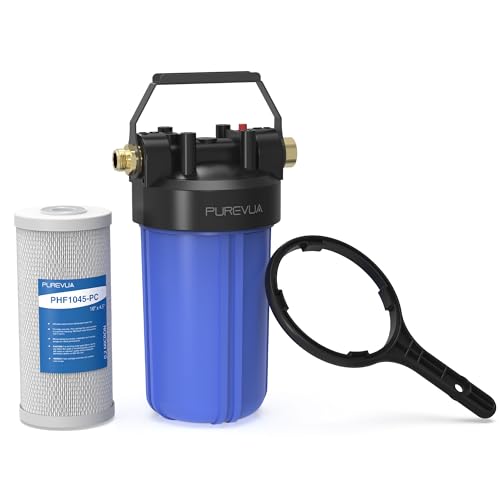
Purevua PHB10 RV Water Filter System
  • 0.2-micron pleated polyester outer layer
  • 5-micron activated carbon core in one housing
  • 3/4 inch hose fittings, detachable handle
Check price on Amazon for Purevua PHB10 RV Water Filter System (opens in a new tab)
Best for: Buyers who want a documented 0.2 micron layer in one housing.

Our take

Owners who want the finest stated particle protection in a single portable unit, and who like carrying a filter between sites, will find the value.

Why it made the shortlist

The Purevua PHB10 costs $119.99, the top of this guide, and it prints the finest particle figure here: a 0.2 micron pleated polyester outer layer wrapped around a 5 micron activated carbon core, all in one housing. Fittings are 3/4 inch hose threads, the hose connection is tool-free and a detachable handle makes carrying easy.

At that price a buyer is paying for a figure, and the figure is documented. A 0.2 micron layer is five times finer than the 1 micron stage on the three-cartridge system just below it, which makes the Purevua the filter to choose when particle size is the priority. A reinforced polypropylene body handles the hookup.

The detachable handle makes moving it a one-hand job, and a tool-free connection means no wrench at the spigot. Micron value per dollar is strongest here among the single-housing options.

What works

  • Documented 0.2 micron layer in a single housing
  • Tool-free hose connection takes only seconds
  • Detachable handle makes it easy to carry
  • Reinforced polypropylene body for the hookup

Watch out for

  • Composite cartridge is one piece to replace
  • Single housing has no separate sediment stage
02

Best Replaceable Stages · 2 of 6

RV Water Filter System

RV Water Filter System
  • 1-micron sediment stage
  • 5-micron carbon block
  • Brass 3/4 inch fittings
Check price on Amazon for RV Water Filter System (opens in a new tab)
Best for: Owners who want separate stages replaceable one at a time.

Our take

Owners who plan to keep a housing for years, and who want to pay for cartridges one at a time, get the best long-run cost.

Why it made the shortlist

This three-cartridge system costs $79.99 and lists a 1 micron sediment stage ahead of a 5 micron carbon block, with brass 3/4 inch fittings described as leak-free. Two carbon stages aim at chlorine and taste, and the sediment prefilter protects the carbon that follows. Each of the three cartridges can be replaced individually, so a spent stage never forces a full system purchase.

Replacing one cartridge instead of a whole filter is where its value lives. A spent sediment stage costs a fraction of a full system, and the carbon stages stay in service until they are used up. Next to the Purevua at $119.99, it trades the 0.2 micron figure for $40 in savings and the freedom to refresh stages separately.

Brass fittings suit a permanent connection and the layered design suits varied campground water. As a value pick for a multi-stage setup, it costs less than the finest single-housing alternative.

What works

  • Sediment prefilter protects the carbon stages
  • Two carbon stages aimed at chlorine and taste
  • Brass fittings are listed as leak-free
  • Three cartridges are replaceable individually

Watch out for

  • No NSF certification named
03
Envig Puretaste Catalytic Carbon KDF Inline RV Filter
  • Catalytic carbon and KDF
  • 8,500 gallons at 4.5 GPM
  • 3/4 inch hose threads
Check price on Amazon for Envig Puretaste Catalytic Carbon KDF Inline RV Filter (opens in a new tab)
Best for: Filters for water with chloramine or a rotten-egg smell.

Our take

Owners with city water treated with chloramine, or with well water that smells of sulfur, get targeted help here.

Why it made the shortlist

The Envig Puretaste costs $54.99 and pairs catalytic carbon with KDF media in a hose-end body. It states 8,500 gallons at 4.5 GPM, uses 3/4 inch hose threads and includes a hose protector. The listing targets chloramine and hydrogen sulfide, two water problems that plain carbon is often less suited to handle, and the 4.5 GPM figure is printed beside the capacity.

On its stated capacity the Envig works out near $6.50 per 1,000 gallons, the strongest capacity value on the page. A 4.5 GPM flow rate also keeps showers and tank fills quick. Beyond the $33.99 Hourleey four-pack, it commits to a gallon figure where the pack offers a time life, and that figure turns filter planning into arithmetic.

A stated 8,500 gallons lets a camper plan filter changes by use rather than by calendar. Full-timers who fill often benefit most from the capacity and flow figures, since a high-volume user reaches a spent filter fastest and needs the number most.

What works

  • Stated 8,500 gallon capacity
  • 4.5 GPM flow stated
  • Targets chloramine and hydrogen sulfide
  • Hose protector included

Watch out for

  • Performance claims are listing wording
04
Best for: Part-time travelers who want a year of cheap filters.

Our take

Part-time travelers, snowbirds and anyone who dislikes mid-season reordering will appreciate a year in one box.

Why it made the shortlist

The Hourleey four-pack costs $33.99 and names fluoride in its title. Four filters arrive in the box, two hose protectors reduce strain at the connection, and each filter is listed for a three-month season life, which fits a typical warm-weather travel window. The pack works out near $8.50 per filter, which keeps a routine of regular swaps affordable.

As a supply play it is the best of the hose-end options here, since four filters cover a full year of three-month changes. Set next to the $23.99 AQUA CREST, the pack adds $10 and delivers four times the filters, while leaving the standards question unanswered. That makes the decision a question of volume versus paperwork, and both are legitimate.

The two protectors give flexibility at awkward spigots, and the fluoride mention in the title tells a buyer what the seller is promising. A low per-filter price suits a routine of regular swaps, and a full year in one order removes the risk of running dry in the middle of a trip.

What works

  • Names fluoride in the title
  • Four filters per pack
  • Hose protectors reduce strain
  • Three-month season life

Watch out for

  • No fluoride percentage stated
  • Disposable design
05

Best Named Standards · 5 of 6

AQUA CREST RV Inline Water Filter

AQUA CREST RV Inline Water Filter
  • NSF/ANSI 42 and 372
  • KDF and activated carbon
  • Hose protector
Check price on Amazon for AQUA CREST RV Inline Water Filter (opens in a new tab)
Best for: Shoppers who want NSF/ANSI 42 and 372 on a single cheap filter.

Our take

Value-focused travelers who want named standards at a hose-filter price will land here.

Why it made the shortlist

Two named standards for $23.99 works out to about $12 per standard, and that is the AQUA CREST pitch: NSF/ANSI 42 and NSF/ANSI 372 are both printed on its listing. Filtering comes from KDF and activated carbon, and a swivel hose protector with copper ends handles the connection. Tool-free installation means a change takes a minute.

On a standards-per-dollar basis this is the best value in the guide, since the systems above it name none. NSF/ANSI 42 addresses aesthetic effects such as chlorine taste and odor, and NSF/ANSI 372 addresses lead-free materials. A checkable mark is worth more than a bigger housing, and the listing's 400 PSI pressure test adds a build-quality detail.

Weekend and seasonal users on municipal water get a straightforward, well-labeled filter with tool-free installation and a single clear purpose. Shoppers who study claims first will see it as the benchmark for paperwork per dollar, and the low price makes it easy to try.

What works

  • Certified to NSF/ANSI 42 and 372
  • Swivel hose protector with copper ends
  • Described 400 PSI pressure test
  • Tool-free installation

Watch out for

  • No gpm figure is stated
  • Single filter with no spare
06
Best for: Municipal-water travelers wanting a named standard and a spare filter cheaply.

Our take

Value shoppers who want a named standard and a printed sediment figure on two filters get the best return.

Why it made the shortlist

The Stokk two-pack costs $18.98 and lists a 10 micron sediment stage with NSF/ANSI 42 named on the listing. A 360 degree swivel protector reduces kinks at the spigot, the wide body is built for flow, and two filters arrive in the box. At $9.49 per filter, it is the cheapest named-standard hose filter in this guide.

Beside the $23.99 AQUA CREST, the pair costs $5.01 less and delivers two filters instead of one, plus a printed sediment figure. The AQUA CREST names a second standard, NSF/ANSI 372, so the comparison comes down to one extra standard against one extra filter and a finer sediment stage. Both cases give a buyer something checkable.

A wide body suits tank fills and showers, the swivel protector helps at awkward spigots, and a pair gives a spare for later. Municipal-water travelers can use it as the low-cost baseline of this guide, and the printed standard gives the purchase a paper trail.

What works

  • Finer 10 micron sediment stage
  • NSF/ANSI 42 listing named
  • Swivel hose protector reduces kinks
  • Wide body for flow

Watch out for

  • No gallon capacity stated
  • Not a bacteria or lead filter by its listing

Methodology

How We Built This Shortlist

Each pick was assessed across 5 criteria weighted for real-world use.

01

Documented micron rating

We compared the finest printed particle figure on each listing and the price paid for it. The Purevua prints 0.2 micron, the three-cartridge system prints 1 micron and the rest print 5 micron or nothing. A figure printed on the page counted for more than a claim in a title.

02

Standards named per dollar

Based on product specs, we counted which listings name NSF standards and divided by price. The AQUA CREST names two for $23.99, the Stokk pair names one for $18.98, and the larger systems name none. We treated unnamed certification as a claim.

03

Capacity and flow per dollar

Where a listing states gallons and GPM, we calculated a cost per 1,000 gallons. The Envig works out near $6.50. Listings that give only a time life were compared by cost per filter instead.

04

Targeted contaminants

We noted which listings name specific problems, such as chloramine, hydrogen sulfide or fluoride. A named target tells a buyer what the seller is promising. We recorded the claim and its source without assuming a result. Named targets were counted in a listing's favor.

05

Replacement economics

A system that can replace one stage at a time costs less over years than one that discards the whole filter. We weighed the three-cartridge system against single-piece and disposable designs, and counted multi-packs by cost per filter. The comparison ran over several seasons, not one trip.

Decision guide

Match an RV Water Filter for the Money to Your RV

By Filtration Goal

Decide what you want the filter to do, then read across to the pick that documents it.

Your goalPickWhy
Finest particle filteringPurevua PHB10A documented 0.2 micron layer
Layered stages, replaced one at a time3-Cartridge System1 micron sediment stage, 5 micron carbon block
Chloramine or sulfur smellEnvig PuretasteCatalytic carbon targeting chloramine and hydrogen sulfide
Named standards at the lowest costAQUA CRESTNSF/ANSI 42 and 372 for $23.99
A year of cheap filtersHourleey 4-PackFour filters at about $8.50 each

By Budget

The picks run from $17.99 to $119.99, and every step shows a different kind of value.

SpendPickWhat it buys
About $19Stokk PairTwo filters, a 10 micron stage and NSF/ANSI 42 named
About $24AQUA CRESTTwo named standards on one filter
About $34Hourleey 4-PackA full year of filters
About $55Envig Puretaste8,500 gallons at 4.5 GPM
About $80 to $1203-Cartridge System or Purevua PHB10Replaceable stages, or the finest micron layer

Single Composite Cartridge vs Separate Stages

The cartridge design changes what you pay each time and what you can fix.

Single composite

Purevua PHB10 wraps a 0.2 micron layer around a 5 micron carbon core in one housing. It carries easily and filters finely, but the whole cartridge is replaced at once.

Separate stages

3-Cartridge System uses three cartridges that are replaced individually. A spent sediment stage costs little to swap, and the carbon stages stay in service.

If you want the finest filtering, buy Purevua PHB10; if you want the lowest long-run cost, buy 3-Cartridge System.

By Capacity Evidence

Some listings give gallons and some give months. Rank them by the strength of the evidence.

EvidencePickWhat is printed
Gallons and flowEnvig Puretaste8,500 gallons at 4.5 GPM
Time life, four filtersHourleey 4-PackThree-month season life per filter
Standards, no capacityAQUA CRESTNSF/ANSI 42 and 372, no gpm figure
Stages, no capacity3-Cartridge System1 micron and 5 micron stages, no gallons
Particle size, no capacityPurevua PHB100.2 micron layer, no gallons

For Smelly or Chloraminated Water Specifically

Odor problems need targeted media, and a plain carbon filter may not be enough.

Look for

Catalytic carbon and a named target such as chloramine or hydrogen sulfide. Envig Puretaste lists both and includes KDF.

In this comparison

Envig Puretaste is the targeted choice, 3-Cartridge System adds two carbon stages behind a sediment prefilter, and AQUA CREST handles ordinary chlorine taste.

When to Spend More

The top of this guide is $119.99, and the next step adds certification.

Spend more if

You need a named microbial standard or an ultrafiltration membrane. Purevua PHB10 and 3-Cartridge System make no such claim, and the $150 system guide covers it.

Save if

You fill from municipal water and want named standards. Stokk Pair, AQUA CREST and Hourleey 4-Pack give good value for under $35.

FAQ

Before You Bring One Home

What does 0.2 micron mean on a listing?

No other listing in this guide prints a finer particle rating. The Purevua prints 0.2 micron for its pleated outer layer and names no test standard. Read it as a particle rating, not a purification claim.

Why name chloramine and hydrogen sulfide?

The Envig listing names both as targets of its catalytic carbon and KDF media. It gives a capacity of 8,500 gallons at 4.5 GPM alongside them. The performance claims are listing wording, so judge by results.

Is $80 for a three-cartridge system better than $120 for one housing?

It depends on the goal. The 3-Cartridge System costs $40 less and replaces stages individually, while the Purevua documents a finer 0.2 micron layer. Choose by whether you value fineness or long-run cost.

How do I compare gallons per dollar?

Gallons in thousands go in the denominator. The Envig is $54.99 for 8,500 gallons, near $6.50 per 1,000. A listing with only months, like the Hourleey, needs your own gallon estimate.

Can a hose filter beat a housing system on value?

On named standards, yes. AQUA CREST names two for $23.99, while the larger systems name none. A housing wins when you need finer micron filtering or replaceable stages.

Does NSF/ANSI 42 on the Stokk mean it removes bacteria or lead?

No. The Stokk listing names NSF/ANSI 42, but it also says the filter is not a bacteria or lead filter. Think of it as a sediment and taste filter with a named standard. Buyers who need a microbial or lead claim should look at the system guide.

Bottom line

The short version

Browse more rv water filters for the money on Amazon →
Bowen Higgins, RV Editor at RV Gear Lab

About the author

Bowen Higgins

RV Editor at RV Gear Lab

Bowen covers RV power, water systems, towing and leveling, upkeep and interior comfort, with a focus on matching gear to the rig, the hookups and the way you actually travel.

More from Bowen →Editorial standards

Keep reading

Related guides