

We research everything we recommend. When you buy through our links, we may earn a commission. Learn more

Buying guide · 11 min read · Updated October 2, 2026

5 Best Budget RV Water Heaters for a Camper Van in 2026: A Practical RV Guide

Five budget water heater options for a camper van, from propane tankless to a plug-in mini tank, ranked by footprint, power source and what a van can feed.

Bowen HigginsBy Bowen HigginsRV Editor at RV Gear Lab5 products comparedSpec-sheet researched

At a glance

Our top picks

Camper vans run out of space long before they run out of ideas, and the water heater is the item that exposes the limits fastest. A conventional six gallon RV tank needs a cutout roughly 12.75 inches square and about 19 inches deep, which is a large hole in a van wall. A plug-in mini tank needs just a cabinet corner but demands 1500 watts of shore power. A propane tankless needs neither a tank nor a cabinet, yet it wants a vented exterior location and a steady 12 volt feed.

That is the real shopping problem for a van, and it is why this shortlist spans very different technologies. Two Suburban tank heaters represent the traditional route and suit vans with a full-height wall opening. The Orbek tankless is the compact propane route. The ERFEI mini tank and the MQLPXI electric conversion kit cover vans that live mostly on shore power or a large inverter. Each route trades something away, whether that is wall space, battery capacity or propane use, and the sections below spell out which trade suits which build.

Because van owners rarely have a 30 amp pedestal, the guide ranks each pick by what energy it demands rather than by sticker price. We compared fit, fuel and power in each listing, and ordered them by relative cost. Each section explains what the money buys, so a builder with a tight budget and a tighter wall can see which option is realistic before measuring anything. Start with the wall and the power source, then let the remaining picks sort themselves out. A van that suits only one of the five is a normal result in this category, not a sign something was missed.

RV Gear Lab field notes

The Rig Fit Check

Start with the job
Suburban SAW6DEL 6-Gallon Direct Fit RV Water Heater, DSI (5322A) leads this shortlist for Van builders with an existing aluminum-tank cutout who want propane and electric options.. Use that fit as a reference point, then compare the alternatives against your own space and workload.
Specs that separate the picks
The first details to compare are 6 gallon steel tank, 10,000 BTU LP, 6 gallon, 12,000 BTU/h propane, 60,000 BTU propane, 3.5-3.9 GPM. Confirm the exact model and included components before ordering.
Trade-off to plan for
Large body for most vans

Before you buy

What Matters Before You Choose a Budget RV Water Heater for a Camper Van

Key buying criteria so you get the right fit the first time.

  1. 01

    Footprint and cutout depth

    A six gallon tank heater needs a cutout of about 12.75 inches square and about 19 inches deep, per the Suburban SW6D listing. Many van walls cannot give up that depth without structural work. A tankless unit and a mini tank need much less. Measure the wall, the floor space behind it and the exterior skin before choosing a technology.

  2. 02

    Where the energy comes from

    A van has propane, a 12 volt battery and sometimes a hookup. A tankless propane heater needs the battery for its fan, so a dead battery means cold water. An electric tank at 1500 watts needs 120 volts, which on a 12 volt inverter means more than 125 amps at the battery before losses. Pick the heater whose power matches the source your van lives on.

  3. 03

    Recovery versus endless supply

    Tank heaters publish recovery in gallons per hour, such as the 14.14 on propane for the Suburban SAW6DEL. Once the tank empties, you wait for it to catch up. A tankless unit with 3.5 to 3.9 GPM never empties but cannot heat the same flow in cold weather. Compare how you shower to decide which fits.

  4. 04

    Altitude and winter output

    GPM is rated at a given temperature rise, so a unit that delivers 3.5 GPM from warm supply delivers less from near-freezing water. Propane tankless units carry altitude ceilings that vary by model. The Orbek listing states a high-altitude mode, which is a good sign for mountain vans. If a listing does not state the rise, treat the GPM as a best case.

  5. 05

    Venting and combustion air

    A propane heater has to exhaust and draw combustion air from outside the cabin, so its position on the van wall matters. Placing it near a sleeping area or an awning track needs thought. Electric units skip this entirely, which is a big reason vans choose them. Look at the exterior wall space before ordering any gas unit.

  6. 06

    Winter and freeze exposure

    Tank heaters hold water that can freeze and split in a parked van. Tankless and mini tank units also hold water in fittings. Plan a way to drain the heater or keep the cabin warm in freezing weather. A drain plug, such as the anode rod that doubles as one on the Suburban tanks, makes winterizing simpler.

Our standards

Why You Can Trust RV Gear Lab

At RV Gear Lab, we compare products based on rig fit and power or hookup compatibility, verified specifications, usability, setup requirements, weight, durability, and real-world trade-offs. We do not rank products purely on marketing claims or commission rates.

We have not personally tested every product listed. Where hands-on testing is not available, recommendations are based on verified manufacturer specifications, product documentation, use-case fit, and comparative research.

How we review RV gear →

Detailed reviews

The 5 best budget rv water heaters for a camper van, explained

01
Suburban SAW6DEL 6-Gallon Direct Fit RV Water Heater, DSI (5322A)
  • 6 gallon steel tank, 10,000 BTU LP
  • 14.14 gph LP, 6.10 gph electric
  • Direct fit, replaceable anode rod
Check price on Amazon for Suburban SAW6DEL 6-Gallon Direct Fit RV Water Heater, DSI (5322A) (opens in a new tab)
Best for: Van builders with an existing aluminum-tank cutout who want propane and electric options.

Our take

A van that already carries an older aluminum-tank heater gets the easiest like-for-like upgrade here, with no carpentry.

Why it made the shortlist

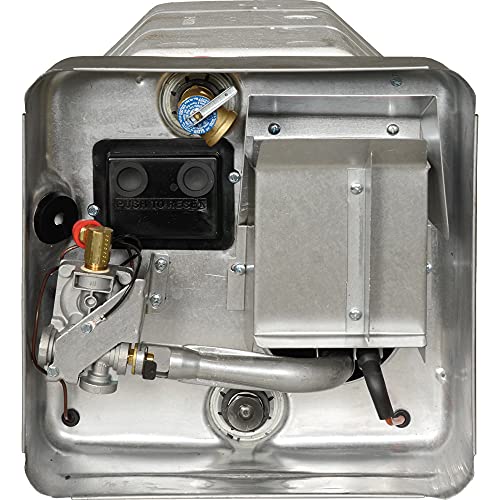
The Suburban SAW6DEL is a six gallon direct fit replacement for competing aluminum tank heaters, built to drop into the same opening without cutout changes, cabinet depth changes or plumbing rework. Its porcelain-lined steel tank mimics the longevity of a residential heater, and the replaceable anode rod doubles as the drain plug. Input is 10,000 BTU on propane.

The Suburban SW6D below it targets a new framed opening, while this model is designed around swapping into an existing aluminum-tank opening, and it offers an optional electric element for campsite or generator power. The listing states a recovery rate of 14.14 gallons per hour on LP gas and 6.10 gallons per hour with the electric element. Direct spark ignition removes the pilot light.

This sits at the top of this shortlist on price, and the step up buys a proven six gallon reserve and dual-fuel flexibility. Owners who want a conventional heater in a larger conversion will find it a straightforward project.

What works

  • Drops into existing aluminum-tank cutouts
  • Optional electric element for shore power
  • Porcelain-lined steel tank, replaceable anode
  • Direct spark ignition, no pilot

Watch out for

  • Large body for most vans
  • Costs the most of the five
  • Electric element is an optional extra
02
Suburban SW6D 6-Gallon RV Water Heater, Direct Spark Ignition (5238A)
  • 6 gallon, 12,000 BTU/h propane
  • 12.69 x 12.69 x 19.19 inch body
  • Optional 1,440W element, DSI
Check price on Amazon for Suburban SW6D 6-Gallon RV Water Heater, Direct Spark Ignition (5238A) (opens in a new tab)
Best for: Larger conversions with room for a 12.75 inch square cutout.

Our take

A bigger van conversion, a bus or a box truck with a bulkhead for an exterior door gets the most from this model.

Why it made the shortlist

The Suburban SW6D is a six gallon, direct spark ignition tank heater with a porcelain-lined steel tank and a replaceable anode rod that doubles as a drain. It is rated at 12,000 BTU per hour on propane, and the optional electric element is 1,440 watts. Its exclusive flue tube design slows combustion to transfer heat into the water efficiently.

Set against the SAW6DEL, the SW6D carries a higher BTU rating and states exact dimensions: a 12.69 by 12.69 by 19.19 inch body for a 12.75 by 12.75 by 19.19 inch cutout. Those figures make planning precise. The listing also states a recovery rate for the electric element, supporting a dual-fuel setup on shore power.

The porcelain-lined steel construction is a residential-style design aimed at long life. It suits a builder who treats the heater as a permanent fixture and has already framed the opening, since the exact dimensions make cabinetry around it easy to plan.

What works

  • Exact dimensions simplify planning
  • Higher BTU than the direct fit model
  • Steel tank with replaceable anode rod
  • Optional electric element adds flexibility

Watch out for

  • Needs a large exterior cutout
  • Too big for many van builds
03
ORBEK RV Tankless Water Heater, Propane, High Altitude, 12V DC, 3.5-3.9 GPM
  • 60,000 BTU propane, 3.5-3.9 GPM
  • 12V DC, high-altitude operating mode
  • CSA certified, 150 PSI PRV built in
Check price on Amazon for ORBEK RV Tankless Water Heater, Propane, High Altitude, 12V DC, 3.5-3.9 GPM (opens in a new tab)
Best for: Van owners who want endless hot water and no tank taking up room.

Our take

A van builder who values floor and wall space above everything gets the best use of both here.

Why it made the shortlist

The Orbek Altitude replaces the tank with a 60,000 BTU propane tankless burner that the listing rates at 3.5 to 3.9 GPM. Oxygen-free copper heat exchangers and brushless DC fans handle the heat transfer, and a high-altitude operating mode keeps it firing in thin mountain air. It runs from a 12 volt DC supply and includes a built-in 150 PSI pressure-reducing valve.

Against the Suburban tank heaters, the Orbek removes the stored volume and the weight that comes with filled steel. Without a tank, a van never runs out of hot water mid-shower, and no yearly tank maintenance is needed. The listing mentions three door sizes in black or white for 15 by 15, 15 by 18 and 18 by 18 inch openings, and it states CSA certification.

High-altitude tuning suits a mountain traveler, and a 12 volt supply matches what a van already has. Of the five, it is the strongest pick for a rig that mostly boondocks on propane with a healthy battery bank, where a tank-free design leaves room for bedding, storage and a proper shower corner.

What works

  • No tank, so hot water never runs out
  • High-altitude mode for mountain trips
  • Built-in 150 PSI pressure-reducing valve
  • Matches a van's 12 volt supply

Watch out for

  • Stops working with a dead house battery
  • Needs an exterior door opening and vent
04
ERFEI 2.5 Gal Water Heater Electric, 1500W 110V Mini Tank Under Sink
  • 2.5 gallon, 1500W, 110V plug
  • Stainless inner tank, pressure relief
  • LED temperature display, NEMA 5-15
Check price on Amazon for ERFEI 2.5 Gal Water Heater Electric, 1500W 110V Mini Tank Under Sink (opens in a new tab)
Best for: Vans on shore power or a big inverter that need a sink heater.

Our take

For a van that spends its nights on a hookup, or one with a large inverter and battery bank, this gives compact hot water at the sink without cutting the wall.

Why it made the shortlist

The ERFEI Mini is a 2.5 gallon electric mini tank that plugs into a standard 110 volt NEMA 5-15 outlet and draws 1500 watts. Its thickened stainless steel inner tank resists corrosion, a pressure relief valve is included, and an LED digital display shows real-time water temperature with a knob to set it. The listing names RV, camper van, garage and food truck as uses.

In contrast to the propane picks, the ERFEI needs no venting, no exterior opening and no gas line, so it tucks under a sink or inside a cabinet. Setup is described as simple do-it-yourself work with standard water connections and no wiring changes. That shrinks the install to an outlet and two hoses, which makes it the quickest project of the five.

The 2.5 gallon reserve covers dishes and washing up. Builders who never want propane inside a small cabin will find it the realistic compact choice, and the digital display helps keep each setting efficient.

What works

  • No venting or exterior cutout needed
  • Plugs into a standard outlet
  • Stainless inner tank with relief valve
  • Clear LED temperature display

Watch out for

  • 1500 watts is a heavy load on an inverter
  • Small reserve for long showers
05
MQLPXI RV Water Heater Electric Conversion Kit, LP Gas to 120V, 6 Gallon
  • 120V element, 304 stainless, brass bushings
  • Adjustable thermostat, independent switch
  • 5 amp overload protection
Check price on Amazon for MQLPXI RV Water Heater Electric Conversion Kit, LP Gas to 120V, 6 Gallon (opens in a new tab)
Best for: Vans that already have a six gallon tank and want a shore power element.

Our take

Days at a time on campground power make this kit worthwhile, heating the tank electrically and saving propane.

Why it made the shortlist

This kit adds a 120 volt electric heating element to an existing six gallon Suburban or Atwood style tank. It is built around 304 stainless steel, brass bushings for the tank connection, a nylon corrugated sleeve, an adjustable thermostat and an independent power switch. Overload protection trips when the current exceeds 5 amps, which protects both the element and the circuit feeding it.

Compared with buying a new dual-fuel heater, this kit upgrades what a van already carries, so the installed gas heater gains a second heat source for the cost of a small kit, with no new wall cutout and no new plumbing runs. The current limit keeps the load modest on a small shore power connection or generator. It is the lowest-cost route to electric heat on this list.

The independent switch lets the owner choose the source. It pairs naturally with a tank heater already in the wall and stretches each propane refill, which matters when a small bottle is the main fuel supply aboard. The adjustable thermostat also lets the owner fine tune the water temperature for dishes and showers.

What works

  • Lowest-cost route to electric heat here
  • Independent switch and adjustable thermostat
  • Brass bushings and 304 stainless build
  • Overload cutoff protects the circuit

Watch out for

  • Needs an existing six gallon tank
  • Low current limit means slow heating

Methodology

How We Built This Shortlist

Each pick was assessed across 5 criteria weighted for real-world use.

01

Footprint first

A van's wall and cabinet space is the hardest constraint, so we compared exact dimensions where listings state them. The Suburban SW6D lists a 12.75 inch square cutout, while the ERFEI needs a cabinet corner. We based this on product specs and treated fit as a pass-fail test.

02

Where the energy comes from

Each pick was matched to the power a van realistically has: propane, a 12 volt house battery, shore power or an inverter. A heater that suits a hookup site may be impractical off-grid. We compared these assumptions across all five listings.

03

Recovery and capacity

Tank heaters publish recovery rates in gallons per hour, while tankless units publish flow in GPM. We kept the two measures separate and noted which assumptions each depends on. Our ranking reflects how long a van owner can keep hot water running.

04

Materials and protections

Porcelain-lined steel, stainless tanks, copper heat exchangers and relief valves all showed up in the listings. We looked for named protections and certifications such as CSA and for overload cutoffs. These come from product specs, not lab measurements.

05

Relative price position

Amazon prices move, so the five picks were ordered from the top of the shortlist to the lowest-cost add-on. The steps up buy capacity, direct-fit design and dual-fuel options. We describe the mechanism and leave the numbers out.

Decision guide

Match a Budget RV Water Heater for a Camper Van to Your RV

By Available Wall Space

Footprint decides which picks are even possible in a given van.

Space situationBest fitWhy
Existing aluminum-tank cutoutSuburban SAW6DELDirect fit with no cutout changes
New 12.75 inch square openingSuburban SW6DStated dimensions allow exact planning
Tight wall, any exterior doorOrbek AltitudeNo tank, so the door opening is the constraint
Cabinet corner under the sinkERFEI MiniNo cutout, no venting
Tank already installedMQLPXI KitAdds an element to the existing tank

By Budget

Ordering from this shortlist, with the mechanism each step buys.

Band within this shortlistBest fitWhat the money buys
Entry of this shortlistMQLPXI KitAn electric element for a tank you already own
Entry of this shortlistERFEI MiniA plug-in sink heater with no installation cutout
Mid of this shortlistOrbek AltitudeA tankless burner with high-altitude tuning
Mid of this shortlistSuburban SW6DA traditional steel tank with exact cutout sizing
Top of this shortlistSuburban SAW6DELA direct fit tank and an electric element option

Propane vs Electric

A van's fuel choice shapes everything from wall cutouts to battery size.

Propane route

The Orbek Altitude, Suburban SAW6DEL and Suburban SW6D burn propane, vent outside and work off-grid. The Orbek needs a 12 volt supply, and the Suburbans use pilotless direct spark ignition. This route suits vans that boondock.

Electric route

Both the ERFEI Mini and MQLPXI Kit run on 120 volts and need no venting. They fit hookup-heavy vans or those with a large inverter. At 1500 watts the load is more than 125 amps on a 12 volt battery.

Go propane with the Orbek Altitude if you boondock, and electric with the ERFEI Mini if you live on hookups.

By Daily Hot Water Use

Match capacity and flow to the way the van is actually used.

Typical useBest fitWhy
Dishes and hand washingERFEI Mini2.5 gallons covers short sink draws
Daily shower for oneOrbek AltitudeEndless supply from a 3.5 to 3.9 GPM burner
Shower and dishes for twoSuburban SW6DSix gallons stores a larger reserve
Mixed shore power and propaneSuburban SAW6DELDual-fuel recovery of 14.14 and 6.10 gph
Weeks at a campgroundMQLPXI KitElectric element stretches propane

For Off-Grid Vans Specifically

Off-grid vans care about propane use, battery draw and altitude.

Look for

Propane operation, a low 12 volt draw and altitude tuning. A pilotless direct spark tank like the Suburban SW6D draws little, while a tankless unit runs a fan on battery power.

In this comparison

The Orbek Altitude carries a high-altitude mode and runs from 12 volts, and the Suburban SW6D lists exact dimensions for a clean install. With a large inverter, an off-grid van can use the ERFEI Mini too.

When to Spend More

The step up is about fit and fuel flexibility, not just heating speed.

Spend more if

You have a matching cutout or want dual-fuel recovery. The Suburban SAW6DEL drops into aluminum-tank openings, and the Orbek Altitude frees the floor plan.

Save if

You live on hookups and want sink hot water. Both the ERFEI Mini and MQLPXI Kit cover that for the lowest outlay.

FAQ

Before You Bring One Home

Can a camper van run a 1500 watt electric water heater off its batteries?

Only with a very large inverter and battery bank. At 12 volts, 1500 watts pulls more than 125 amps before losses, which strains most van electrical systems. For a van that stays on shore power or a generator, the ERFEI Mini is the best fit. Add a sink heater to a battery-only van after checking inverter and cable ratings.

Does a propane tankless heater need a vent in a van?

Yes. Any propane burner needs to exhaust outside and draw combustion air from outside the cabin. That means an exterior opening such as a water heater door. A cabinet-only install is not possible for the Orbek Altitude, and the door sizes in the listing are 15 by 15, 15 by 18 and 18 by 18 inches.

What is the Suburban cutout size, and will it fit my van?

The SW6D lists a 12.75 by 12.75 by 19.19 inch cutout for a 12.69 by 12.69 by 19.19 inch body. That is a large hole in a van wall and often means a framed bulkhead. Measure the interior depth and the exterior skin before ordering, and consider the Orbek or ERFEI if the dimensions do not fit.

How does altitude affect a van water heater?

Propane burners lose output in thin air, and the ceiling varies by model. The Orbek listing mentions a high-altitude operating mode but gives no ceiling in its bullets, so look up the rated limit in the manual. Mountain travelers should find this spec before buying.

How do I protect the heater from freezing in a parked van?

Drain the heater and lines, or keep the cabin above freezing. A tank heater holds several gallons that can split a fitting, and mini tanks and tankless units trap water in their fittings too. The anode rod on Suburban steel tanks doubles as a drain, which makes draining straightforward.

Is the MQLPXI kit worth it in a van?

It is worth it when the van already has a six gallon tank and spends days on campground power. The element has 5 amp overload protection, so heating is slow. It saves propane but does not replace a gas burner. Vans without an existing Suburban or Atwood tank will not benefit.

Bottom line

The short version

Browse more budget rv water heaters for a camper van on Amazon →
Bowen Higgins, RV Editor at RV Gear Lab

About the author

Bowen Higgins

RV Editor at RV Gear Lab

Bowen covers RV power, water systems, towing and leveling, upkeep and interior comfort, with a focus on matching gear to the rig, the hookups and the way you actually travel.

More from Bowen →Editorial standards

Keep reading

Related guides