

We research everything we recommend. When you buy through our links, we may earn a commission. Learn more

Buying guide · 10 min read · Updated October 2, 2026

4 Best 110w Portable Solar Panels in 2026: A Practical Camping Guide

Best 110W portable solar panels compared on bifacial design, weight, waterproof rating and brand-matched compatibility for small power stations.

Danny WalkerBy Danny WalkerCamping Editor at RV Gear Lab4 products comparedSpec-sheet researched
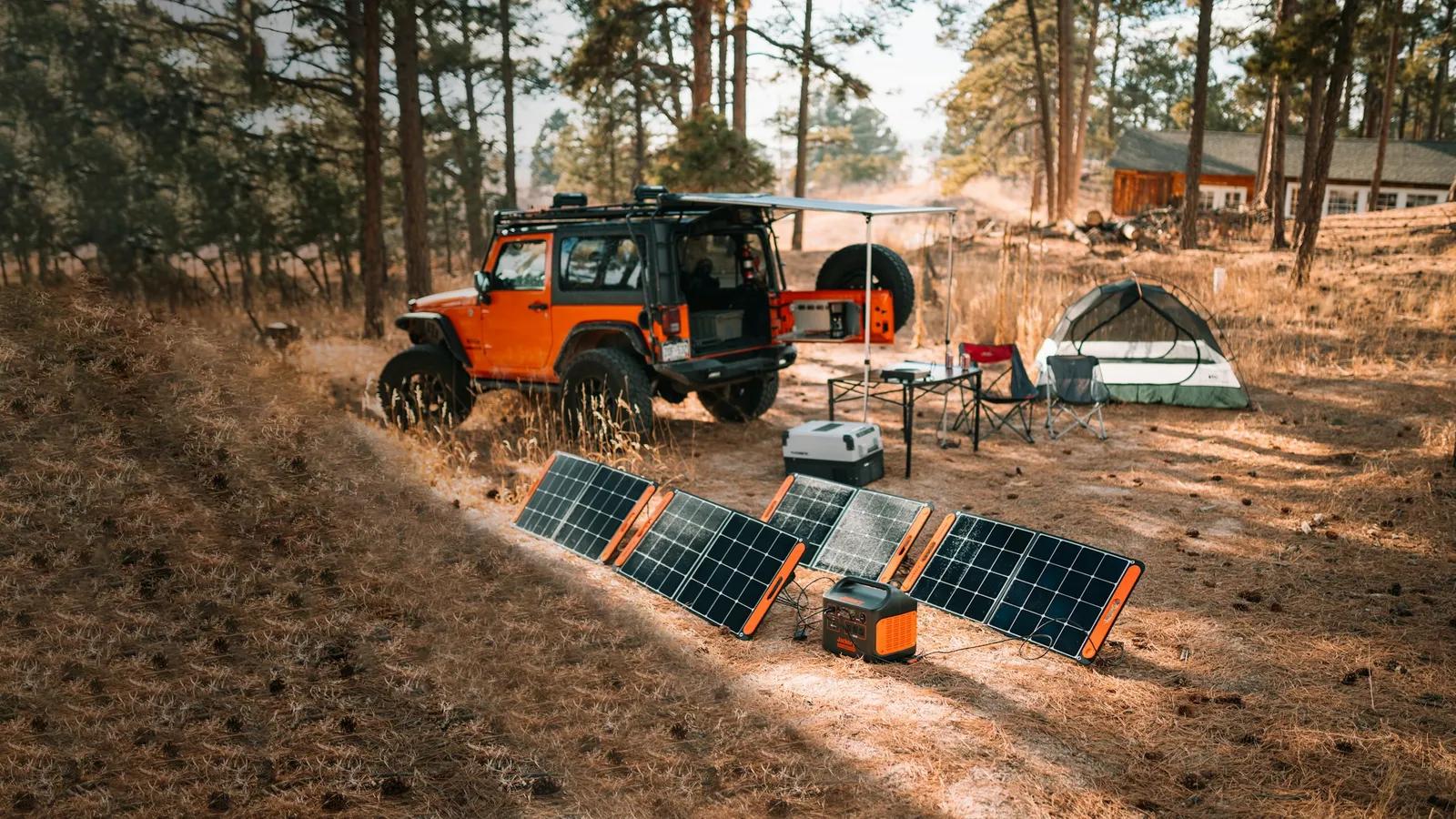
Jeep camp with a tent, solar panels and a portable power station at a pine forest campsite

At a glance

Our top picks

Most 110W portable panels look alike on paper, so the useful differences are bifacial design, real weight, waterproof rating and whether the cable set suits your station. One listing is tied to its own brand of stations, which changes who should buy it.

Four panels were compared on stated wattage, weight and folded size, ingress rating, connectors and extras such as USB ports and kickstands. Each is explained with the buyer it fits.

RV Gear Lab field notes

The Campsite Fit Check

Start with the job
110W Bifacial Portable Solar Panel for Power Station leads this shortlist for buyers comparing capacity, compatibility, included components and storage needs. Use that fit as a reference point, then compare the alternatives against your own space and workload.
Specs that separate the picks
The first details to compare are 110W bifacial, 23.5%, 25.6% N-type, 8.02 lbs, 110W, 9.74 lbs, 0.8 in fold. Confirm the exact model and included components before ordering.
Trade-off to plan for
No USB ports are listed

Before you buy

What Matters Before You Choose a 110w Portable Solar Panel

Key buying criteria so you get the right fit the first time.

  1. 01

    Bifacial versus single-sided

    A bifacial panel collects reflected light on its rear, and gains are largest over snow, sand or light ground. Over dark soil the benefit is small. Check the listing to confirm the panel is double-sided before paying more.

  2. 02

    Real weight

    A 110W foldable runs from about 7.7 to 9.74 pounds in this group, and the lightest is easiest for a trail or boat. Folded thickness also matters for backpack fit. Compare weight and fold dimensions on the listing.

  3. 03

    Compatibility and voltage

    A panel tied to one brand, like the VTOMAN VS110 at 19V, may exclude other stations in its listing. Universal panels use multi-connector cables. Check your station's solar input range and connector type.

  4. 04

    Waterproof ratings

    IP68 survives immersion, IP67 tolerates rain and brief submersion, and some listings warn against leaving a panel in rain. Connectors and junction boxes are weaker than the panel. Read the care notes.

  5. 05

    USB ports and extras

    Panels with USB ports charge a phone directly, while others only feed a station. Kickstands and hanging holes give setup options. Pick the extras you will use.

Our standards

Why You Can Trust RV Gear Lab

At RV Gear Lab, we compare products based on campsite fit, verified specifications, usability, setup requirements, weight, durability, and real-world trade-offs. We do not rank products purely on marketing claims or commission rates.

We have not personally tested every product listed. Where hands-on testing is not available, recommendations are based on verified manufacturer specifications, product documentation, use-case fit, and comparative research.

How we review camping gear →

Detailed reviews

The 4 best 110w portable solar panels, explained

01
Best for: Buyers comparing capacity, compatibility, included components and storage needs

Our take

The lightest 110W here, with bifacial output and an IP68 rating.

Why it made the shortlist

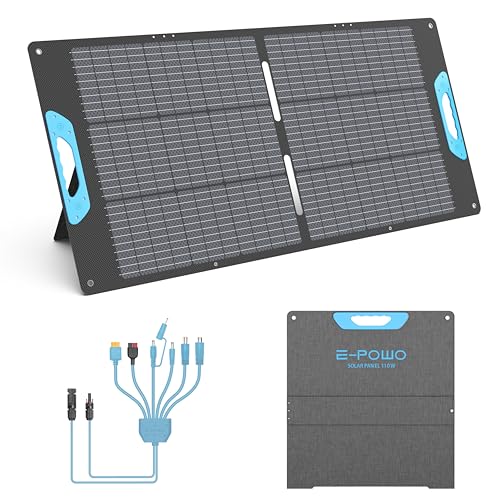
The E-POWO Bifacial is a 110W panel that collects light on both sides, with A+ monocrystalline cells at 23.5 percent and an IP68 rating. It weighs 7.7 lbs, folds to 24 by 23.6 by 1.3 inches, and includes a 7-in-1 solar cable for DC8020, DC7909, DC35135 and XT60.

Against the ZOUPW, it costs a little less and carries a better waterproof rating, while the USB hub is absent.

It suits campers who want the lightest 110W with the strongest weather rating. An accessory pouch and two kickstands come with it.

What works

  • Lightest 110W in the group
  • Bifacial rear-side collection
  • Seven connector types in the cable

Watch out for

  • No USB ports are listed
  • Rear gain needs bright ground
The catch
Rear-side gain only helps over light-colored ground.
02
ZOUPW 110 Watt Portable Solar Panel for Power Station
  • 25.6% N-type, 8.02 lbs
  • USB-C PD plus two USB-A
  • Five-connector cable, IP67
Check price on Amazon for ZOUPW 110 Watt Portable Solar Panel for Power Station (opens in a new tab)
Best for: Station and phone charging together

Our take

A 110W with the highest stated efficiency, USB ports and five connectors.

Why it made the shortlist

The ZOUPW stands out for its 25.6 percent stated efficiency in a 8.02 lb frame, with a USB-C PD plus two USB-A hub built in. Its solar cable carries five connectors, and it folds to 24.45 by 22.99 by 1.57 inches.

Compared with the bifacial E-POWO, it has higher stated efficiency and direct USB charging at a slightly higher price. Against the VTOMAN, it fits many more stations.

It suits campers who charge a station and a phone from the same panel. The magnetic handle and kickstand legs set up in seconds.

What works

  • Direct USB charging on the panel
  • Five connectors fit many stations
  • Highest stated efficiency
  • Magnetic handle and kickstands

Watch out for

  • IP67 is below IP68
The catch
It costs a little more than the other E-POWO panels.
03
110W Portable Solar Panel for Power Station
  • 110W, 9.74 lbs, 0.8 in fold
  • 3 USB ports, 7-in-1 adapter
  • Kickstands at 40/50/60 degrees
Check price on Amazon for 110W Portable Solar Panel for Power Station (opens in a new tab)
Best for: Angle-adjusted charging

Our take

A thin-folding 110W with three set tilt angles and USB ports.

Why it made the shortlist

This E-POWO panel is the thinnest fold in the group at 0.8 inches, packing to 24.09 by 23.23 inches at 9.74 lbs. Three USB ports, a seven-way adapter set and two kickstands with 40, 50 and 60 degree positions come with it.

Compared with the VTOMAN, it fits more stations and costs less.

It suits campers who like to angle a panel toward the sun and charge a phone at the same time. The built-in pouch stores adapters.

What works

  • Thinnest folded profile
  • Three set tilt angles
  • USB ports on the panel

Watch out for

  • Heavier than the bifacial E-POWO
  • Efficiency is stated only as up to
The catch
At 9.74 lbs it is heavier than the two panels above.
04
VTOMAN 110W 19V Portable Solar Panel for Solar Generator
  • 110W, 19V working voltage
  • MC4, Anderson, XT60, DC5521
  • 2 kickstands, 4 hanging holes
Check price on Amazon for VTOMAN 110W 19V Portable Solar Panel for Solar Generator (opens in a new tab)
Best for: Owners of VTOMAN Jump stations

Our take

A brand-matched 110W for VTOMAN Jump stations.

Why it made the shortlist

The VTOMAN VS110 works at 19V with MC4, Anderson, XT60 and DC5521 interfaces, and the listing names Jump 600X, Jump 1500X and Jump 1800 stations. It uses monocrystalline cells at up to 23 percent efficiency, with two kickstands and four hanging holes.

It suits owners of the named VTOMAN stations who want a matched panel. The IP67 rating protects against splashes.

What works

  • Matched to named VTOMAN stations
  • Hanging holes for balconies
  • Two kickstands
  • Four interface types

Watch out for

  • Listing carries an exclusion note for other stations
The catch
Read the listing's compatibility note before using it with another brand.

Methodology

How We Built This Shortlist

Each pick was assessed across 5 criteria weighted for real-world use.

01

Stated wattage

Listings were checked for a 110W rating and portable fold.

02

Bifacial design

Double-sided panels were separated from single-sided ones.

03

Weight and fold

Weight and folded dimensions were compared.

04

Compatibility

Connector sets and brand-matched listings were noted.

05

Weather rating

IP67 and IP68 claims were compared, along with listing notes about rain.

Decision guide

Match a 110w Portable Solar Panel to Your Camp Setup

By Priority

Your situationRecommended pickWhy
Lightest carry, strongest weather ratingE-POWO Bifacial 110W7.7 lbs and IP68.
Station and phone from one panelZOUPW 110W PanelUSB-C PD and five connectors.
Angle adjustment and thin foldE-POWO 110W PanelThree set kickstand angles.
Own a VTOMAN Jump stationVTOMAN VS110Matched to named models.

By Budget

BudgetRecommended pick
$90 to $100E-POWO 110W Panel or E-POWO Bifacial 110W
$100 to $150ZOUPW 110W Panel or VTOMAN VS110

Bifacial vs Single-Sided

Bifacial

Both sides collect light, so output rises over reflective ground at the same rating. The E-POWO Bifacial 110W is the only bifacial pick.

Single-sided

A standard panel only collects from the front and costs the same or a little less. The ZOUPW 110W Panel, E-POWO 110W Panel and VTOMAN VS110 are single-sided designs in this group.

Most campers should pick the E-POWO Bifacial 110W unless they need USB ports from the panel.

By Budget

BudgetRecommended pick
Lowest budgetE-POWO 110W Panel
Mid budget, light and ruggedE-POWO Bifacial 110W
Mid budget, USB hubZOUPW 110W Panel
Brand-matched for VTOMANVTOMAN VS110

Small Stations on Weekend Trips

Look for

A connector set that matches the station, a weight you will carry, and an IP rating for wet weather.

In this comparison

The E-POWO Bifacial 110W covers seven connector types at 7.7 lbs, and the ZOUPW 110W Panel adds a USB hub.

When to Spend More

Spend more if

Spend more on the E-POWO Bifacial 110W for the lightest build with IP68, or on the ZOUPW 110W Panel for USB ports.

Save if

Save with the E-POWO 110W Panel if you want a thin fold and tilt control for less.

FAQ

Before You Bring One Home

Is a bifacial 110W panel worth it?

On bright ground it adds output, and the E-POWO Bifacial 110W costs less than the ZOUPW 110W Panel. Over dark ground the gain is small.

What is the biggest mistake with 110W panels?

Assuming every panel fits every station. Check the connector and the voltage window. The VTOMAN VS110 lists a specific brand's models.

How long does a 110W panel take to charge a station?

A 300Wh station takes roughly a long sunny day, and a 1000Wh station several days. Real output is below 110W, so plan generously.

How do I set up a portable panel?

Unfold it facing the sun, snap the kickstands and connect to the station. Keep the junction box dry. Re-aim every couple of hours.

How do I keep a panel clean?

Wipe it with a damp soft cloth, never abrasives. Store it dry in its pouch. Check connectors for grit before each trip.

Bottom line

The short version

Browse more 110w portable solar panels on Amazon →
Danny Walker, Camping Editor at RV Gear Lab

About the author

Danny Walker

Camping Editor at RV Gear Lab

Danny covers camping gear, campsite setup, outdoor power, sleep systems and practical camping advice, with a focus on helping campers make better gear decisions.

More from Danny →Editorial standards

Keep reading

Related guides