


We research everything we recommend. When you buy through our links, we may earn a commission. Learn more

Buying guide · 10 min read · Updated October 2, 2026

6 Best 2000w Inverters For Camping in 2026: A Practical Camping Guide

Best 2000W camping inverters compared on surge rating, sine wave type, outlets and remote control, for campers running a fridge, kettle or tools off a 12V bank.

Danny WalkerBy Danny WalkerCamping Editor at RV Gear Lab6 products comparedSpec-sheet researched
Dome tent and hammock at a forest campsite at golden hour

At a glance

Our top picks

A 2000W inverter is the step up from a plug-in socket adapter, the size that can run a microwave, a coffee maker or a power tool when it is wired to a proper 12V battery. At 12 volts, 2000 watts pulls roughly 170 amps, so the inverter is only half the project: the other half is cable, fuse and battery.

Six 2000W models are ranked here, four pure sine wave and two where the listing is either modified sine or silent on waveform. I compared them on listed surge watts, outlets, waveform, displays and remotes, and the safety protections each seller names.

RV Gear Lab field notes

The Campsite Fit Check

Start with the job
Ampeak 2000W Pure Sine Wave Power Inverter 6000W Surge Peak 12V DC to 120V AC 3 AC Outlets with 20A Outlet leads this shortlist for Fridge and pump loads. Use that fit as a reference point, then compare the alternatives against your own space and workload.
Specs that separate the picks
The first details to compare are 2000W pure sine, 6000W surge, 2000W pure sine wave, 2000W continuous, 4000W peak. Confirm the exact model and included components before ordering.
Trade-off to plan for
Heavy 12V current needs thick cable

Before you buy

What Matters Before You Choose a 2000w Inverter For Camping

Key buying criteria so you get the right fit the first time.

  1. 01

    Continuous versus surge watts

    Continuous watts are the steady load the inverter can feed, and surge watts are the brief spike it can cover for motor starts. A fridge compressor or pump can need several times its running watts for a moment. Check both numbers, and note that the Ampeak lists 6000W while most list 4000W.

  2. 02

    Pure versus modified sine wave

    Pure sine wave is clean power that suits electronics, motors and medical gear, while modified sine is choppier and can cause buzz or heat. This affects what you can safely plug in. Look for the waveform in the listing, since one pick here does not state it.

  3. 03

    Battery bank and cable sizing

    At 12 volts, 2000 watts means about 170 amps, which needs thick cable, a fuse near the battery and a bank that can deliver the current. Undersized wire can overheat. Check the maker's cable and fuse guidance, and run the shortest cable you can.

  4. 04

    Outlet type and 12V socket limits

    A vehicle's 12V accessory socket is usually limited to about 150 watts, so a 2000W inverter must connect directly to the battery. Plugging it into the socket risks a blown fuse or worse. Look for battery clamps or terminals in the listing.

  5. 05

    Remote and hardwire terminals

    A wired remote lets you switch the inverter from inside the camper, and a hardwire terminal supports heavy loads without a plug. These matter for permanent installs. Compare the remote cable lengths and terminal ratings in the listings.

  6. 06

    Ventilation and battery drain

    Inverters create heat and draw idle power even with nothing plugged in. A closed cabinet shortens life, and a lead-acid battery should not be run flat. Choose lithium with a BMS where possible, mount in a ventilated spot and turn the unit off when idle.

Our standards

Why You Can Trust RV Gear Lab

At RV Gear Lab, we compare products based on campsite fit, verified specifications, usability, setup requirements, weight, durability, and real-world trade-offs. We do not rank products purely on marketing claims or commission rates.

We have not personally tested every product listed. Where hands-on testing is not available, recommendations are based on verified manufacturer specifications, product documentation, use-case fit, and comparative research.

How we review camping gear →

Detailed reviews

The 6 best 2000w inverters for camping, explained

01
Best for: Fridge and pump loads

Our take

The best surge headroom and clean power, for campers with a real battery bank.

Why it made the shortlist

The Ampeak is a 2000W pure sine wave inverter with a 6000W surge rating, three AC outlets (one is a 20A outlet), two USB ports and an LCD. It lists intelligent voltage regulation and cooling with multi-layer protection, at 3 to 4 percent THD.

Its 6000W surge is the highest here, 2000W above the OUBOTEK and Vansdon at 4000W, which matters for motor starts like a fridge or a pump.

It suits campers with a real battery bank who want the best surge headroom and clean power. The voltage regulation helps avoid shutdowns when battery voltage sags.

What works

  • Pure sine wave for sensitive gear
  • 20A outlet for heavier plugs
  • Voltage regulation limits shutdowns

Watch out for

  • Heavy 12V current needs thick cable
The catch
It costs the most, and the cable and fuse must be sized for 170 amps or more.
02
Best for: Remote-mounted installs

Our take

A pure sine inverter with a 5 meter remote and a detailed protection list.

Why it made the shortlist

The OYPSX is a pure sine wave 2000W inverter with a 5 meter wired controller and an LCD showing voltage, power and fault codes. It lists overvoltage, undervoltage, overload, short circuit, over temperature, over current and reverse polarity protection.

Beside the Ampeak it offers the longest control cable here and a more detailed protection list. It sits just below the Ampeak on price.

It suits van and RV builders who mount the inverter far from the cabin and want a controller at arm's reach. It also lists use with electric fans, washing machines and computers.

What works

  • Longest controller cable of the six
  • Reverse polarity protection listed
  • LCD shows fault codes
  • Pure sine wave output
The catch
Check the surge wattage with the seller if you have motor loads.
03
Best for: Multi-device camp setups

Our take

A pure sine inverter with four outlets and a hardwire terminal for flexible installs.

Why it made the shortlist

The OUBOTEK provides 2000W continuous and 4000W peak pure sine wave power through four AC outlets rated 15A each plus a 25A AC terminal block and a USB port. A wired remote with a 9.8 ft (3 m) cable and an LCD for battery voltage, output voltage, frequency and load are included.

It offers the most outlets of the six and the terminal block for hardwiring a heavy load, which the Ampeak and OYPSX do not list.

It suits campers who run several devices at once and want a hardwire option. It targets vehicles, boats and solar systems.

What works

  • Four 15A AC outlets
  • 25A terminal block for hardwiring
  • LCD shows frequency and load
  • Pure sine wave power

Watch out for

  • Lower surge than the Ampeak
  • Remote cable shorter than the OYPSX
The catch
Four outlets still share the 2000W total, so add up the devices.
04
Vansdon 2000W Pure Sine Wave Inverter 12V DC to 120V AC Inverters for RV
  • Regulated 110-120V output
  • Hardwire terminal, 30W USB-C PD
  • Dual cooling, aluminum heat sinks
Check price on Amazon for Vansdon 2000W Pure Sine Wave Inverter 12V DC to 120V AC Inverters for RV (opens in a new tab)
Best for: Banks that sag under load

Our take

A voltage-regulated pure sine inverter with a 30W USB-C and hardwire terminal.

Why it made the shortlist

The Vansdon delivers 2000W continuous and 4000W surge pure sine wave power at 3 to 4 percent THD. The regulated output holds 115 to 120V when input is 12V or more and stays at 110V or above when input drops to 10 to 11V.

That regulation is the feature none of the others document so precisely. It has 3 AC outlets plus a hardwired terminal, a 5V 2.1A USB port, a 30W USB-C PD port and a dual cooling system with two aluminum heat sinks.

The 30W USB-C also charges a laptop directly.

What works

  • Output stays near 110V on a sagging battery
  • Hardwired terminal for big loads
  • 30W USB-C PD charging
  • Dual cooling with heat sinks

Watch out for

  • 4000W surge is below the Ampeak's
  • No wired remote is listed
The catch
A low battery can still cut out, so keep the bank charged.
05
Best for: Mixed-battery budget setups

Our take

A lower-cost 2000W inverter that is honest about waveform and battery fit.

Why it made the shortlist

The EGSCATEE delivers 2000W continuous and 4000W peak modified sine wave power for laptops, small appliances, fans, lights, TVs and chargers. It lists five-layer protection and compatibility with LiFePO4, AGM, GEL and lead-acid 12V batteries.

Next to the pure sine models it costs less and is clear about its waveform, noting which devices are not recommended on modified sine. Compared with the YSOLX it names its battery chemistry compatibility.

It suits campers with lithium or lead-acid banks who run chargers, lights and small appliances. It pairs with a compatible external 12V battery.

What works

  • Names compatible battery chemistries
  • Clear modified sine wave labeling
  • Five-layer protection

Watch out for

  • Modified sine wave limits some devices
  • Needs an external 12V battery
The catch
Check the listing's not-recommended device list before running medical or motor gear.
06
Best for: Lowest-cost 2000W installs

Our take

The cheapest 2000W option, with certifications and a return window.

Why it made the shortlist

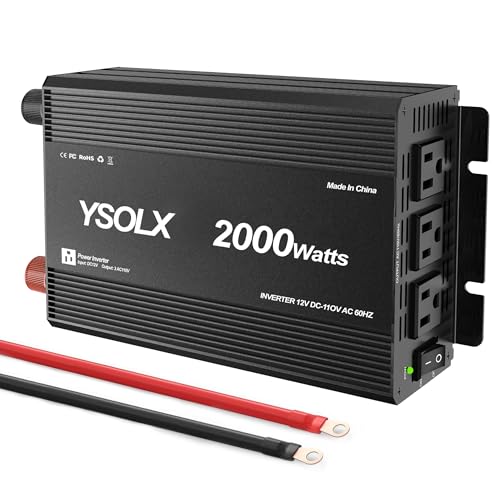
The YSOLX is a 2000W inverter with a 4000W peak and three AC outlets, with plug-and-play installation. It lists overload, over-voltage and under-voltage protection, and carries FCC, CE and RoHS certifications.

No inverter here costs less, and it adds a 30-day return and exchange policy with 24/7 technical support.

It suits budget campers running lights, fans and chargers from a battery bank.

What works

  • FCC, CE and RoHS certifications
  • 30-day return and exchange
  • Plug-and-play installation

Watch out for

  • Waveform type is not stated
  • No remote or LCD in the details
The catch
The waveform is not stated, so treat it as unsuitable for sensitive electronics until confirmed.

Methodology

How We Built This Shortlist

Each pick was assessed across 5 criteria weighted for real-world use.

01

Surge rating

Peak and surge watts named in each listing.

02

Waveform

Pure sine, modified sine or not stated.

03

Outlets and terminals

AC outlet count, hardwire terminals and USB ports.

04

Controls and display

LCD and wired remote details.

05

Protections

Voltage, overload, heat and polarity protections.

Decision guide

Match a 2000w Inverter For Camping to Your Camp Setup

By Load Type

Your situationRecommended pickWhy
Fridge, pump and high surgeAmpeak 2000W6000W surge rating.
Remote mounted installOYPSX 2000W5 meter controller.
Many devices at onceOUBOTEK 2000WFour AC outlets and terminal.
Sagging battery bankVansdon 2000WRegulated output.
Mixed battery chemistriesEGSCATEE 2000WNames battery fit.
Lowest priceYSOLX 2000WCheapest, certified.

By Budget

BudgetRecommended pick
$80 to $110YSOLX 2000W or EGSCATEE 2000W
$110 to $130Vansdon 2000W or OUBOTEK 2000W
$150 to $180OYPSX 2000W or Ampeak 2000W

Pure Sine vs Modified Sine

Pure sine wave

Ampeak 2000W, OYPSX 2000W, OUBOTEK 2000W and Vansdon 2000W give clean power for electronics and motors. They cost more.

Modified sine wave

EGSCATEE 2000W is modified sine and costs less. It is fine for chargers, lights and fans but can upset some devices. YSOLX 2000W does not state its waveform.

Most campers should pick a pure sine model such as the Vansdon 2000W.

By Budget

BudgetRecommended pick
PremiumAmpeak 2000W
About $160OYPSX 2000W
About $120OUBOTEK 2000W or Vansdon 2000W
About $105EGSCATEE 2000W
LowestYSOLX 2000W

Safe Battery Install Specifically

Look for

Fused cable, a ventilated mount and a battery bank sized for the load

In this comparison

Vansdon 2000W lists dual cooling with aluminum heat sinks, and OYPSX 2000W lists reverse polarity protection. Whichever you choose, fuse the battery cable and avoid the vehicle's 12V socket.

When to Spend More

Spend more if

Spend more on Ampeak 2000W or OYPSX 2000W if you run motor loads or want a long remote, since the extra surge and controls justify the cost.

Save if

Save with EGSCATEE 2000W or YSOLX 2000W if you run chargers, lights and fans, and confirm their waveform before plugging in sensitive gear.

FAQ

Before You Bring One Home

Can I plug a 2000W inverter into my vehicle's 12V socket?

No. A 12V accessory socket is typically limited to about 150 watts, so 2000W units connect straight to the battery with fused cable.

What is the biggest mistake with 2000W inverters?

Undersized cable and no fuse. At 12V the current is roughly 170 amps, so use thick cable and a fuse close to the battery.

Is pure sine worth it over modified sine?

For motors, medical gear and sensitive electronics, yes. EGSCATEE 2000W is fine for chargers and lights, but Ampeak 2000W suits fridges and pumps.

How do I install a 2000W inverter?

Mount it in a ventilated spot, wire it with short thick cable and fit a fuse near the battery. Connect with the unit switched off and double-check polarity.

How do I maintain a camping inverter?

Keep vents clear, check terminals for heat discoloration and turn the unit off when idle. Store it dry and inspect the cable ends each season.

Bottom line

The short version

Browse more 2000w inverters for camping on Amazon →
Danny Walker, Camping Editor at RV Gear Lab

About the author

Danny Walker

Camping Editor at RV Gear Lab

Danny covers camping gear, campsite setup, outdoor power, sleep systems and practical camping advice, with a focus on helping campers make better gear decisions.

More from Danny →Editorial standards

Keep reading

Related guides