


We research everything we recommend. When you buy through our links, we may earn a commission. Learn more

Buying guide · 10 min read · Updated October 2, 2026

3 Best 50 Amp Camping Extension Cords in 2026: A Practical Camping Guide

Three 50 amp RV extension cords with NEMA 14-50 ends compared on wire gauge, ETL listing, weatherproofing and length so you match the pedestal gap.

Danny WalkerBy Danny WalkerCamping Editor at RV Gear Lab3 products comparedSpec-sheet researched
Dome tent and hammock at a forest campsite at golden hour

At a glance

Our top picks

A 50 amp RV service carries a lot of power. The two hot legs together can deliver up to 12,500 watts, and that current runs through your extension cord every time the air conditioners, microwave and water heater are on. A cord that is too thin, too long or poorly built heats up, wastes power as voltage drop and in the worst case melts at the plug. That is why a 50 amp cord is a safety item first and a convenience second, and why price should come after gauge, plug type and certification.

Most owners meet this problem the same way: the pedestal sits a few feet farther from the rig than the permanent shore cord can reach. A short extension solves it, and the right one is usually the shortest that clears the gap. Longer runs raise resistance and voltage drop, and a heavy 50 foot cord is awkward to coil and store. All three cords in this guide use NEMA 14-50 plugs and receptacles, which also means they suit Level 2 EV charging, so a cord bought for the RV can double as a home or road-trip charging lead. That dual use also means a cord with a good plug and a sturdy jacket earns its price over many years rather than one trip.

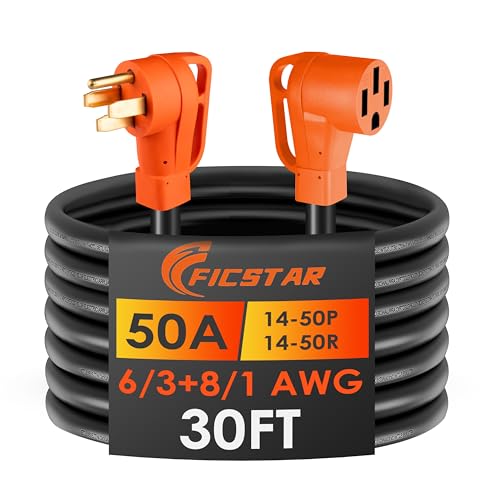
The three picks are PlugSaf, Ficstar and POWGRN, each with a different strength. PlugSaf sells in 15, 30 and 50 foot sizes with a plated finish. Ficstar is a 30 foot cord that spells out its 6/3 plus 8/1 AWG wiring and adds 90 degree heads. POWGRN is a shorter 25 foot cord at a lower price. Lines sold in several lengths count as one pick here, which is why the list is short: few cord lines meet this need and state their specs clearly.

We evaluated each cord on stated wire gauge, plug and receptacle type, weather and temperature claims, certification and length options, drawing on listed ratings, certifications and owner comments. The scoring leans on documented specifications and the pattern of owner feedback. If your rig has a 30 amp inlet, a 50 amp cord with a 14-50 plug will not fit directly, so confirm your inlet before reading further.

RV Gear Lab field notes

The Campsite Fit Check

Start with the job
PlugSaf 50 FT 50 Amp RV/EV Extension Cord Outdoor leads this shortlist for Standard 50A pedestals. Use that fit as a reference point, then compare the alternatives against your own space and workload.
Specs that separate the picks
The first details to compare are 50A, 125V and 250V, 12500W, 50A, 6/3 plus 8/1 AWG, 50A, 125V and 250V. Confirm the exact model and included components before ordering.
Trade-off to plan for
50 ft size costs the most

Before you buy

What Matters Before You Choose a 50 Amp Camping Extension Cord

Key buying criteria so you get the right fit the first time.

  1. 01

    Wire gauge

    Gauge is the thickness of the copper inside the jacket, and a lower AWG number means thicker wire. A thick conductor carries 50 amps with less heat and less voltage drop, while thin wire warms up and wastes power. Look for the gauge in the title or bullet points, such as 6/3 plus 8/1 AWG, and treat a listing that gives no gauge as a reason to read the label on the cord itself before you rely on it.

  2. 02

    Plug and receptacle type

    A 50 amp RV pedestal uses a four-pin NEMA 14-50 receptacle, and the cord must have a matching 14-50P plug on one end and a 14-50R receptacle on the other. A 30 amp TT-30 plug is a different shape and will not fit. Check that the listing names NEMA 14-50P to 14-50R, and look at your own rig's inlet before buying, since a 30 amp rig needs an adapter or a different cord.

  3. 03

    Safety certification

    A listing mark such as ETL means the product was evaluated against a recognized safety standard rather than only claiming to be safe. For a cord that carries 12,500 watts, that is a meaningful extra assurance. Look for the certification name in the bullet points and, once the cord arrives, check that the mark is printed on the cord or its packaging.

  4. 04

    Cord length

    Longer cords have more resistance, and resistance causes voltage drop and heat under heavy load. A 50 foot run is fine for a short burst, but a 25 foot cord is more efficient for a normal pedestal gap. Measure the real path from the receptacle to your inlet, add a few feet of slack and buy the shortest cord that clears it, rather than the longest one on sale.

  5. 05

    Weather and temperature rating

    An IP65 claim means dust-tight and resistant to water jets, which suits rain and sprinklers but not submersion. A stated temperature range, such as -40F to +221F, tells you the jacket stays flexible in the cold and stable in the heat. Look for both in the listing, and keep plug connections off the ground and out of standing water, since no jacket rating protects a wet connection.

  6. 06

    Plug construction and grip

    The plug is where the heat builds first, so its materials and shape matter. Nickel plating resists corrosion at the contacts, insulated grips let you pull the plug without strain, and 90 degree heads reduce sideways stress. Check the listing for plating, the grip style and the head angle, and look at buyer photos to see whether the plug body is solid and the pins sit straight.

Our standards

Why You Can Trust RV Gear Lab

At RV Gear Lab, we compare products based on campsite fit, verified specifications, usability, setup requirements, weight, durability, and real-world trade-offs. We do not rank products purely on marketing claims or commission rates.

We have not personally tested every product listed. Where hands-on testing is not available, recommendations are based on verified manufacturer specifications, product documentation, use-case fit, and comparative research.

How we review camping gear →

Detailed reviews

The 3 best 50 amp camping extension cords, explained

01
PlugSaf 50 FT 50 Amp RV/EV Extension Cord Outdoor
  • 50A, 125V and 250V, 12500W
  • NEMA 14-50P to 14-50R
  • IP65 claim, -40F flexible
Check price on Amazon for PlugSaf 50 FT 50 Amp RV/EV Extension Cord Outdoor (opens in a new tab)
Best for: Standard 50A pedestals

Our take

The widest choice of lengths and a plated finish. A solid 50A default.

Why it made the shortlist

The PlugSaf 50 FT RV/EV Extension Cord is a 50 amp STW cord rated 125V and 250V, giving 6,250W and 12,500W, with NEMA 14-50P and 14-50R ends and a nickel-plated pure copper finish. It is sold in 15, 30 and 50 foot sizes and carries an IP65 waterproof claim, flexibility to -40F and an ETL listing. At $169.99 for the 50 foot size, it is the top pick.

Compared with the Ficstar below it, the PlugSaf gives you three length choices instead of one, so you can buy the exact reach your site needs. The plated finish resists corrosion at the contacts, which matters at coastal and wet campsites, and the wide insulated grip protects the plug when you pull it from a stiff receptacle. The listing also names Level 2 EV charging use.

This is the pick for an owner who wants a standard 50 amp extension in the correct length for a pedestal gap. It suits full-time RVers, owners who also charge an EV and anyone who wants a long-lasting default cord from a line with several sizes.

What works

  • Three length options
  • Nickel-plated corrosion resistance
  • Also fits Level 2 EV charging
  • Wide insulated grip

Watch out for

  • 50 ft size costs the most
  • Heavy and stiff when coiled
The catch
At 50 ft the cord is costly and heavy, so choose the shortest length that reaches.
02
Best for: Hot and cold sites

Our take

A clearly specified 6-gauge cord. Good if you want to see the wire size.

Why it made the shortlist

The Ficstar 30FT 50 Amp RV Extension Cord is built with 6/3 plus 8/1 AWG wiring, a heat-resistant flame-retardant PVC jacket and IP65 waterproofing. It uses 14-50 ends with 90 degree heads to reduce plug stress, ergonomic grips and ETL certification, and it handles temperatures from -40F to +221F. It costs $119.59 for the 30 foot length.

Against the PlugSaf above it, the Ficstar states its gauge up front, so you can see the thick wire you are paying for without hunting through the listing. The 90 degree heads sit flat against the pedestal and the rig, which saves clearance in tight spots and keeps the cord from pulling sideways on the plug. Against the POWGRN below it, the Ficstar adds five feet of reach and a stated wiring spec.

Choose it when you want the wire size stated clearly and who visit both hot desert sites and freezing mountain campgrounds. It suits owners with a tight pedestal layout, a plug that sits close to the ground and a preference for knowing exactly what is inside the jacket.

What works

  • Gauge is clearly stated
  • 90-degree heads reduce stress
  • Wide temperature range
  • ETL certified

Watch out for

  • Only one length listed
The catch
Single 30 ft length only.
03
Best for: Short pedestal gaps

Our take

A short, lower-cost 50A cord. Uncoil it fully before use.

Why it made the shortlist

The POWGRN 25 FT 50 Amp RV/EV Extension Cord is a NEMA 14-50P to 14-50R cord rated 50A, 125V and 250V, giving 6,250W and 12,500W, with an IP65 jacket, an insulated handle and flexibility to -40F. The listing names ETL certification and Level 2 EV charging compatibility. It costs $88.99.

Against the Ficstar above it, the POWGRN trades five feet of length for a lower price, and it matches the PlugSaf on its stated 50 amp rating. It is also much lighter to handle than the 50 foot PlugSaf, which is easier to coil and stow in a basement bay. The listing advises unfolding the cable fully during use, a sensible habit for any high-load cord.

This is the pick for campers who need a short 50 amp extension of about 25 feet and want to spend less. It suits seasonal campers with a pedestal just out of reach, owners who store the cord in a tight compartment and anyone who wants an ETL-listed cord without paying for extra length.

What works

  • ETL certified
  • Insulated handle
  • Also suits EV charging

Watch out for

  • Only 25 ft listed
  • Wire gauge is not stated on the listing
The catch
The listing does not show the gauge, so check the label.

Methodology

How We Built This Shortlist

Each pick was assessed across 5 criteria weighted for real-world use.

01

Wire gauge and current rating

The wire inside decides how much heat the cord makes under load. We compared the 6/3 plus 8/1 AWG wiring stated on the Ficstar with the 50A, 125V and 250V ratings stated on all three cords, and we gave more credit to a listing that names the gauge than to one that only names the amperage.

02

Plug type and compatibility

All three cords use NEMA 14-50P and 14-50R ends, which suit RV pedestals and Level 2 EV charging. We checked that each listing names both ends, since a cord with a mismatched plug will not connect to a standard 50 amp receptacle without an adapter.

03

Weatherproofing and temperature range

Cords live outdoors in rain, heat and snow. We compared the IP65 claims on all three, the -40F flexibility stated on each and the +221F ceiling on the Ficstar, because a jacket that stiffens in the cold or softens in the heat is harder to handle and slower to wear out.

04

Certification and build details

An ETL listing means the product was submitted for safety testing against a recognized standard. We compared which listings name ETL, then looked at the build extras: nickel plating on the PlugSaf, 90 degree heads on the Ficstar and the insulated handle on the POWGRN.

05

Length options and price

A cord that is too long wastes money and adds voltage drop, while one that is too short is useless. We compared the 15, 30 and 50 foot sizes on the PlugSaf, the 30 foot Ficstar and the 25 foot POWGRN against their prices of $169.99, $119.59 and $88.99.

Decision guide

Match a 50 Amp Camping Extension Cord to Your Camp Setup

By Distance to the Pedestal

Length is the first decision, because every extra foot adds resistance and cost. Measure from the pedestal receptacle to your rig's inlet along the path the cord will actually take, then add a few feet of slack.

Gap to the pedestalRecommended pickWhy
Up to about 15 feetPlugSaf 50 Amp RV/EV Extension Cord in the 15 ft sizeThe shortest size in a line that also sells 30 and 50 ft lengths.
15 to 25 feetPOWGRN 25 FT 50 Amp RV/EV Extension CordA 25 ft cord at $88.99 covers most normal pedestal gaps.
25 to 30 feetFicstar 30FT 50 Amp RV Extension CordAdds five feet of reach over the POWGRN and states its wiring gauge.
Over 30 feetPlugSaf 50 FT 50 Amp RV/EV Extension CordThe only listing in this guide that offers a 50 ft size.

By Budget

Prices here range from under $90 to nearly $170, and most of that spread is cord length rather than quality. Compare cost against the length you actually need.

BudgetRecommended pick
Under $100POWGRN 25 FT at $88.99, an ETL-listed cord with an IP65 jacket.
$100 to $150Ficstar 30FT at $119.59, with stated 6/3 plus 8/1 AWG wire and 90 degree heads.
$150 and upPlugSaf 50 FT at $169.99, the longest cord here with a nickel-plated finish.

Straight Plug vs 90 Degree Head

Plug shape affects both clearance and how much stress the cord puts on the pedestal receptacle. The two designs suit different rigs and different pedestal layouts.

Straight plug heads

The PlugSaf and POWGRN use conventional straight ends with an insulated grip or handle. They are easy to pull out and suit pedestals with open space around the receptacle. A cord that hangs straight down puts more sideways load on the plug if the rig is close to the ground.

90 degree heads

The Ficstar uses 90 degree heads that turn the cord away from the receptacle face. That saves clearance in tight spots and reduces the bending stress on the plug and the first few inches of cable. It is a helpful design for pedestals mounted close to the ground or boxed in by trim.

Most owners with an open pedestal can use either style, and anyone with tight clearance should choose the Ficstar.

By Climate and Season

Temperature changes how a cord behaves. Cold stiffens the jacket and heat softens it, so the climate you camp in is a second way to choose.

Where you campRecommended pick
Hot desert or summer southern sitesFicstar 30FT, rated up to +221F on its listing.
Cold mountain or winter sitesPlugSaf 50 Amp Extension Cord, with flexibility stated to -40F and a plated finish.
Mild three-season campingPOWGRN 25 FT at $88.99, which also lists -40F flexibility at the lowest price.

For Owners Who Also Charge an EV Specifically

The NEMA 14-50 connection is also the standard outlet for many Level 2 EV chargers, so a good cord can serve two uses. A few extra checks apply when the cord will work as a charging lead.

Look for

A cord that names Level 2 EV charging in the listing, a 50A rating at 250V, a plug that fully seats in the outlet and a jacket rated for outdoor use. Remember that an EV charger can draw a steady load for hours, so a well-built cord matters more than for brief RV loads.

In this comparison

The PlugSaf and POWGRN listings both name Level 2 EV charging, and both are rated 50A at 125V and 250V. The PlugSaf adds three length options and a plated finish, while the POWGRN keeps the price lower at $88.99. The Ficstar is rated for RV use with ETL certification.

When to Spend More

The price gap between the cheapest and the dearest cord is about $80, and that is small compared with the cost of damage to an RV's electrical system. The decision should rest on usage.

Spend more if

Spend on the PlugSaf at $169.99 or the Ficstar at $119.59 if you plug in every night, camp in extreme weather or need a longer reach. Plating, stated gauge and extra length give a full-timer a cord that stays dependable season after season.

Save if

Save with the POWGRN at $88.99 if you camp part of the year, have a short pedestal gap and store the cord in a small bay. A shorter cord also carries less voltage drop, so the cheaper option is often the better electrical choice for short gaps.

FAQ

Before You Bring One Home

Can I use a 50 amp extension cord on a 30 amp RV?

Not directly. A 30 amp rig has a TT-30 inlet, and the four-pin 14-50 plug on these cords will not fit it. You would need an adapter, and the rig will still draw only 30 amps. If you own a 30 amp rig and a 50 amp pedestal, an adapter and a short 30 amp cord are usually simpler.

Is a longer cord always worse?

Longer cords have more resistance, so they produce more voltage drop and heat under a heavy load. For a 50 amp circuit that matters, so choose the shortest cord that reaches. Using the 25 foot POWGRN for a 20 foot gap is a better electrical choice than using the 50 foot PlugSaf and leaving coils on the ground.

Is a 150 dollar cord worth it over an 89 dollar one?

The $89 POWGRN and $170 PlugSaf both state a 50A rating and an IP65 jacket, so the difference is mainly length, the plated finish and the wider size choice. If you need 25 feet or less and plug in only part of the year, the cheaper cord covers the job. For frequent use or longer reach, the extra money is easier to justify.

How do I plug in a 50 amp cord safely?

Turn the pedestal breaker off, connect the cord to the rig first and then to the pedestal, and switch the breaker on last. Uncoil the whole cable, since a coiled cord traps heat under load. Make sure the plug seats fully in the receptacle and the connection sits off wet ground.

Can I connect two extension cords together?

It is better not to. Every extra connection is another place for heat to build, and the added length increases voltage drop. If you need more reach than one cord provides, buy a single longer cord, such as the PlugSaf in its 50 foot size, instead of joining two shorter ones.

How should I store and maintain the cord?

Coil it loosely in large loops instead of tight wraps, and keep it dry and out of direct sun. Inspect the plug for discoloration, melted plastic or loose pins after each trip. A plug that feels hot, or a jacket that is cracked or stiff, means the cord should be replaced.

Bottom line

The short version

For most 50 amp RV owners, the PlugSaf is the easiest default because it comes in 15, 30 and 50 foot sizes with a plated finish and ETL listing. Pick the size that just clears your pedestal gap and avoid paying for length you will not use.

The Ficstar suits owners who want the 6/3 plus 8/1 AWG wiring stated and 90 degree heads for tight pedestals, and the POWGRN is the sensible low-cost choice for gaps around 25 feet. Check your inlet type, measure the run and unroll the cord fully every time you plug in.

Whichever cord you pick, treat it as part of your electrical system. Inspect the plug ends each season, keep the connection dry and replace the cord at the first sign of discoloration, because a few dollars saved on a worn cord is never worth a damaged rig.

Browse more 50 amp camping extension cords on Amazon →
Danny Walker, Camping Editor at RV Gear Lab

About the author

Danny Walker

Camping Editor at RV Gear Lab

Danny covers camping gear, campsite setup, outdoor power, sleep systems and practical camping advice, with a focus on helping campers make better gear decisions.

More from Danny →Editorial standards

Keep reading

Related guides