We research everything we recommend. When you buy through our links, we may earn a commission. Learn more

Buying guide · 10 min read · Updated October 2, 2026

3 Best 61200mah Solar Power Banks in 2026: A Practical Camping Guide

Three huge-capacity solar power banks compared by real mAh, charging speed, recharge routes and weight, for RV owners and campers who need backup power.

Danny WalkerBy Danny WalkerCamping Editor at RV Gear Lab3 products comparedSpec-sheet researched
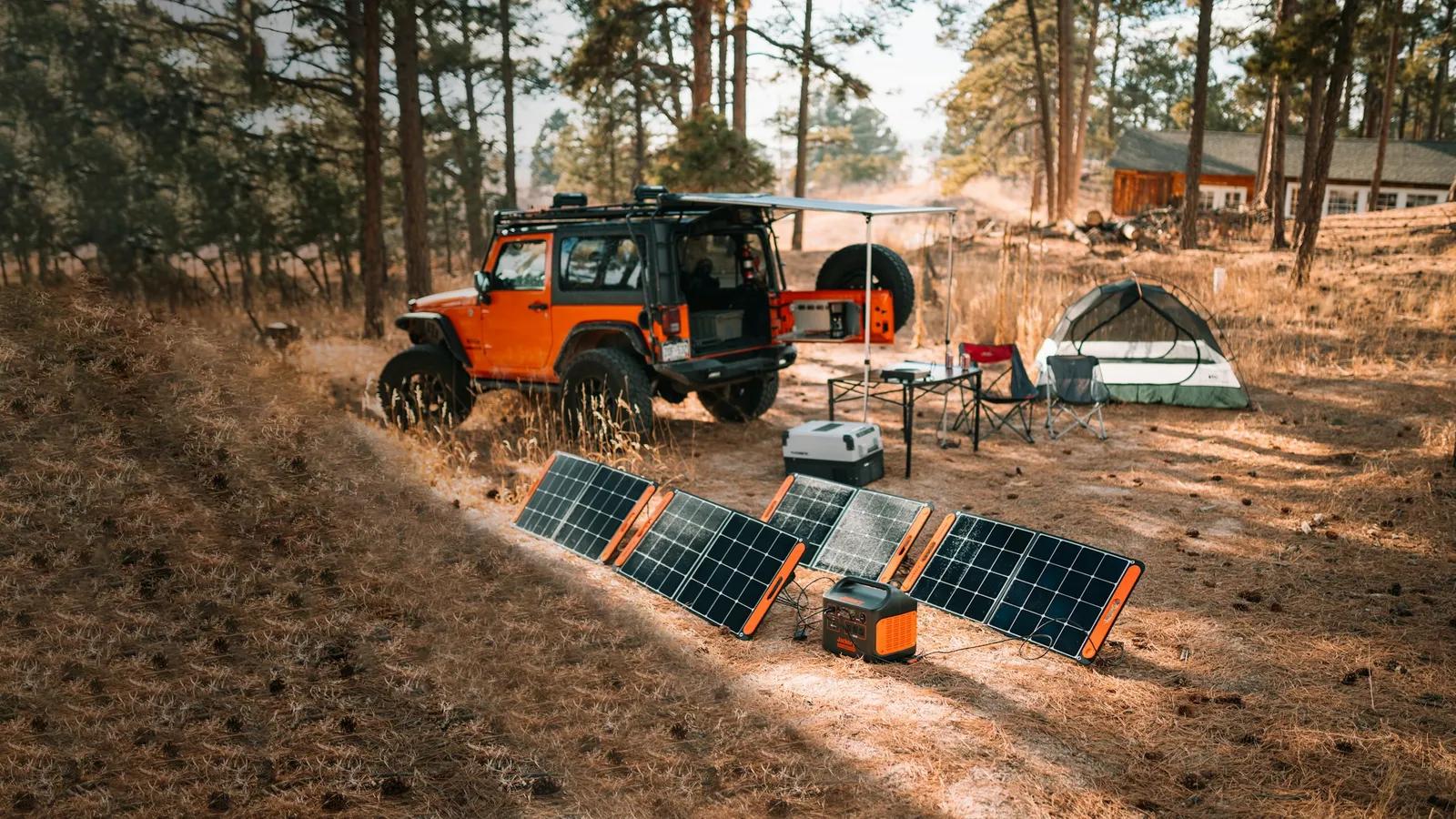
Jeep camp with a tent, solar panels and a portable power station at a pine forest campsite

At a glance

Our top picks

A 61200mAh power bank sounds like a spec-sheet fantasy, yet a handful of listings really do sell at that number. The appeal for RV and camping use is easy to see: a battery that size can refill a phone many times over a long weekend, run a lantern or fan overnight and sit in the glovebox as an emergency reserve when the coach batteries are low. Add a small solar panel and a hand crank and the bank becomes a last-resort source that does not depend on shore power at all.

Capacity numbers on this kind of product need care, though. Marketing for portable banks often quotes the raw cell rating in milliamp hours at the cell voltage, which is not the same as the energy you can pull out through a USB port after conversion losses. A 61200mAh label does not mean 61200mAh delivered to your phone, and the solar panel on top is a trickle charger, not a way to fill the bank quickly. Treat the panel as a bonus for a sunny day and plan on recharging by cable before a trip, since that is the only route that fills a bank this large in a reasonable time.

Three products made this lineup. The ReeZar at $29.99 is the one that states the exact 61200mAh figure and adds three recharge routes. The 66800mAh bank at $49.99 is the largest cell and doubles as a lamp. The Luvknit 20000mAh at $16.99 is included as the lightweight alternative for buyers who find the big units too heavy. We evaluated them on stated capacity, output wattage, recharge options, built-in cables and weight, leaning on published specifications and owner comments, and we make no claim of personal bench trials.

A practical way to think about these banks is as a pantry rather than a faucet. A big bank holds a lot, then hands it out at the speed its ports allow, and refilling it is a slow, planned event. In an RV that means topping it up while parked at home or plugged in at a campground, then drawing it down over days of dry camping. Used that way, a single bank can keep phones, a lantern and a small fan alive through a long weekend without ever touching the coach batteries, which is the real reason to buy one this large.

RV Gear Lab field notes

The Campsite Fit Check

Start with the job
ReeZar Solar Charger Power Bank 61200mAh leads this shortlist for Large cell with backups. Use that fit as a reference point, then compare the alternatives against your own space and workload.
Specs that separate the picks
The first details to compare are 61200mAh, PD 15W and QC 3.0, 66800mAh, hand crank, 20000mAh, Qi wireless. Confirm the exact model and included components before ordering.
Trade-off to plan for
Heavy for its size class

Before you buy

What Matters Before You Choose a 61200mah Solar Power Bank

Key buying criteria so you get the right fit the first time.

  1. 01

    Real capacity behind the label

    Milliamp hours measure how much charge a battery stores, and portable banks quote the cell rating rather than what reaches your device. After voltage conversion, the usable amount is meaningfully lower, so a 61200mAh label does not equal 61200mAh into a phone. Look for any stated watt hours on the listing and compare banks by the same measure instead of trusting the biggest number in the title.

  2. 02

    Output wattage per port

    A port rated at 5 watts will take hours to fill a phone no matter how big the battery behind it is. Faster ports use PD or QC standards at 15 to 22.5 watts and above. Check the stated output next to each port in the bullet points, and confirm that your phone or tablet supports the fast charging standard you are paying for.

  3. 03

    Recharge options and time

    A huge bank can take a day or more to refill by cable, and the small solar panel on top adds only a trickle. A hand crank is an emergency measure, since cranking for minutes gives very little. Look at the input rating in the listing, plan on charging at home before a trip, and treat solar and crank as backup only.

  4. 04

    Weight and size

    More cells mean more weight, and some large banks are heavy for their size. That is fine in a car or RV cabinet, and it is a burden in a daypack. Find the weight in the product details or the dimensions, then decide whether the bank will live in a vehicle or travel with you on foot.

  5. 05

    Built-in cables and extras

    Built-in cables mean one fewer item to lose, and a lamp or compass adds small conveniences. They also add moving parts, and a damaged built-in cable can be hard to replace. Check whether the cables match your devices, such as Lightning, USB-C and micro USB, and whether a USB port remains free for your own cable.

  6. 06

    Water and shock protection

    Camp gear gets rained on, dropped and sat on. An IPX rating describes water protection, and IPX7 means short submersion. Check that the rating is stated for the whole unit, and remember that the ports and the solar panel seam are the weakest points, so keep covers closed in wet weather.

Our standards

Why You Can Trust RV Gear Lab

At RV Gear Lab, we compare products based on campsite fit, verified specifications, usability, setup requirements, weight, durability, and real-world trade-offs. We do not rank products purely on marketing claims or commission rates.

We have not personally tested every product listed. Where hands-on testing is not available, recommendations are based on verified manufacturer specifications, product documentation, use-case fit, and comparative research.

How we review camping gear →

Detailed reviews

The 3 best 61200mah solar power banks, explained

01

Best Exact 61200mAh · 1 of 3

ReeZar Solar Charger Power Bank 61200mAh

ReeZar Solar Charger Power Bank 61200mAh
  • 61200mAh, PD 15W and QC 3.0
  • Hand crank, solar, cable recharge
  • IPX7, 4 built-in cables
Check price on Amazon for ReeZar Solar Charger Power Bank 61200mAh (opens in a new tab)
Best for: Large cell with backups

Our take

The exact-match pick, with a crank for emergencies.

Why it made the shortlist

The ReeZar Solar Charger Power Bank states 61200mAh outright, which makes it the one listing that matches the keyword exactly. It offers PD 15W and QC 3.0 output, an IPX7 rating and four built-in cables, and it refills by hand crank, solar panel or cable for $29.99.

Compared with the 66800mAh bank below it, the ReeZar is the lower-priced way into a giant reserve and adds four built-in cables plus an IPX7 water rating. Compared with the compact Luvknit at the bottom of the list, it stores roughly three times the charge for a $13 step up in price.

It is the pick for RV and camping owners who want a large emergency reserve that can be refilled in three different ways, kept in a cabinet for outages and long off-grid weekends.

What works

  • Exact 61200mAh capacity
  • Three recharge routes
  • Four built-in cables

Watch out for

  • Heavy for its size class
  • Crank gives little power
The catch
A crank and panel will not fill 61200mAh.
02
Best for: Light plus power

Our take

Biggest cell and a lamp function. A solid camp hub.

Why it made the shortlist

The Solar Power Bank Portable Charger 66800mAh is the largest cell in this roundup at $49.99. It pairs a hand crank with a 22.5W USB-A port and a 5V/3A Type-C port, and it doubles as a lamp with a compass carabiner attached.

Compared with the ReeZar above it, this unit adds roughly 5,600mAh of stated capacity, a faster USB-A port and lamp features for night walks around camp. Compared with the Luvknit below it, it brings a far larger store of energy for longer stays away from outlets.

It suits campers and boondockers who want the most stored charge available, plus a lamp and compass for evenings, and who keep the bank in the vehicle or the coach.

What works

  • Largest cell of the three
  • Works as a lamp
  • 22.5W USB-A port
  • Compass carabiner included

Watch out for

  • Heavier than the others
  • No built-in cables
The catch
The listing admits it is heavier than standard banks.
03
Luvknit Solar Charger Power Bank 20000mAh
  • 20000mAh, Qi wireless
  • 3 built-in cables
  • Solar panel, 3-mode LED
Check price on Amazon for Luvknit Solar Charger Power Bank 20000mAh (opens in a new tab)
Best for: Light weekend camping

Our take

The light, cheap alternative. Pick it for short trips.

Why it made the shortlist

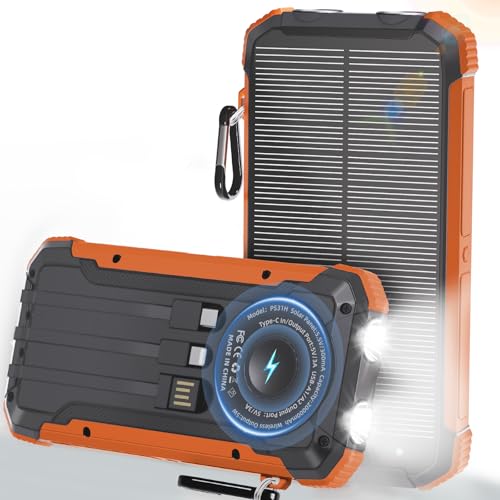
The Luvknit Solar Charger Power Bank is a 20000mAh unit at $16.99 with a built-in Qi wireless pad and three built-in cables. A small solar panel and a 3-mode LED light round out the kit, and the body is described as shockproof and waterproof.

Compared with the ReeZar above it, the Luvknit brings a wireless charging surface and a lighter overall package at the lowest price in the group. It still holds enough for several phone charges, which is plenty for a typical weekend.

It is the best match for day trippers, weekend campers and anyone who wants a light, low-cost bank with wireless charging and a lamp for the picnic table or tent.

What works

  • Qi wireless pad included
  • Three built-in cables
  • Shockproof and waterproof body

Watch out for

  • Much smaller capacity
  • Wireless charging is slow
The catch
About a third of the capacity of the other two.

Methodology

How We Built This Shortlist

Each pick was assessed across 5 criteria weighted for real-world use.

01

Stated capacity versus the 61200mAh target

The keyword is a specific number, so we compared each bank against it. The ReeZar states 61200mAh exactly, the second bank states 66800mAh, and the Luvknit states 20000mAh and is included only as a lighter fallback.

02

Output wattage and ports

Capacity matters little if the ports charge slowly. We compared the ReeZar's PD 15W and QC 3.0 output with the 22.5W USB-A port and 5V/3A Type-C on the larger 66800mAh unit, and we noted the Qi wireless pad on the Luvknit.

03

Ways to recharge the bank

A bank this large takes a long time to fill by cable, so extra routes help in a pinch. We looked at the ReeZar's hand crank, solar and cable recharge, the hand crank on the 66800mAh unit and the solar panel on the Luvknit, and we weighed how realistic each is.

04

Weight and carrying practicality

More cells mean more weight. Buyer comments across these listings point out that the big banks are heavy for their size, so we scored how well each suits a car, an RV compartment or a pack, and we gave credit to the lighter Luvknit.

05

Weather and extras

Outdoor gear needs to survive a bit of abuse. We noted the ReeZar's IPX7 rating, the Luvknit's shockproof and waterproof body, the lamp and compass carabiner on the 66800mAh unit, and the number of built-in cables each includes.

Decision guide

Match a 61200mah Solar Power Bank to Your Camp Setup

By How Much Capacity You Need

The right size depends on how many devices you charge and how long you go between recharges. Overbuying adds weight without adding value.

Your situationTop choiceWhy
Exactly 61200mAh, with several recharge routesReeZar Solar Charger Power Bank 61200mAhStates the exact capacity and adds crank, solar and cable recharge for $29.99.
Maximum capacity for a long off-grid staySolar Power Bank Portable Charger 66800mAhThe largest cell of the three at 66800mAh, plus a lamp for evenings.
A weekend of phone and earbud chargingLuvknit Solar Charger Power Bank 20000mAh20000mAh is plenty for phones and small gear at only $16.99.
Emergency reserve kept in the RVReeZar Solar Charger Power Bank 61200mAhThe crank and solar options give it a way back to life without any outlet.

By Budget

These three sit between $16.99 and $49.99, so the question is how much capacity you want per dollar.

BudgetTop choice
Under $20Luvknit 20000mAh at $16.99, with Qi wireless and three built-in cables.
Around $30ReeZar 61200mAh at $29.99, which gives the most capacity for the money.
Up to $50The 66800mAh bank at $49.99 for the biggest cell, a lamp and a compass carabiner.

Giant Bank vs Compact Bank

Bigger is not always better. Weight, charging time and your actual device list decide whether a giant bank earns its place.

Giant bank

The ReeZar at 61200mAh and the 66800mAh bank store several times more energy than a typical bank, which suits long boondocking trips and emergency reserves. They are heavier, take far longer to recharge by cable and are overkill for a single phone.

Compact bank

The Luvknit at 20000mAh weighs much less, charges in a fraction of the time and still refills a phone several times. It also carries a Qi wireless pad and three built-in cables, which makes day trips easier.

Most campers do well with the compact Luvknit, and only long off-grid stays justify the ReeZar or the 66800mAh bank.

By Recharge Method

How you plan to refill the bank is a second decision, since solar and hand cranks deliver little power compared with a wall adapter.

How you will rechargeTop choiceWhy
Wall or car cable before each tripReeZar Solar Charger Power Bank 61200mAhSupports PD 15W and QC 3.0, the fastest wired path of the three.
Emergency crank when nothing else worksSolar Power Bank Portable Charger 66800mAhHand crank is built in and the lamp shows it is working.
Daily top-up from a sunny windowsillLuvknit Solar Charger Power Bank 20000mAhA smaller cell responds better to a small solar panel.
Three methods in one unitReeZar Solar Charger Power Bank 61200mAhLists hand crank, solar and cable recharge together.

For Boondocking RV Owners Specifically

A bank in a boondocking rig backs up phones, lanterns, fans and routers when the house batteries run low.

Look for

High stated capacity, several output ports, a rugged water-resistant body and at least one recharge path that does not need an outlet. Built-in cables reduce the chance of leaving one behind.

In this comparison

The ReeZar offers IPX7 water protection, four built-in cables and three recharge routes at $29.99, so it covers those needs. The 66800mAh unit adds a lamp and compass for night walks around the campsite.

When to Spend More

A gap of only $33 separates the three, yet the extra money buys specific features rather than general quality.

Spend more if

Choose the 66800mAh bank at $49.99 if you want the biggest cell, a built-in lamp and a faster 22.5W USB-A port. Those extras matter on long trips and around camp at night.

Save if

Choose the Luvknit at $16.99 or the ReeZar at $29.99 if weight and cost matter more than the last few thousand milliamp hours. Both cover typical phone and small-device charging.

FAQ

Before You Bring One Home

Will a 61200mAh bank work with my phone and tablet?

Yes, as long as your device accepts USB or Type-C charging, which nearly all do. The ReeZar lists PD 15W and QC 3.0, so supported phones can fast charge. Bring your own cable if your device needs a connector the built-in cables do not cover.

What is the biggest mistake with solar power banks?

Expecting the built-in panel to recharge the bank in a useful time. The panel is small, and filling a bank this size from it could take many days of full sun. Charge by cable before leaving, and use the panel only to keep a little energy flowing.

Is the ReeZar worth it over the 66800mAh bank?

The ReeZar costs $20 less and states the exact 61200mAh figure with IPX7 and four built-in cables. The 66800mAh bank gives more capacity, a lamp and a faster USB-A port. Pick the ReeZar for value and the larger unit for lamp features. Either way, you are paying for the same basic idea, a very large reserve, so the choice usually comes down to the extras you will actually use around camp and how much you value the lower price.

How do I use the hand crank?

Turn the crank at a steady pace and watch the indicator, which shows that energy is flowing in. It gives only a small charge, so it is meant for an emergency top-up. Do not rely on it as a regular way to fill the bank.

Can I take a power bank on a plane?

Airlines set limits on lithium battery capacity in watt hours, and very large banks can exceed them. A 61200mAh bank could be over the limit, so check your airline rules before flying. The Luvknit at 20000mAh is the safer bet for travel, and carrying any bank in your cabin bag rather than checked luggage is the usual rule.

How should I store a power bank?

Keep it in a cool, dry place and charge it partially every few months rather than leaving it empty. Heat shortens battery life, so avoid a closed RV in summer. Check the ports for dirt before use, and wipe the solar panel surface now and then so dust does not block what little light it collects. Never leave the bank on a dashboard in direct sun, since a hot cabin can push a lithium cell well past its comfortable range.

Bottom line

The short version

For a bank that really matches the 61200mAh keyword, the ReeZar is the clear choice at $29.99, with IPX7 protection, four built-in cables and three ways to recharge. If you want even more capacity and a built-in lamp, the 66800mAh bank at $49.99 is the step up.

Buyers who care about weight should consider the Luvknit at $16.99, which holds 20000mAh and adds wireless charging. Remember that the solar panel is a backup, charge by cable before your trip, and check the airline rules before flying with any of these. A short trial run at home, charging a phone from empty and timing the recharge, tells you far more than a spec sheet about how the bank will behave on the road, and it is the cheapest insurance against a surprise at the campsite.

Browse more 61200mah solar power banks on Amazon →
Danny Walker, Camping Editor at RV Gear Lab

About the author

Danny Walker

Camping Editor at RV Gear Lab

Danny covers camping gear, campsite setup, outdoor power, sleep systems and practical camping advice, with a focus on helping campers make better gear decisions.

More from Danny →Editorial standards

Keep reading

Related guides