

We research everything we recommend. When you buy through our links, we may earn a commission. Learn more

Buying guide · 11 min read · Updated October 2, 2026

6 Best Budget Portable Power Stations for Air Conditioners in 2026: A Practical Camping Guide

A straight look at what six budget power stations can run: small cooling loads yes, a rooftop RV air conditioner no. Compared by watts and watt-hours.

Danny WalkerBy Danny WalkerCamping Editor at RV Gear Lab6 products comparedSpec-sheet researched

At a glance

Our top picks

At a glance · 6 picks

Short answer first: none of these six will run a rooftop RV air conditioner for any meaningful stretch. A rooftop unit is a compressor load, and compressors ask for a burst of several times their running draw at startup, which is why continuous watts, surge watts and stored watt-hours all have to clear the bar together. A unit that cannot start that compressor is not underpowered, it is simply the wrong tool, and a listing that implies otherwise is selling you a hope instead of a spec. The sections below keep that line visible so the ranking never drifts into wishful thinking.

What these picks can do is smaller and still genuinely useful. They keep a 12V or small AC fan running through a hot night, power a low-wattage cooling appliance whose nameplate fits inside the inverter rating, hold a CPAP and a phone alongside a fan, and bridge a short outage. The two strongest, the PurMars 1075Wh and the DaranEner 1000W, are the only ones with enough inverter headroom to even enter the conversation about a compact cooler, and even they drain in about an hour or two at a few hundred watts.

So the buying question changes from which unit runs my air conditioner to what does my cooling plan actually need. Read the cooler's nameplate for running and startup watts, divide the pack's watt-hours by the running figure for hours, and then choose. A twenty-second read of a label saves a return, and it usually points to a smaller, cheaper unit than the one a headline would suggest. We ranked the six by how much usable cooling-adjacent power each can deliver for the money, and we say clearly where each one stops, because an honest ceiling is worth more to a camper than an optimistic runtime. Each product section also names the real ports and the real chemistry the listing states.

RV Gear Lab field notes

The Campsite Fit Check

Start with the job
Portable Power Station 1075Wh, 3x1200W AC Outlets (Peak 2400W), Outdoor Solar Generator PD100W leads this shortlist for Buyers who want the biggest battery here for overnight fans and small coolers.. Use that fit as a reference point, then compare the alternatives against your own space and workload.
Specs that separate the picks
The first details to compare are 1,075Wh LiFePO4, 1200W (2400W peak), 576Wh LiFePO4, 600W (1200W surge), 576Wh LiFePO4, 1000W (2000W surge). Confirm the exact model and included components before ordering.
Trade-off to plan for
Most expensive pick in this guide

Before you buy

What Matters Before You Choose a Budget Portable Power Station for Air Conditioners

Key buying criteria so you get the right fit the first time.

  1. 01

    Compressor Starting Surge

    A rooftop air conditioner's compressor draws a large burst when it starts, commonly several times its running load, and it holds that for a fraction of a second. A power station that cannot meet that burst trips its overload protection no matter how full the battery is. Find the surge or peak figure in the listing and compare it with the air conditioner's own nameplate for locked-rotor or startup amps. A fridge that runs near 700W may need around 2,200W to start, which shows how wide the gap can be.

  2. 02

    Continuous Output Against Running Watts

    Continuous watts are what the inverter can hold indefinitely, and they must sit above the cooler's running watts with some margin. An inverter running at its ceiling gets hot and shortens runtime. Look for the continuous figure in the title or first bullet, and ignore a unit that only quotes a peak. If the label lists amps, multiply by 120 volts to estimate running watts.

  3. 03

    Watt-Hours and Real Runtime

    Watt-hours decide how long a load runs. Divide the pack's watt-hours by the load's watts to get hours, then subtract about a fifth for inverter loss. A 576Wh pack feeding a 300W load lasts under two hours in practice, and a 1,075Wh pack feeding a 500W load lasts under two hours too. Cooling loads run for hours, so a large pack matters more than a headline wattage.

  4. 04

    Fan and DC Efficiency

    A 12V DC fan skips the inverter completely, which saves the conversion loss that an AC fan pays. Several of these units include 12V DC ports rated 6A to 12A, enough for a small fan or a 12V cooler pad. Look for the DC port's amperage in the listing, and match it to the fan's rating.

  5. 05

    Recharge Speed and Solar Input

    A cooling session drains a pack quickly, so recharge speed decides whether it is ready the next night. Look for the AC input wattage and the solar input range, since a 100W panel refills a 576Wh pack slowly. Bidirectional inverters and 80 percent recharge times in the listing are the clearest signals.

  6. 06

    Chemistry and Heat Tolerance

    Cooling loads run in hot conditions, and iron phosphate cells tolerate heat and deep discharge better than conventional lithium-ion. Most picks here state LiFePO4 outright. Where a listing says only lithium, the chemistry is open, so a short question to the seller is worth sending.

Our standards

Why You Can Trust RV Gear Lab

At RV Gear Lab, we compare products based on campsite fit, verified specifications, usability, setup requirements, weight, durability, and real-world trade-offs. We do not rank products purely on marketing claims or commission rates.

We have not personally tested every product listed. Where hands-on testing is not available, recommendations are based on verified manufacturer specifications, product documentation, use-case fit, and comparative research.

How we review camping gear →

Detailed reviews

The 6 best budget portable power stations for air conditioners, explained

01
Best for: Buyers who want the biggest battery here for overnight fans and small coolers.

Our take

Well matched to a buyer who needs hours of cooling-adjacent runtime rather than a headline wattage: an overnight 12V fan, a small compact cooler whose nameplate fits under the inverter rating, and a CPAP for the same night.

Why it made the shortlist

The PurMars 1075Wh carries the largest battery in this guide, a LiFePO4 pack of 1,075Wh behind three AC outlets rated 1200W each with 2400W peak. Two USB-C PD ports at 100W, two 18W USB outputs and two 12V 8A DC ports bring the total to ten outlets, so a fan, a laptop and a CPAP can all run from the same box through a hot night.

Next to the DaranEner 576Wh units it brings close to 1.9 times the stored energy, which is the number that decides how many hours a fan or a small cooler keeps running. A bidirectional inverter accepts AC and DC input, a 600W AC input and a 400W DC input recharge it quickly, and an app over Wi-Fi or Bluetooth reports what each outlet is drawing.

It is the most expensive pick in this guide, and the extra money goes to stored watt-hours, not a stronger claim.

What works

  • Largest pack here for the longest fan runtime
  • Three AC outlets plus ten ports in total
  • Bidirectional inverter takes AC and DC input
  • App shows draw per outlet

Watch out for

  • Most expensive pick in this guide
  • Still cannot start a rooftop RV air conditioner
02
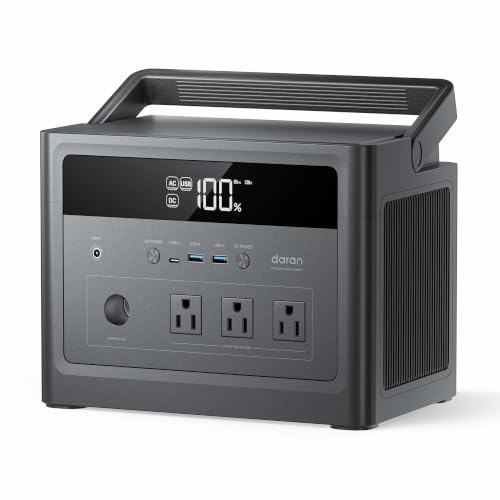
Daran Portable Power Station, LiFePO4 Solar Generator, 576Wh, 600W AC, 1200W Surge
  • 576Wh LiFePO4, 600W (1200W surge)
  • 3 AC, 100W USB-C PD, 12V car port
  • 13.67 lb, 80% in about 2 hours
Check price on Amazon for Daran Portable Power Station, LiFePO4 Solar Generator, 576Wh, 600W AC, 1200W Surge (opens in a new tab)
Best for: Campers with a 12V fan, a CPAP and a laptop sharing one battery.

Our take

A natural fit for a buyer who wants a fan, a laptop and a CPAP running through a warm night rather than a cooler.

Why it made the shortlist

The DaranEner 600W couples a 576Wh LiFePO4 pack with a 600W continuous, 1200W surge inverter and three AC outlets, two USB-A ports, a 100W USB-C PD port and a 12V car socket. The listing describes it as able to run a 60W car fridge alongside other essentials, and at 13.67 lb it stays carryable between car and tent.

Stepping down from the PurMars 1075Wh, it keeps half the battery and half the inverter, and in exchange it reaches 80 percent in about two hours from the wall and sits in a clearly lower band on price. It shares its 3,500+ cycle rating with the DaranEner 1000W, so the choice between the two comes down to inverter strength and how much a buyer values the lower band on price.

A 576Wh pack feeding a 100W fan load lasts several hours before conversion loss, and solar-ready input of 100W to 150W lets a panel refill it by afternoon, which turns a single warm night into a repeatable routine across a long weekend.

What works

  • Strong balance of watts and watt-hours
  • Stated 3,500+ cycle life
  • 80% recharge in about two hours
  • Light for its capacity at 13.67 lb

Watch out for

  • 600W ceiling rules out most compressor coolers
  • Solar panel not included
03
Portable Power Station LiFePO4 Battery, Solar Power Bank, 576Wh 1000W AC, 2000W Surge
  • 576Wh LiFePO4, 1000W (2000W surge)
  • 4 AC, 100W USB-C PD, XT60 120W
  • 14.8 lb, fanless, under 35dB
Check price on Amazon for Portable Power Station LiFePO4 Battery, Solar Power Bank, 576Wh 1000W AC, 2000W Surge (opens in a new tab)
Best for: Buyers who need the inverter strength to try a compact low-wattage cooler.

Our take

Tailored to a buyer who has already read a compact cooler's nameplate and found a running figure near the middle of the inverter range.

Why it made the shortlist

The DaranEner 1000W puts a 1000W continuous inverter with 2000W peak on the same 576Wh LiFePO4 pack, and it weighs 14.8 lb. Four AC outlets, a 100W USB-C PD port, an 18W USB-C port, two 18W USB-A ports and an XT60 output of 120W give nine ways to draw power, enough for a fan, a laptop, a camera charger and a phone at the same time.

A fanless design under 35dB keeps the room quiet, and a 70 percent recharge arrives in as little as 1.4 hours via solar or car.

The 2000W peak helps a motor start, and a 576Wh pack supplies roughly an hour at a few hundred watts, which makes it a tool for short cooling bursts, a patio hour or a hot afternoon rest, not an all-night session.

What works

  • Highest inverter output among the small packs
  • Fanless and under 35dB for sleeping nearby
  • 70% recharge in about 1.4 hours
  • Four AC outlets plus nine total outputs

Watch out for

  • Pack drains in about an hour at a few hundred watts
  • Same capacity as the cheaper DaranEner 600W
04
PurMars 300W Portable Power Station (Peak 500W), LiFePO4 Solar Generator, 288Wh
  • 288Wh LiFePO4, 300W (500W peak)
  • Pure sine wave, UL2743 stated
  • 9.3 lb, 3 recharge methods
Check price on Amazon for PurMars 300W Portable Power Station (Peak 500W), LiFePO4 Solar Generator, 288Wh (opens in a new tab)
Best for: Fan-and-phone campers who want a stated UL2743 safety certification.

Our take

Great for a buyer who wants a quiet overnight fan, a CPAP and phone charging from a unit that names its safety certification, and who understands that its 300W ceiling means it is a fan and electronics tool.

Why it made the shortlist

The PurMars 300W holds 288Wh of LiFePO4 behind a 300W pure sine wave inverter with 500W peak, and the listing states UL2743 whole-machine safety certification. A built-in battery management system guards against overcharge, short circuit and temperature extremes, and seven devices can draw at once, including a fan, a CPAP and a pair of phones. The unit also reports its charge level on a display, so the remaining reserve is visible at a glance.

Against the MARBERO 296Wh it adds a stated iron phosphate chemistry and a safety certification, which gives a long-term buyer a more complete record, and it recharges by AC, car or solar, a flexible mix for trips with changing sun. At 9.3 lb it carries about as easily as the MARBERO, and the two sit within a small step of each other on price.

It is a careful choice for tent and cabin sleeping, away from heavy loads, and its calm, defined ratings make planning easy.

What works

  • Names a UL2743 safety certification
  • LiFePO4 chemistry stated in the listing
  • Pure sine wave output for sensitive devices
  • Seven devices charge at once

Watch out for

  • 300W ceiling is a fan-and-electronics limit
  • Bulk of its 288Wh drains in an evening of cooling
05
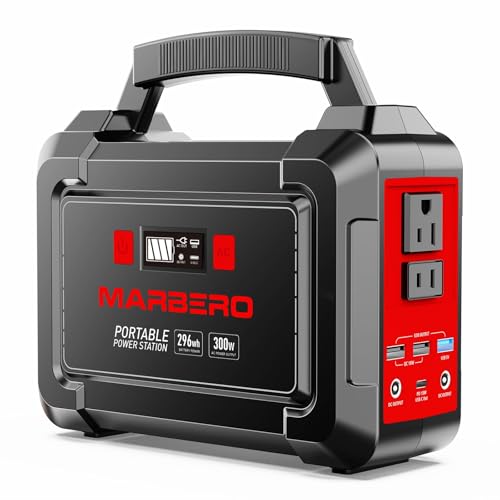
Best for: Light campers needing fan and device charging at 5.7 lb.

Our take

Perfect for a tent camper who wants a 12V fan on a gentle setting, a USB fan and a phone charger from the lightest unit in this guide.

Why it made the shortlist

The MARBERO 296Wh stores 296Wh in an 80,000mAh pack and ships at just 5.7 lb with a compact handle. It supports QC3.0 USB, a USB-C port, two 5.5mm DC ports and an AC outlet with 350W peak, and the listing says it can charge a phone 25 times or a laptop about four times, which is a handy way to size a weekend.

It undercuts the PurMars 300W on price while carrying a similar 296Wh of energy, and it adds a white LED flashlight with three modes (steady, strobe and SOS) for night-time chores around camp. Recharging takes about seven to eight hours by wall adapter, with solar and car charging supported, which suits an overnight reset before the next day of driving.

It is the right size for a bedside setup and the wrong size for any compressor, a boundary this guide states plainly, so the buyer knows exactly which jobs it was built for.

What works

  • Lightest unit with a full-size 296Wh pack
  • Flashlight with three lighting modes
  • Wall, car and solar recharge supported
  • Charges a laptop about four times

Watch out for

  • Only a peak figure for AC output is stated
  • About seven to eight hours to recharge
06
Best for: Backpackers and commuters who need a laptop-class AC outlet at 1.7 lb.

Our take

Handy for the traveler who wants one small AC outlet and a battery for a hot-weather camp, and who will pair it with a 12V fan at the DC port.

Why it made the shortlist

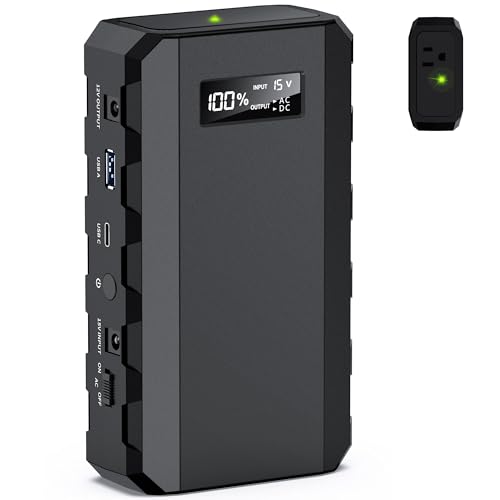
The Apowking 88Wh is a slim 6.8 by 3.8 by 1.8 inch power bank weighing 1.7 lb, with an 88.8Wh pack and a 110V AC outlet rated 65W. A USB-A port, a USB-C port and a 9V to 12.6V DC port round out the four outputs, and it recharges by AC adapter, car charger or a 13V to 16V solar panel, so a trailhead stop or a sunny picnic table works as a charging point.

It is the smallest and lightest unit here, a full 1.7 lb against the 5.7 lb MARBERO 296Wh, and it sits at the entry of this shortlist. For a backpacker or a commuter it turns a laptop, a phone and a camera charger into a single pocket kit, and the DC port feeds a small 12V fan directly without any inverter loss.

It is a charging tool that sits at the opposite end of the scale from any air conditioner, which is exactly why it earns a place for shoulder-season trips.

What works

  • Pocket-size body at 1.7 lb
  • AC outlet runs a laptop charger
  • Recharges by wall, car or solar
  • Entry of this shortlist by a wide margin

Watch out for

  • 65W AC ceiling suits only small electronics
  • Smallest pack in this guide

Methodology

How We Built This Shortlist

Each pick was assessed across 5 criteria weighted for real-world use.

01

Reading the nameplate gap

We read each unit's continuous rating, its surge rating and its stored energy as three independent promises. A rooftop RV air conditioner needs all three at once and none of these picks supplies them, so we ranked the units on the cooling-adjacent loads they can really carry. This keeps the ordering honest about what the category can do.

02

Runtime arithmetic

We divided each pack's watt-hours by plausible fan, CPAP and small-cooler loads to estimate hours before inverter losses. A 576Wh pack feeding a few hundred watts lasts roughly an hour or two. We state that arithmetic rather than a marketing runtime.

03

Inverter headroom

We looked at surge ratings against continuous ratings to see which units could start a small motor. A compressor commonly asks for a surge well above its running watts, so a surge figure alone is not enough. The DaranEner 1000W and the PurMars 1075Wh carry the most headroom.

04

Chemistry and safety claims

We noted whether each listing names LiFePO4 chemistry and a safety certification. Those are stated facts, not measurements, and where a listing is silent we say so. The PurMars 300W was the only listing to name UL2743.

05

Price position

We placed each pick against the others on price, and we tied every step up to a mechanism, such as more watt-hours or a stronger inverter. The cheapest picks here are honest small-device tools and the dearest buys storage. Our scoring rules live on the how we review page.

Decision guide

Match a Budget Portable Power Station for Air Conditioners to Your Camp Setup

By Cooling Load

Match the real load you want to run to the unit's inverter and pack.

What you want to coolPick
A 12V fan and phone charging overnightMARBERO 296Wh covers it from the lightest body in this guide.
A fan, laptop and CPAP through a warm nightDaranEner 600W balances 576Wh against a 600W inverter.
A compact low-wattage cooler for short burstsDaranEner 1000W has the inverter headroom to try it.
Several hours of fan runtime for the whole tentPurMars 1075Wh holds the most stored energy.
A rooftop RV air conditionerNone of these picks suits it, and PurMars 1075Wh is the closest in capacity.

By Budget

Bands are positions inside this shortlist, not price quotes.

Band within this shortlistPick
Entry of this shortlistApowking 88Wh for a pocket-size AC outlet.
Low of this shortlistMARBERO 296Wh for a light camp fan setup.
Low-mid of this shortlistPurMars 300W for the stated safety certification.
Upper-mid of this shortlistDaranEner 600W and DaranEner 1000W for the 576Wh pack and a real inverter.
Top of this shortlistPurMars 1075Wh for the biggest pack, at roughly double the 576Wh units.

Battery Capacity vs Inverter Strength

A cooling plan needs energy to last and power to start, and budget buys one more easily than the other.

Capacity-first group

A large pack gives hours of fan runtime and a lower chance of a night ending early. PurMars 1075Wh and DaranEner 600W sit here. Choose this group for sleeping comfort.

Inverter-first group

A strong inverter can start a small motor, though a 576Wh pack drains fast at that draw. DaranEner 1000W is the clearest example. Choose this group for a short, planned cooler burst.

For overnight use, PurMars 1075Wh gives the longest runtime, and DaranEner 1000W suits short bursts.

By Recharge Speed

A second night of cooling depends on how fast the pack refills.

Recharge needPick
Back to 80 percent in about two hoursDaranEner 600W refills from the wall at that pace.
70 percent in about 1.4 hours by solar or carDaranEner 1000W suits drive-day top-ups.
Fastest full refill with AC and DC togetherPurMars 1075Wh takes 600W AC and 400W DC input.
Overnight wall recharge is fineMARBERO 296Wh needs about seven to eight hours.
Charge from a laptop-class sourceApowking 88Wh recharges by AC adapter, car or panel.

For Hot-Weather Camping Specifically

Heat limits what a small battery can do, so aim the spec at the sleep session.

Look for

A 12V DC port rated 6A or more, a fanless or quiet design and at least 500Wh if the fan runs all night. PurMars 1075Wh and DaranEner 1000W both fit.

In this comparison

DaranEner 1000W is rated under 35dB and fanless, PurMars 1075Wh adds capacity, and MARBERO 296Wh keeps the weight down for a tent.

When to Spend More

The honest upgrade for an air conditioner is a different class of product, not a notch up.

Spend more if

You want any compressor cooling at all. PurMars 1075Wh is as far as this guide goes, and a rooftop unit needs a much larger inverter and battery.

Save if

You need a fan, CPAP and phone charging. MARBERO 296Wh or Apowking 88Wh covers that for the least outlay.

FAQ

Before You Bring One Home

Can any of these run an RV rooftop air conditioner?

No, and it is better to know that now. A rooftop compressor needs a startup surge several times its running draw and then a steady load in the hundreds of watts for hours. The PurMars 1075Wh has the biggest pack and a 2400W peak, yet its pack would still drain in a short stretch at that load. Treat these picks as fan, CPAP and electronics tools.

How long will a 576Wh pack run a small fan or cooler?

Divide the watt-hours by the device's watts and subtract about a fifth for inverter loss. A 40W fan runs close to eleven hours on a 576Wh pack, a 300W load runs under two hours, and a few hundred watts drains it in about an hour. That arithmetic is why capacity matters more than a headline wattage for cooling.

What is the difference between 1000W and 2000W surge?

Continuous watts are what the unit can hold for hours, while surge watts are a brief burst for starting a motor. The DaranEner 1000W lists 1000W continuous and 2000W peak, so it can start a small motor but still cannot hold a large load. Always compare the running figure on your cooler's nameplate with the continuous rating, not the surge.

Is a 12V fan better than an AC fan on a power station?

Usually yes, because a 12V fan skips the inverter and its conversion loss. The DaranEner 600W has a 12V car port and the PurMars 1075Wh has two 12V 8A DC ports, which suit 12V fans directly. Run an AC fan only if it is the only one you own.

Is a bigger pack worth the step up in price?

For cooling, yes. The PurMars 1075Wh holds nearly twice the energy of the DaranEner 600W, which turns about two hours of low-wattage runtime into closer to four. If you only need a fan for part of a night, the DaranEner 600W is the better value.

Do I need a solar panel to use one for cooling?

Not to start, but a panel makes a multi-day trip possible. A 100W panel adds roughly a few hundred watt-hours on a good day, so a single panel refills a 576Wh pack slowly. The DaranEner 600W accepts 100W to 150W panels, and the PurMars 1075Wh takes more through its 12V to 50V DC input.

Bottom line

The short version

Browse more budget portable power stations for air conditioners on Amazon →
Danny Walker, Camping Editor at RV Gear Lab

About the author

Danny Walker

Camping Editor at RV Gear Lab

Danny covers camping gear, campsite setup, outdoor power, sleep systems and practical camping advice, with a focus on helping campers make better gear decisions.

More from Danny →Editorial standards

Keep reading

Related guides