

We research everything we recommend. When you buy through our links, we may earn a commission. Learn more

Buying guide · 11 min read · Updated October 2, 2026

6 Best Budget Portable Power Stations for RV in 2026: A Practical RV Guide

Budget portable power stations that suit RV life, compared on bay fit, fridge and converter loads, road charging and cold-weather behavior in 2026.

Bowen HigginsBy Bowen HigginsRV Editor at RV Gear Lab6 products comparedSpec-sheet researched

At a glance

Our top picks

An RV is a strange customer for a power station. It already has a house battery, a converter and shore power, so the portable unit is a second source that must earn its place by doing something the coach cannot: covering a fridge when the hookup fails, powering the awning side of a campsite, or riding in a basement bay as the backup for a rooftop system. That changes what matters, and weight and bay fit rise to the top. Treat the shortlist below as a guide to which second source fits which kind of rig.

The picks here sit in the 1,000Wh to 2,000Wh class, large enough to hold up a fridge, a laptop desk and a few lights for a day. Four of them are LiFePO4 or semi-solid LiFePO4 units rated for several thousand cycles, which matters when the unit lives in a bay that swings from freezing nights to hot afternoons. Two carry a small built-in panel, which is a trickle charger and nothing more. Cycle rating, cold behavior and a quick recharge matter more here than they would on a shelf at home, since the unit is moved, jostled and stored in a bay.

We compared them on stored energy, inverter size, charging sources and what each does in the cold, then sorted them by price band. The ordering shows where the spend buys more watt-hours, a faster recharge or a unit built for freezing mornings. We leave the rooftop air conditioner out of the promise, because starting a full-size RV air conditioner is a job for a soft start or a much larger system. That scope keeps every recommendation honest about what a unit of this size can and cannot do on a campground pedestal.

RV Gear Lab field notes

The Rig Fit Check

Start with the job
DABBSSON 2000L Portable Power Station, 2048Wh Semi-Solid LiFePO4, 2200W leads this shortlist for Full-timers wanting a bay-friendly backup that refills in about an hour.. Use that fit as a reference point, then compare the alternatives against your own space and workload.
Specs that separate the picks
The first details to compare are 2048Wh semi-solid LiFePO4, 2200W, 1,024Wh LFP, 1,500W (3,000W peak), 2048Wh LFP, 2400W AC. Confirm the exact model and included components before ordering.
Trade-off to plan for
Panel and cables are not part of the box

Before you buy

What Matters Before You Choose a Budget Portable Power Station for RV

Key buying criteria so you get the right fit the first time.

  1. 01

    Bay Fit and Carry Weight

    Realistically, a 2000Wh station can weigh around 40 to 55 lbs, which is fine on a shelf and awkward on a camper step. Measure the storage bay, then add the height of the handles, because the case dimensions rarely include them. The Dabbsson 2000L at 41 lb is noticeably easier to load than the 55 lb class. Decide whether the unit lives in the coach or gets carried out to the awning each day, since that changes how much weight you are willing to accept.

  2. 02

    Fridge and Converter Loads

    An RV compressor fridge, a converter and a water pump each draw differently, and some need a startup burst well above their running watts. Watch the surge rating as well as continuous watts, since a compressor or pump can demand a brief burst several times its running draw. Add up what runs together, then keep the total under the continuous rating with room left over. From the specs, a 1600W inverter handles a fridge and a laptop easily, while a coffee maker plus a microwave quickly eats the margin.

  3. 03

    Charging on the Road

    Any power station that only charges from a wall socket is stranded between campgrounds. All told, a 12V car socket input tops up the battery while you drive, a solar input refills it at camp, and a fast AC input rebuilds it at a powered stop. Compare the maximum solar input watts and the AC recharge time, and look for the actual number in the listing. Any unit that fills in about an hour can recover during a lunch stop.

  4. 04

    Cold Weather and Storage

    Lithium cells charge and discharge differently in the cold, and many batteries limit charging near freezing to protect themselves. Growatt's Cold Start technology claims operation to minus 22 degrees F, which is a specific figure worth seeking out. Check the stated operating range in the manual before buying. Store a unit at a partial charge in a bay that stays above freezing if you can, and bring it inside during hard cold.

  5. 05

    Built-In Panel Versus Roof Solar

    In real use, a 40W panel in the case adds a trickle of charge, enough to offset standby draw rather than refill a 1024Wh battery. If your RV already has roof panels, a separate input from the coach can matter more than a bundled panel. Study the solar input watts and voltage, then decide whether a 100W panel in the box is worth the extra spend. A built-in panel is convenient, but a separate larger panel delivers more energy.

  6. 06

    Cell Chemistry and Cycle Rating

    Most LiFePO4 cells are rated for around 3,000 to 4,000 cycles, while older NMC cells fade after roughly 500 to 800, which makes a difference for a unit that cycles every weekend. Cycle counts are only comparable at the same depth of discharge, so look for the percentage next to the number and an end-of-life capacity. The Browey lists 3,000+ cycles to 80%, and the Blavor lists 4,000+. Pick the longer rating when two units otherwise match.

Our standards

Why You Can Trust RV Gear Lab

At RV Gear Lab, we compare products based on rig fit and power or hookup compatibility, verified specifications, usability, setup requirements, weight, durability, and real-world trade-offs. We do not rank products purely on marketing claims or commission rates.

We have not personally tested every product listed. Where hands-on testing is not available, recommendations are based on verified manufacturer specifications, product documentation, use-case fit, and comparative research.

How we review RV gear →

Detailed reviews

The 6 best budget portable power stations for rv, explained

01
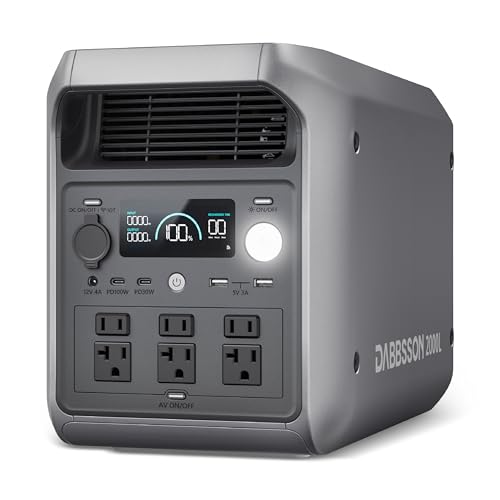
DABBSSON 2000L Portable Power Station, 2048Wh Semi-Solid LiFePO4, 2200W
  • 2048Wh semi-solid LiFePO4, 2200W
  • 3300W boost, under 15ms EPS
  • 41 lb, one hour full AC recharge
Check price on Amazon for DABBSSON 2000L Portable Power Station, 2048Wh Semi-Solid LiFePO4, 2200W (opens in a new tab)
Best for: Full-timers wanting a bay-friendly backup that refills in about an hour.

Our take

The cells are described as having higher stability than standard LFP and a lifespan of ten years or more, with app control over Wi-Fi.

Why it made the shortlist

The Dabbsson 2000L carries 2048Wh in semi-solid LiFePO4 cells, a 2200W continuous inverter and a 3300W boost mode, all in a 41 lb body that the maker calls compact for the class. That much stored energy runs an RV fridge, a laptop desk and lighting for most of a day away from a hookup. The result is a backup that earns its bay space.

Growatt Infinity 2000 Pro is the yardstick, and Dabbsson 2000L matches the 2048Wh capacity and adds an 800W MPPT solar input plus a one hour AC recharge to full, so the unit is ready again after a quick stop at a powered site. An EPS switch under 15ms protects a computer, a router or a NAS from a power loss. That pairing of speed and capacity is what anchors this list.

Dabbsson 2000L takes the top slot for a full-time RV household that wants capacity, fast charging and a solid bay weight in one box. A semi-solid cell design also adds a safety margin for a unit that rides along on rough roads.

What works

  • Large 2048Wh battery, 41 lb body
  • Under 15ms EPS switch protects computers
  • 800W solar input and one hour recharge
  • App control over Wi-Fi

Watch out for

  • Panel and cables are not part of the box
02
Jackery Solar Generator 1000 v2 with 100W Solar Panel, 1024Wh, 1500W
  • 1,024Wh LFP, 1,500W (3,000W peak)
  • 100W solar panel in the bundle
  • 50 minute app-enabled full charge
Check price on Amazon for Jackery Solar Generator 1000 v2 with 100W Solar Panel, 1024Wh, 1500W (opens in a new tab)
Best for: Weekend RVers wanting a panel, a quiet mode and app control.

Our take

On a trip, a 10ms UPS function protects a laptop or router during a hookup trip, and the LFP battery keeps over 70% capacity after 4,000 cycles.

Why it made the shortlist

The Explorer 1000 v2 kit pairs a 1,024Wh LiFePO4 battery and 1,500W inverter (3,000W peak) with a 100W solar panel, so an RV owner can start harvesting at the first sunny campsite. Two pure sine wave AC ports, two USB-C ports, a USB-A port and a DC car socket cover the usual devices. The kit works straight out of the box at the first sunny campsite.

Dabbsson 2000L is the yardstick, and Jackery 1000 v2 brings half the capacity and the panel in the bundle, which turns the first weekend into a complete test of solar. Emergency charging from the app takes the battery from empty to full in 50 minutes, and a 30 dB quiet charging mode runs overnight inside a camper. Because the app handles charging modes, a family can pick a quiet profile for the night.

Jackery 1000 v2 is built for a weekend RVer or a camper van who values a quiet, app-driven unit with solar included. It is a friendly first station for someone who has never run solar on the road.

What works

  • 100W panel included in the bundle
  • Quiet 30 dB overnight charging mode
  • 10ms UPS protects a laptop or router
  • Over 70% capacity after 4,000 cycles

Watch out for

  • 1,024Wh runs a fridge for about a day
  • Fast charge needs the app turned on
03
GROWATT INFINITY 2000 Pro Portable Power Station, 2048Wh, 2400W AC
  • 2048Wh LFP, 2400W AC
  • Cold Start works to minus 22 F
  • 15ms EPS switchover, 4,000+ cycles
Check price on Amazon for GROWATT INFINITY 2000 Pro Portable Power Station, 2048Wh, 2400W AC (opens in a new tab)
Best for: Shoulder-season RVers camping where mornings drop below freezing.

Our take

A built-in BMS guards against overcharge, over-discharge and short circuit, and the design suits all-weather use.

Why it made the shortlist

The Growatt Infinity 2000 Pro runs 2048Wh of EV-grade LFP cells through a 2400W inverter, and its Cold Start technology is designed to keep working in harsh winter conditions as low as minus 22 degrees F. That cold rating is the headline for an RV parked in a shoulder-season campground. The same unit handles shoulder-season trips without a second thought, and it rides in a bay all winter.

Dabbsson 2000L is the yardstick, and Growatt Infinity 2000 brings the same capacity with a higher 2400W ceiling and a 15ms EPS switchover that keeps computers and security gear alive. Cell ratings reach 4,000+ cycles and a ten year lifespan, backed by Growatt's own inverter engineering. The mix of output and protection suits a rig that is used across several seasons.

Growatt Infinity 2000 is built for a snowbird or a four-season camper who stores the unit in a basement bay and needs it to start on a freezing morning. Together, those features make it a dependable cold-morning companion for a rig that never really stops.

What works

  • Cold Start works down to minus 22 F
  • 2400W output covers a fridge and tools
  • 15ms EPS keeps gear running
  • EV-grade cells rated 4,000+ cycles

Watch out for

  • Confirm the listing is the main unit, not an expansion battery
  • Panel is not part of the box
04
BROWEY 1600W Portable Power Station, 1024Wh LiFePO4, Built-In 40W Solar Panel
  • 1024Wh LiFePO4, 1600W (3200W peak)
  • Built-in 40W fold-out solar panel
  • 80% in about 3 hours, 100W USB-C
Check price on Amazon for BROWEY 1600W Portable Power Station, 1024Wh LiFePO4, Built-In 40W Solar Panel (opens in a new tab)
Best for: Short trips needing a CPAP, laptop and fridge with a panel on board.

Our take

Its LiFePO4 cells are rated for 3,000+ cycles to 80% capacity with an advanced BMS covering overvoltage and overheating.

Why it made the shortlist

The Browey 1600W combines a 1024Wh LiFePO4 battery with a 1600W pure sine wave inverter (3200W peak) and a fold-out 40W solar panel built right into the housing. That means no separate panel to carry, and the unit runs refrigerators, CPAP machines and tools directly. Everything is in one piece, so there is nothing to forget at the campsite.

Where the Jackery 1000 v2 ships a 100W panel in a second box, the Browey keeps its slimmer 40W panel attached for a one-piece setup. A bidirectional 100W PD USB-C port charges laptops, and AC plus the PD port together bring the battery to 80% in about three hours. The cells and protection circuits suit a unit that cycles every weekend.

Browey 1600W is built for a short-trip RVer or a tailgater who wants one compact unit that runs a CPAP and a fridge without a separate panel box. That makes setup quick for a trip with a short stop and a long drive home.

What works

  • Built-in panel means nothing extra to carry
  • 1600W pure sine wave runs a CPAP
  • 100W PD USB-C works both directions
  • LiFePO4 rated 3,000+ cycles

Watch out for

  • 40W panel is a trickle against 1024Wh
  • AC recharge is slower than the leaders
05
BLAVOR 1600W Solar Generator, 1024Wh LiFePO4, Built-In 40W Panel
  • 1024Wh LiFePO4, 1600W (3200W peak)
  • Built-in 40W panel, 100W USB-C
  • 4,000+ cycle LiFePO4, four recharge paths
Check price on Amazon for BLAVOR 1600W Solar Generator, 1024Wh LiFePO4, Built-In 40W Panel (opens in a new tab)
Best for: Budget RVers wanting a simple unit with four ways to recharge.

Our take

The bidirectional 100W USB-C port doubles as a laptop charger and an input, and the unit packs easily for fishing trips and road trips.

Why it made the shortlist

The Blavor 1600W is a 1024Wh LiFePO4 station with 1600W continuous output (3200W peak), a built-in 40W solar panel and a 100W USB-C port. It runs refrigerators, coffee makers, CPAP machines and laptops, and it unfolds its panel when the sun is out. That keeps the pieces together for a quick weekend setup at a campground.

Browey 1600W makes the cleanest comparison, since Blavor 1600W offers four ways to recharge: a wall outlet, a car socket, the built-in panel or a compatible external panel. Cycle life is rated above 4,000, a stronger figure than the Browey's 3,000+, and a smart BMS guards them. The longer cycle rating suits a unit that is used on most trips for several years.

Blavor 1600W is built for a budget RVer who wants simple controls, a built-in panel and a long cycle life. It makes a sensible companion for a rig that has no solar of its own.

What works

  • Four ways to recharge, including car
  • 4,000+ cycle LiFePO4 cells
  • Built-in panel unfolds from the case
  • Bidirectional 100W USB-C

Watch out for

  • 40W panel gives only a slow trickle
  • 1024Wh limits fridge runtime to a day
06
DYNESS 1536Wh Portable Power Station, 1800W AC (3600W Surge), LiFePO4
  • 1536Wh LiFePO4, 1800W (3600W surge)
  • 50 minutes to 80% on AC
  • Up to 1200W solar input, app control
Check price on Amazon for DYNESS 1536Wh Portable Power Station, 1800W AC (3600W Surge), LiFePO4 (opens in a new tab)
Best for: Buyers comparing capacity, compatibility, included components and storage needs

Our take

A built-in UPS keeps Wi-Fi routers and PCs running during a blackout, and the smart app lets you monitor the battery and control outputs.

Why it made the shortlist

The Dyness 1536Wh is the entry pick, with 1536Wh of LiFePO4 capacity and an 1800W pure sine wave inverter that surges to 3600W. It brings half again the stored energy of the 1024Wh units while staying in the lowest price band of this shortlist. That capacity gives a fridge and a laptop desk a full day of cushion between recharges.

Blavor 1600W makes the cleanest comparison, since Dyness 1536Wh adds roughly 500Wh of capacity and drops the built-in panel, putting the spend into the battery. AC charging reaches 80% in 50 minutes, and up to 1200W of solar input reaches 80% in about 1.2 hours under strong sun. The app also lets you check remaining charge from the bed or the picnic table.

Dyness 1536Wh is built for a budget RVer who wants the most energy for the money and will add a panel later. A bay shelf and a few extension cords are all the setup it needs.

What works

  • Strong capacity for the entry band
  • 1800W output with 3600W surge
  • 80% in 50 minutes on AC
  • App monitoring and a built-in UPS

Watch out for

  • No panel is included in the box
  • UPS switchover time is not given

Methodology

How We Built This Shortlist

Each pick was assessed across 5 criteria weighted for real-world use.

01

RV Fit and Carry Weight

We started with body weight and size, because a basement bay and a camper step both limit what you will actually move. We noted stated weights where listed and flagged the heaviest units. We evaluated this from specifications, not from carrying them.

02

Loads an RV Actually Runs

We compared inverter ratings against the loads a camper depends on, including a compressor fridge, a CPAP, a laptop desk and lighting. Continuous watts and surge watts were read separately. We treated a rooftop air conditioner as outside the scope of these units.

03

Charging on the Road

We looked at every route that refills the battery: shore power, a 12V car socket while driving, a rooftop or portable panel, and USB-C input. A faster recharge means one battery covers a longer trip. We based this on stated recharge times and input limits.

04

Weather and Storage

An RV bay swings between freezing nights and hot afternoons. We noted cold-start claims, cell chemistry and cycle ratings, and which units protect the battery with a management system. A cell rated for thousands of cycles survives seasons of storage better.

05

Value Within the Shortlist

We positioned each pick by price band and asked what the step up buys, whether that is more watt-hours, a panel in the box, a faster recharge or cold-weather operation. A pick earned points when the added spend produced something an RV owner uses weekly. Figures are left out because pricing moves daily.

Decision guide

Match a Budget Portable Power Station for RV to Your RV

By Rig Type

A fifth wheel with a basement bay and a camper van with a tight cabinet need different units.

Rig typeBest pickWhy
Fifth wheel or class A with a bayDabbsson 2000L2048Wh in a 41 lb body
Travel trailer for weekendsJackery 1000 v2Panel included and quiet app control
Four-season camperGrowatt Infinity 2000Cold Start operates to minus 22 F
Class B or camper vanBlavor 1600WBuilt-in panel, four recharge paths
Pop-up or teardropBrowey 1600WOne-piece unit with a built-in panel

By Budget

Each step up the shortlist buys either watt-hours, a faster recharge or weather capability.

Budget bandBest pickWhat it buys
Entry of this shortlistDyness 1536Wh1536Wh and 1800W, no panel
Low-mid of this shortlistBlavor 1600W1024Wh with a built-in panel
Mid of this shortlistBrowey 1600W1024Wh with a built-in panel and pure sine
Upper-mid of this shortlistGrowatt Infinity 20002048Wh with cold start to minus 22 F
Top of this shortlistDabbsson 2000L2048Wh and a one hour recharge

Big Battery vs Built-In Panel

The two ideas in this shortlist are a large battery with no panel, or a mid-size battery with a panel attached.

Big battery (1500Wh and up)

The Dabbsson 2000L, Growatt Infinity 2000 and Dyness 1536Wh hold the most energy and run a fridge and more for a full day. They rely on shore power or a separate panel to refill.

Built-in or bundled panel

The Blavor 1600W and Browey 1600W carry a 40W panel on board, and the Jackery 1000 v2 adds a 100W panel in the bundle. They suit weekend use and give small solar top-ups.

Pick the Dabbsson 2000L for full-time use, or the Jackery 1000 v2 for weekends with solar.

By Charging Route

How you get energy back in matters as much as how much the battery holds.

Charging routeBest pickWhy
Quick shore power stopDabbsson 2000LOne hour to full on AC input
Large solar arrayDyness 1536WhUp to 1200W solar input
Mix of wall, car and panelBlavor 1600WFour ways to recharge
Quiet overnight chargingJackery 1000 v230 dB mode for an indoor camper
Wall plus USB-C togetherBrowey 1600W80% in about three hours using both

For Boondocking Weekends Specifically

Away from hookups, the unit has to carry a fridge, lights and a laptop until the sun comes back.

Look for

At least 1500Wh, a surge rating above the fridge's startup, a solar input of 500W or more and a body light enough to carry, as the Dabbsson 2000L offers.

In this comparison

The Dabbsson 2000L is the best off-grid all-rounder, the Dyness 1536Wh is the capacity-per-spend choice, and the Jackery 1000 v2 suits a short stay with a panel included.

When to Spend More

The most expensive picks buy capacity, cold-weather operation and speed, so spend where your trips demand them.

Spend more if

You camp in cold weather or stay off the grid for days, since the Growatt Infinity 2000 adds cold start and the Dabbsson 2000L adds a faster recharge.

Save if

You camp on weekends with hookups. The Dyness 1536Wh or Blavor 1600W gives plenty of backup for the fridge and a laptop.

FAQ

Before You Bring One Home

Can a portable power station run an RV air conditioner?

Not reliably in this class. A rooftop air conditioner needs a large startup burst, and most of these inverters do not have the surge headroom. A soft start device helps, and a much larger battery system is the proper answer.

Will it run an RV refrigerator for a full day?

A compressor fridge usually draws modest average power, so a 1536Wh to 2048Wh unit covers a day with room left over. Dividing capacity by the fridge's average watts, then trimming about 15% for inverter loss, gives a planning figure. In this setup, a 1024Wh unit gets through a day when you add little else.

Can I charge it while driving?

Most of these accept a 12V car socket input, which tops up slowly during a drive. Fast recharge is better done at a powered site on AC. Check the listing's car input rating before relying on it.

Is the Growatt Infinity 2000 Pro the main unit or an expansion battery?

Some listings under the Growatt name describe an expansion battery that connects to the main unit and cannot charge on its own. The title and specs describe the main 2048Wh station with a 2400W inverter, so confirm the box contents on the product page. Buying the right piece matters.

Is a built-in 40W panel useful?

It offsets standby draw and tops up a small amount each day, but it will not refill a 1024Wh battery. Treat it as a convenience for a short stay in the sun. For daily solar, pair the station with a larger separate panel or roof solar.

How should I store the unit in a basement bay?

Keep it at a partial charge in a bay that stays above freezing, and bring it inside during hard cold. Run it every few months so you know it works. Avoid storing it fully drained.

Bottom line

The short version

Browse more budget portable power stations for rv on Amazon →
Bowen Higgins, RV Editor at RV Gear Lab

About the author

Bowen Higgins

RV Editor at RV Gear Lab

Bowen covers RV power, water systems, towing and leveling, upkeep and interior comfort, with a focus on matching gear to the rig, the hookups and the way you actually travel.

More from Bowen →Editorial standards

Keep reading

Related guides