

We research everything we recommend. When you buy through our links, we may earn a commission. Learn more

Buying guide · 10 min read · Updated October 2, 2026

6 Best Camping Battery Banks in 2026: A Practical Camping Guide

Best camping battery banks compared on capacity, USB output, weather sealing and port count for campers who keep phones, lights and gear charged off grid.

Danny WalkerBy Danny WalkerCamping Editor at RV Gear Lab6 products comparedSpec-sheet researched
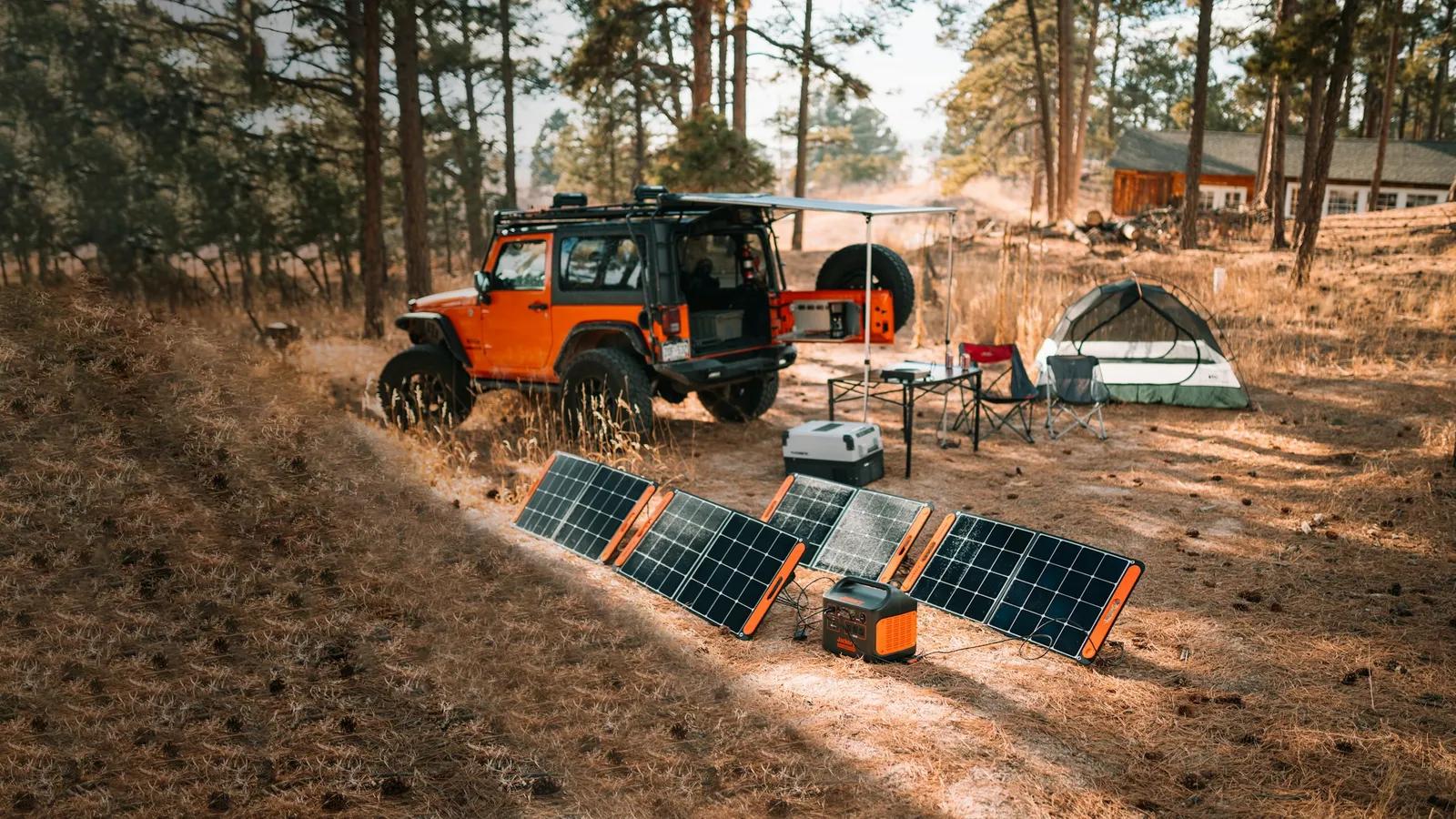
Jeep camp with a tent, solar panels and a portable power station at a pine forest campsite

At a glance

Our top picks

A camping battery bank is the quiet workhorse of a campsite: it keeps the phone, headlamp and tablet alive when there is no outlet for days. Capacity in milliamp hours gets the headlines, but output wattage, port mix and how rough a pack can be treated decide how useful it is in a tent.

Six banks are lined up here, from a rugged 15,000mAh IP67 pack to 80,000mAh bricks and a 5V pack built for heated camping gear. Each was compared on the capacity, output ports and protections its own listing names, so you can match a bank to the length of your trip.

RV Gear Lab field notes

The Campsite Fit Check

Start with the job
NESTOUT Rugged Power Bank leads this shortlist for Wet, rough trips. Use that fit as a reference point, then compare the alternatives against your own space and workload.
Specs that separate the picks
The first details to compare are 15,000mAh, 32W USB-C PD, 80,000mAh, five outputs, 60,000mAh, 22.5W PD. Confirm the exact model and included components before ordering.
Trade-off to plan for
Smallest capacity in this group

Before you buy

What Matters Before You Choose a Camping Battery Bank

Key buying criteria so you get the right fit the first time.

  1. 01

    Capacity in mAh and Wh

    A bank's mAh rating is measured at the cell voltage, not the 5V USB output, so real phone charges come in below the printed number. Multiply mAh by 3.7 and divide by 1,000 for watt hours, then plan a phone at around 12 to 15Wh per full charge. Most airlines also cap carry-on banks near 100Wh, which 27,000mAh packs sit under and 50,000mAh packs do not.

  2. 02

    Output wattage and ports

    USB-C Power Delivery at 20W to 30W refills a phone or tablet far faster than a 5V 2A port. Several ports share the total output, so a bank labelled 30W per port may split that when all are in use. Check the listing for the output per port and the PD or QC protocols it names.

  3. 03

    Weather sealing

    An IP rating on a bank is the only reliable signal that rain or dust will not reach the circuit. IP65 resists dust and water jets, while IP67 survives brief submersion. If the listing gives no rating, keep the bank in a dry bag.

  4. 04

    Heated gear compatibility

    Heated seat pads, blankets and gloves usually pull 5V at 2A or more continuously. A bank that auto-shuts when the load is low can cut off a heater, so a bank sold for heated gear is the safer fit. Match the heater's input voltage and plug type to the bank's listing.

  5. 05

    Recharge time and cold

    A large bank can need many hours from a wall adapter, and lithium cells charge slower and weaker in freezing temperatures. Keep the bank inside your sleeping bag overnight on cold trips. Look for the recharge input wattage in the listing so you know how long a refill takes.

Our standards

Why You Can Trust RV Gear Lab

At RV Gear Lab, we compare products based on campsite fit, verified specifications, usability, setup requirements, weight, durability, and real-world trade-offs. We do not rank products purely on marketing claims or commission rates.

We have not personally tested every product listed. Where hands-on testing is not available, recommendations are based on verified manufacturer specifications, product documentation, use-case fit, and comparative research.

How we review camping gear →

Detailed reviews

The 6 best camping battery banks, explained

01

Best Rugged Bank · 1 of 6

NESTOUT Rugged Power Bank

NESTOUT Rugged Power Bank
  • 15,000mAh, 32W USB-C PD
  • IP67 waterproof, dustproof
  • Shockproof silicone shell
Check price on Amazon for NESTOUT Rugged Power Bank (opens in a new tab)
Best for: Wet, rough trips

Our take

The pick for kayaks, rain and rough packs, where weather sealing matters more than raw capacity.

Why it made the shortlist

The NESTOUT is a 15,000mAh bank with a 32W USB-C Power Delivery port and an IP67 rating that its listing describes as waterproof and dustproof, with up to 30 minutes of submersion. The hard shell is wrapped in a silicone cushion to damp vibration.

Against the 50,000mAh to 80,000mAh packs it gives up total charge in exchange for a body that can ride in a pack pocket in rain.

It suits hikers and paddlers who charge a phone and earbuds every night and want a bank that shrugs off weather. Smart power delivery sends more energy to a power-hungry device automatically.

What works

  • IP67 sealing survives wet conditions
  • 32W USB-C fast charging
  • Smart power delivery adapts to devices
  • Shock-cushioned hard shell

Watch out for

  • Smallest capacity in this group
  • Costs the most here
The catch
At 15,000mAh it gives roughly a few phone charges, so long trips need a second bank.
02
Best for: Group trips, many devices

Our take

Huge capacity and the best port count for a family or group campsite.

Why it made the shortlist

The Liahomco is an 80,000mAh bank that its listing rates for 15 to 20 phone charges. It has five outputs and two inputs, two 30W USB ports, a 20W USB-C output and an LED display.

It holds more charge than any other bank here and has the strongest output, with 30W per USB port against the 22.5W of the ZZI and OHOVIV. Compared with the NESTOUT it trades sealing for sheer capacity.

It suits group campsites and week-long trips where several phones, a tablet and a camera share one bank. The non-slip base and side grips keep it steady on a table or in a tent.

What works

  • Biggest capacity in the group
  • Two 30W USB ports for fast charging
  • Five outputs for shared use
  • Digital display shows what is left

Watch out for

  • Heavy and large for backpacking
The catch
Recharging a bank this size takes a long time, so plan to refill it from a wall before leaving.
03

Best Compact Big Bank · 3 of 6

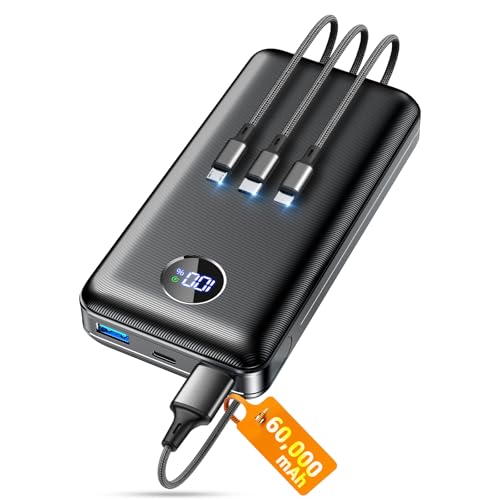
ZZI Portable Charger Power Bank 60000mAh

Best for: Weekend car camping

Our take

A slim 60,000mAh bank with its own cable, good for weekend trips for one or two people.

Why it made the shortlist

The ZZI packs 60,000mAh into a body measuring 5.8 by 2.9 by 1.1 inches, with 22.5W PD output and a 3-in-1 braided cable for USB-C, iOS and Micro USB. Its listing names five-layer protection against overcharge, overcurrent, overdischarge, overvoltage and short circuit.

The LED display shows remaining charge at a glance.

It suits car campers and weekend backpackers who want a large reserve without a brick-sized bank. The listing says a phone reaches 60% in about 30 minutes.

What works

  • Slim body for its capacity
  • Built-in 3-in-1 cable
  • Five-layer safety protection
  • 22.5W fast charging

Watch out for

  • Charges five devices but slowly together
The catch
A body this slim is still dense, so check the weight if you plan to carry it far.
04

Best Built-In Cables · 4 of 6

BLASOUL Solar Power Bank

BLASOUL Solar Power Bank
  • 49,800mAh, 22.5W PD
  • 15W wireless charging
  • IP65 with built-in cables
Check price on Amazon for BLASOUL Solar Power Bank (opens in a new tab)
Best for: Cable-free phone charging

Our take

The simplest all-in-one bank, with cables, wireless pad and weather sealing.

Why it made the shortlist

The BLASOUL is a 49,800mAh bank with 22.5W PD and QC 3.0 output, 15W wireless charging and four built-in cables (three output, one USB-A input). An IP65 rating covers water, shock and dust, and the solar panel on top trickle-feeds the cells.

Compared with the OHOVIV it adds wireless charging and a sealed body for a similar capacity.

It suits day hikers and festival campers who want one pocketable device that handles every phone type. A small solar top-up helps in an emergency, while a wall recharge is the real refill.

What works

  • Four built-in cables, none to lose
  • 15W wireless pad on the body
  • Solar panel for a trickle top-up

Watch out for

  • Solar input is slow for 49,800mAh
  • Built-in cables can wear out
The catch
Solar trickle charging will not refill a bank this large, so treat it as an emergency boost.
05

Best Budget Capacity · 5 of 6

OHOVIV Portable Charger Power Bank 50000mAh

Best for: Budget big-capacity

Our take

The cheapest way into a 50,000mAh reserve for multi-day trips.

Why it made the shortlist

The OHOVIV is a 50,000mAh bank with a 22.5W PD output and QC support, two USB-A ports and one USB-C port that takes 18W in and gives 22W out. A digital display tracks remaining charge, and the Li-polymer cells carry multiple protections.

It is the lowest priced bank in the group and still reaches 50,000mAh, more than the BLASOUL and NESTOUT combined at 15,000mAh.

It suits budget-minded campers who want plenty of reserve and are happy to carry their own cords. Three outputs run phone, tablet and headlamp together.

What works

  • 50,000mAh reserve for several days
  • USB-C takes 18W input
  • LED display shows remaining charge

Watch out for

  • No built-in cables
The catch
Cables, a weather case and any wireless charging are all up to you.
06
Best for: Heated chairs and pads

Our take

A purpose-built power source for heated seats and blankets in cold camps.

Why it made the shortlist

The UMEIDEA is a 20,000mAh 5V 2A battery pack sold for electric heated camping chairs, heated blankets, hunting seat pads and sleeping bags.

The larger banks give more charge, while this one targets the fixed 5V 2A output those items expect.

It suits cold-weather campers and hunters who run a heated seat pad for hours.

What works

  • Matches 5V 2A heated gear
  • 20,000mAh runs seat pads longer
  • Simple plug-and-go output

Watch out for

  • Listing gives few port details
  • No fast charging protocol named
The catch
The listing is short on port detail, so match it to your heated item's input first.

Methodology

How We Built This Shortlist

Each pick was assessed across 5 criteria weighted for real-world use.

01

Capacity per trip

Each bank was weighed on its stated mAh against the nights between wall outlets.

02

Output power

We compared the wattage and port types each listing names for phones, tablets and cold-weather gear.

03

Weather and carry

Weather ratings, body shape and cable handling were read from the listing for camp use.

04

Protection

Listed safety protections and the cell type were checked against what a tent-bound bank needs.

05

Price for capacity

Capacity per dollar was compared across the six banks to find where the extra money stops buying anything useful.

Decision guide

Match a Camping Battery Bank to Your Camp Setup

By Trip Length

Your situationRecommended pickWhy
Day hike or kayak, rain likelyNESTOUT Rugged 15000IP67 sealing and a shock-cushioned shell keep it working when the pack gets wet.
Weekend for one or two peopleZZI 60000mAhSlim body with a built-in cable and plenty of reserve for a few nights.
Week-long trip or group campsiteLiahomco 80000mAhFive outputs and the biggest capacity cover several phones and a tablet.
Heated seat pad on a cold huntUMEIDEA 20000mAh 5VThe 5V 2A output is made for heated gear.

By Budget

BudgetRecommended pick
$20 to $30OHOVIV 50000mAh or ZZI 60000mAh
$30 to $40UMEIDEA 20000mAh 5V or BLASOUL Solar 49800
$50 to $70Liahomco 80000mAh or NESTOUT Rugged 15000

Built-In Cables vs Bring Your Own

Built-in cables

The BLASOUL Solar 49800 carries four fused cables and the ZZI 60000mAh a 3-in-1 braided cable, so you cannot forget a cord at the trailhead. A cable that frays cannot be swapped on the BLASOUL, so it is a trade for convenience.

Bring your own

The Liahomco 80000mAh, NESTOUT Rugged 15000, OHOVIV 50000mAh and UMEIDEA 20000mAh 5V rely on your cables, which can be replaced or upgraded with a better PD cable.

Most campers should lean toward the ZZI 60000mAh for its built-in cable and spare ports.

By Budget

PickRecommended pick
Lowest spend for big capacityOHOVIV 50000mAh
Mid-range with built-insBLASOUL Solar 49800
Largest reserve for the moneyLiahomco 80000mAh
Pay more for weather sealingNESTOUT Rugged 15000

For Backpacking Specifically

Look for

Weight, a weather rating and a compact body, since every ounce rides on your back.

In this comparison

The NESTOUT Rugged 15000 is the only IP67 pick and the smallest, which suits a trail pack, while the ZZI 60000mAh is the slim big-capacity step up for longer hikes.

When to Spend More

Spend more if

Spend more on the NESTOUT Rugged 15000 if you paddle, hike in rain or drop gear often, because its IP67 shell is the one that survives the weather. Go up to the Liahomco 80000mAh if you charge for a whole group.

Save if

Save with the OHOVIV 50000mAh, which still gives a 50,000mAh reserve at the lowest price here. The BLASOUL Solar 49800 also trims cables from your kit for a modest bump.

FAQ

Before You Bring One Home

How many charges does a 50,000mAh bank give?

A rough guide is to divide the bank's Wh by a phone's battery, around 12 to 15Wh. A 50,000mAh bank holds about 185Wh at cell level, but conversion loss means real use is lower. Listings quote their own phone-charge counts, so treat those as best case.

Can I take a camping battery bank on a plane?

Airlines generally allow lithium banks in carry-on only and cap them near 100Wh without special approval. That is about 27,000mAh. The large banks in this guide sit above that limit, so check your airline's policy before flying with one.

Is the BLASOUL solar panel enough to recharge it?

Treat the solar panel as a trickle source only. A 49,800mAh bank needs many hours of strong sun to move a meaningful amount of charge. Use a wall adapter before the trip and keep solar for an emergency boost.

How do I charge a bank on a cold trip?

Lithium cells charge slower and can protect themselves by refusing to charge below freezing. Keep the bank in a coat pocket or sleeping bag so it stays warm. Recharge it indoors or in a vehicle rather than leaving it on a cold ground.

Do I need a special bank for a heated chair?

Heated chairs and blankets usually need a steady 5V 2A or more draw. Some banks shut off when the current drops, so a bank sold for heated gear like the UMEIDEA is a safer choice. Always match the heater's input to the bank before relying on it.

Bottom line

The short version

Browse more camping battery banks on Amazon →
Danny Walker, Camping Editor at RV Gear Lab

About the author

Danny Walker

Camping Editor at RV Gear Lab

Danny covers camping gear, campsite setup, outdoor power, sleep systems and practical camping advice, with a focus on helping campers make better gear decisions.

More from Danny →Editorial standards

Keep reading

Related guides