


We research everything we recommend. When you buy through our links, we may earn a commission. Learn more

Buying guide · 10 min read · Updated October 2, 2026

5 Best Group 27 Deep Cycle Batteries in 2026: A Practical Camping Guide

Best Group 27 deep cycle batteries for campers, covering flooded, AGM and lithium options by size, chemistry, charging and box fit.

Danny WalkerBy Danny WalkerCamping Editor at RV Gear Lab5 products comparedSpec-sheet researched
Dome tent and hammock at a forest campsite at golden hour

At a glance

Our top picks

Group 27 is a BCI case size, roughly 12 by 6.5 by 8 inches, and it is one of the most common footprints for camper house banks and battery boxes. The same size now comes as flooded lead acid, sealed AGM and drop-in lithium, and the chemistry decides how you charge, vent and wire it.

This list keeps five Group 27 batteries that clearly name the size in the listing. They were compared on listed capacity, terminal type, chemistry, included protection and what kind of camp system each one suits.

RV Gear Lab field notes

The Campsite Fit Check

Start with the job
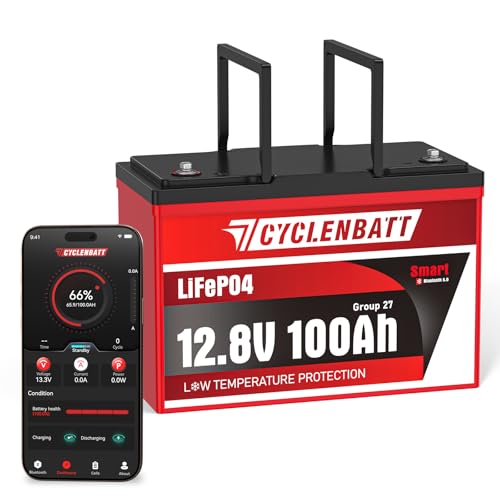
CYCLENBATT 12V 100Ah LiFePO4 Battery Group27 Size with Low-Temp Protection leads this shortlist for Lithium swap into a Group 27 box. Use that fit as a reference point, then compare the alternatives against your own space and workload.
Specs that separate the picks
The first details to compare are 12V 100Ah LiFePO4, Bluetooth 5.0 monitoring, 115Ah per battery. Confirm the exact model and included components before ordering.
Trade-off to plan for
No app for checking charge level

Before you buy

What Matters Before You Choose a Group 27 Deep Cycle Battery

Key buying criteria so you get the right fit the first time.

  1. 01

    Group 27 versus Group 27M

    Group 27 is a size standard, and the M suffix usually means a marine version with different terminals. The footprint is close, but check length and height against your battery box and mounting tray. Compare the dimensions listed for the exact battery rather than relying on the group number alone.

  2. 02

    Flooded, AGM or lithium

    Flooded batteries are cheapest per amp hour but need watering and ventilation. AGM is sealed and spill-resistant, while lithium is much lighter and holds more usable capacity. Match the chemistry to your charger, because a lead acid charger can undercharge lithium and a lithium charger may not suit flooded cells.

  3. 03

    Usable capacity

    Lead acid is usually discharged only about 50% to protect its life, so a 100Ah battery gives roughly 50Ah in practice. Lithium listings often claim 100% depth of discharge, which makes a 100Ah lithium pack act like a much bigger lead acid one. Check the depth of discharge stated for cycle claims.

  4. 04

    Battery protection and fusing

    Lithium packs rely on a built-in battery management system for overcharge, over-discharge and short circuit protection, and the continuous discharge current is capped by that system. Wire a fuse or breaker close to the positive terminal of any battery. Size the fuse to the cable gauge, not to the battery.

  5. 05

    Ventilation and safe placement

    Flooded batteries release hydrogen while charging and should sit in a ventilated box, never inside a closed tent or sleeping area. Sealed AGM and lithium vent far less but still need space to avoid heat. Keep any battery secured so it cannot tip or short across a metal object.

Our standards

Why You Can Trust RV Gear Lab

At RV Gear Lab, we compare products based on campsite fit, verified specifications, usability, setup requirements, weight, durability, and real-world trade-offs. We do not rank products purely on marketing claims or commission rates.

We have not personally tested every product listed. Where hands-on testing is not available, recommendations are based on verified manufacturer specifications, product documentation, use-case fit, and comparative research.

How we review camping gear →

Detailed reviews

The 5 best group 27 deep cycle batteries, explained

01
Best for: Lithium swap into a Group 27 box

Our take

A plain drop-in lithium 100Ah that fits the Group 27 slot and protects itself in the cold.

Why it made the shortlist

The CYCLENBATT low-temp version is a 12V 100Ah LiFePO4 battery listed at 12.09 by 6.65 by 8.19 inches so it slides into a Group 27 box. Its smart BMS stops charging when the cells fall below 32F, and the listing describes it as 66% lighter than lead acid.

Next to the Bluetooth CYCLENBATT it keeps the same capacity and size for the same listed price, trading the app for a simpler plug-and-play install. Against the Banshee AGM it gives a full 100Ah of lithium capacity instead of 90Ah of lead acid.

It suits car campers and van builders replacing a lead acid Group 27 with a lighter, maintenance-free battery. It is a good fit for shoulder-season trips where charging may happen near freezing.

What works

  • Fits a standard Group 27 battery box
  • BMS blocks charging below 32F
  • Much lighter than lead acid
  • No watering or venting routine

Watch out for

  • No app for checking charge level
  • Needs a lithium-compatible charger
The catch
Lithium needs a charger or solar controller set to a LiFePO4 profile, not a lead acid one.
02

Best Smart Monitoring · 2 of 5

CYCLENBATT 12V 100Ah Bluetooth LiFePO4 Battery

CYCLENBATT 12V 100Ah Bluetooth LiFePO4 Battery
  • Bluetooth 5.0 monitoring
  • 21.49 lb, Group 27 size
  • Up to 20.48kWh bank
Check price on Amazon for CYCLENBATT 12V 100Ah Bluetooth LiFePO4 Battery (opens in a new tab)
Best for: Phone-monitored solar setups

Our take

Same Group 27 lithium, with an app so you can see charge level without a separate meter.

Why it made the shortlist

This CYCLENBATT variant adds Bluetooth 5.0 to the same 12V 100Ah LiFePO4 pack, with an app showing live battery data. It meets the BCI Group 27 size, weighs 21.49 lb, and its listing claims more than 5000 cycles.

Compared with the low-temp model above it, the app is the main addition, and it can be expanded to a 4S4P bank of up to 20.48kWh. Against the lead acid picks below, the weight saving is the headline difference on a long carry from the car.

It fits campers who want to watch state of charge on their phone while off grid. A solar camper checking the bank from inside the tent will use the app daily.

What works

  • App shows charge and battery data
  • Light enough to carry one handed
  • Expandable to larger banks
  • Low-temp shutdown below 32F

Watch out for

  • App adds a phone dependency
  • Listing leans toward trolling motor use
The catch
Bluetooth range is short, so it will not replace a hardwired meter for a fixed install.
03

Best Flooded Value Pair · 3 of 5

Crown Battery 27HDC 12V Deep Cycle Battery

Best for: Fixed battery bank on a budget

Our take

The strongest capacity-for-cost option here if you can handle a heavy flooded pair.

Why it made the shortlist

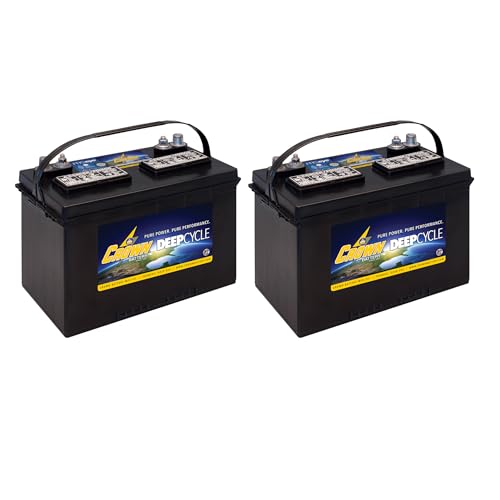
Crown sells the 27HDC as a two-battery set, each 12V and 115Ah with 875 MCA in a standard Group 27 case. The flooded design uses stud terminals and is aimed at repeated deep discharge in marine, RV and backup power work.

Compared with the US Battery set it offers more listed capacity per battery, and the pair price is lower.

Two batteries wired in parallel give a 230Ah house bank.

What works

  • Higher capacity than the other flooded pick
  • Two batteries ready for a parallel bank
  • Standard Group 27 fitment
  • Built for repeated deep cycles

Watch out for

  • Flooded cells need ventilation and watering
  • Heavy compared with lithium
The catch
Flooded batteries vent hydrogen, so keep them in a ventilated box away from sparks and tents.
04
Best for: Long-service flooded banks

Our take

A serious flooded battery with clear runtime numbers for people sizing a bank carefully.

Why it made the shortlist

The US 27DC XC2 is a flooded Group 27 deep cycle rated 105Ah at the 20 hour rate, with SAE and bolt terminals and a heat-sealed polypropylene case. Its listing gives runtime ratings of 54 minutes at 75 amps and 205 minutes at 25 amps.

Compared with Crown it lists a little less capacity, while the published runtime figures give clearer expectations at set loads. Against the Banshee AGM, it is a serviceable flooded design that can be recharged to full rated capacity.

It suits campers building a long-lived bank who want a commercial-service battery with dual terminal options. This listing is a two pack, and the same product also appears as a six pack.

What works

  • Heat-sealed commercial grade case
  • Dual terminal options
  • Sold as a pair for a bank

Watch out for

  • Highest cost per battery in this list
  • Needs regular water checks
The catch
Priciest option here and the weight is the same as any flooded Group 27.
05
Banshee Group 27M AGM Marine Deep Cycle Battery
  • AGM sealed lead acid
  • 185 minute reserve capacity
  • Carry handle, SAE terminals
Check price on Amazon for Banshee Group 27M AGM Marine Deep Cycle Battery (opens in a new tab)
Best for: Single-battery weekend setups

Our take

A cheap sealed Group 27M for weekend power with no watering or maintenance.

Why it made the shortlist

The Banshee is a Group 27M sealed AGM battery listed at 12V, 185 minute reserve capacity and dual SAE terminals. It measures 13.5 by 6.69 by 8.42 inches and has a built-in carrying handle.

It also sits well below the lithium picks in price, with less usable capacity.

It suits a weekend car camper powering an inverter, lights and a small cooler who wants a single sealed battery. The handle helps with moving it between the car and the site.

What works

  • Sealed AGM needs no watering
  • Built-in carrying handle
  • Dual-purpose starting and deep cycling use

Watch out for

  • Rated capacity is below the 100Ah picks
  • Listing is aimed at marine use
The catch
It is the 27M variant, so check your box dimensions before ordering.

Methodology

How We Built This Shortlist

Each pick was assessed across 4 criteria weighted for real-world use.

01

Group 27 size

Each listing was checked for a named BCI Group 27 or 27M case size, then compared on stated dimensions.

02

Chemistry

Flooded, AGM and lithium picks were compared on charging, venting and maintenance needs.

03

Capacity and runtime

Listed amp hours, reserve capacity and runtime ratings were compared at stated discharge rates.

04

Protection and terminals

Battery management systems, low-temperature handling and terminal type were compared across the listings.

Decision guide

Match a Group 27 Deep Cycle Battery to Your Camp Setup

By Camp Setup

Your situationRecommended pickWhy
Lithium swap in a Group 27 boxCYCLENBATT Group 27 Low-TempSimple drop-in with cold-charge protection
Phone-checked solar bankCYCLENBATT Group 27 BluetoothApp shows live battery data
Cheapest sealed batteryBanshee Group 27M AGMSealed AGM with a carry handle
Fixed bank with maximum capacityCrown 27HDC 2-Pack115Ah per battery in a pair
Careful runtime planningUS Battery 27DC XC2Runtime ratings at three load levels

By Budget

BudgetRecommended pick
$190 to $210Banshee Group 27M AGM or CYCLENBATT Group 27 Low-Temp
$200 to $790CYCLENBATT Group 27 Bluetooth or Crown 27HDC 2-Pack
$830 to $840US Battery 27DC XC2

Lead Acid vs Lithium

Lead acid

Crown 27HDC 2-Pack, US Battery 27DC XC2 and Banshee Group 27M AGM are heavier and cost less per amp hour. They want an AC-powered or solar lead acid charge profile and half-depth discharge for long life.

Lithium

CYCLENBATT Group 27 Low-Temp and CYCLENBATT Group 27 Bluetooth weigh about a third as much and offer full 100Ah use. They cost more up front and need a lithium-rated charger.

Most weekend campers should default to the CYCLENBATT Group 27 Low-Temp unless the weight and price of lead acid is an advantage, as with a fixed bank in a cabin.

By Maintenance Tolerance

PreferenceRecommended pick
No watering everBanshee Group 27M AGM
Happy to top up waterCrown 27HDC 2-Pack
Prefer an app to check chargeCYCLENBATT Group 27 Bluetooth
Want zero upkeep and low weightCYCLENBATT Group 27 Low-Temp

For Camp Power Banks Specifically

Look for

A 12V Group 27 with a stated capacity, a named chemistry and a charge profile that matches your charger or solar controller.

In this comparison

CYCLENBATT Group 27 Low-Temp and CYCLENBATT Group 27 Bluetooth both name 12V 100Ah lithium in the Group 27 size, so they suit a solar charge controller set to a lithium profile.

When to Spend More

Spend more if

Spend more if you want light weight and full usable capacity, as in the CYCLENBATT Group 27 Bluetooth, or a commercial-grade flooded pair such as the US Battery 27DC XC2 for long service life.

Save if

Save if you only need weekend power and a sealed battery: the Banshee Group 27M AGM costs the least here, and the Crown 27HDC 2-Pack gives the most capacity per dollar.

FAQ

Before You Bring One Home

What size is a Group 27 battery?

Group 27 is a BCI case size around 12 to 13 inches long, 6.5 to 7 inches wide and 8 to 9 inches tall, though dimensions vary a little by maker. Compare the listed dimensions to your box before ordering. The 27M marine type may have a different terminal arrangement.

Can I put a lithium battery where a lead acid one was?

Many lithium packs are made to the Group 27 footprint so they drop into the same box. Your charger, solar controller or alternator charging must support a lithium profile. A lead acid-only charger can leave a lithium pack undercharged or ignore the battery protection.

Is a lithium Group 27 worth the extra cost?

If you carry the battery often or want the full 100Ah, lithium is usually worth it, since lead acid is normally used only to about half capacity. If the battery stays in a fixed bank and weight does not matter, a flooded pair is cheaper per amp hour.

How do I wire two Group 27 batteries together?

Parallel wiring joins positive to positive and negative to negative with matching cables, which keeps 12V and doubles capacity. Use equal-length cables, a fuse close to the battery, and batteries of the same type and age. Never mix lead acid and lithium in the same bank.

How should I store a Group 27 battery between trips?

Charge it fully and store it in a cool, dry place away from tents and sleeping areas. Flooded batteries should be checked for water level and kept ventilated. Lithium packs should stay out of freezing temperatures when possible, and any battery should be disconnected from loads while stored.

Bottom line

The short version

Browse more group 27 deep cycle batteries on Amazon →
Danny Walker, Camping Editor at RV Gear Lab

About the author

Danny Walker

Camping Editor at RV Gear Lab

Danny covers camping gear, campsite setup, outdoor power, sleep systems and practical camping advice, with a focus on helping campers make better gear decisions.

More from Danny →Editorial standards

Keep reading

Related guides