


We research everything we recommend. When you buy through our links, we may earn a commission. Learn more

Buying guide · 10 min read · Updated October 2, 2026

5 Best Portable Generators Under 1000 in 2026: A Practical Camping Guide

Best portable generators under $1000: five 3300 to 5500W gas and dual-fuel generators compared on running watts, CO safety, noise and carrying weight.

Danny WalkerBy Danny WalkerCamping Editor at RV Gear Lab5 products comparedSpec-sheet researched
Two folding camping chairs beside a tent in a redwood forest

At a glance

Our top picks

A thousand dollars is the ceiling for a household-class portable generator. The five picks here run from about $550 to $999, and every one of them can power a fridge, a furnace blower and lights during an outage.

What separates them is output, fuel flexibility, noise and weight. The $450 spread buys either more watts, a quieter enclosed case or dual-fuel convenience, and the notes show which one earns its price.

RV Gear Lab field notes

The Campsite Fit Check

Start with the job
DuroMax XP5500HX 5 leads this shortlist for Home backup and big RVs. Use that fit as a reference point, then compare the alternatives against your own space and workload.
Specs that separate the picks
The first details to compare are 5500 watts, gas or propane, 6000 peak, 5250 rated watts, 2500 running, 3300 starting watts. Confirm the exact model and included components before ordering.
Trade-off to plan for
Open frame is louder

Before you buy

What Matters Before You Choose a Portable Generator Under 1000

Key buying criteria so you get the right fit the first time.

  1. 01

    Running watts for a home

    A fridge needs about 700W to start and 150W to run, a furnace blower 800W and a sump pump 1000W. A 3500W running unit covers essentials while a 5000W unit covers more. Total the loads and add 20 percent, so a 5000W running unit leaves room for a second fridge or a well pump.

  2. 02

    CO sensors

    A CO shutdown sensor turns the generator off at dangerous CO levels, which helps if it is placed badly. It does not replace the rule to keep it 20 feet away from windows and doors. Look for a CO sensor or alert in the specs, and use a battery CO alarm inside.

  3. 03

    Open frame vs inverter

    An open-frame unit like the DuroMax is cheaper per watt but louder, about 70 dB or more, while an enclosed inverter like the Westinghouse runs at 52 dBA. Inverters also produce cleaner power for electronics. Choose by how close the unit will be to neighbors.

  4. 04

    Fuel choice

    Gasoline gives the most power but goes stale in 3 to 6 months. Propane stores for years and burns cleaner but gives about 10 percent less power. Dual fuel gives you both. Check the running watts on each fuel, so write down the propane running watts on the data plate before buying.

  5. 05

    Weight and wheels

    A 90 to 110 lb generator needs wheels, a handle and often two people. Wheels matter on gravel and grass. Check the weight and the kit, and a unit near 100 lb needs wheels, a ramp for a truck bed and a second person to load it, so check the dry weight in the specs and plan how it will get from the truck to the pad on gravel or grass before you buy.

  6. 06

    Transfer switch and cords

    Powering a house needs a transfer switch or an interlock installed by an electrician, never a backfeed cord. A 30A or 120/240V outlet matches the inlet. Check the outlet type before buying cords, and a 30A or 120/240V outlet only matters if the cord and inlet match the generator, so check the plug type on your inlet box before buying cords.

Our standards

Why You Can Trust RV Gear Lab

At RV Gear Lab, we compare products based on campsite fit, verified specifications, usability, setup requirements, weight, durability, and real-world trade-offs. We do not rank products purely on marketing claims or commission rates.

We have not personally tested every product listed. Where hands-on testing is not available, recommendations are based on verified manufacturer specifications, product documentation, use-case fit, and comparative research.

How we review camping gear →

Detailed reviews

The 5 best portable generators under 1000, explained

01

Best Value Under $1000 · 1 of 5

DuroMax XP5500HX 5

DuroMax XP5500HX 5
  • 5500 watts, gas or propane
  • 120/240V 30A, two GFCI
  • CO alert, MX2 switch
Check price on Amazon for DuroMax XP5500HX 5 (opens in a new tab)
Best for: Home backup and big RVs

Our take

The most power and fuel choice for the price.

Why it made the shortlist

DuroMax XP5500HX produces 5500 watts from a 210cc engine that runs on gasoline or propane. It has two 120V GFCI outlets, a 120/240V 30A twist-lock outlet, an MX2 switch that doubles the 120V power, a digital control center and a CO alert.

It costs about $599, $400 less than the Westinghouse iGen5000DFc, and offers more peak output.

Choose it for home backup and a big RV on a budget. All copper windings are built to last for years.

What works

  • Dual fuel at about $599
  • Copper windings for long life
  • 120/240V 30A twist-lock outlet
  • CO alert for safety

Watch out for

  • Open frame is louder
  • Heavier than inverter units
The catch
Needs outdoor space and distance.
02

Best Wheeled Big Output · 2 of 5

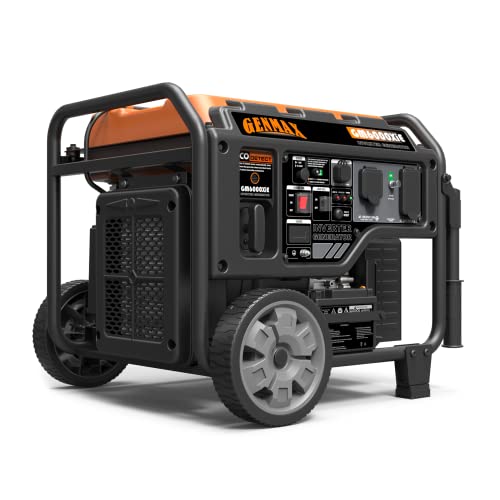
GENMAX Portable Inverter Generator

GENMAX Portable Inverter Generator
  • 6000 peak, 5250 rated watts
  • 106.9 lb with two wheels
  • CO detect shutdown
Check price on Amazon for GENMAX Portable Inverter Generator (opens in a new tab)
Best for: Heavy loads that need wheels

Our take

The most rated watts for the lowest price here.

Why it made the shortlist

GENMAX pairs a 312cc engine with inverter technology for 6000 peak watts and 5250 rated. It has a steel handle and two wheels, weighs 106.9 lb, has an hour meter, LED alerts for low oil and overload and a CO detect shutdown.

It costs about $550 and has more rated power than the DuroMax.

Choose it for a big RV or a cabin where moving the unit on wheels matters. It carries a 1-year warranty and lifetime support.

What works

  • 5250 rated watts at about $550
  • Wheels and handle for moving
  • CO detect shutdown
  • Hour meter and LED alerts

Watch out for

  • Gasoline only
  • 1-year warranty is short
The catch
Plan on two people for loading.
03

Best Clean Power Mid-Size · 3 of 5

Generac 3

Generac 3
  • 2500 running, 3300 starting watts
  • COsense CO monitoring
  • 7 hours at 25% load
Check price on Amazon for Generac 3 (opens in a new tab)
Best for: Household essentials with CO monitoring

Our take

A smaller, smarter unit from a big name.

Why it made the shortlist

Generac delivers 2500 running and 3300 starting watts with TruePower sine wave under 3 percent THD. PowerRush gives 50 percent more starting capacity, COsense shuts it down at dangerous CO levels, and a 1.06 gallon tank gives up to 7 hours at 25 percent load.

It is the pick with a recognized brand and automatic CO monitoring.

Choose it for a fridge, lights and laptops at home or a campsite.

What works

  • COsense monitors CO and shuts down
  • PowerRush 50% more starting capacity
  • Clean sine wave under 3% THD
  • USB charging

Watch out for

  • Less running power than larger picks
  • Small 1.06 gallon tank
The catch
Not enough for a big RV air conditioner.
04
EFURDEN 7000W Gas Inverter Generator
  • 7000 peak, 5500 running watts
  • 3.5 gallon tank, 11 hours
  • Under 2% THD, 89 lb
Check price on Amazon for EFURDEN 7000W Gas Inverter Generator (opens in a new tab)
Best for: Long outages and big loads

Our take

The most runtime and running watts in the guide.

Why it made the shortlist

EFURDEN offers 7000 peak and 5500 running watts from a 223cc engine with under 2 percent THD. With a 3.5 gallon tank and ECO mode it can run 11 hours on a quarter load, and it measures 23.81 by 16.92 by 22.04 inches at 89 lb.

It is the biggest output in the guide at about $700, with 250W more running power than the GENMAX. It operates at 69 dB from 23 feet.

Choose it for a long outage or a big RV that needs a day of runtime on one tank. It suits owners who want to refuel less.

What works

  • 5500 running watts
  • Up to 11 hours at 25% load
  • Under 2% THD
  • Compact at 89 lb

Watch out for

  • Gasoline only
  • 69 dB is loud
The catch
Keep spare fuel in an approved can.
05
Best for: Quiet RV and neighborhood use

Our take

The quietest big unit at the top of the budget.

Why it made the shortlist

Westinghouse iGen5000DFc gives 5000 peak and 3900 running watts on gasoline from a 224cc 4-stroke engine with a CO sensor. It runs as low as 52 dBA, has a TT-30R RV outlet, a 5-20R outlet, two USB ports, a remote electric start and uses less than 3 percent THD power.

It costs $999, $400 more than the DuroMax, and buys quiet running, a remote start and an enclosed case. It can run in parallel with a second unit, and the parallel kit is sold separately.

Choose it for an RV or a neighborhood where noise matters. It suits owners who want the quietest unit at the top of the budget.

What works

  • As low as 52 dBA
  • Remote electric start
  • CO sensor
  • Parallel ready

Watch out for

  • Costs $400 more than the DuroMax
  • Lower running watts than larger units
The catch
The price is for quiet, not for power.

Methodology

How We Built This Shortlist

Each pick was assessed across 5 criteria weighted for real-world use.

01

Running watts

Rated watts from 2500W to 5500W were compared against household and RV loads.

02

Noise

Stated decibel levels from 52 to 69 dB were compared.

03

Safety

CO sensors and shutdowns were noted.

04

Fuel

Gas, dual fuel and tank size were compared.

05

Price against the cap

Every pick is under $1000, and the top pick offers the most power and flexibility for the price.

Decision guide

Match a Portable Generator Under 1000 to Your Camp Setup

By use

Your situationRecommended pickWhy
Best value for home backupDuroMax XP5500HX5500 watts, dual fuel.
Heavy loads on wheelsGENMAX 6000W5250 rated, 2 wheels.
Smaller unit with CO monitoringGenerac 3300COsense shutdown.
Long outagesEFURDEN 7000W11 hours at 25%.
Quiet RVWestinghouse iGen5000DFc52 dBA.

By Budget

BudgetRecommended pick
$540 to $600GENMAX 6000W or DuroMax XP5500HX
$630 to $700Generac 3300 or EFURDEN 7000W
$990 to $1000Westinghouse iGen5000DFc

Open frame vs enclosed inverter

Open frame

The DuroMax XP5500HX, GENMAX 6000W and EFURDEN 7000W give the most watts per dollar but are louder and heavier.

Enclosed inverter

The Generac 3300 and Westinghouse iGen5000DFc run quieter and cleaner at a higher price per watt.

Most buyers should take the DuroMax XP5500HX, and noise-sensitive buyers the Westinghouse iGen5000DFc.

By budget

Budget bandRecommended pick
About $550GENMAX 6000W
About $599DuroMax XP5500HX
About $637Generac 3300
About $700EFURDEN 7000W
About $999Westinghouse iGen5000DFc

For home outage backup specifically

Look for

Look for 3500W or more running, a 30A outlet, a CO sensor and propane if you store fuel.

In this comparison

The DuroMax XP5500HX gives 5500 watts with dual fuel, and the Generac 3300 adds COsense.

When to Spend More

Spend more if

Spend more if you need silence and a remote start, which the Westinghouse iGen5000DFc provides at $999. Spend on the Generac 3300 for CO monitoring in a smaller unit.

Save if

Save if you want the most power per dollar, since the GENMAX 6000W and DuroMax XP5500HX cost about $550 to $600.

FAQ

Before You Bring One Home

Can I power my house with one of these?

You can power essentials such as a fridge, lights and a furnace blower, but only through a transfer switch or interlock installed by an electrician. Never plug a generator into a wall outlet. A 5000W unit like the DuroMax XP5500HX covers many homes' essentials.

How do I store propane for a generator?

Keep cylinders upright outdoors in a ventilated spot, away from heat and flames. The DuroMax XP5500HX and Westinghouse iGen5000DFc run on propane through a regulator. Never store a propane tank indoors, and replace a cylinder that is rusted or past its 12 year date.

Why does the CO alert matter?

Generators produce carbon monoxide that can drift into a home through doors and windows. A CO shutdown sensor, as on the GENMAX 6000W, turns the unit off at dangerous levels. Keep it 20 feet away and use a battery CO alarm.

How loud are these generators?

The Westinghouse iGen5000DFc runs as low as 52 dBA, while the EFURDEN 7000W is 69 dB at 23 feet and open-frame units can be louder. A 10 dB difference sounds twice as loud. Check your area's noise rules.

How often should I run a generator?

Run it for 10 to 15 minutes under load every month and change the oil on the maker's schedule. Stabilize the fuel before storage. A neglected carburetor is the top reason a generator fails to start.

Bottom line

The short version

Browse more portable generators under 1000 on Amazon →
Danny Walker, Camping Editor at RV Gear Lab

About the author

Danny Walker

Camping Editor at RV Gear Lab

Danny covers camping gear, campsite setup, outdoor power, sleep systems and practical camping advice, with a focus on helping campers make better gear decisions.

More from Danny →Editorial standards

Keep reading

Related guides