


We research everything we recommend. When you buy through our links, we may earn a commission. Learn more

Buying guide · 10 min read · Updated October 2, 2026

6 Best Portable Generators With Electric Start in 2026: A Practical Camping Guide

Best portable generators with electric start compared on running watts, fuel type, noise and outlets for campers who skip the pull cord.

Danny WalkerBy Danny WalkerCamping Editor at RV Gear Lab6 products comparedSpec-sheet researched
Two people in folding chairs around a campfire in autumn woods

At a glance

Our top picks

Electric start trades a hard recoil pull for a button or key fob, which matters for anyone with a bad shoulder, cold mornings or a generator parked out of easy reach. It runs from a small starter battery, so charging that battery becomes part of maintenance.

Six electric-start generators made the list, from a 4750 watt open frame to a 12,500 peak watt dual-fuel unit. They were compared on running watts, fuel options, CO protection, outlets and the extras each listing includes.

RV Gear Lab field notes

The Campsite Fit Check

Start with the job
Westinghouse 12500 Watt Dual Fuel Home Backup Portable Generator leads this shortlist for Large RVs and home backup. Use that fit as a reference point, then compare the alternatives against your own space and workload.
Specs that separate the picks
The first details to compare are 9500 running, 12,500 peak watts, 6600 peak, 5300 running watts, 4000 rated watts, gas or propane. Confirm the exact model and included components before ordering.
Trade-off to plan for
Propane watts drop to 8500

Before you buy

What Matters Before You Choose a Portable Generator With Electric Start

Key buying criteria so you get the right fit the first time.

  1. 01

    Starter battery upkeep

    Electric start runs from a small battery that must stay charged, and some units include a charger. A flat battery means the recoil pull becomes the backup. Check whether the listing includes a charger and a recoil option.

  2. 02

    Key fob versus push button

    A push button needs you at the generator, while a key fob starts it from a distance. In rain or cold, a fob is a real comfort. Look for 'remote' and the fob range in the listing.

  3. 03

    Running watts first

    Peak watts are brief, so judge by the rated watts, from 3750 to 9500 here. A rooftop air conditioner needs more than 3000 running watts including start. Match loads to the rated figure.

  4. 04

    CO shutdown and certifications

    CO shutoff, low-oil shutdown and standards like ANSI/PGMA G300 reduce risk but do not remove it. Keep the generator outdoors and away from doors. Check the safety features listed.

  5. 05

    Weight and wheels

    Electric start adds a battery, and big generators weigh over 100 pounds. Wheels and handles decide whether one person can move it. Check the weight and wheel kit.

Our standards

Why You Can Trust RV Gear Lab

At RV Gear Lab, we compare products based on campsite fit, verified specifications, usability, setup requirements, weight, durability, and real-world trade-offs. We do not rank products purely on marketing claims or commission rates.

We have not personally tested every product listed. Where hands-on testing is not available, recommendations are based on verified manufacturer specifications, product documentation, use-case fit, and comparative research.

How we review camping gear →

Detailed reviews

The 6 best portable generators with electric start, explained

01
Westinghouse 12500 Watt Dual Fuel Home Backup Portable Generator
  • 9500 running, 12,500 peak watts
  • Dual fuel, key fob start
  • 50A RV outlet, 457cc
Check price on Amazon for Westinghouse 12500 Watt Dual Fuel Home Backup Portable Generator (opens in a new tab)
Best for: Large RVs and home backup

Our take

The most powerful electric-start unit here, with a complete box. Pick it for big loads.

Why it made the shortlist

The Westinghouse WGen12500 lists 9500 running and 12,500 peak watts on gasoline, and 8500 running and 11,200 peak on propane. It has remote start with a key fob, electric and recoil start, up to 12 hours on a tank and a 457cc engine with low-oil shutdown and an hour meter.

It offers the most running watts of the six, more than 4000 above the Westinghouse 6600. The 50A RV-ready outlet and a transfer switch ready L14-30R make it the one for big rigs and home backup.

It suits owners who want one large dual-fuel generator ready for whole-home essentials. A key fob, charger, oil and tools come in the box.

What works

  • Largest output of the six
  • Gas and propane options
  • 50A RV and transfer switch outlets
  • Key fob, oil and tools included

Watch out for

  • Propane watts drop to 8500
The catch
Propane running watts fall to 8500.
02
Westinghouse 6600 Watt Home Backup Portable Generator
  • 6600 peak, 5300 running watts
  • Push-button start, RV outlet
  • 4.7 gallon tank, 14.5 hours
Check price on Amazon for Westinghouse 6600 Watt Home Backup Portable Generator (opens in a new tab)
Best for: Mid-size travel trailers

Our take

A balanced RV generator with CO shutdown. A good middle step.

Why it made the shortlist

The Westinghouse 6600 lists 6600 peak and 5300 running watts, a 4.7 gallon tank with a fuel gauge and up to 14.5 hours of runtime. Push-button electric start with remote key fob, a TT-30R RV receptacle and a transfer switch ready L14-30R are included.

It costs far less than the Westinghouse WGen12500.

It suits travel-trailer owners who want an RV outlet and CO shutdown in a mid-size electric-start generator. A wheel kit and tool kit are included.

What works

  • Up to 14.5 hours on a tank
  • TT-30R RV outlet
  • CO and low-oil shutdown
  • Wheel kit and tools included

Watch out for

  • Gasoline only is named
The catch
The listing does not give a noise figure.
03
Best for: Inverter power with propane choice

Our take

A flexible inverter for RV campers. Good for propane storage and quiet use.

Why it made the shortlist

The WEN 4800W Dual Fuel lists 4800 surge and 4000 rated watts on gasoline, and 4320 surge with 4000 rated on propane. The package adds electric start, a CO Watchdog shutdown, four 120V receptacles and a TT-30R RV plug.

It suits larger campers and RV owners who want quiet inverter power with a choice of fuels. Wheels and a telescoping handle help move it.

What works

  • Electric start and propane option
  • CO Watchdog shutdown
  • Four 120V outlets plus RV outlet
  • Wheels and a telescoping handle

Watch out for

  • Pricier than the PowerSmart 4800
  • No decibel figure on the listing
The catch
No decibel rating is stated.
04
Best for: Long runtime at light load

Our take

The best runtime and a long safety list for the price. A strong value pick.

Why it made the shortlist

The PowerSmart 4800 lists 4800 peak and 3800 rated watts from a 223cc engine with electric start, and a 3.43 gallon tank that runs up to 18 hours at 25 percent load. It has four 120V 20A receptacles, a 120V 30A RV-ready receptacle, a 12V 8A DC outlet, two USB ports, Eco mode and parallel ports.

It quotes an 18 hour figure at light load and states CO protection, overload protection and low-oil shutdown. It also lists EPA, ANSI/PGMA G300 and ANSI/UL certification.

It suits campers and backup users who want long runs at light load. Parallel ports allow linking a second unit.

What works

  • Up to 18 hours at 25% load
  • CO protect and low-oil shutdown
  • Certified to EPA and ANSI standards
  • Parallel ports and USB outlets

Watch out for

  • Gasoline only is named
The catch
The 18 hours applies at 25 percent load.
05

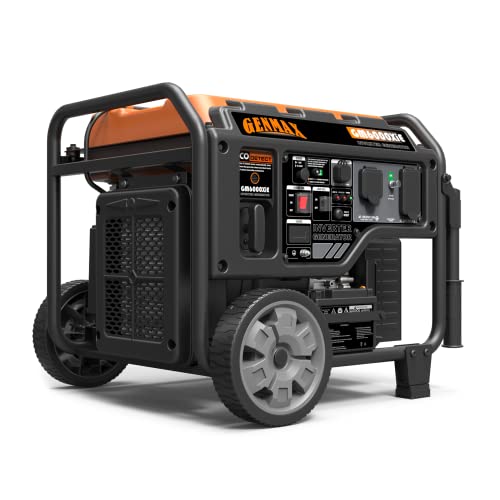
Best Inverter Power · 5 of 6

GENMAX Portable Inverter Generator

GENMAX Portable Inverter Generator
  • 6000 peak, 5250 rated watts
  • Inverter, 106.9 lb, wheels
  • L14-30R outlet, CO shutoff
Check price on Amazon for GENMAX Portable Inverter Generator (opens in a new tab)
Best for: Inverter backup on wheels

Our take

A strong inverter at a mid price. Good for home backup with a CO sensor.

Why it made the shortlist

The GENMAX lists 6000 peak and 5250 rated watts from a 312cc OHV engine with electric start, inverter power, 2 rolling wheels and a steel handle. It weighs 106.9 pounds, has an hour meter with LED indicators, a 120/240V 30A locking outlet and CO detection with auto shutoff.

It states 5250 rated watts, about 1500 above the PowerSmart 4800, in an inverter. It includes a 1-year warranty with lifetime technical support.

It suits campers and backup users who want inverter output and a CO sensor on wheels. The listing says it is 50 percent quieter and 30 percent lighter than a traditional 6000 watt generator.

What works

  • Inverter power at 5250 rated watts
  • CO detection auto shutoff
  • Wheels and steel handle
  • Hour meter with LED alerts

Watch out for

  • Only a 1-year warranty
  • Heavy at 106.9 pounds
The catch
It weighs about 107 pounds even with wheels.
06
Best for: Budget electric start

Our take

A basic, affordable electric-start generator. Fine for tools and basic camp power.

Why it made the shortlist

The WEN 56475 uses a 223cc engine for 4750 surge and 3750 rated watts with electric start, low-oil shutdown, an automatic voltage regulator and overload protection. A digital readout manages oil changes, and a wheel kit and foldable handles are included.

Nothing else here costs less, and the listing says it meets CARB and EPA III for sale in all 50 states. A wheel kit and foldable handles come with it.

It suits campers on a budget who want electric start and basic protection. The wheel kit makes it easier to move.

What works

  • Electric start
  • Automatic voltage regulator
  • CARB and EPA III compliant

Watch out for

  • No CO shutdown is named
  • No inverter or noise figure is stated
The catch
No carbon monoxide shutdown is named.

Methodology

How We Built This Shortlist

Each pick was assessed across 4 criteria weighted for real-world use.

01

Running watts

Compared the rated output on gasoline and propane.

02

Start system

Looked at push button, key fob and recoil backup.

03

Safety

Noted CO shutdown, low-oil shutdown and certification.

04

Outlets and portability

Checked for RV outlets, wheels and weight.

Decision guide

Match a Portable Generator With Electric Start to Your Camp Setup

By Load

Your situationRecommended pickWhy
Whole-home essentials or big RVWestinghouse WGen125009500 running watts
Mid-size travel trailerWestinghouse 66005300 running watts, RV outlet
Propane and inverter powerWEN 4800W Dual FuelDual fuel inverter
Long runtimePowerSmart 480018 hours at 25% load
Inverter power at 5000 plus wattsGENMAX 6000W5250 rated watts
Budget tools and camp powerWEN 56475Lowest price

By Budget

BudgetRecommended pick
$470 to $550WEN 56475 or GENMAX 6000W
$560 to $650PowerSmart 4800 or WEN 4800W Dual Fuel
$640 to $1000Westinghouse 6600 or Westinghouse WGen12500

Inverter vs open frame

Inverter

The WEN 4800W Dual Fuel, PowerSmart 4800 and GENMAX 6000W produce cleaner power at lower noise.

Open frame

The Westinghouse WGen12500, Westinghouse 6600 and WEN 56475 give more watts for the money.

Most campers should default to the PowerSmart 4800 unless they need 5000 watts or more.

By Fuel and Safety

Best fitRecommended pick
Propane optionWEN 4800W Dual Fuel
CO shutdown namedGENMAX 6000W
Key fob remoteWestinghouse WGen12500
Lowest priceWEN 56475

For Cold-Weather Camping Specifically

Look for

Electric or key fob start and a way to keep the battery charged

In this comparison

The Westinghouse WGen12500 includes a key fob and a 12V charger, and the Westinghouse 6600 has push-button start.

When to Spend More

Spend more if

Spend more on the Westinghouse WGen12500 or GENMAX 6000W if you need large output or inverter power.

Save if

Save with the WEN 56475 or PowerSmart 4800 if you need electric start and basic protection.

FAQ

Before You Bring One Home

Is electric start reliable?

It is, as long as the starter battery stays charged. Most units here also keep a recoil pull as a backup.

Do I need to charge the starter battery?

Yes, on a schedule. The Westinghouse WGen12500 includes a 12V charger, which keeps it ready.

Is electric start worth it over a pull cord?

It is for larger engines and cold weather, where pull starts are harder. For small units, a recoil is simple and cheap.

How do I start it?

Check oil and fuel, set the switch to run, and push the button or use the fob. Connect loads after it warms.

How do I keep it ready for storms?

Keep fresh fuel with stabilizer in the tank. Run it every few months and keep the starter battery charged.

Bottom line

The short version

Browse more portable generators with electric start on Amazon →
Danny Walker, Camping Editor at RV Gear Lab

About the author

Danny Walker

Camping Editor at RV Gear Lab

Danny covers camping gear, campsite setup, outdoor power, sleep systems and practical camping advice, with a focus on helping campers make better gear decisions.

More from Danny →Editorial standards

Keep reading

Related guides