


We research everything we recommend. When you buy through our links, we may earn a commission. Learn more

Buying guide · 10 min read · Updated October 2, 2026

4 Best Portable Solar Panels For Battery Charging in 2026: A Practical Camping Guide

Best portable solar panels for battery charging compared on controller, battery type and wattage for trickle-charging 12V batteries and power banks.

Danny WalkerBy Danny WalkerCamping Editor at RV Gear Lab4 products comparedSpec-sheet researched
Jeep camp with a tent, solar panels and a portable power station at a pine forest campsite

At a glance

Our top picks

Battery charging is a different job from running gear, because the panel must charge a battery slowly and safely over hours. That favors a panel with a built-in controller for 12V batteries, or a small USB panel for power banks.

Four panels fit, from a 6W USB panel up to a 30W foldable. They were compared on controller protection, battery types named, panel build and output ports.

RV Gear Lab field notes

The Campsite Fit Check

Start with the job
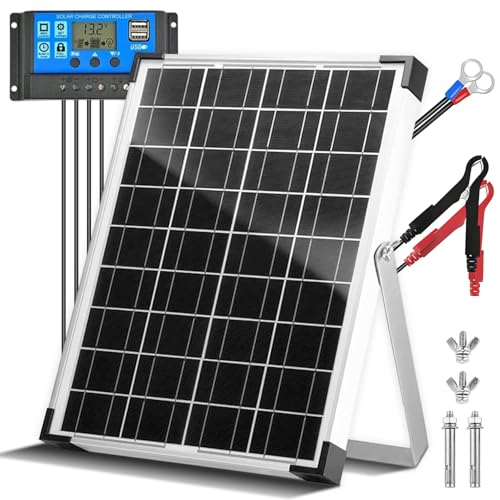
Hoysicy 12V Solar Battery Charger 20W Solar Panel Kit leads this shortlist for 12V battery maintenance. Use that fit as a reference point, then compare the alternatives against your own space and workload.
Specs that separate the picks
The first details to compare are 10A controller with LCD, 20W, 21% to 30% cells, 30W foldable, 23% cells. Confirm the exact model and included components before ordering.
Trade-off to plan for
Title says 20W, one bullet says 30W

Before you buy

What Matters Before You Choose a Portable Solar Panel For Battery Charging

Key buying criteria so you get the right fit the first time.

  1. 01

    Charge controller necessity

    Connecting a panel straight to a 12V battery with no controller risks overcharging it. A controller with overcharge and over-discharge protection stops that. Look for a named controller and its amp rating, not just a panel.

  2. 02

    Panel wattage versus battery size

    A 20W panel in good sun gives roughly 1 to 1.5 amps, which tops up but does not refill. A 100Ah battery needs far more to recharge from empty. Match panel size to battery size, or use it purely for maintenance.

  3. 03

    Battery chemistry compatibility

    Lead acid, AGM, gel and LiFePO4 each want a different charge profile. A controller that names your type is a safer fit. If the listing does not name it, ask the maker.

  4. 04

    USB versus 12V output

    A USB panel charges power banks and phones at 5V and cannot charge a 12V battery. A 12V kit uses a controller and clips or ring terminals. Pick by what you actually charge.

  5. 05

    Temperature and placement

    Lithium batteries should not charge below freezing, and a hot dashboard can bake the panel and battery. Place the panel in sun and the battery in shade. Check the battery manual for a charging temperature range.

Our standards

Why You Can Trust RV Gear Lab

At RV Gear Lab, we compare products based on campsite fit, verified specifications, usability, setup requirements, weight, durability, and real-world trade-offs. We do not rank products purely on marketing claims or commission rates.

We have not personally tested every product listed. Where hands-on testing is not available, recommendations are based on verified manufacturer specifications, product documentation, use-case fit, and comparative research.

How we review camping gear →

Detailed reviews

The 4 best portable solar panels for battery charging, explained

01
Best for: 12V battery maintenance

Our take

A well-protected 12V kit with a readable controller.

Why it made the shortlist

The Hoysicy kit has a built-in 10A controller with an LCD display and protection against overcharge, over-discharge, over-voltage and short circuits. It lists dual USB ports, an IP65 waterproof panel and compatibility with LiFePO4, lithium, AGM, SLA and gel batteries.

Compared with the SOLUPUP, it connects straight to a 12V battery in place of a USB port.

It suits campers and boaters who keep a 12V battery topped up in an RV, trailer or camper. The 360 degree bracket tilts to the sun through the day.

What works

  • LCD shows charging status
  • Names LiFePO4, AGM, SLA and gel
  • Dual USB ports for phones
  • 360 degree adjustable bracket

Watch out for

  • Title says 20W, one bullet says 30W
  • Fixed panel, not foldable
The catch
The listing mentions both 20W and 30W, so confirm the panel wattage before ordering.
02

Best Budget 12V · 2 of 4

SOLPERK Solar Panel Kit

SOLPERK Solar Panel Kit
  • 20W, 21% to 30% cells
  • 10A MPPT controller
  • Three-stage charging
Check price on Amazon for SOLPERK Solar Panel Kit (opens in a new tab)
Best for: Stored battery maintenance

Our take

A budget trickle charger for a battery that sits unused between trips.

Why it made the shortlist

The SOLPERK 20W kit is a monocrystalline panel with a smart 10A MPPT controller using three-stage charging. It lists low-iron tempered glass, a rustproof frame, a 360 degree mount and compatibility with LiFePO4 and lithium batteries.

It is the cheapest 12V kit in this list and is priced the same as the Hoysicy. Against the Hoysicy it drops the USB ports and LCD for a plain trickle charger.

It fits car, boat and trailer owners who want to keep a battery from sulking in storage. The kit includes an alligator clip and mounting hardware.

What works

  • Three-stage charging protects the battery
  • Tempered glass and rustproof frame
  • Alligator clip and mount included
  • Works with lithium and LiFePO4

Watch out for

  • No USB ports for phones
  • 20W is slow for a drained battery
The catch
Twenty watts keeps a battery topped up but cannot refill a deeply drained one quickly.
03
Best for: Power bank recharging

Our take

The pick for recharging USB power banks on the trail.

Why it made the shortlist

The SOLUPUP 30W is a foldable panel whose two USB sockets (A and Type-C) top out at 15W, built on cells rated 23% or higher. It weighs 2.4 lbs, folds to 10.63 inches and includes carabiners and a cable.

It is the bigger foldable option for battery packs, with five times the Aocoray's wattage. Next to the Hoysicy it charges USB batteries, not a 12V bank.

It suits hikers and campers who recharge a power bank or phone in the daytime. A smart chip adjusts charging for the connected device.

What works

  • Charges a power bank by day
  • Light at 2.4 lbs
  • Smart chip prevents overcurrent
  • Carabiners and cable included

Watch out for

  • Cannot charge a 12V battery directly
  • Output depends on sun angle
The catch
It is a USB panel, so a 12V battery needs a controller kit instead.
04
Aocoray Mini 5V 6W USB Solar Panel
  • 5V 6W monocrystalline
  • Waterproof, scratch-resistant
  • Mini size
Check price on Amazon for Aocoray Mini 5V 6W USB Solar Panel (opens in a new tab)
Best for: Phone and lantern trickle

Our take

A tiny, cheap panel for small gadgets and lantern top-ups.

Why it made the shortlist

The Aocoray is a 5V 6W monocrystalline mini panel for phones, power banks, cameras, fans and lanterns. The listing calls it waterproof and scratch-resistant, with a mini size aimed at camping and hiking.

It is the smallest and cheapest panel here, at about a fifth of the SOLUPUP wattage. That keeps it light enough to hang from a pack.

What works

  • Small enough to hang from a pack
  • Powers phones, fans and lanterns
  • Waterproof build named

Watch out for

  • 6W is very slow for a power bank
  • No weight or folded size listed
The catch
At 6W, a power bank can take many sunny hours to fill.

Methodology

How We Built This Shortlist

Each pick was assessed across 5 criteria weighted for real-world use.

01

Controller protection

Named controller amp ratings and protection lists were compared first.

02

Battery types

Listings naming LiFePO4, lithium, AGM and gel were noted.

03

Panel wattage

Panel sizes of 6W, 20W, 30W were matched to realistic battery charging jobs.

04

Build

Tempered glass, ETFE and waterproof claims were compared.

05

Outputs

USB, alligator clip and DC outputs were checked for each use case.

Decision guide

Match a Portable Solar Panel For Battery Charging to Your Camp Setup

By Battery Type

Your situationRecommended pickWhy
12V battery with LCD readoutHoysicy 12V Panel KitController with a status display.
Stored battery trickleSOLPERK 20W Panel KitThree-stage charging at a low price.
USB power bank on a hikeSOLUPUP 30W PanelFoldable with USB-C output.
Phone or lantern trickleAocoray 6W USB Panel5V 6W mini.

By Budget

BudgetRecommended pick
$0 to $40Aocoray 6W USB Panel or Hoysicy 12V Panel Kit
$30 to $50SOLPERK 20W Panel Kit or SOLUPUP 30W Panel

12V Kit vs USB Panel

12V kit

The Hoysicy 12V Panel Kit and SOLPERK 20W Panel Kit use a controller and clips to charge a 12V battery.

USB panel

The SOLUPUP 30W Panel and Aocoray 6W USB Panel charge USB devices and power banks.

Choose a 12V kit like the Hoysicy 12V Panel Kit for vehicle batteries, and a USB panel for power banks.

By Budget

BudgetRecommended pick
Under $10Aocoray 6W USB Panel
Around $35 with controllerSOLPERK 20W Panel Kit
Around $35 with LCDHoysicy 12V Panel Kit
Near $49 for foldable USBSOLUPUP 30W Panel

Boat or RV Battery Maintenance Specifically

Look for

A 10A controller with overcharge protection and a mount.

In this comparison

The Hoysicy 12V Panel Kit lists a 10A LCD controller and a 360 degree bracket, and the SOLPERK 20W Panel Kit lists three-stage charging.

When to Spend More

Spend more if

Spend more on the Hoysicy 12V Panel Kit if you want an LCD readout and USB ports on a 12V battery kit.

Save if

Save with the Aocoray 6W USB Panel if you only trickle a small device or lantern.

FAQ

Before You Bring One Home

Can I charge a car battery with these?

The Hoysicy 12V Panel Kit and SOLPERK 20W Panel Kit are meant to maintain 12V batteries, not jump-start them. They keep a stored battery topped up. A deeply drained battery needs a wall charger.

What is the common mistake?

Skipping the controller and clipping a panel straight to a battery. That risks overcharge. Use a kit with a controller, and connect the battery first.

Is a bigger panel worth it for batteries?

For maintenance, 20W is enough. For real recharging, you need 100W or more. See the charge controller kits for larger options.

How do I connect a kit?

Connect the controller to the battery, then to the panel, and read the indicator. Place the panel in the sun and the battery in shade. Check polarity before clipping.

How do I maintain the panel?

Wipe the glass with a soft damp cloth and check the cable for cracks. Keep the connectors dry. Re-aim it every season.

Bottom line

The short version

Browse more portable solar panels for battery charging on Amazon →
Danny Walker, Camping Editor at RV Gear Lab

About the author

Danny Walker

Camping Editor at RV Gear Lab

Danny covers camping gear, campsite setup, outdoor power, sleep systems and practical camping advice, with a focus on helping campers make better gear decisions.

More from Danny →Editorial standards

Keep reading

Related guides