


We research everything we recommend. When you buy through our links, we may earn a commission. Learn more

Buying guide · 10 min read · Updated October 2, 2026

5 Best Power Stations Under 1000 in 2026: A Practical Camping Guide

Best power stations under $1,000: five 1 to 2 kWh LiFePO4 units from DJI, EcoFlow, Jackery, Bluetti and Anker, compared on speed, output and runtime.

Danny WalkerBy Danny WalkerCamping Editor at RV Gear Lab5 products comparedSpec-sheet researched
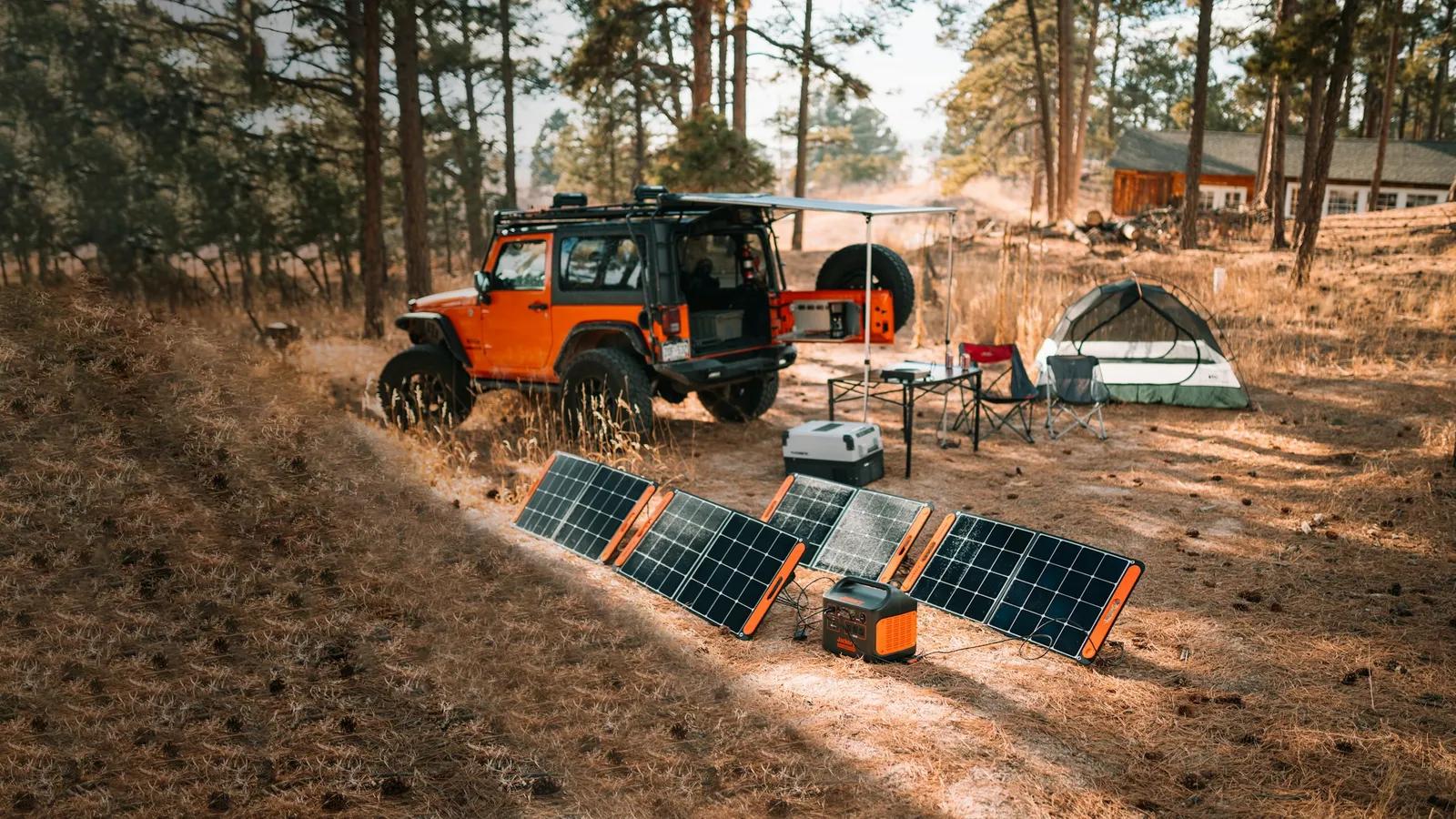
Jeep camp with a tent, solar panels and a portable power station at a pine forest campsite

At a glance

Our top picks

One thousand dollars lets a buyer skip the budget brands and choose a station for speed, noise or ecosystem. The five here hold 1,024Wh to 2,010Wh and sit between about $400 and $650, and the real question is which premium feature the extra money should buy.

The ranking asks whether the premium over a $320 1,000Wh unit buys a faster recharge, more AC output, quieter fans or a bigger battery. The top spot goes to the best all-round balance, and the others are placed by their strongest feature.

RV Gear Lab field notes

The Campsite Fit Check

Start with the job
DJI Power 1000 V2 Portable Power Station leads this shortlist for Fast, quiet camping power. Use that fit as a reference point, then compare the alternatives against your own space and workload.
Specs that separate the picks
The first details to compare are 1,024Wh LFP, 2,600W output, 1,024Wh LiFePO4, 1,800W AC, 1,024Wh, 1,800W rated. Confirm the exact model and included components before ordering.
Trade-off to plan for
No solar panel included

Before you buy

What Matters Before You Choose a Power Station Under 1000

Key buying criteria so you get the right fit the first time.

  1. 01

    Charging speed

    A station that reaches 80 percent in 37 to 45 minutes can be refilled during a lunch stop, while a slower unit needs an overnight charge at the next campsite. Fast charging matters most when you move camp daily or run on shore power for only a short window. Check the minutes to 80 percent and the AC input rating in the product title.

  2. 02

    AC output and surge

    Rated output decides which appliances you can run together, and the surge figure only covers motor start-up. A 2,600W unit like the DJI can run a kettle and a microwave at once, while a 1,500W unit cannot. Match the continuous watts to your largest appliance, and add up everything you plan to run at the same time.

  3. 03

    Capacity per dollar

    A 1,024Wh unit costs about $400 to $500 here, while a 2,010Wh unit costs about $650, so the larger unit is cheaper per watt-hour. If you run a fridge for days, capacity wins over speed. Divide each price by its Wh figure to compare, and decide how many hours of runtime you really need.

  4. 04

    Noise and fans

    A station that runs near 26 to 30 dB is almost silent, while a loud cooling fan disturbs sleep when the unit sits in your tent vestibule. Fan noise also rises under heavy load, so a quiet idle figure can mislead. Look for a stated decibel level or a silent mode in the product details.

  5. 05

    Brand support and warranty

    A well-known brand tends to offer app updates, replacement parts and warranty service that last for years, while a new brand may be cheaper and harder to support. That matters because a station should last a decade. Read the warranty length and the support terms in the product details before you pay more.

Our standards

Why You Can Trust RV Gear Lab

At RV Gear Lab, we compare products based on campsite fit, verified specifications, usability, setup requirements, weight, durability, and real-world trade-offs. We do not rank products purely on marketing claims or commission rates.

We have not personally tested every product listed. Where hands-on testing is not available, recommendations are based on verified manufacturer specifications, product documentation, use-case fit, and comparative research.

How we review camping gear →

Detailed reviews

The 5 best power stations under 1000, explained

01

Best Value Under $1,000 · 1 of 5

DJI Power 1000 V2 Portable Power Station

DJI Power 1000 V2 Portable Power Station
  • 1,024Wh LFP, 2,600W output
  • 80% in 37 minutes
  • 26 dB, dual 140W USB-C
Check price on Amazon for DJI Power 1000 V2 Portable Power Station (opens in a new tab)
Best for: Fast, quiet camping power

Our take

The fastest, quietest all-rounder below the cap.

Why it made the shortlist

The DJI Power 1000 V2 is a 1,024Wh LFP station with 2,600W of output, an 80 percent charge in 37 minutes and about 26 dB operation. It has dual 140W USB-C ports for laptops.

It costs about $400, around $100 less than the EcoFlow Delta 3 Classic, and it charges faster and runs quieter than any other pick here. It stores half of what the Anker SOLIX S2000 holds.

It suits campers and van-lifers who sleep near the unit and want a fast refill between stops. The compact body keeps it easy to carry.

What works

  • Charges to 80 percent in 37 minutes
  • Quiet at about 26 dB for sleeping
  • Dual 140W USB-C for laptops
  • Compact for 1 kWh of LFP

Watch out for

  • No solar panel included
  • Shorter record in power stations
The catch
It holds 1,024Wh, so heavy loads drain it quickly.
02
EF ECOFLOW Portable Power Station Delta 3 Classic
  • 1,024Wh LiFePO4, 1,800W AC
  • 3,600W surge, X-Boost
  • 80% in 45 minutes
Check price on Amazon for EF ECOFLOW Portable Power Station Delta 3 Classic (opens in a new tab)
Best for: Brand-supported systems

Our take

Pay a little extra for ecosystem and support.

Why it made the shortlist

The EcoFlow Delta 3 Classic stores 1,024Wh of LiFePO4 and delivers 1,800W of AC with a 3,600W X-Boost surge. It reaches 80 percent in 45 minutes and has a UPS switch under 10ms.

It costs about $499, roughly $100 more than the DJI Power 1000 V2, and the extra money buys an established brand and a mature app ecosystem. Its 1,800W output is lower than the DJI's 2,600W.

It suits buyers who want a well-supported product with solar and expansion options. It handles most camp kitchens.

What works

  • 1,800W AC with 3,600W surge
  • 80 percent in 45 minutes
  • UPS under 10ms
  • LiFePO4 for long cell life

Watch out for

  • Costs about $100 more than DJI
  • No solar panel included
The catch
It outputs less than the DJI.
03
Best for: Portable heavy loads

Our take

A light, strong unit for camp kitchens.

Why it made the shortlist

The BLUETTI Elite 100 V2 packs 1,024Wh with 1,800W of rated output and a 2,700W Power Lifting mode. It reaches 80 percent in 45 minutes, weighs 25 pounds and has a 30 dB silent mode.

It costs about $499, the same as the EcoFlow Delta 3 Classic, and it weighs less than the Anker SOLIX S2000 by a wide margin. It adds app control with OTA updates.

It suits campers who want strong output and portability in one unit. The silent mode helps near the tent.

What works

  • 1,800W output for heavy loads
  • 80 percent charge in about 45 minutes
  • 30 dB silent mode
  • App control with OTA updates

Watch out for

  • Cell chemistry is not named in the title
The catch
Check cell type in the specs.
04
Best for: Familiar-brand buyers

Our take

Pick for the brand and one-hour full charge.

Why it made the shortlist

The Jackery Explorer 1000 v2 holds 1,070Wh and outputs 1,500W with 3,000W surge on a LiFePO4 pack rated for 4,000 cycles to 70 percent health. A one-hour emergency charge takes it from empty to full.

It costs about $499, level with the EcoFlow Delta 3 Classic, and it has the biggest battery of the 1 kWh group at 1,070Wh. It outputs less than the DJI or the BLUETTI.

It suits campers who want a familiar name and full recharge in an hour. Three AC ports let you plug in several devices.

What works

  • Full charge in an hour
  • Three pure sine AC ports
  • LiFePO4 with 4,000 cycle life
  • Quiet overnight charging mode

Watch out for

  • Lower output than rivals
The catch
Output is the lowest of the 1 kWh group.
05

Best Largest Battery · 5 of 5

Anker SOLIX S2000 Portable Power Station

Anker SOLIX S2000 Portable Power Station
  • 2010Wh LFP, 1500W output
  • 3000W peak, 400W solar input
  • 10,000-cycle rating
Check price on Amazon for Anker SOLIX S2000 Portable Power Station (opens in a new tab)
Best for: Multi-day trips

Our take

The battery to buy when runtime matters most.

Why it made the shortlist

The Anker SOLIX S2000 stores 2,010Wh in LFP cells, outputs 1,500W with a 3,000W peak and accepts up to 400W of solar. It is rated for 10,000 cycles.

It gives lower AC output than the DJI Power 1000 V2.

It suits long stays, fridge backup and anyone who wants a decade-long battery. The cycle rating is the highest in this guide.

What works

  • Largest capacity in the guide
  • Listed 35-hour fridge backup claim
  • Six ways to recharge

Watch out for

  • 1,500W output limits big loads
  • No UPS switch time is named
The catch
It is twice the weight and price of the 1 kWh units.

Methodology

How We Built This Shortlist

Each pick was assessed across 5 criteria weighted for real-world use.

01

Charging speed

Minutes to 80 percent were compared.

02

AC output

Rated and surge watts were checked.

03

Capacity

Watt-hours were compared against price.

04

Noise

Stated decibel levels were considered.

05

Price against the cap

All five are under $1,000.

Decision guide

Match a Power Station Under 1000 to Your Camp Setup

By priority

Your situationRecommended pickWhy
Fastest and quietestDJI Power 1000 V237 minutes to 80 percent and about 26 dB.
Established ecosystemEcoFlow Delta 3 ClassicApp and expansion support.
Light with strong outputBLUETTI Elite 100 V225 lb and 1,800W.
Familiar brand, one-hour chargeJackery Explorer 1000 v20 to 100 percent in an hour.
Maximum runtimeAnker SOLIX S20002,010Wh and 10,000 cycles.

By Budget

BudgetRecommended pick
$390 to $500DJI Power 1000 V2 or EcoFlow Delta 3 Classic
$490 to $500BLUETTI Elite 100 V2 or Jackery Explorer 1000 v2
$640 to $650Anker SOLIX S2000

Fast 1 kWh vs big battery

Fast 1 kWh

The DJI Power 1000 V2, EcoFlow Delta 3 Classic, BLUETTI Elite 100 V2 and Jackery Explorer 1000 v2 hold about 1 kWh and recharge in under an hour.

Big battery

The Anker SOLIX S2000 holds 2,010Wh for days of fridge runtime.

Choose the DJI Power 1000 V2 for travel and the Anker SOLIX S2000 for a fixed camp.

By price tier

Price tierRecommended pick
About $400DJI Power 1000 V2
About $499EcoFlow Delta 3 Classic
About $499BLUETTI Elite 100 V2
About $499Jackery Explorer 1000 v2
About $650Anker SOLIX S2000

For van or RV living specifically

Look for

Look for fast AC charging, a UPS function and 1,800W or more of output.

In this comparison

The DJI Power 1000 V2 offers 2,600W and a quiet 26 dB, while the Anker SOLIX S2000 offers two days of fridge power.

When to Spend More

Spend more if

Spend more if you want a longer-lasting battery: the Anker SOLIX S2000 adds 10,000 cycles, and the EcoFlow Delta 3 Classic adds ecosystem support.

Save if

Save if you want speed and silence: the DJI Power 1000 V2 is the cheapest of the five at about $400.

FAQ

Before You Bring One Home

Is a $1,000 power station better than a $320 one?

It charges faster, runs quieter and comes from a brand with a stronger warranty. A cheaper 1,000Wh unit holds a similar amount of energy, so you are paying for speed and polish, not extra runtime. Pay more for the DJI Power 1000 V2 if you move camp daily.

What do buyers get wrong about premium power stations?

They assume more money means more capacity. Four of these five hold about the same 1 kWh, and the extra cost buys speed, output or support. Compare watts and minutes to 80 percent before you choose.

Is the Anker worth $250 more than the DJI?

If you need multi-day runtime, yes. The Anker SOLIX S2000 holds twice the energy of the 1 kWh units and is rated for 10,000 cycles. For weekend trips, the DJI Power 1000 V2 is the better value at about $250 less.

How do I size a power station?

Add the watts of everything you run at once, then multiply by the hours of use to get watt-hours. A 1,000Wh unit runs a 100W fridge for about 8 to 10 hours after losses. Add 20 percent as a safety margin.

How do I take care of a power station?

Store it at moderate temperatures, keep it above half charge and avoid running it inside a closed tent. Top it up every few months so the cells stay healthy. Keep the vents clear while it charges.

Bottom line

The short version

Browse more power stations under 1000 on Amazon →
Danny Walker, Camping Editor at RV Gear Lab

About the author

Danny Walker

Camping Editor at RV Gear Lab

Danny covers camping gear, campsite setup, outdoor power, sleep systems and practical camping advice, with a focus on helping campers make better gear decisions.

More from Danny →Editorial standards

Keep reading

Related guides