

We research everything we recommend. When you buy through our links, we may earn a commission. Learn more

Buying guide · 10 min read · Updated October 2, 2026

6 Best Solar Power Banks For Phones in 2026: A Practical Camping Guide

Best solar power banks for phones compared on capacity, wireless charging, built-in cables and lights for campers who keep phones alive off grid.

Danny WalkerBy Danny WalkerCamping Editor at RV Gear Lab6 products comparedSpec-sheet researched
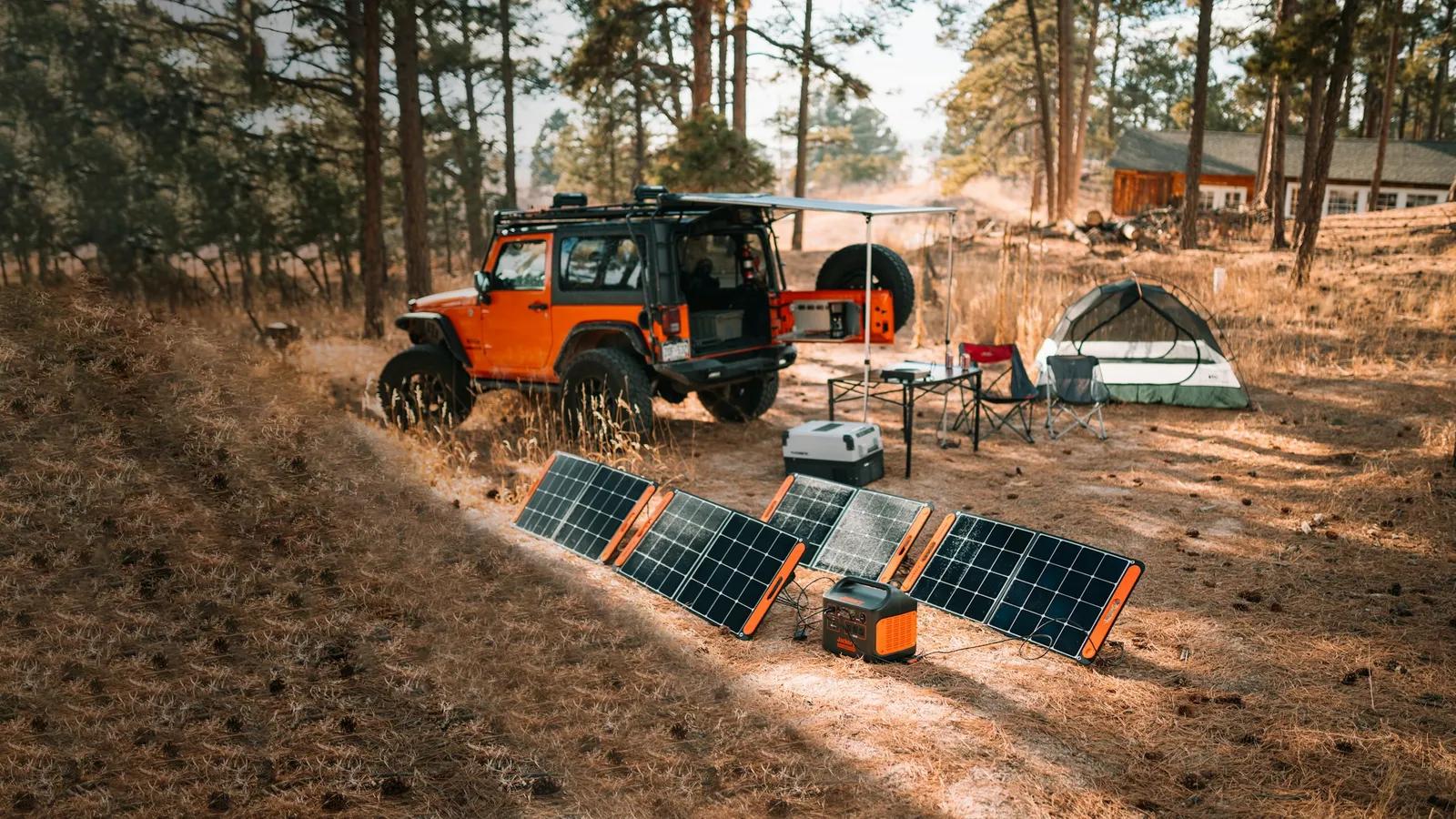
Jeep camp with a tent, solar panels and a portable power station at a pine forest campsite

At a glance

Our top picks

For a phone, a solar power bank is mostly a battery with a bonus panel. Capacity decides how many days a phone lasts, and the built-in cables, wireless pad and weather resistance decide how convenient the pack is.

Six solar banks made the shortlist, from 10000mAh to near 50000mAh. They were compared on stated capacity, charging speed, built-in cables, wireless charging, lights and certifications.

RV Gear Lab field notes

The Campsite Fit Check

Start with the job
SOARAISE Solar Power Bank 48000mAh Wireless Portable Charger with 4 Cables leads this shortlist for Multi-day phone use. Use that fit as a reference point, then compare the alternatives against your own space and workload.
Specs that separate the picks
The first details to compare are 48000mAh, four panels, 40000mAh, 20W PD Type-C, 20000mAh, wireless, 6 devices. Confirm the exact model and included components before ordering.
Trade-off to plan for
Heavy for daypacks

Before you buy

What Matters Before You Choose a Solar Power Bank For Phones

Key buying criteria so you get the right fit the first time.

  1. 01

    Capacity for phones

    A phone battery is about 4000 to 5000mAh, so 20000mAh covers roughly four charges and 40000mAh about eight. Add days of use to your estimate. Check the charges-per-phone line.

  2. 02

    Solar panel reality

    The panel on a power bank collects a trickle, so a full recharge by sun alone takes days. It helps in an emergency. Charge from a wall before the trip.

  3. 03

    Wireless versus cable

    Wireless charging saves a cord but is slower and needs a phone that supports it. A cable is faster. Check whether your phone accepts wireless charging.

  4. 04

    Built-in cables

    Built-in cables match common phones. They cannot be replaced if one breaks. Check that the cable types fit your phones.

  5. 05

    Safety certifications

    UL, CE, FCC and UN38.3 show that the battery was tested, which matters for a bank left in a hot tent. Listings without them give less assurance. Check the safety list.

Our standards

Why You Can Trust RV Gear Lab

At RV Gear Lab, we compare products based on campsite fit, verified specifications, usability, setup requirements, weight, durability, and real-world trade-offs. We do not rank products purely on marketing claims or commission rates.

We have not personally tested every product listed. Where hands-on testing is not available, recommendations are based on verified manufacturer specifications, product documentation, use-case fit, and comparative research.

How we review camping gear →

Detailed reviews

The 6 best solar power banks for phones, explained

01
Best for: Multi-day phone use

Our take

The complete solar phone bank, with four panels, four cables and wireless charging.

Why it made the shortlist

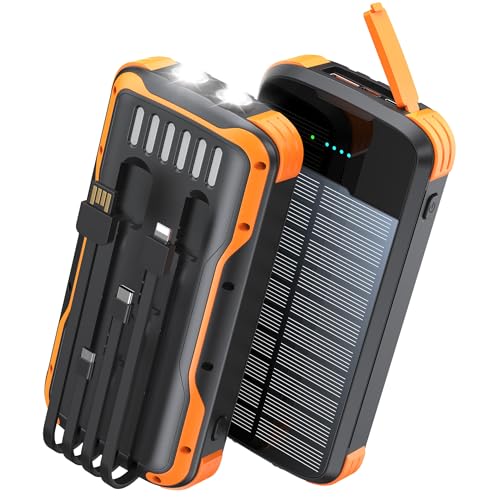
The SOARAISE lists 48000mAh, four solar panels said to charge up to 5 times faster than single-panel models, 4 built-in cables, 3 ports (2 USB-A outputs and 1 USB-C in and out) and a wireless charging pad. It uses a lithium-polymer battery described as lasting more cycles.

It is the most complete pick for multi-day phone use.

It suits campers who want the most solar panel area and several cables. The wireless pad charges phones without a cord.

What works

  • Four panels collect more sun
  • Four built-in cables
  • Wireless pad for phones
  • Capacity for many phone charges

Watch out for

  • Heavy for daypacks
The catch
Solar still adds only a trickle, so charge it from a wall first.
02
Best for: Fast phone top-ups

Our take

A 40K solar bank with 20W PD and flashlights at a reasonable price.

Why it made the shortlist

The SOXONO lists 40000mAh with a 20W PD Type-C port that charges an iPhone to 65 percent in about 30 minutes. It has 3 output cables (Type-C, iOS and Micro USB) plus a USB-A input cable and dual LED flashlights with four modes.

Its 20W port sits above the Nuynix's 15W, and it costs less than the SOARAISE. It has no wireless pad.

It suits campers who want a quick phone refill with a light. The flashlights run steady, SOS, strobe and low.

What works

  • 20W PD charges an iPhone to 65 percent in 30 minutes
  • Three output cables
  • Dual flashlights with four modes

Watch out for

  • No wireless charging
  • Solar panel is small for this capacity
The catch
Use the solar panel only as a backup.
03

Best for Phones and Watches · 3 of 6

BLAVOR Solar Power Bank 20000mAh

BLAVOR Solar Power Bank 20000mAh
  • 20000mAh, wireless, 6 devices
  • 4 built-in cables, 3 ports
  • Phone and Apple Watch charging
Check price on Amazon for BLAVOR Solar Power Bank 20000mAh (opens in a new tab)
Best for: Phone plus watch

Our take

A mid-size solar bank with wireless charging for a phone and a watch.

Why it made the shortlist

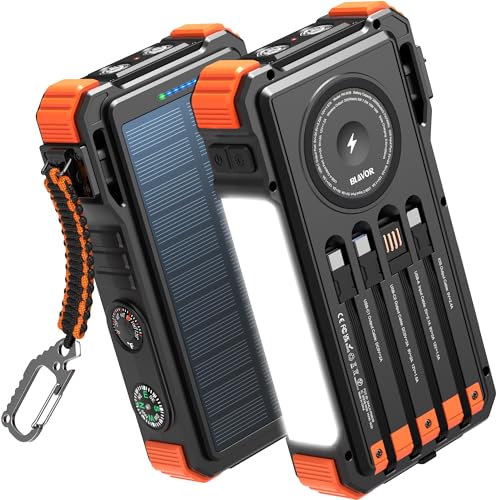
The BLAVOR lists 20000mAh with 4 built-in cables (2 USB-C, 1 iOS and 1 USB-A), 3 ports and wireless charging for phones and an Apple Watch. It charges 6 devices at once and has a flame-retardant ABS and PC shell with silicone protection.

It suits campers with an iPhone and a watch who want a mid-size bank. Seven accessory functions include a flashlight.

What works

  • Wireless charging covers phone and watch
  • Four built-in cables
  • Six devices at once
  • Silicone and flame-retardant shell

Watch out for

  • Smaller capacity than the 40K banks
The catch
20000mAh gives about four charges, so it suits weekends.
04

Best Compact · 4 of 6

BLAVOR Solar Power Bank 10

BLAVOR Solar Power Bank 10
  • 10,000mAh, 20W USB-C
  • Wireless charging, IPX5
  • Lithium-cobalt battery
Check price on Amazon for BLAVOR Solar Power Bank 10 (opens in a new tab)
Best for: Pocket carry

Our take

The compact pick for day trips, with fast USB-C and an IPX5 rating.

Why it made the shortlist

The BLAVOR 10,000mAh bank has a 20W USB-C output that charges an iPhone 15 to 65 percent in about 30 minutes, plus wireless charging, a lithium-cobalt battery and an IPX5 rating. The listing calls it the smallest and lightest solar charger of its kind.

It is the smallest pick here, and it has a fast USB-C port. It holds about a fifth of the SOARAISE's capacity.

It suits day hikers and commuters who want a pocket solar bank. A flame-retardant case and silicone protect it.

What works

  • 20W USB-C charges an iPhone 15 to 65 percent in 30 minutes
  • IPX5 water and dust protection
  • Smallest and lightest here
  • Wireless charging included

Watch out for

  • 10,000mAh is about two phone charges
  • Panel is tiny
The catch
It is a day bank, not a multi-day one.
05
GULLVEN Solar Power Bank 20000mAh
  • 20000mAh, 4 cables, 6 devices
  • UL, CE, FCC, RoHS, UN38.3
  • Camping light with SOS
Check price on Amazon for GULLVEN Solar Power Bank 20000mAh (opens in a new tab)
Best for: Value with certifications

Our take

A value 20K with named safety marks and a camp light.

Why it made the shortlist

The GULLVEN lists 20000mAh with 3 built-in output cables (Type-C, Lightning and Micro USB), a USB-A input cable, 3 ports and 6 devices at once. It carries UL, CE, FCC, RoHS and UN38.3 certifications and a camping light with an SOS flashlight.

It names the most safety certifications of the six, and it costs less than the BLAVOR 20000mAh. It has no wireless pad.

It suits budget campers who want named certifications and a camp light. It recharges by solar or by a wall socket.

What works

  • Most named certifications in the group
  • Camping light with SOS mode
  • Three output cables plus input

Watch out for

  • No wireless charging
  • Waterproof claims are broad
The catch
Check the water protection yourself, since the listing says only waterproof.
06
Best for: Maximum capacity per dollar

Our take

The cheapest way into near-50K capacity with a solar backup.

Why it made the shortlist

The Nuynix lists 49800mAh with a 15W USB-C fast-charging port, multiple USB ports, a rugged housing and an LED flashlight. It can recharge by USB or by solar as a backup.

It is the cheapest pick and the one with the most mAh per dollar. It has slower 15W charging than the SOXONO.

It suits budget buyers who want maximum capacity and a flashlight. The listing frames solar as a supplemental option.

What works

  • Nearly 50,000mAh capacity
  • 15W USB-C port
  • Solar as a backup option

Watch out for

  • Slower than the 20W and 22.5W models
The catch
Check the packaging details before relying on it.

Methodology

How We Built This Shortlist

Each pick was assessed across 5 criteria weighted for real-world use.

01

Capacity

Stated capacities from 10,000 to 49,800mAh were compared.

02

Charging speed

15W, 20W and wireless charging were compared.

03

Built-in cables

Cable counts and types were noted.

04

Certifications

Named safety certifications were compared.

05

Extras

Lights and panels were noted.

Decision guide

Match a Solar Power Bank For Phones to Your Camp Setup

By Trip Length

Your situationRecommended pickWhy
Week-long tripSOARAISE 48000mAh 4-Panel48000mAh and four panels.
Fast phone chargeSOXONO 40000mAh PD 20W20W PD.
Phone and watchBLAVOR 20000mAh WirelessWatch charging.
Day hikeBLAVOR 10000mAh CompactSmallest and lightest.
Named certificationsGULLVEN 20000mAh 4-CableFive marks listed.
Cheapest big bankNuynix 49800mAh 15WLowest price.

By Budget

BudgetRecommended pick
$10 to $30Nuynix 49800mAh 15W or GULLVEN 20000mAh 4-Cable
$20 to $40BLAVOR 10000mAh Compact or SOXONO 40000mAh PD 20W
$40 to $60BLAVOR 20000mAh Wireless or SOARAISE 48000mAh 4-Panel

Big vs Small

Big

40K to 50K banks give a week of phone power, at more weight. The SOARAISE 48000mAh 4-Panel, SOXONO 40000mAh PD 20W and Nuynix 49800mAh 15W fit here.

Small

10K to 20K banks are lighter and last a weekend. The BLAVOR 20000mAh Wireless, BLAVOR 10000mAh Compact and GULLVEN 20000mAh 4-Cable fit here.

Most campers should pick the BLAVOR 20000mAh Wireless for weekends and go bigger for longer trips.

By Charging Method

MethodRecommended pick
Wireless padSOARAISE 48000mAh 4-Panel
20W USB-CSOXONO 40000mAh PD 20W
Watch chargingBLAVOR 20000mAh Wireless

Phone-Only Camping Specifically

Look for

A capacity matched to trip length, a fast port and a flashlight.

In this comparison

The SOXONO 40000mAh PD 20W lists 20W PD and flashlights, and the BLAVOR 10000mAh Compact keeps weight low.

When to Spend More

Spend more if

Spend more on the SOARAISE 48000mAh 4-Panel if you want panels, cables and wireless in one bank.

Save if

Save with the Nuynix 49800mAh 15W or GULLVEN 20000mAh 4-Cable if phones are the only load.

FAQ

Before You Bring One Home

Can solar charge my phone directly?

A small panel can, slowly, in full sun. The SOARAISE 48000mAh 4-Panel lists four panels for faster solar. A wall charger is still the main route.

What is the common mistake with solar phone banks?

Buying for the panel and ignoring capacity. A tiny panel adds little. Pick by capacity and cables first.

Is wireless charging worth it?

For convenience, yes. The BLAVOR 20000mAh Wireless can charge a phone and watch without cables. A cable is faster.

How do I recharge the bank?

Use a USB-C or micro cable from a wall charger and expect many hours. The SOXONO 40000mAh PD 20W accepts USB-C. Plug it in overnight.

How do I store it?

Keep it half charged, dry and out of hot cars. Top it up every few months. Wipe the panel clean.

Bottom line

The short version

Browse more solar power banks for phones on Amazon →
Danny Walker, Camping Editor at RV Gear Lab

About the author

Danny Walker

Camping Editor at RV Gear Lab

Danny covers camping gear, campsite setup, outdoor power, sleep systems and practical camping advice, with a focus on helping campers make better gear decisions.

More from Danny →Editorial standards

Keep reading

Related guides