
Practical Camping Guide · 13 min read
How to Choose an Outdoor Extension Cord (Gauge and Length)
Pick the right outdoor extension cord for camping by matching wire gauge, length and amp rating, with tables for tents, RV pedestals and generators.

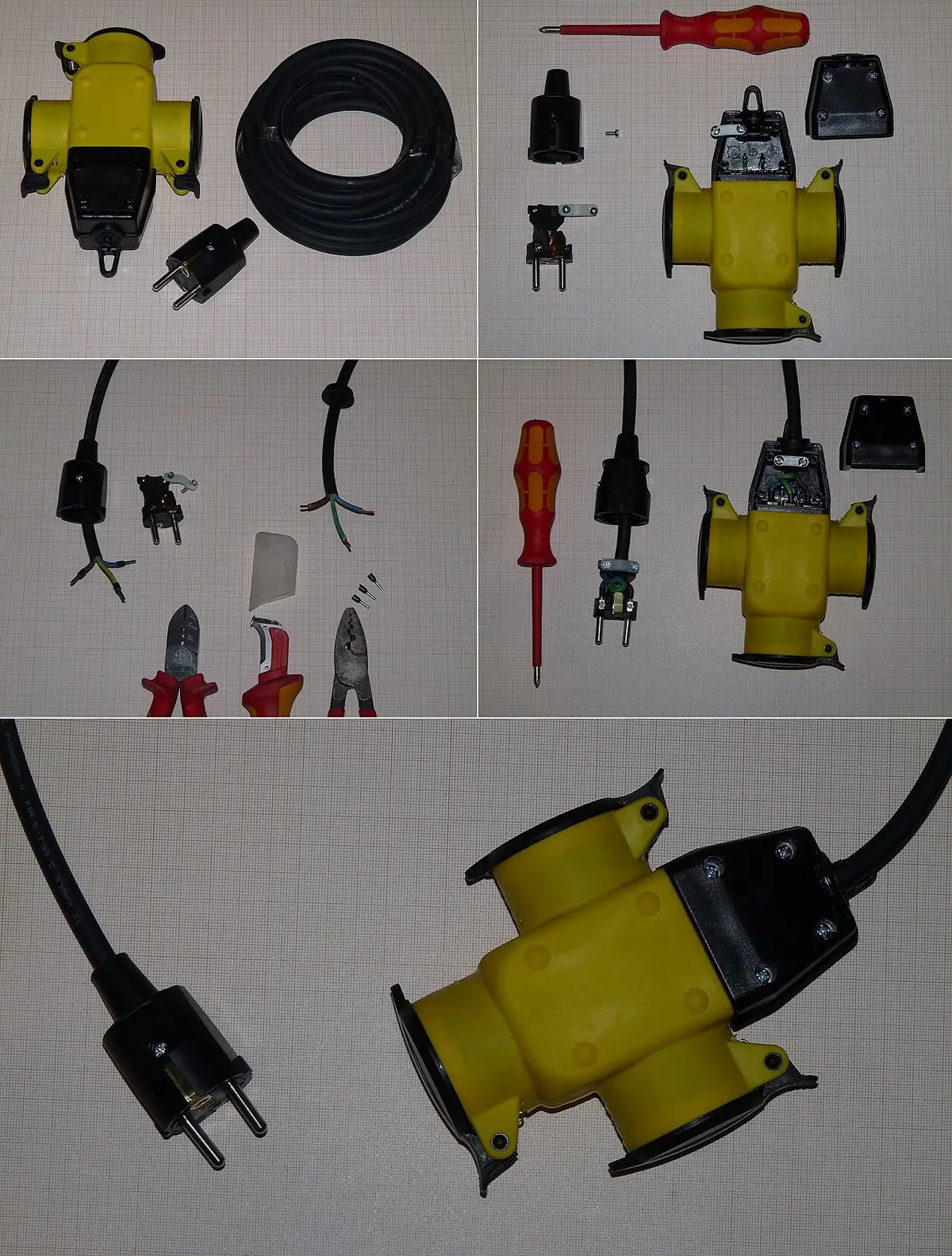
Match the cord to the load: choose a lower AWG number (thicker wire) the more amps you draw and the longer the run. For a typical campsite, a 16 AWG cord is fine for lamps and phone chargers up to about 13 A over 25 to 50 feet, 14 AWG handles up to 15 A at that length, and 12 AWG is the safe choice for anything that draws 10 A or more or runs 100 feet. Make sure the jacket carries a "W" for outdoor use (SJTW or SJEOW, for example), and use a cord with a grounded, three-prong plug.
Most campers pick a cord by length and price, then discover that a cheap, thin one turns warm, trips breakers or makes a heater run weakly. The reason is physics, not bad luck: a long, thin wire has resistance, resistance wastes power as heat, and that heat is what melts jackets and starts fires. Here is how to read the markings, size the cord with real numbers, and choose a cord for tent sites, RV pedestals and generators.
Why gauge and length matter
Electricity flowing through a wire meets resistance. The longer the wire and the thinner it is, the more resistance it has. That resistance causes two things:
- Voltage drop. The voltage at the far end is lower than at the outlet. Motors and compressors run hotter and weaker at low voltage, and some electronics misbehave.
- Heat. The lost power turns into heat inside the cord. A cord loaded beyond its rating can soften its insulation, and a coiled cord traps heat and makes it worse.
Wire thickness is measured in American Wire Gauge (AWG), where a smaller number means a thicker wire. A 10 AWG cord is much thicker than a 16 AWG one. A thicker wire costs more and weighs more, but it carries current with less loss over distance.
Gauge, length and amp ratings
Electrical safety groups publish conservative sizing charts. The numbers below follow the commonly cited approach of matching gauge to amps and length, and they err on the safe side.
| Cord length | 16 AWG | 14 AWG | 12 AWG | 10 AWG |
|---|---|---|---|---|
| 25 ft | Up to 13 A | Up to 15 A | Up to 20 A | Up to 25 A |
| 50 ft | Up to 13 A | Up to 15 A | Up to 20 A | Up to 25 A |
| 100 ft | Up to 10 A | 11 to 13 A | Up to 15 A | Up to 20 A |
| 150 ft | Not advised for heavy loads | Up to 10 A | Up to 13 A | Up to 15 A |
Treat this as a planning guide, not a guarantee. Check the label on the cord and its plug, and never exceed the lowest rating on the cord, plug or socket. If a source tells you a 14 AWG cord is fine for a full 15 A at 100 feet, stay with the more cautious figure when the load is heavy or the cord will be bundled up. A common rule of thumb: if your device draws 10 amps or more, do not use anything thinner than 12 AWG.
Find the amps: how to know what your gear draws
Amps equal watts divided by volts. On a 120 V outlet, a 1,500 W space heater draws 12.5 A. A 60 W lamp draws 0.5 A. Check the label on each device for watts or amps.
| Device | Typical watts | Amps at 120 V |
|---|---|---|
| Phone charger, LED string lights | 5 to 20 | Under 0.2 |
| Laptop charger | 45 to 90 | 0.4 to 0.8 |
| Electric blanket | 50 to 100 | 0.4 to 0.8 |
| Small fridge | 60 to 150 | 0.5 to 1.3, with surge 3 to 5 A |
| Slow cooker, coffee maker | 600 to 1,000 | 5 to 8.5 |
| Microwave | 1,000 to 1,500 | 8.5 to 12.5 |
| Space heater | 750 to 1,500 | 6 to 12.5 |
| RV air conditioner (13,500 BTU) | 1,300 to 1,800 | 11 to 15 plus startup surge |
| Circular saw or other power tool | 1,200 to 1,800 | 10 to 15 |
Add up everything that will be plugged into the cord at once. If the total exceeds the cord's rating, use a thicker cord or split the load across separate cords and outlets. Be careful with generators and battery stations too: if your source can only supply 1,000 W, the cord is not the limit, but a thin cord adds losses to a source that you cannot spare them from. If you are powering a cord from a battery station, see how to size the load in how long a power station runs a 12V fridge.
Reading the jacket markings
A cord's jacket carries printed letters that tell you what it can do. The common codes are:
- S: a flexible service cord for hard use.
- J: junior service, rated for 300 V.
- T: thermoplastic (vinyl) jacket.
- E: thermoplastic elastomer (rubber-like) jacket, which stays more flexible in cold weather.
- O: oil-resistant outer jacket.
- W: suitable for outdoor use and weather exposure.
SJTW means a service cord for junior hard use with a vinyl jacket rated for weather. SJEOW or SJEOOW uses a rubber-like jacket and is oil resistant as well, which stays supple in cold and resists abrasion. For camping, the "W" is essential, and a rubber-like jacket is worth the extra money if you camp in cold weather, because vinyl stiffens and cracks at low temperatures.
Check also for a safety listing, such as UL or ETL, printed on the cord or its packaging. An unlisted cord may use less copper than its label claims, and cheap cords labeled with a heavy gauge sometimes use copper-coated aluminum, which carries less current. If a cord is surprisingly light for its length and gauge, be skeptical.
Plug and socket quality
The weak point of an outdoor cord is often the connection, not the wire.
- Three-prong, grounded plugs. Use grounded cords with grounded equipment. Never remove the ground pin.
- Lighted ends. A small light on the female end tells you the cord is live, helpful at night.
- Molded plugs. They resist crushing and moisture better than screw-together ends.
- Locking or sealed connectors. A locking plug resists pulling apart, and a sealed or cover-protected connection keeps rain and dew out.
- Strain relief. The cord should enter the plug through a thick collar that stops the wire from bending sharply.
For rain exposure, keep connections off the wet ground. Hang them under a cover or put them in a weatherproof junction box. Look for ingress protection ratings such as IP44 for splash resistance in accessories. Even then, no ordinary plug and socket is made to be submerged.
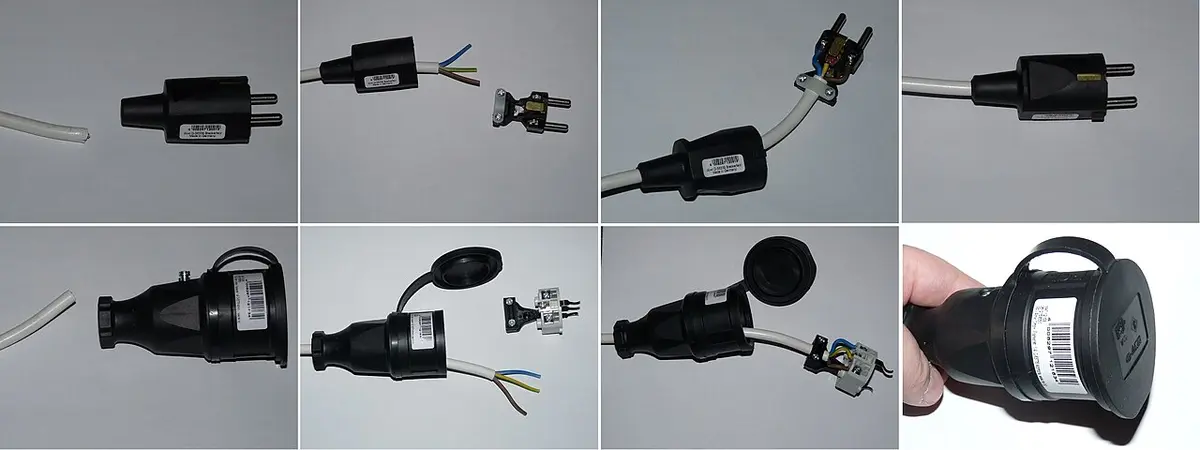
Choosing a cord for a tent campsite
Tent campers with an electric site typically run small loads: lights, phone chargers, a small fan, maybe an electric blanket or a small cooler. A 25 to 50 foot, 14 to 16 AWG cord is enough. Pick one with a lighted end and a bright color so that people do not trip over it. The ground at a tent site gets damp, so elevate the connection and route the cord away from foot traffic. See the best extension cords for tent camping for options, and the best camping extension cords for a broader selection.
Choosing a cord for an RV pedestal
RV pedestals deliver 30 A or 50 A at the connection, and your RV's shore power cord is already a heavy-duty cord. The extension you add must match it. Do not use a household extension cord to connect an RV to power, since an RV can draw 30 A (3,600 W) or 50 A (12,000 W) through its cord.
| RV service | Plug type | Typical cord wire | Notes |
|---|---|---|---|
| 15 or 20 A household | Standard 5-15 or 5-20 | 12 AWG for 20 A | Fine for small trailers on a light load |
| 30 A RV | TT-30 | 10 AWG, 3 conductors | Common for travel trailers |
| 50 A RV | 14-50 | 6 AWG, 4 conductors | Large trailers and motorhomes |
Use a dedicated RV extension cord rated for the amperage and a suitable length. Every extra foot adds voltage drop, so use the shortest cord that reaches. For travel trailers, see the best RV camping extension cords and the best 30 amp camping extension cords. Pair a long RV cord with a surge protector at the pedestal end, so that damage from a bad pedestal does not travel into the camper.
Metric lengths and long runs
Campers who buy abroad or from international sellers often find cords listed in meters. A 10 meter cord is about 33 feet, which suits many campsites where the outlet is close. See the best 10 meter camping extension cords if that length fits. Past 50 feet, step up one gauge, and past 100 feet, step up two. If you find yourself needing a very long cord, consider moving the generator or battery closer to the load or using a higher-voltage solution, since a short cord is almost always safer than a long one.
Budget tiers: what to expect
Price tells you something about copper content and build quality, though not everything. In very rough terms:
- Under $20. Usually 16 AWG, 25 to 50 feet, adequate for lights and chargers. See the best extension cords under $20.
- $20 to $30. Often 14 AWG, longer lengths, better jackets. See the best extension cords under $30.
- $30 to $50. Sometimes 12 AWG at 25 to 50 feet, lighted ends and sturdy plugs. See the best extension cords under $50.
Weight is a helpful clue. A cord that weighs much less than similar ones at the same gauge and length may contain less copper. Do not buy the cheapest cord for a heater or a generator.
A worked voltage drop example
Voltage drop is easy to estimate once you know the resistance of copper wire. Roughly, 12 AWG copper has about 1.6 ohms per 1,000 feet, 14 AWG about 2.5 ohms, and 16 AWG about 4 ohms. Current flows out and back, so the total wire length is twice the cord length.
Suppose you run a 1,000 W electric kettle (8.3 A) through a 50 foot, 16 AWG cord. The round trip is 100 feet, so resistance is about 0.4 ohms. Voltage drop is 8.3 A times 0.4 ohms, about 3.3 V, which is under 3 percent of 120 V. The kettle will work, and the cord will dissipate roughly 28 W as heat spread over 50 feet, which is warm but tolerable. Now swap in a 100 foot cord of the same gauge. Resistance doubles, the voltage drop reaches about 6.6 V (5.5 percent), and the cord sheds 55 W as heat. At that point the appliance runs noticeably weaker, and if the cord is coiled the heat concentrates in the coil.
Repeat with a 12 AWG cord at 100 feet and the resistance of the round trip is about 0.32 ohms. The same kettle sees a drop of about 2.7 V, or 2.2 percent, which is comfortably inside the usual guideline of keeping drop under 3 to 5 percent. That is why a thicker cord feels so different at long distances: it is not a matter of the appliance working, it is a matter of how much energy is wasted before the power arrives.
When to skip the cord and move the source
Sometimes the right fix for a long, heavy run is not a better cord but a shorter one. If you are powering a camp kitchen, an air conditioner or power tools from a generator, putting the generator within 25 feet of the load (while still keeping it safely distant from sleeping areas and downwind) saves more than a thicker cord does. Similarly, a battery power station can sit in the tent vestibule or on the picnic table, so a short cord reaches everything, and the station can be charged with solar from a separate panel cable placed in the sun. Low-voltage DC runs are even less forgiving of length, since the same wattage at 12 V draws ten times the current of 120 V AC, so keep DC cables short and thick.
Cord storage and care
A good cord lasts a decade if you treat it well. After each trip, wipe off dirt and dampness, then let the cord dry before coiling. Store it loosely looped in a dry place, using the over-under coiling method to avoid twists that stress the conductors. Avoid hanging it by a nail, which creates a sharp bend, and keep it away from solvents and fuel, which can degrade the jacket. In freezing weather, handle the cord gently: vinyl jackets stiffen and can crack, which is another reason to choose a rubber-like jacket for cold-weather camping. Replace cords that have cuts, exposed conductors, softened spots or plugs that have gone loose in the socket. A plug that does not grip tightly creates a high-resistance contact that heats up under load, and that is a more common failure point than the wire itself.
Setup and safety at the campsite
- Uncoil the entire cord before use. A coiled cord under load heats up, and heat can melt the jacket.
- Route it away from foot and vehicle traffic. Use cord covers or bury it in leaves only if allowed, never under a rug where heat is trapped.
- Keep connections dry and off the ground. Use a cord connection cover, or a plastic box, and tilt the connection so that water runs away.
- Plug into a GFCI outlet. Ground fault circuit interrupters cut power fast when current leaks. Most modern pedestals include them. Otherwise use a portable GFCI adapter.
- Do not daisy chain. Chaining several cords adds resistance and connection points. Use one properly sized cord.
- Inspect before every trip. Look for cracked insulation, bent or loose prongs and discoloration. Replace damaged cords, do not tape them.
- Feel the cord and plug after 15 minutes at full load. Warm is normal. Hot means the cord is too small, the connection is poor or the load is too large.
- Unplug at the outlet end first when disconnecting, and never pull by the cord.
For small power sources, remember that the cord is only one part of the system. If your load comes from a battery station or a generator, consider the watt-hours versus mAh explanation to understand how long your battery lasts on a given load, and read how to size a solar panel for camping if panels feed that battery.
Common mistakes to avoid
- Choosing a cord by length and price alone. Check the gauge and the amp rating.
- Using an indoor cord outdoors. Without a "W" rating, the jacket may crack and absorb moisture.
- Running a heater or microwave on a 16 AWG cord. It is a common cause of melted plugs.
- Leaving the cord coiled while in use. Heat has nowhere to go.
- Using a household cord for a 30 A or 50 A RV connection. It cannot carry the current.
- Joining cords with tape or homemade splices. Moisture gets in, and the connection can fail or shock.
- Forgetting about the voltage drop on long runs. The appliance may run hot or weak.
Frequently asked questions
What gauge extension cord do I need for a camping lantern and phone charger?
Almost any 16 AWG outdoor cord handles it, because the total load is well under 1 amp. Choose a length that reaches without slack, a "W" rated jacket and a lighted end so you can see that it is live.
Can I use a 100 foot extension cord for a space heater?
It is not advised. A 1,500 W heater draws 12.5 A, and over 100 feet you would need at least a 12 AWG cord, and ideally a shorter one. Heaters are among the most common causes of cord overheating, so use the thickest, shortest cord you can, or avoid a cord entirely.
Is it safe to leave an extension cord plugged in outside overnight?
It can be if the cord is outdoor-rated, plugged into a GFCI outlet, kept off wet ground and under a rating-appropriate load. Use a cover on the connection, and inspect it before sleeping if rain is forecast. Unplug if you are not using it.
What is the difference between SJTW and SJEOW cords?
Both are outdoor-rated service cords. SJTW has a vinyl jacket, while SJEOW has a rubber-like jacket that is also oil resistant and stays flexible in cold weather. SJEOW usually costs more but handles winter camping and abrasion better.
Can I use a thinner cord if it is shorter?
Shorter cords lose less to resistance, so a short thin cord can carry its rated current. The limit is the amp rating on the cord itself, so a 16 AWG cord still tops out around 13 A at short lengths. Do not exceed that, even at 10 feet.
Do I need a special cord for a generator?
Use a cord rated for the full current of the outlet you are using, and keep it as short as practical. For a 30 A generator outlet, use a 30 A generator cord with a matching locking plug. Never use a light-duty cord for a high-wattage load.
Sources & further reading
- ESFI: Extension cord safety
- Lowe's: Extension cord gauge guide
- WC Safety: Extension cord gauge chart
Image credits
- "DIY outdoor extension cord" by Dmitry G, CC BY-SA 3.0, via Wikimedia Commons.
- "DIY outdoor IP44 extension cord" by Dmitry G, CC BY-SA 3.0, via Wikimedia Commons.


Ready to buy?
Compare the gear: Camp Power
6 Best Extension Cords Under 20 in 2026
Best extension cords under $20: six 20 to 50 ft 16-gauge outdoor and indoor cords compared on length, grounding and weather ratings for camping.
6 Best Extension Cords Under 30 in 2026
Best extension cords under $30: six 25 to 50 ft outdoor and flat-plug cords compared on length, weather rating and outlet count for camping.
6 Best Extension Cords Under 50 in 2026
Best extension cords under $50: six heavy-duty 10 and 12 gauge outdoor cords from 25 to 50 feet, compared on wire gauge, jackets and what extra money buys.
5 Best Camping Extension Cords in 2026
Best camping extension cords compared on gauge, length, outlet count and weather rating for campsites with a distant power post.
6 Best Extension Cords For Tent Camping in 2026
Best extension cords for tent camping compared on length, outlet count, lighted ends and weather rating for campers who power lights and chargers.
3 Best RV Camping Extension Cords in 2026
Best RV camping extension cords compared on TT-30 plugs, 10 gauge wire, length and weather rating for 30 amp rigs reaching a pedestal.
4 Best 10m Camping Extension Cords in 2026
Camping extension cords near 10 meters (about 33 ft), compared on 25 ft and 50 ft options, wire gauge, amp rating and plug type.
4 Best 30 Amp Camping Extension Cords in 2026
Best 30 amp camping extension cords compared on TT-30 and twist-lock plugs, 10 gauge wire, length options and weather protection.
Keep reading