
Practical Camping Guide · 12 min read
LiFePO4 vs Lithium-Ion (NMC) Power Stations
Compare LiFePO4 and NMC lithium-ion power stations on cycle life, safety, weight, cold charging and price so you pick the right chemistry for camping.

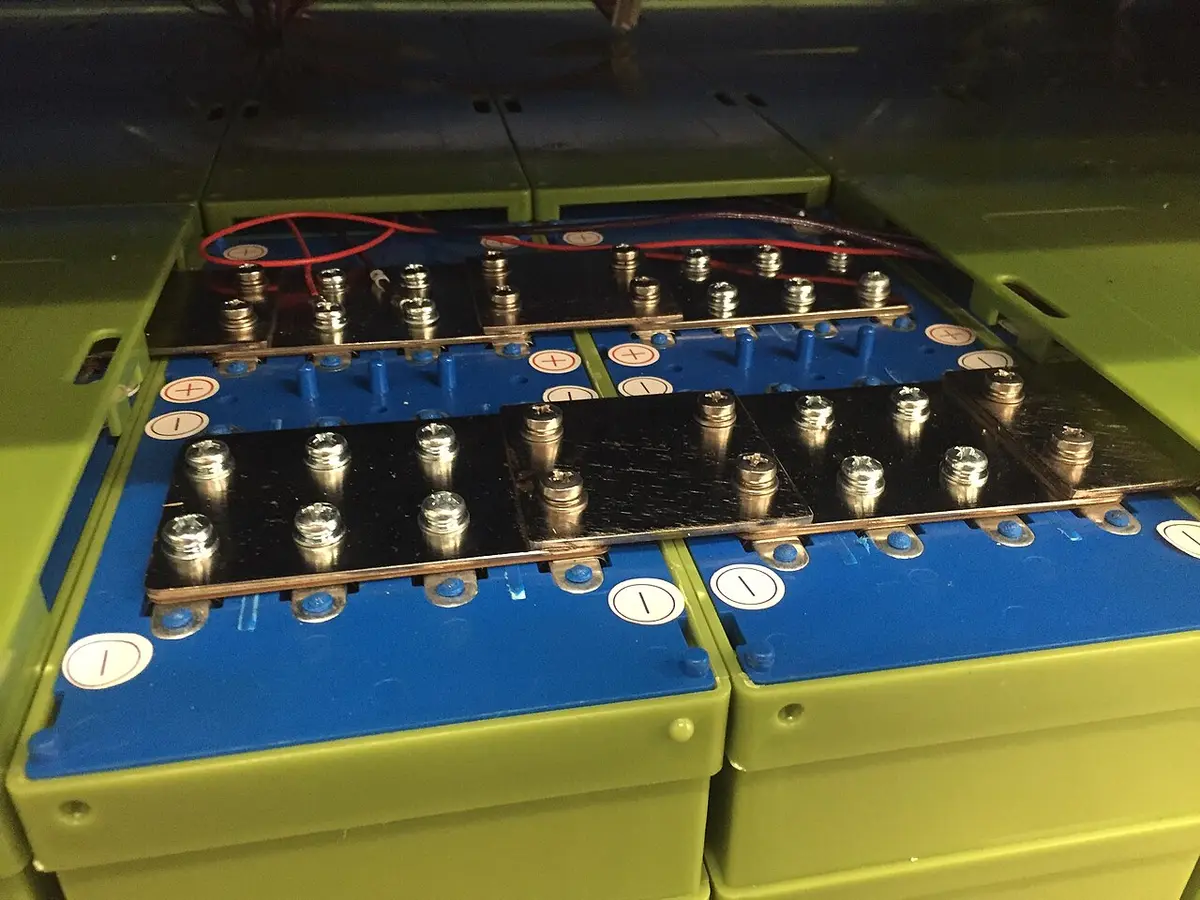
For a camping power station you will keep for years, LiFePO4 (lithium iron phosphate) is usually the better chemistry: it is commonly rated for 2,000 to 6,000 charge cycles, tolerates heat and abuse better, and holds its capacity for a decade of weekend use. Lithium-ion NMC (nickel manganese cobalt) wins on weight and size, so it still makes sense for a backpack-friendly unit or a tight budget. Most of the trade-off comes down to cycle life and safety versus weight and price.
Both are lithium batteries, both charge from a wall, a car or solar, and both power the same appliances. The difference shows up in the third and fourth year of ownership, in a hot trunk in August, and when you try to lift the thing out of the truck. Here is how the two chemistries differ in ways that matter at a campsite, and a decision framework you can apply to any spec sheet.
What the labels actually mean
"Lithium-ion" is the umbrella term for a family of batteries. In consumer power stations it usually means NMC or a close cousin such as NCA, which use nickel, manganese and cobalt in the cathode. LiFePO4, sometimes written LFP, uses iron phosphate in the cathode instead. Both are rechargeable lithium cells with a graphite anode, and both are managed by a battery management system (BMS) that watches voltage, current and temperature.
The cell chemistry changes the numbers:
| Property | NMC lithium-ion | LiFePO4 (LFP) |
|---|---|---|
| Nominal cell voltage | About 3.6 to 3.7 V | About 3.2 V |
| Typical cycle life to 80 percent capacity | 500 to 1,000 cycles | 2,000 to 6,000 cycles |
| Energy density at pack level | Higher, roughly 150 to 250 Wh/kg at cell level | Lower, roughly 90 to 160 Wh/kg at cell level |
| Thermal stability | Good with a BMS, lower runaway threshold | Better, higher runaway threshold |
| Usable depth of discharge | Often 80 to 90 percent | Often 90 to 100 percent |
| Cost per Wh | Historically lower upfront | Historically higher upfront, lower per cycle |
These ranges reflect typical manufacturer data and industry reporting. Specific units can fall outside them, which is why the spec sheet and the warranty matter more than the chemistry label alone.
Cycle life: the number that decides total cost
A cycle is one full discharge and recharge. In practice, two half cycles count as one. A camper who uses a power station for 30 weekend trips a year, draining it about once each trip, puts around 30 to 60 cycles a year on it. At 500 cycles, an NMC unit reaches 80 percent capacity in 8 to 16 years of that light use, but if you use the same station daily for a van or remote work, it reaches that in a year or two. A LiFePO4 unit with 3,000 cycles reaches the same point in 8 years of daily use and well beyond a lifetime of occasional use.
Calendar aging matters too. Batteries age with time and heat even when not used. Heat is the bigger factor: a trunk or a shed in summer can reach 120 degrees F or more, and both chemistries lose capacity faster when stored hot. LiFePO4 tolerates heat better, though neither should sit in a car all summer.
If you use your station for 10 to 20 nights a year, either chemistry will outlast your interest. If you use it as a daily power source for work-from-van, full-time living or home backup, cycle life becomes the dominant cost factor, and LiFePO4 pays for itself. To see how many cycles you would really use, compare your daily Wh from our guide to how long a power station runs a fridge with the unit's capacity.
Safety: what "safer" really means
Lithium batteries can fail by thermal runaway, a chain reaction where a damaged or overheated cell heats its neighbors. LiFePO4 has stronger chemical bonds and a higher temperature threshold before it starts to release oxygen, so it is less prone to violent failures and fire. NMC, with a lower runaway threshold, has a higher risk of venting if it is punctured, short-circuited, overcharged or heated.
Both chemistries rely on a good BMS, and a poorly designed unit of either type can be unsafe. Modern power stations from established makers include protections for over-voltage, under-voltage, over-current, short circuit and over-temperature. The practical advice for camping is the same for both: do not leave a station in a hot car, do not charge it under a sleeping bag, do not use a damaged unit, and keep it away from a campfire or a heater.
In summary, LiFePO4 gives a bigger margin for mistakes. It is not fireproof, but it fails more gently.
Weight and size: where NMC still wins
The trade-off is physical. At the cell level, NMC packs more energy per kilogram and per liter. That shows up in the pack as roughly 20 to 40 percent less weight for the same capacity in many comparisons, though the extra weight of the inverter, case and fans narrows the gap on small units.
| Capacity class | Typical NMC unit weight | Typical LiFePO4 unit weight |
|---|---|---|
| About 300 Wh | 6 to 8 lb | 8 to 10 lb |
| About 700 to 1,000 Wh | 16 to 22 lb | 20 to 28 lb |
| About 2,000 Wh | 40 to 50 lb | 45 to 65 lb |
Those weights are indicative and vary by brand. What they show is that on a hike-in trip or when you load a kayak, NMC saves meaningful pounds. In a car, truck or RV, the extra pounds of LiFePO4 rarely matter, and for most campers the choice should lean on cycle life.
Cold-weather behavior
Lithium batteries of all kinds should not be charged below freezing (32 degrees F, 0 degrees C) unless the manufacturer specifies low-temperature charging. Charging a cold lithium cell can plate metallic lithium on the anode, which permanently reduces capacity and can create a safety hazard. Many stations either refuse to charge in the cold or include a self-heating feature. LiFePO4 is particularly sensitive to this, so check the spec for "charging temperature" rather than just "operating temperature".
Discharging in the cold is less damaging but reduces available capacity. Expect 10 to 30 percent less usable energy near freezing. For winter camping, keep the station inside the vehicle or the tent, insulated, and consider a model with a heater. The extra margin matters when a cold night is also the night you use a heated blanket or a CPAP.
Voltage and system compatibility
A LiFePO4 pack is built from four 3.2 V cells in series for 12.8 V, which is a convenient match for 12 V systems, a "drop-in" replacement for lead-acid. NMC stacks usually produce 10.8 to 14.8 V nominal depending on the cell count, and station designers hide that behind a DC-DC converter. For camping, this rarely matters unless you are building a battery bank and connecting separate batteries together. If you are building your own system, see best LiFePO4 camping batteries for the 12 V drop-in options, and use the planning method in how to size a solar panel for camping to match panels to the pack.
Real-world capacity you can use
LiFePO4 packs can typically be discharged to 90 or even 100 percent of their label capacity without much damage, and they hold a flatter voltage curve through most of the discharge, which means devices run at consistent power until the end. NMC packs have a sloping voltage curve and manufacturers usually restrict usable depth to protect the cell, which makes the label capacity a bit more optimistic than the delivered capacity.
That is one reason a 1,000 Wh LiFePO4 station often delivers as much usable energy as a nominally larger NMC unit. When you compare two stations in the same price range, look at both the label Wh and the rated cycles, and divide: Wh per cycle per dollar is a rough but useful way to compare. For the underlying watt-hour math, our explainer on watt-hours versus mAh walks through usable versus label capacity.

Price: upfront versus lifetime
NMC units tend to cost less per watt-hour upfront because the supply chain is mature and the units are smaller. LiFePO4 units have narrowed that gap in recent years as production has scaled, but a typical like-for-like model still carries a premium. A simple lifetime view makes this clearer: a 1,000 Wh station that costs 30 percent more but lasts four to six times as many cycles is far cheaper per kilowatt-hour delivered. If you will use it fewer than 100 times in its life, that math does not matter, and the cheaper unit is a rational choice.
For the budget-conscious, the best budget lithium portable power stations include NMC units that fit this thinking, and our best LiFePO4 portable power stations for camping list covers the long-life tier.
How to tell which chemistry a station uses
Manufacturers do not always put the chemistry in the product title. Look for:
- The spec sheet's battery line. It might say "LiFePO4", "LFP", "Lithium Iron Phosphate", "Li-ion NMC" or "Lithium-ion".
- The rated cycle life. "3,000+ cycles to 80 percent" is a LiFePO4 signal. "500 cycles" is NMC.
- The weight per watt-hour. A 1,000 Wh unit under about 22 lb is likely NMC. Above that, it may be LiFePO4.
- The warranty. Five-year or longer warranties are more common with LiFePO4.
- The cell voltage. A 12.8 V nominal battery is LiFePO4. A 14.4 V or 11.1 V nominal pack is NMC.
When the product page is vague, assume NMC and verify before paying a LiFePO4 price.
Matching chemistry to the way you camp
- Weekend car camping, 10 to 20 nights a year: either chemistry. Choose on weight, price and features.
- RV owners who run a fridge and CPAP: LiFePO4. The daily cycling shortens the life of NMC.
- Backpack or kayak camping: NMC for weight, ideally in a small capacity.
- Home backup plus camping: LiFePO4. Backup units sit at full charge for months, and LFP handles that better. See also the best power stations for refrigerators if a fridge is the main load.
- Cold climates: whichever has a low-temperature charging protection feature, and store the unit indoors.
- Large loads such as a 30 amp RV connection or a 240 V appliance: capacity, output rating and chemistry all matter, so browse the best 30 amp portable power stations for RV camping and the best 240V portable power stations.
Storage and care for either chemistry
Both chemistries last longer if you avoid extremes. Store the station at about 40 to 60 percent charge if you will not use it for months, in a cool, dry place away from direct sun. Top it up every three to six months. Avoid leaving it plugged in at 100 percent in a hot space for weeks. Charge it before a trip, not a week earlier. LiFePO4 is more forgiving of full-charge storage than NMC, but neither enjoys heat.
Use the right chargers and cables. A mismatched charger or a damaged cable can overheat connectors long before the battery is the problem. Keep air vents clear, and do not run a station inside a sealed bag or box. If a unit gets swollen, hot to the touch while idle, or smells chemical, stop using it and contact the maker.
A worked ownership comparison
Imagine two 1,000 Wh stations. Unit A is NMC, rated for 800 cycles to 80 percent, and costs 100 units of currency. Unit B is LiFePO4, rated for 3,500 cycles, and costs 130. Suppose you drain each about 60 times a year, which is a camper who goes out most weekends and uses a good share of the battery each trip.
Unit A reaches its 80 percent mark after about 13 years on paper, but real packs also age with calendar time and heat, so a more cautious estimate is 7 to 10 years of useful life. Unit B reaches 80 percent after nearly 58 years of that use, which is obviously longer than any electronics will survive, so its practical life is set by the inverter, fans and connectors, probably 10 to 15 years. In that scenario the two units have a similar practical lifespan and the cheaper one wins on cost.
Now change the usage to 250 cycles a year, as with a van dweller or a remote worker. Unit A reaches the 800 cycle mark in just over three years. Unit B has plenty of life left. The extra 30 units of currency buy roughly four times the service life, and the cost per delivered kilowatt-hour falls to a fraction. The break-even point is somewhere around 100 cycles a year, which is a useful rule of thumb: below it, choose on weight and price, and above it, choose LiFePO4.
Questions to ask before you buy
- How many cycles is the battery rated for, and to what remaining capacity? A rating of 3,000 cycles to 70 percent is not the same as 3,000 cycles to 80 percent.
- What is the warranty period, and does it cover capacity loss or only failure?
- Can it charge below freezing, and does it have a heater? This matters for shoulder-season camping.
- What is the continuous and surge output, and does it match your biggest load?
- Is there a 12 V DC output rated for a fridge, and what is its current limit?
- Can the battery be expanded with an extra battery pack, and is the pack the same chemistry?
- What is the real weight in pounds, and can you lift it at the angle you will need, such as from a truck bed?
Write the answers down for each candidate. Spec sheets that avoid answering these questions are telling you something, and the missing answer is usually the less flattering one. Treat a vague cycle-life claim the way you would treat a vague fuel economy claim: ask for the test conditions.
Common mistakes to avoid
- Judging by capacity alone. Two 1,000 Wh units may differ by a factor of four in lifetime cycles.
- Assuming LiFePO4 can charge in the cold. Most cannot below 32 degrees F without a heater.
- Paying LiFePO4 prices for NMC. Verify the chemistry and rated cycles before buying.
- Ignoring weight. A 60 lb unit that you cannot comfortably lift will stay in the garage.
- Storing at 100 percent in a hot trunk. It speeds up aging for any lithium battery.
- Treating "safer" as "safe". Both chemistries need a good BMS, proper charging and care.
Frequently asked questions
Is LiFePO4 worth the extra money for occasional camping?
Often not. If you camp fewer than 20 nights a year, an NMC station can last a decade or more, and the savings in cost and weight may matter more. LiFePO4 becomes worth it with frequent cycling, hot storage, home backup duty or an expectation of keeping the unit more than eight years.
Can I swap a LiFePO4 battery into a station designed for NMC?
No. Power stations are sealed systems with a BMS tuned for one chemistry. Voltage and charging profiles differ. Choose a unit built for the chemistry you want, or build your own system from a 12 V LiFePO4 battery, a charge controller and an inverter.
Do LiFePO4 stations last longer in the heat?
They handle heat better than NMC, but they still age faster when hot. Keep them shaded and ventilated, and avoid leaving any lithium battery in a closed vehicle on a summer day.
Why are LiFePO4 power stations heavier?
The cells store less energy per kilogram, so the same capacity needs more cells. Pack, inverter and case weight are similar, so the cell difference shows up directly in the total, usually 20 to 40 percent more for the same Wh.
What does "3,000 cycles to 80 percent" mean?
It means after 3,000 full charge and discharge cycles, the battery should still hold about 80 percent of its original capacity under the test conditions. It does not mean the battery stops working, and real life varies with temperature, depth of discharge and charge rate.
Is NMC dangerous?
No, a well-made NMC power station with a proper BMS is widely used and generally safe in normal use. Risk rises with damage, overheating or poor-quality units. LiFePO4 simply has more margin if something goes wrong.
Sources & further reading
- Renogy: battery capacity and conversion guide
- Anker: battery capacity basics
- Battery University: Types of lithium-ion batteries
Image credits
- "Lithium Iron Phosphate LiFePO4 Cells 400 Ah Amp Hours 3.25 Volts - 5" by Yo-Co-Man, CC BY-SA 4.0, via Wikimedia Commons.
- "Lithium Iron Phosphate LiFePO4 Cells 700 Ah Amp Hours 3.25 Volts - 7" by Yo-Co-Man, CC BY-SA 4.0, via Wikimedia Commons.


Ready to buy?
Compare the gear: Camp Power
5 Best 2400w Portable Power Stations in 2026
Best 2400W portable power stations compared on capacity, surge, charge speed, ports and warranty for RVs, home backup and heavy camp loads.
6 Best LIFEPO4 Camping Batteries in 2026
Best LiFePO4 camping batteries compared on capacity, BMS protection, cold-weather charging and size for tents, vans and small solar setups.
3 Best 240v Portable Power Stations in 2026
Best 240V portable power stations compared on how each listing reaches 240V, capacity, output and expansion for RV, cabin and home backup use.
2 Best 30 Amp Portable Power Stations For RV Camping in 2026
Best 30 amp portable power stations for RV camping compared on TT-30 outlet, capacity, expansion and recharge options for a travel trailer.
4 Best 4000w Portable Power Stations in 2026
Best 4000W portable power stations compared on rated output versus peak surge, capacity and expansion for RV, cabin and backup use.
4 Best 768Wh Portable Power Stations in 2026
Best 768Wh portable power stations compared with smaller step-down options on output, ports and weight for camping, short outages and RV trips.
2 Best LIFEPO4 Portable Power Stations in 2026
Best LiFePO4 portable power stations compared on cycle life, output, charging speed and weight, with notes on which listings name the chemistry.
3 Best Portable Power Stations For Refrigerators in 2026
Best portable power stations for refrigerators compared on standby draw, UPS switchover, output and capacity for outages, RV trips and camping.
Keep reading