
Practical Camping Guide · 13 min read
Surge Protector Joule Ratings Explained
Joules measure how long a surge protector lasts, not how well it protects. Learn UL 1449 VPR, EMS features and what RV campers should buy.

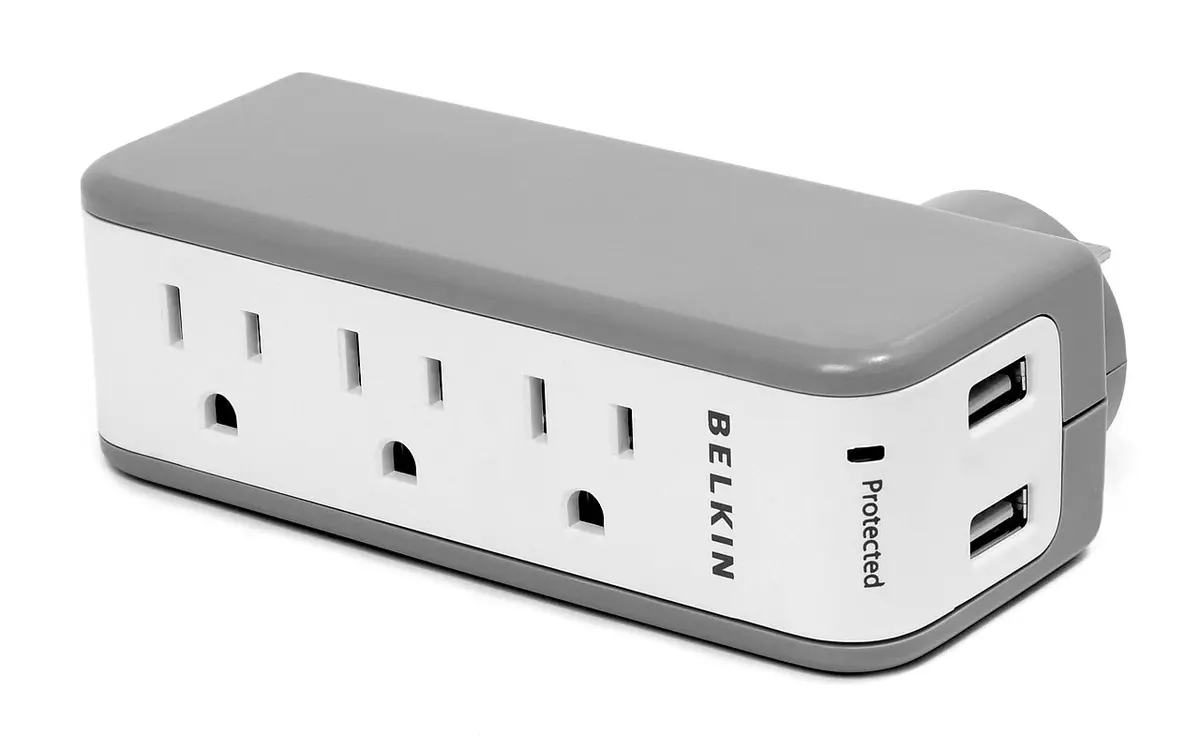
A joule rating tells you how much surge energy a protector can absorb before it wears out, not how well it shields your gear in the moment. The number that actually describes protection quality is the UL 1449 voltage protection rating (also called let-through or suppression voltage), where 330 V is the common benchmark for 120 V equipment and lower is better. For an RV or camping setup, a unit with a modest joule rating, a UL 1449 listing and a low let-through voltage beats a flashy, high-joule unit with no listing.
Joules are the first number on every surge protector box, which is why they get so much attention. The truth is more nuanced: joules measure durability, not defense. Here is what the figure means, what to look at instead, how surge protectors and electrical management systems (EMS) differ for campers, and a practical checklist for buying one.
What a joule is, and what it measures
A joule is a unit of energy (one watt for one second). On a surge protector it describes how much energy the internal protection components can absorb over their life. Most consumer surge protectors use metal oxide varistors (MOVs). A MOV is a component that behaves like an open circuit at normal voltage and conducts when the voltage rises above a threshold, diverting the extra energy away from the protected device. Each time it does this, the MOV degrades a little, and the joule rating is a rough estimate of how much total absorption it has before it fails.
So joules answer the question "How long will this protector last under repeated hits?" and "How big a single event can it survive?" They do not answer "How high a voltage spike will reach my laptop?" That second question is about clamping voltage, and it matters more for the equipment you are protecting.
A good comparison is a bucket and a valve. The joule rating is the size of the bucket that collects overflow. The clamping voltage is the setting of the valve that decides when overflow starts. A huge bucket with a valve that opens too late still lets a damaging spike through.
Why a higher joule rating is not always better
Manufacturers advertise joules because the number is large and easy to compare. A protector listed at 4,000 joules sounds twice as protective as one at 2,000. Engineering sources, including a U.S. military facilities criteria manual, note that the joule figure is not an important performance attribute and is often misunderstood. A device with a higher let-through voltage can have a high joule rating, because it lets more of the surge pass through to the load rather than diverting it, and so appears to "absorb" more.
In practice, the useful interpretation is:
- Joules suggest lifespan. A higher rating usually means more or larger MOVs, which spread the work and last through more events.
- Joules do not guarantee protection. Two units with the same joule rating can let very different voltage through.
- Joule claims are not standardized. Different makers test and report differently, and RV-oriented marketing numbers are often inflated or inconsistent.
If you see a protector advertised with a giant joule figure but no UL 1449 listing and no let-through voltage, treat the number with suspicion.
The numbers that matter more
UL 1449 and voltage protection rating
UL 1449 is the U.S. safety standard for surge protective devices. It tests how much voltage reaches the load during a standardized surge, and assigns a Voltage Protection Rating (VPR). Standard VPR levels for 120 V equipment include 330 V, 400 V, 500 V, 600 V and higher. A VPR of 330 V is the lowest standard level and is considered the best. A listing mark (UL, ETL or similar) also means the device has been tested for safety, such as not catching fire when its components fail.
| Spec | What it tells you | What to look for |
|---|---|---|
| UL 1449 listing | Passed safety and performance testing | Listed, with the mark on the product |
| VPR (let-through voltage) | Peak voltage reaching the load in a test | 330 V or 400 V is good, higher is weaker |
| Joules | Energy absorbed over its life | Moderate to high, as a durability hint |
| Response time | How fast the MOV conducts | Nanoseconds, rarely a meaningful differentiator |
| Protection modes | Line-neutral, line-ground, neutral-ground | All three modes, ideally |
| Status indicator | Whether protection is still working | A "protected" light or app status |
Remember that ratings from different UL 1449 editions are not directly comparable, so look at the edition when comparing older units. Also be cautious of makers who quote only a "clamping voltage" without the standardized VPR, since the two can differ.
Protection modes
A good protector monitors all three conductor pairs: hot to neutral, hot to ground and neutral to ground. A device that protects only line to neutral leaves gaps. Higher-quality RV protectors list all modes.
Indicator and failure behavior
MOVs wear out, and many cheap strips keep supplying power after the protection has failed, without telling you. A good protector has a status light that goes out, or cuts power, when protection is gone. If a protector has taken a strong hit, replace it.
Surge protector versus EMS for RVs
A basic surge protector only clamps spikes, which are brief overvoltage events from lightning, utility switching or heavy equipment cycling. An electrical management system (EMS) adds a monitor and a disconnect relay. The EMS measures voltage, amperage and wiring faults continuously and disconnects your RV when a problem appears.
| Hazard | Basic surge protector | EMS |
|---|---|---|
| Voltage spike (microseconds) | Protects | Protects |
| Sustained high voltage (over about 128 V) | No | Disconnects |
| Brownout, low voltage (below about 104 V) | No | Disconnects |
| Open or reversed polarity | Some indicate | Disconnects |
| Open ground or neutral | Some indicate | Disconnects |
| Miswired pedestal | Some indicate | Disconnects, shows fault code |
| Power restoration after a fault | Immediate | Delay of 90 to 180 seconds to protect the air conditioner |
Low voltage deserves special mention. On a hot day in a crowded campground, voltage at the pedestal can sag well below the nominal 120 V, and air conditioners and refrigerators run hot and fail early under those conditions. A surge-only unit does nothing about it. If your RV has an air conditioner, a fridge compressor or any other motor load, an EMS with low-voltage cutoff is a sensible choice. See the best RV surge protectors with low voltage protection and the best RV surge protectors with auto shutoff.
Features campers actually use
- Circuit analysis. A pedestal tester detects open ground, reversed polarity and other wiring faults before you connect. The best RV surge protectors with circuit analyzers show what that looks like in practice.
- Bluetooth or Wi-Fi monitoring. An app displays voltage and amperage and alerts you to faults while you are away from the RV. Compare the best RV surge protectors with Bluetooth and the best RV surge protectors with Wi-Fi if remote monitoring matters. A Wi-Fi unit depends on a signal at the campsite, while Bluetooth works only within range, a trade-off to weigh against your habits.
- Auto shutoff. The relay opens when conditions are unsafe, and closes again after a delay.
- Hardwired or portable. A portable unit travels with you, plugs into the pedestal and locks with a cable. A hardwired unit is installed inside the RV and protects every site, though it costs more to install.
- Generator compatibility. Some protectors can misbehave on generator power, because voltage and frequency may be less stable. The best RV surge protectors for generators covers units that accommodate that.
- Weather rating and lock. Pedestal units sit outdoors, and a locking cable or bracket deters theft.
Amp rating: 30 A, 50 A and adapters
Choose the amperage that matches your RV's shore power cord: 30 A with a TT-30 plug for many travel trailers, or 50 A with a 14-50 plug for larger rigs. A 30 A protector on a 50 A rig will not work, and an adapter that steps 50 A down to 30 A limits power, so use one only when needed. Make sure the protector is rated for at least the current your RV can draw, with room to spare, since an underrated unit overheats.
Budget tiers
The price of an RV surge protector reflects the features more than the joules. A basic surge-only 30 A unit costs the least, and an EMS with low-voltage cutoff costs more. Look at the best RV surge protectors under $100 for simpler units and the best RV surge protectors under $150 for a step up toward EMS features. Spending more on an EMS makes sense when you own an air conditioner or fridge worth far more than the protector.
A practical buying checklist
- Match the amperage and plug type to your RV's shore power cord.
- Look for a UL 1449 listing and the VPR value, not just the joules.
- Check for all three protection modes.
- Decide on surge-only or EMS. If you run an air conditioner, choose EMS with low-voltage cutoff.
- Confirm the thresholds. Over-voltage cutoff around 128 to 132 V and under-voltage cutoff around 104 V are common settings.
- Check the reconnect delay. A delay of one to three minutes protects compressors.
- Look for a status display. You should see voltage, amps and fault codes at a glance.
- Check the build. Weatherproof housing, a lock, and a sturdy plug.
- Read the warranty. A good protector offers equipment coverage or a multi-year warranty.
- Consider how you power the RV. If you use a generator or inverter at times, check compatibility.
Using protectors with other camping gear
Surge protection is not only an RV issue. A tent camper with a pedestal outlet and a laptop, or a vanlifer plugged in to shore power, can use a smaller power-strip protector with the same principles: look for UL 1449, a clear status light and a decent VPR. For power stations, an extra protector is rarely necessary on the output side since the inverter regulates the voltage, but it helps on the input when you charge from a campground outlet. Be sure any strip you use is rated for the current drawn, and plug heavy loads, such as space heaters, directly into the wall rather than into a strip. For help working out your loads and battery size, see how long a power station runs a 12V fridge, watt-hours versus mAh and how to size a solar panel for camping.
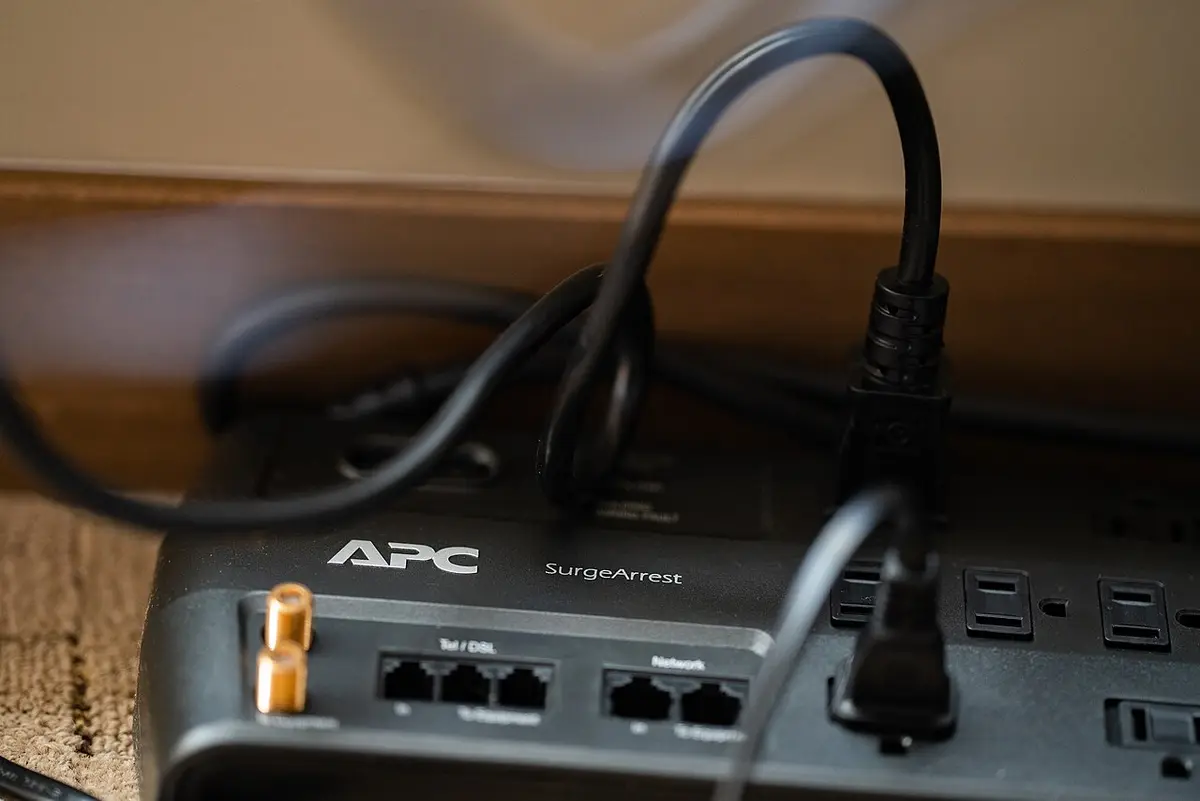
How surge protectors fail
Understanding failure helps you decide when to replace one. Each MOV degrades with every surge, and many small surges together shorten life as much as one big one. Heat and age also play a part. Failure can be gradual, with the protector slowly losing effectiveness, or sudden, with a large surge destroying the MOVs. Quality units include thermal fuses that disconnect the MOVs when they overheat, so the protector fails safe instead of catching fire. Cheap units may skip this safeguard, which is why a listing matters.
Replace a protector when:
- The status light indicates protection is gone.
- It has been through a lightning strike or a known large surge.
- It is more than about five years old in heavy use, or has been used in a harsh environment.
- The housing is discolored, warm without a load or has a burning smell.
Keep in mind that no protector stops a direct lightning strike. Unplug sensitive equipment in a storm if you can.
Where surges and bad power really come from at campgrounds
Campers tend to picture lightning, but most damaging events are quieter and more common. A campground pedestal is the end of a long chain of wiring, often older than the RVs plugged into it, and the faults that matter come from that chain.
- Switching surges. When a large motor at the campground, such as an air conditioner or a pump, cycles on and off, it can send small voltage spikes down the line. These are usually below the level that damages equipment instantly, but they hit MOVs again and again.
- Low voltage from overloaded circuits. On a hot weekend, dozens of air conditioners can pull a feeder down by 10 percent or more. Motors then draw extra current to compensate, which overheats windings.
- High voltage and lost neutral. A broken neutral conductor can push one leg of a 120/240 V system far above its normal level while the other sags. That is the kind of event that destroys televisions and converters in seconds.
- Reversed polarity and open ground. Miswired pedestals are not rare in older parks, and they remove the protective path that makes a fault safe.
- Generator irregularities. Poorly regulated generators can deliver high voltage on startup or sag under load.
Most of these are sustained conditions rather than short spikes. This is why a protector with a respectable joule rating but no voltage monitoring can feel like insurance and still leave the expensive appliances exposed.
Reading the fine print on a product page
When you compare listings, look for evidence rather than adjectives. "Military grade," "ultimate protection" and "lifetime protection" do not mean anything measurable. These details do:
- The listing standard. A named standard, such as UL 1449, and a listing mark.
- The VPR figure. If the page gives a peak let-through voltage, such as 330 V or 400 V, it is giving you something checkable.
- The cutoff thresholds. A good EMS page states its high and low voltage cutoffs and its delay time.
- The amperage and plug type. It should state 30 A or 50 A and the exact plug.
- The failure behavior. The page should say what happens when the protection components are used up.
- The warranty terms. A warranty that covers connected equipment is a mark of confidence, though read what it excludes.
If a page gives you joules and nothing else, ask the seller for the UL 1449 details before buying. A silent answer is information too.
A worked example: air conditioner on a hot weekend
Imagine a travel trailer with a 13,500 BTU air conditioner that draws about 13 A when running. At the pedestal the voltage is 120 V in the morning but sags to 108 V by mid-afternoon as the campground fills up. At 108 V, the current rises to compensate, and the compressor runs hotter. If the voltage dips further to 103 V, a basic surge protector does nothing, while an EMS set to a 104 V cutoff opens its relay, protects the compressor and waits for power to recover before reconnecting after its delay. The cost of that protection is a few hours without air conditioning on the worst afternoon, while the alternative is a compressor that may fail in the middle of summer. That trade is the real value of an EMS, and it has nothing to do with the joule number printed on the box.
Common mistakes to avoid
- Buying by joules alone. A big number with no UL 1449 listing is not reassurance.
- Assuming a surge protector handles low voltage. Only an EMS with a cutoff does.
- Plugging a space heater into a power strip. High-draw loads can overload the strip.
- Daisy chaining protectors. It adds resistance and can void warranties.
- Ignoring the status light. A dead protector looks identical to a live one without the indicator.
- Skipping a pedestal check. Test the outlet for wiring faults before plugging in.
- Using a 30 A unit on a 50 A rig. Match amperage to the RV.
Frequently asked questions
How many joules do I need for an RV surge protector?
There is no magic number, and joules are a durability clue rather than a protection measure. Many RV units advertise 1,000 to several thousand joules. Prioritize UL 1449 listing, a low VPR such as 330 V, all-mode protection and an EMS if you run an air conditioner.
Is an EMS worth the extra money over a surge protector?
Usually yes for RVs with air conditioners or compressors. An EMS disconnects during low or high voltage, miswired pedestals and open grounds, problems that a surge-only unit ignores. If your RV is small and you camp mostly at well-maintained sites, a basic unit may be enough.
Do surge protectors wear out?
Yes. The MOVs degrade with each surge they absorb. A protector can stop protecting while still passing power, so use a model with a status indicator, and replace it after major surges or when the light shows protection is gone.
Can I use a surge protector with a generator?
Some can, but not all. Generators may have unstable voltage or frequency, and an EMS may trip or refuse to connect. Look for a model that lists generator compatibility, and test it with your generator before you rely on it.
What is the difference between clamping voltage and VPR?
Clamping voltage is the level at which a protector begins diverting a surge, and makers define it in different ways. VPR is the standardized peak let-through voltage measured under UL 1449 testing. VPR is more comparable between products, so prefer it.
Where should I plug in the surge protector at a campsite?
Plug it directly into the pedestal, with the protector between the pedestal and your RV's cord. That way it shields the RV from both the pedestal and any extension cord. Lock it down if the product has a lock, and keep the connection off wet ground.
Sources & further reading
Image credits
- "Belkin-Surge-Protector" by Evan-Amos, Public domain, via Wikimedia Commons.
- "APC SurgeArrest Surge Protector Power Strip (48968398472)" by Tony Webster from Minneapolis, Minnesota, United States, CC BY 2.0, via Wikimedia Commons.


Ready to buy?
Compare the gear: Camp Power
5 Best RV Surge Protectors With Auto Shutoff in 2026
Best RV surge protectors with auto shutoff compared on cutoff voltage ranges, auto reset, joules, circuit analyzers and 30 or 50 amp fit.
5 Best RV Surge Protectors With Bluetooth in 2026
Best RV surge protectors with Bluetooth compared on 30 and 50 amp fit, joules, app monitoring, remote cutoff and Wi-Fi options.
5 Best RV Surge Protectors For Generators in 2026
Best RV surge protectors for generator use compared on plug type, joule rating, circuit analyzers and weather covers for campers who run portable gensets.
4 Best RV Surge Protectors With Low Voltage Protection in 2026
Best RV surge protectors with low voltage protection compared on auto disconnect, voltage readouts and fault indicators for campground power.
3 Best RV Surge Protectors With Circuit Analyzers in 2026
Three 50 amp RV surge protectors with built-in circuit analyzers compared on joule rating, fault display, auto shutoff and weather protection.
2 Best RV Surge Protectors With Wi Fi in 2026
Two Wi-Fi RV surge protectors compared: a 50 amp and a 30 amp Power Watchdog with wireless alerts, IP65 housings and replaceable surge modules.
6 Best RV Surge Protectors Under 100 in 2026
Best RV surge protectors under $100: six 30 and 50 amp surge protectors from Progressive and GEARGO compared on fault detection, shutoff and warranty.
6 Best RV Surge Protectors Under 150 in 2026
Best RV surge protectors under $150: six 30 and 50 amp protectors compared on auto shutoff, thermal protection and displays, for travel trailers and motorhomes.
Keep reading