
Practical Camping Guide · 12 min read
How to Choose a Camping Axe or Hatchet
Choose a camping axe or hatchet by handle length, head weight and handle material, with safety rules, sharpening tips and firewood regulations.

For most car campers, a hatchet or small camp axe with a 14- to 19-inch handle and a head of 1.25 to 2 pounds is the right tool: it splits kindling, limbs small branches and drives stakes. If you split larger rounds regularly, step up to a 23- to 28-inch splitting axe or maul with a heavier head. Choose a hickory or fiberglass handle, a forged carbon steel head with a sheath, and learn the safety basics (clear space, stable chopping block, controlled swings) before the first swing. For a backpacker, a folding saw usually beats an axe on weight and safety.
An axe is the most dangerous common camping tool, and the wrong one makes wood processing slower, not faster. A hatchet that is too light bounces off logs, an axe that is too long is hard to control, and a thin felling blade sticks in rounds instead of splitting them. This guide matches tool to task, explains the parts that matter, shows how to use and sharpen one safely, and covers the rules that decide whether you may cut firewood at all.
Axe, hatchet and maul: what is the difference?
The names overlap, but the tools differ in size and purpose.
| Tool | Handle length | Head weight | Best at | Limits |
|---|---|---|---|---|
| Hatchet | 10 to 16 in | 0.75 to 1.5 lb | Kindling, small branches, tent stakes | Not enough reach or weight for large rounds |
| Camp axe (boy's axe, scout axe) | 19 to 28 in | 1.25 to 2.5 lb | General camp chores, small to medium wood | Slower on big, knotty rounds |
| Splitting axe | 28 to 36 in | 4 to 6 lb | Splitting rounds along the grain | Heavy to carry, wedge head is a poor chopper |
| Splitting maul | 30 to 36 in | 6 to 8 lb | Splitting large, tough rounds | Heavy, and the blunt wedge cannot cut across the grain |
| Felling axe | 28 to 36 in | 3 to 4 lb | Cutting across the grain, felling small trees | Slow at splitting, rarely needed at camp |
| Ice axe | 50 to 90 cm | 0.5 to 1 lb | Mountaineering, snow and ice travel | Not a wood tool |
The best all-around choice for a campsite is a camp axe, around 24 inches with a 2 pound head, because it can limb, split kindling and handle most commercial firewood. A hatchet is easier to carry and control for small jobs. If you buy firewood already split, you may need nothing bigger than a hatchet to make kindling.
Head design: bit and weight
The head's shape decides what the tool does well.
- Thin, sharp bit (felling profile). Slices across the grain and sticks in a round when you try to split. Good for cutting limbs and small trees, poor at splitting.
- Wedge-shaped, convex bit (splitting profile). Pushes the wood apart and shrugs off knots. Good for splitting, less efficient at cutting across fibers.
- A compromise (general-purpose camp axe). A medium bit with some convexity chops and splits adequately, which is why camp axes are a sensible single tool.
Head weight sets how much energy each swing delivers. A 1.5 pound head swung at moderate speed splits kindling and small rounds. A 2.5 pound head hits harder but tires the arm, and a 4 to 6 pound head needs a long handle and good technique. Heavier is not better if you cannot control it. For most adults, a 1.5 to 2.5 pound head on a 24-inch handle is a comfortable limit.
The steel matters too. Forged carbon steel heads hold an edge and take sharpening well, but rust if neglected. Stainless steel resists rust and is rare in axes. Cast or stamped heads are cheaper and chip more easily. Look for a head that is forged and heat-treated, with a smooth finish and a firm fit on the handle.
Handle materials
| Material | Strengths | Weaknesses |
|---|---|---|
| Hickory (wood) | Shock-absorbing, strong, easy to replace, traditional feel | Needs care, can split or dry out |
| Ash or other hardwoods | Light, good shock absorption | Less durable than hickory |
| Fiberglass or composite | Very durable, weatherproof, low maintenance | Transmits more shock, harder to repair |
| Steel or tubular steel | Nearly indestructible | Heavy, cold and harsh on the hands |
| Wrapped or rubberized grips | Better grip when wet | Add weight and wear over time |
Look for straight-grain hickory with the grain running along the handle, not across it, and a slight swell at the end (the knob) to keep the axe from slipping from your hands. A fiberglass handle is a good low-maintenance option for a tool that lives in a vehicle or a trailer. Check that the head is securely wedged, with no gaps or movement.
Sheath and protection
A cover is not optional. A sharp edge in a bag or a trunk is dangerous to people and to other gear. A leather or heavy fabric sheath protects the blade and you. Check that the sheath fits snugly and has a strap that closes over the edge. Keep the sheath dry, since moisture can trap rust on the blade.
Sizing: match the tool to your body and your wood
- Handle length: an axe should be roughly the length of your arm from the fingertips to the armpit when held at the bit. Longer handles give more power but demand more control.
- Weight: if you tire after ten swings, the axe is too heavy for you.
- Wood type: softwoods such as pine split easily, hardwoods such as oak and maple need a heavier splitter.
- Wood size: commercial bundles are typically 2 to 5 inches in diameter and need only a hatchet for kindling. Rounds of 8 inches or more need a splitting axe or a maul.
If you plan to cut and split your own wood where it is permitted, consider a camp axe plus a folding saw for cross-cutting. A saw cuts logs to length faster and with less risk than an axe, and it is light enough to carry in a pack.
Safety: the rules that prevent injuries
Axes cause serious injuries every year, mostly from glancing blows, missed swings and poor setups. A few habits remove most of the risk.
- Clear the work area. Keep a circle around you, at least 10 feet in every direction for a full swing, free of people, pets, tents and low branches. Many outdoor programs call this a safety circle.
- Use a chopping block. Place the wood on a stable stump or a large round, not on the ground or on a rock. Chopping into dirt dulls the edge, and a rock can cause a deflection.
- Stand stable and keep your feet apart. A balanced stance lets you control the swing.
- Kneel or sit for small work. Many safe-handling guides advise kneeling on one knee when working with a hatchet on small wood, so that a miss lands in the ground, not your leg.
- Never hold the wood with your hand while you chop it. Use a split-and-stand technique, or a wedge, or a baton.
- Wear protective gear. Eye protection, sturdy boots and gloves reduce risk. Avoid loose clothing.
- Swing in a controlled arc. Let the weight of the head do the work. Do not swing across your body.
- Pass an axe handle-first, with the head down and the blade turned away.
- Never use an axe when tired, impaired or in the dark without good light. A headlamp helps for evening chores, and the guide to choosing a headlamp covers how bright and how long. See also lumens explained for camping lights for how much light is enough.
- Store it sheathed, away from children, and never leave an axe stuck in a log or a stump.
Basic first aid skills and a kit nearby make sense whenever you use an edged tool.
Splitting wood the safe way
- Choose a round that stands stable on the block. If it wobbles, trim the bottom or choose another.
- Look for cracks in the top of the round and aim along them.
- Set your stance and take a few practice swings without hitting the wood.
- Swing with the head of the axe aimed at the center or at a crack, letting gravity do most of the work.
- If the axe sticks, do not twist it free by force. Tap the back of the axe with another piece of wood or use a wedge.
- Split kindling by standing a small piece upright and tapping the axe on top, or by batoning with a second piece of wood.
Knots and green wood are the toughest. Dry, seasoned wood splits much more easily than green wood, and a straight-grained round with no knots splits with one blow.
Sharpening and care
A dull axe is more dangerous than a sharp one, since it bounces and requires more force.
- Sharpen with a mill bastard file or a sharpening stone, working from the edge toward the body of the head and following the existing bevel. A few strokes after each trip keep the edge in shape.
- Remove nicks with a coarse file before you refine the edge.
- Check the bevel, and avoid creating a razor edge, which will chip in hard wood. A slightly convex, durable edge lasts longer.
- Keep the head dry and wipe it with a light oil after use to prevent rust.
- Check the handle for cracks, splinters and looseness. Sand and oil a wooden handle with boiled linseed oil or a similar finish once or twice a year.
- Replace a loose head or a cracked handle. Do not use a damaged axe.
- Store it in a dry place with a cover on the edge.
A worked example: a weekend of firewood for four
A family of four camps for two nights and plans one fire each evening, each lasting about three hours. A small camp fire burns roughly a bundle of firewood per hour, so they need about six bundles, which at about 0.75 cubic feet each is four to five cubic feet of wood. The campground sells bundles of split wood in 12 to 16 inch lengths, with pieces 3 to 6 inches across.
What they need to do. Most pieces will burn as sold, but the biggest ones need splitting into halves or quarters for easier ignition, and they want a handful of kindling splinters at the start of each fire. That is a job for a hatchet or a small camp axe, not a maul. They bring a 16 inch hatchet with a 1.25 pound head, which is easy to control and light enough for the kids to watch from a safe distance.
The setup. One adult chooses a flat spot 10 feet away from the tent and the picnic table, with no branches overhead, and sets a large round as a chopping block. They clear a circle, put on gloves and safety glasses and keep the children at the edge of the site. Each large piece is stood on end, and the adult taps the hatchet into the top of the piece along a crack, then lifts both together and brings them down on the block, which splits the piece with little force. For kindling, they baton: they set the hatchet on the end of a small log and strike its back with another stick, which splits the wood safely without a full swing.
Light and weather. On the second evening, splitting happens after dusk and a drizzle starts, so they switch to a headlamp with a rain-resistant rating, and the explainer on IP ratings for outdoor gear is a good reference for what a rating like IPX4 means in practice. They pause when the handle gets slick, and they dry it before stowing it.
The outcome. In twenty minutes of work, they have enough kindling and split logs for the evening, no one is injured and the hatchet goes back in its sheath, wiped dry. A splitting maul would have been faster for big rounds, but they did not have any, and it would have been unnecessary for the bundles they bought. The lesson is to buy the tool for the wood you actually handle, and not for the wood you imagine.
Rules about cutting wood
An axe does not give you the right to cut anything you like.
- Do not cut live trees. Most campgrounds, parks and forests prohibit cutting living trees or branches. Use only dead and downed wood where collection is allowed, and follow local rules.
- Check the firewood regulations. Some areas ban collecting firewood or require you to buy it locally to prevent the spread of insects and diseases.
- Check fire restrictions. In dry conditions, campfires can be banned altogether. See the Leave No Trace guidance on minimizing campfire impacts for the principles, including using established fire rings and small fires.
- Leave no trace. Do not scar trees or leave chopped stumps. Pack out everything.
A note on ice axes
Several of the guides tied to this topic cover ice axes, which are tools for mountaineering and glacier travel, not for chopping wood. An ice axe has a pick and an adze designed for self-arrest, balance and climbing on snow and ice. Choosing one depends on terrain and discipline: general mountaineering axes are longer and have a straight or slightly curved shaft, while ski mountaineering axes are shorter and lighter. Use it only after training in self-arrest and snow travel. For the specific tools, see the best ice axes for general mountaineering and the best ice axes for ski mountaineering.
Carrying and storing it
In a vehicle, keep the axe sheathed and secured so that it cannot slide in a sudden stop, ideally lying flat in a bin or tied to the side of the cargo area, and never loose in the passenger cabin. On a trail, carry it with the head covered and the edge pointed down and away from your body, holding it just below the head. At camp, store it in the same place every time so that anyone can find it and it never ends up lying in the grass. In the off season, oil the head, check the wedge in the handle and hang the tool in a dry garage or shed, away from children.
Budget and where to start
You do not need a premium tool to start. A solid camp axe or hatchet with a forged head and a good sheath works well for years, and well-kept tools last decades. For lower prices, see the best axes under $50 and the best axes under $100. For general picks, the best axes cover the market. If you have a particular task, see the best axes for chopping wood, the best axes for splitting wood and the best axes for chopping trees.
Common mistakes to avoid
- Buying a splitting maul for a weekend trip. It is heavy and overkill for kindling.
- Using a thin felling axe to split. It sticks.
- Swinging with people nearby. Keep a safety circle.
- Chopping on the ground. It dulls the blade and risks deflection.
- Skipping the sheath. Edge protection matters.
- Letting the edge dull. A dull axe is more dangerous.
- Ignoring local rules. Cutting live trees or collecting wood where banned can bring fines.
- Using an axe in the dark without enough light. Visibility prevents accidents.
Frequently asked questions
What size axe is best for camping?
A camp axe with a 24-inch handle and a 1.5 to 2 pound head is the best single tool for most campers. A hatchet is lighter for kindling, and a splitting axe is better if you split large rounds often.
Is a hatchet or an axe better for splitting firewood?
An axe, especially a splitting axe or a maul, because of the longer handle and heavier head. A hatchet works for small kindling and small pieces, but it is not efficient for large rounds.
How do I keep an axe from getting dull?
Chop on a block, not on the ground, avoid hitting rocks, sharpen with a file after each trip and store the axe in a sheath. A light coat of oil keeps rust away.
Are fiberglass handles as good as hickory?
They are more durable and need less care, but they transmit more vibration and are harder to repair. Hickory absorbs shock and is easier to replace. Both are good choices.
Can I cut down a tree at a campground?
Usually not. Most campgrounds and public lands prohibit cutting living trees. Use dead and downed wood where allowed, or buy local firewood.
Is a saw better than an axe for camping?
For cutting logs to length, yes. A folding saw is lighter, safer and faster across the grain. An axe is better for splitting. Many campers carry both.
Sources & further reading
Image credits
- "Large collection of Axe products" by Unknown author, Public domain, via Wikimedia Commons.
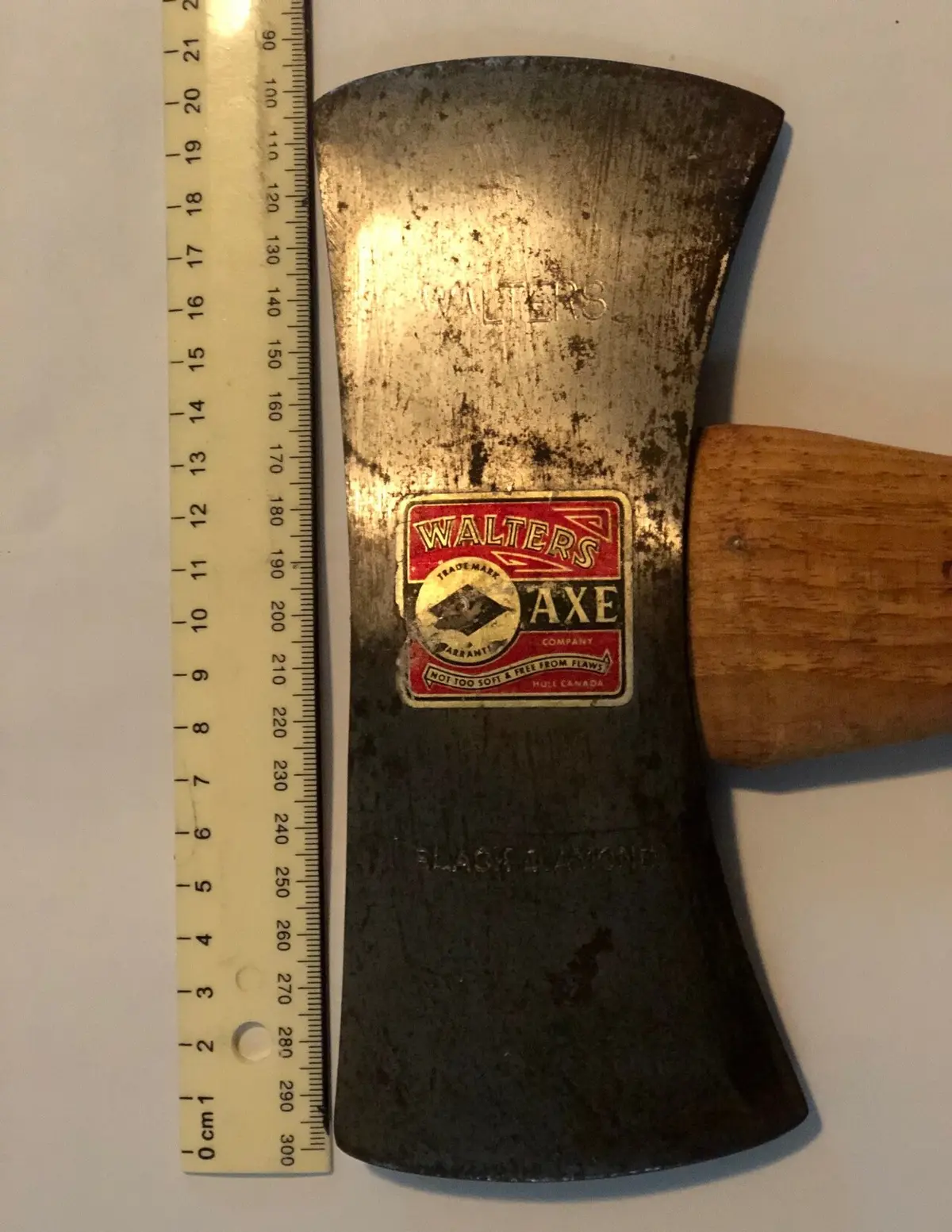
- "Walters Axe Company's Black Diamond Axe" by Jeff Blackadar, CC BY-SA 4.0, via Wikimedia Commons.


Ready to buy?
Compare the gear: Campsite Gear
6 Best Axe in 2026
Axes and hatchets compared for camping: a 33.5 inch felling axe, a 28 inch chopping axe and compact hatchets for kindling, from Fiskars to budget picks.
6 Best Axe For Chopping Trees in 2026
Best axes for chopping trees: six felling and chopping axes from 24 to 36.7 inches, compared on head weight, handle length and edge width.
6 Best Axe For Chopping Wood in 2026
Best axes for chopping wood: six firewood axes and mauls from 15 to 36 inches, compared on handle length, head weight and shock reduction.
5 Best Axe For Splitting Wood in 2026
Best axes for splitting wood: five splitting axes and mauls from 27.8 to 36 inches, compared on head weight, handle length and shock absorption.
4 Best Axe Under 100 in 2026
Best axes under $100: four camp and yard axes from a 28 inch Fiskars to a folding Liantral, compared on handle, steel, weight and sheath.
4 Best Axe Under 50 in 2026
Best axes under $50: four camp hatchets from 10 to 14.7 inches, hand-forged to folding, compared on handle, steel and sheath.
5 Best Ice Axe For General Mountaineering in 2026
Best ice axes for general mountaineering: five straight-shaft axes for glacier travel and snow climbs, compared on weight, head design and shaft length.
5 Best Ice Axe For Ski Mountaineering in 2026
Best ice axes for ski mountaineering: five compact axes from 280 g to B-rated alpine models, picked for packing on a ski pack and arresting a fall.
Keep reading