

We research everything we recommend. When you buy through our links, we may earn a commission. Learn more

Buying guide · 11 min read · Updated October 2, 2026

6 Best RV Air Conditioners for the Money in 2026: A Practical RV Guide

Which RV air conditioner gives the most cooling and the least noise per dollar, ranked from $229 to $999.99 by cost per 1,000 BTU and stated decibels.

Bowen HigginsBy Bowen HigginsRV Editor at RV Gear Lab6 products comparedSpec-sheet researched

At a glance

Our top picks

Value in an air conditioner is arithmetic, and the arithmetic changes the ranking. Divide each price by its rated cooling and the $229.00 DC unit comes out near $21 per 1,000 BTU, the $773.10 Arsenda near $43, the $859.00 Arsenda near $48, and the $999.99 FOGATTI near $63. One shelf, a threefold spread. Prices run from $229.00 to $999.99 here, and the ranking sorts the picks by what each dollar actually returns in cooling, in quiet and in features that save money later, which is a different question from which unit is cheapest to buy.

Noise belongs in the same equation. The cheapest unit states 45 dB, the dearer Arsenda states 50 dB, and the FOGATTI states 59 dB, so the least expensive pick is also the quietest on paper, and the dearest is the loudest. That inversion is the lesson of the value shelf: a higher price does not buy quiet by default. It buys build details, a heat pump or a name on the listing, and a buyer should decide whether those are worth the added cost before opening a wallet. Each listing below is judged on the numbers it prints.

Format is the last variable that moves the ranking. Four of the six picks need both 115V AC and 12V DC, one runs on 24V and one on 12V alone. Two are ducted, which helps a coach that already has ceiling channels and means nothing in one without. The cheapest pick runs from a 12V supply, so its true cost includes the battery bank behind it, and sticker prices alone cannot settle the question. Weighing format before price keeps the dollar comparison honest for every kind of rig, from a van to a large coach.

RV Gear Lab field notes

The Rig Fit Check

Start with the job
FOGATTI RV Air Conditioner 16000 BTU Ducted leads this shortlist for Ducted coaches that want a drop-in 16,000 BTU rooftop with dual compressors.. Use that fit as a reference point, then compare the alternatives against your own space and workload.
Specs that separate the picks
The first details to compare are 16,000 BTU ducted, 18,000 BTU ducted, 18,000 BTU, 10,236 BTU heat. Confirm the exact model and included components before ordering.
Trade-off to plan for
Cooling only

Before you buy

What Matters Before You Choose an RV Air Conditioner for the Money

Key buying criteria so you get the right fit the first time.

  1. 01

    Dollars per 1,000 BTU

    Dividing the price by the rated cooling in thousands of BTU puts very different units on one scale. DC 12V works out near $21, the Arsenda 18K Entry near $43, the Arsenda 18K Heat near $48 and the FOGATTI Ducted near $63. The lower the number, the more cooling each dollar returns. Run the division on any listing before comparing features, and then ask what the higher-priced options add in return.

  2. 02

    Quiet for the money

    Decibels are the other half of value, and the correlation with price is weak. The cheapest unit prints 45 dB, the Arsenda 18K Heat prints 50 dB and the FOGATTI Ducted prints 59 dB. Listed noise on the 24V Thin AC spans 45 to 60 dB, a wide band to plan around. Seek a single stated number from a listing, and expect the higher end of any range to be what you hear.

  3. 03

    Cost of the power behind it

    A unit's true price includes the supply it needs. The DC 12V unit lists a 350 to 750W operating range, so it depends on a battery bank that can feed that draw for the hours you run it. The 115V picks lean on shore power or a generator, and they also need a 12V feed. Price the supply you will actually use, not the supply the listing assumes. Add the cost of the power source to the unit before deciding which is cheaper.

  4. 04

    Profile and clearance

    Height matters more than most buyers expect. At 5.5 inches tall, the 24V Thin AC fits standard 14 inch vents, which helps under low overhead structures and in tall-vehicle garages. A taller box costs nothing extra to buy but can cost a lot to live with. Find the height or profile on the listing and measure the clearance your rig actually needs.

  5. 05

    Heat pump value

    A heat pump turns a summer appliance into a year-round one, which spreads its cost across more camping days. The Arsenda units list 10,236 BTU of heat against 18,000 BTU of cooling, and the 24V Thin AC lists 3,400 BTU of heat. A cooling-only unit like the FOGATTI Ducted leaves winter to a furnace. Count the heating months you will camp before paying for the function.

  6. 06

    Protection and track record

    A cheap unit can be a bargain or a risk, and the listing is the best clue. Multi-layer circuit protection appears on the DC 12V unit, a concrete feature that guards the wiring. It also carries a sparse brand history, which means little support. Find the protection features and the warranty on the listing, and consider the track record when the savings are large.

Our standards

Why You Can Trust RV Gear Lab

At RV Gear Lab, we compare products based on rig fit and power or hookup compatibility, verified specifications, usability, setup requirements, weight, durability, and real-world trade-offs. We do not rank products purely on marketing claims or commission rates.

We have not personally tested every product listed. Where hands-on testing is not available, recommendations are based on verified manufacturer specifications, product documentation, use-case fit, and comparative research.

How we review RV gear →

Detailed reviews

The 6 best rv air conditioners for the money, explained

01
Best for: Ducted coaches that want a drop-in 16,000 BTU rooftop with dual compressors.

Our take

Class A and larger Class C coaches with a ducted ceiling layout are the intended match, since a ducted unit slots into that airflow plan without new cutting.

Why it made the shortlist

The FOGATTI Ducted lists at $999.99 and rates 16,000 BTU through a ducted fit, which sends cooled air through the ceiling channels that many larger coaches already have. Dual compressors, R32 refrigerant and a stated 59 dB operating level are all printed on the listing, so the buyer knows the hardware and the sound level ahead of a purchase. That level of disclosure helps anyone planning a ducted replacement.

At about $62.50 per 1,000 BTU, this is the top-priced unit on the page per unit of cooling, and what that price buys is the ducted format and the dual-compressor design. Placed against the 18,000 BTU Arsenda units, the decision is simple: pay for compatibility with existing ducts, or spend less on a non-ducted body that delivers more rated BTU.

Anyone replacing a failed ducted rooftop gets a like-for-like swap with a stated noise figure. The R32 refrigerant and twin compressors give the build real substance, and a ducted layout keeps airflow even across a long coach.

What works

  • Ducted fit for existing ceiling channels
  • Dual compressors
  • R32 refrigerant
  • Noise figure stated

Watch out for

  • Cooling only
  • Needs 115V AC and 12V DC
02

Best 18K Ducted Value · 2 of 6

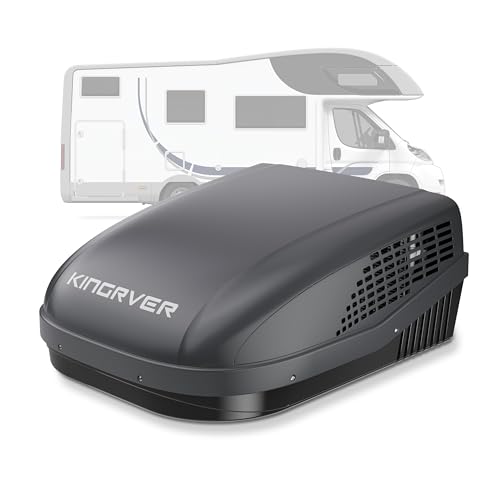
KINGRVER RV Air Conditioner 18K BTU

Best for: Large coaches with ceiling ducts that want 18,000 BTU and a stated 52 dB.

Our take

Large coaches with an existing ceiling duct layout and no call for winter heat get the strongest ducted value on this page.

Why it made the shortlist

Listed at $899.99, the KINGRVER 18K is a ducted rooftop unit rated at 18,000 BTU with a stated 52 dB operating level. A ducted fit sends cooled air through ceiling channels, a gray finish option is offered, and the listing pitches the cooling power at large RVs. Supply is 115V AC plus 12V DC, the same dual feed as the other rooftops here.

At $50.00 per 1,000 BTU, it lands between the Arsenda 18K Heat at about $47.70 and the FOGATTI Ducted at about $62.50. Against the FOGATTI, it costs $100.00 less, adds 2,000 BTU of rated cooling and prints a 52 dB figure that sits 7 dB under the FOGATTI's 59 dB. Both are ducted and cooling focused, so the comparison is clean.

Owners who already heat with a furnace avoid paying for a heat pump function, and the quiet stated rating suits a bedroom under the duct run. The gray finish option also helps match the roof to the coach.

What works

  • Ducted fit
  • Large-RV cooling power
  • Gray finish option

Watch out for

  • Cooling only
  • Needs 115V AC and 12V DC
03

Best Heat Pump Value · 3 of 6

Arsenda 18000 BTU RV Air Conditioner

Arsenda 18000 BTU RV Air Conditioner
  • 18,000 BTU, 10,236 BTU heat
  • 50 dB operation
  • Up to 680 sq ft
Check price on Amazon for Arsenda 18000 BTU RV Air Conditioner (opens in a new tab)
Best for: Big interiors wanting 18,000 BTU, heating and a stated 50 dB.

Our take

Large travel trailers and fifth wheels that camp in spring and fall get the most from a heat pump that shares the cooling roof opening.

Why it made the shortlist

The Arsenda 18K Heat lists at $859.00 and covers up to 680 square feet with an 18,000 BTU rating, a heat pump and a stated 50 dB. A wide operating range lets the unit run in more seasons than a cooling-focused design, which spreads its cost across more months of use. Winter output of 10,236 BTU sits alongside the 18,000 BTU cooling rating.

Working out to about $47.70 per 1,000 BTU, it comes in $14 below the FOGATTI Ducted per 1,000 BTU, and it adds heat on top. Beside the cheaper Arsenda at $773.10, the extra $85.90 buys a printed noise figure and a stated 680 square foot coverage claim, so the choice reduces to whether those two numbers are worth that gap.

Shoppers wanting one appliance for every season, plus the noise level in writing, can justify the step above the entry 18K unit. Big interiors benefit from the capacity, and the heat pump covers the cool months.

What works

  • Covers up to 680 sq ft
  • Heat pump included

Watch out for

  • Needs 115V AC and 12V DC
  • Higher amp draw
04
Best for: Owners who want the most rated cooling and heat pump heating per dollar.

Our take

Value-focused owners of large rigs, and anyone replacing a worn standard-size unit, can stop here with a clear conscience.

Why it made the shortlist

The Arsenda 18K Entry costs $773.10, the lowest price among the 18,000 BTU units, which works out to about $43 per 1,000 BTU. Heat pump heating comes with R32 refrigerant, a stated 23 to 115 degrees F outdoor range and a fit for a 14.25 inch roof opening, which is the standard size on many rigs.

Among the rooftop units past 16,000 BTU, it returns the most rated cooling for each dollar, and it adds a heating function on top. Sitting $86 below the Arsenda 18K Heat and about $227 below the FOGATTI Ducted, it carries the same 18,000 BTU rating with a lower sticker price, and the savings can cover installation hardware and cabling.

The 14.25 inch fit keeps installation simple, and a heat pump function spreads the cost over a longer camping season. As the strongest all-round value on the shelf, it also offers a roof-opening fit that makes the swap simple for confident DIY owners.

What works

  • Heat pump adds winter use
  • Fits 14.25 inch openings

Watch out for

  • Needs both 115V AC and 12V DC
  • No noise level listed
05

Best Low-Profile Pick · 5 of 6

24V RV Air Conditioner

24V RV Air Conditioner
  • 8,500 BTU cool, 3,400 BTU heat
  • Variable frequency compressor
  • 5.5 inch ultra-thin body
Check price on Amazon for 24V RV Air Conditioner (opens in a new tab)
Best for: Rigs with low clearance that want a variable-speed 24V unit.

Our take

Vans, truck campers and low-roof trailers where a standard rooftop box would sit too tall will value the 5.5 inch height.

Why it made the shortlist

Listed at $508.00, the 24V Thin AC rates 8,500 BTU of cooling with 3,400 BTU of heating, driven by a variable frequency compressor. Its 5.5 inch body is a standout, since it fits standard 14 inch roof vents while sitting low on the roof for tight overhead clearance. A Fahrenheit display keeps the controls familiar, and the listing states the variable-frequency design plainly.

At roughly $60 per 1,000 BTU, its appeal lies in the slim shape, the variable-speed compressor and the heating stage rather than raw capacity. Set against the $229.00 DC unit, the extra $279 pays for a thinner profile, a 24V platform and a heat function, which is a clear exchange for the right rig. Heat output adds shoulder-season value.

A variable-frequency compressor eases battery load by adjusting output, which matters for a 24V lithium build. Owners who store the rig in a low garage or under a carport gain the same benefit, and the variable-speed compressor eases the load on a 24V battery bank.

What works

  • Variable-frequency compressor adjusts output
  • 5.5 inch thin body for low clearance
  • Fits standard 14 inch roof vents
  • Fahrenheit display

Watch out for

  • 45 to 60 dB range is wide
  • Lowest cooling BTU of the rooftop units
06

Lowest Price per BTU · 6 of 6

DC 12V RV Air Conditioner

DC 12V RV Air Conditioner
  • 12V DC, 11,000 BTU
  • 350 to 750W range
  • 45 dB, 350 CFM
Check price on Amazon for DC 12V RV Air Conditioner (opens in a new tab)
Best for: Battery-bank owners who want maximum cooling for the least spend.

Our take

Van builders, skoolie owners and solar-powered trailer campers with a large 12V bank get the most for their money here.

Why it made the shortlist

Listed at $229.00, the DC 12V unit rates 11,000 BTU, which comes to roughly $21 per 1,000 BTU, the best figure on the page by a wide margin. It states a 350 to 750W operating range, 350 CFM of airflow, 45 dB noise and multi-layer circuit protection, which is a surprising amount of printed detail at this price.

Holding a price $544 below the Arsenda 18K Heat, it posts a 45 dB figure, the lowest single decibel number on the page. Printing that figure plainly gives the buyer something firm to plan around. Where the other picks ask for 115V AC and 12V DC together, this one runs from a single 12V supply, which simplifies the electrical plan and cuts cable cost.

Total cost depends on the battery behind it, so a buyer should price the bank before celebrating the sticker. For anyone who already owns the batteries, it is the cheapest cooling per BTU in the guide.

What works

  • Multi-layer circuit protection
  • 45 dB low-noise operation

Watch out for

  • Runtime depends on your battery
  • Sparse brand history

Methodology

How We Built This Shortlist

Each pick was assessed across 5 criteria weighted for real-world use.

01

Cost per 1,000 BTU

We divided each listed price by its rated cooling to get a dollars-per-1,000-BTU figure. The spread ran from about $21 to about $63 across the rooftop units. Where a unit reports separate heating, we treated that as added value, not as a substitute for cooling.

02

Noise per dollar

Based on product specs, we lined up the printed decibel figures against price. The $229 unit states 45 dB while the $999.99 unit states 59 dB. Listings that print no figure were treated as unproven instead of quiet.

03

Cost of the power behind the unit

A 12V cooler needs a battery bank and a 115V unit needs shore power or a generator. We counted that supporting cost when comparing sticker prices. The cheapest pick runs from 12V alone, so its supply cost matters most in that comparison.

04

Features that repay over time

Heat pump heating, a variable-frequency compressor, circuit protection and a named refrigerant all extend a unit's useful months or efficiency. We credited them as value. Marketing words without numbers earned no credit.

05

Fit and clearance

A bargain that needs fabrication stops being a bargain. We read the roof opening, profile and format on each listing. Standard 14 and 14.25 inch fits scored well, and ducted designs were matched to coaches that already have ducting.

Decision guide

Match an RV Air Conditioner for the Money to Your RV

By Value Priority

Value means different things to different buyers, so pick the priority first and read across to a unit.

Your priorityPickWhy
Lowest cost per BTUDC 12V 11000About $21 per 1,000 BTU on a 12V supply
Most cooling and heat per dollarArsenda 18K Entry18,000 BTU heat pump at $773.10
Heat pump with a printed noise figureArsenda 18K Heat50 dB and 680 square feet stated
Lowest profile24V Thin AC5.5 inch body with a variable-frequency compressor
Ducted ceiling compatibilityFOGATTI Ducted16,000 BTU ducted fit with dual compressors

By Budget

Price steps tell you what each extra dollar returns. The table lists the real prices in this guide.

SpendPickWhat it buys
About $229DC 12V 1100011,000 BTU, 45 dB and circuit protection
About $50824V Thin ACA thin variable-speed unit with heating
About $773Arsenda 18K Entry18,000 BTU with a heat pump
About $859 to $900Arsenda 18K Heat or KINGRVER 18KA stated 50 dB heat pump, or 18,000 BTU ducted at 52 dB
About $1,000FOGATTI Ducted16,000 BTU ducted with dual compressors

Spend on the Unit vs Spend on the Power

A cheap air conditioner can hide an expensive supply, and a costly one can run on equipment you already own.

Spend on the unit

Arsenda 18K Entry, Arsenda 18K Heat, KINGRVER 18K and FOGATTI Ducted run on shore power or a generator and carry the cooling cost in the sticker price. Pick them if you camp at hookup sites.

Spend on the power

DC 12V 11000 is cheap to buy but leans on a battery bank that must feed its 350 to 750W range. Pick this path if you boondock and already own a bank.

If you camp on hookups, buy Arsenda 18K Entry; if you boondock with a big bank, buy DC 12V 11000.

By Noise Evidence

A printed decibel number beats an adjective. Rank the picks by how firmly the listing commits.

EvidencePickWhat is printed
One clear number, quietDC 12V 1100045 dB at 350 CFM
One clear number, mid-rangeArsenda 18K Heat50 dB
Ducted, 52 against 59 dBKINGRVER 18K52 dB, where FOGATTI Ducted prints 59 dB
A wide range24V Thin AC45 to 60 dB depending on speed
No numberArsenda 18K EntryNo noise level listed

For Boondocking Specifically

Off-grid use puts the whole system on the table, not just the air conditioner.

Look for

A stated wattage range, circuit protection and a single 12V or 24V supply. DC 12V 11000 lists 350 to 750W and 24V Thin AC uses a variable-frequency compressor.

In this comparison

DC 12V 11000 is the cheapest, and 24V Thin AC adds a variable-frequency compressor that adjusts output. Size the bank behind either before buying.

When to Spend More

The best value is not always the lowest price, and some buyers should pay up.

Spend more if

You run the unit daily and want heat and a printed noise figure. Arsenda 18K Heat and FOGATTI Ducted add features that repay over many seasons.

Save if

You own a large battery bank and camp seasonally. DC 12V 11000 and Arsenda 18K Entry deliver the best cooling per dollar.

FAQ

Before You Bring One Home

How do I compare air conditioner value fairly?

Take the price over rated cooling in thousands of BTU, then compare noise and features. DC 12V comes to about $21 per 1,000 BTU, the Arsenda 18K Entry about $43 and the FOGATTI Ducted about $63. Ratings from different listings may use different bases, so compare like with like.

Is the $229 unit a real bargain or a trap?

With batteries already owned, it is a bargain. Printed on the DC 12V listing are 11,000 BTU, 45 dB, a 350 to 750W range and multi-layer circuit protection, which is a lot of detail at the price. The sparse brand history is the risk, so treat support as something you provide yourself.

Is a ducted 18,000 BTU unit worth paying for in a coach without ducts?

Usually not. A ducted fit sends cooled air through ceiling channels, which both the KINGRVER and the FOGATTI list. Without ducts the format buys nothing extra, and the Arsenda 18K Entry at $773.10 delivers 18,000 BTU for less. Match the format to your ceiling before comparing price.

Why pay $1,000 for a 16,000 BTU cooling-only unit?

For the ducted fit and the build. The FOGATTI Ducted slots into existing ceiling ducts and lists dual compressors and R32 refrigerant. For a coach with ducting it is a sensible swap, though the KINGRVER delivers 18,000 BTU ducted for $100 less.

Does a thin rooftop unit cool less?

Capacity depends on the rating, not the height. Capacity is rated at 8,500 BTU on the 24V Thin AC, which sits below the 11,000 and 18,000 BTU units here. Its 5.5 inch body is chosen for clearance, so buy it for the profile.

Which Arsenda is the better value?

That comes down to the noise figure. The 18K Entry is $773.10 and the 18K Heat is $859.00, and both list 18,000 BTU with a heat pump. The dearer one adds a printed 50 dB and a 680 square foot claim, and the cheaper one saves $85.90.

Bottom line

The short version

Browse more rv air conditioners for the money on Amazon →
Bowen Higgins, RV Editor at RV Gear Lab

About the author

Bowen Higgins

RV Editor at RV Gear Lab

Bowen covers RV power, water systems, towing and leveling, upkeep and interior comfort, with a focus on matching gear to the rig, the hookups and the way you actually travel.

More from Bowen →Editorial standards

Keep reading

Related guides