

We research everything we recommend. When you buy through our links, we may earn a commission. Learn more

Buying guide · 11 min read · Updated October 2, 2026

6 Best RV Air Conditioners Under $1,000 in 2026: A Practical RV Guide

RV air conditioners up to $1,000 where heat pumps and quiet 43 to 50 dB rooftops appear, with a look at when the step up from $800 is worth paying for.

Bowen HigginsBy Bowen HigginsRV Editor at RV Gear Lab6 products comparedSpec-sheet researched

At a glance

Our top picks

A stated heating output is the clearest sign that a unit belongs in the $1,000 tier. Across $384.90 to $972.80, four of the six picks print a heat pump figure: 12,500 BTU on the TOSOT, 10,236 BTU on both Arsenda units and 3,500 BTU on the 12V model. Below $800 heating is rare and vague. Here it comes with numbers, and a buyer can finally compare what a rooftop unit does in January as well as July. That change alone explains why many owners treat $1,000 as the dividing line between a seasonal cooler and an everyday appliance.

Noise figures improve at the same time. Decibel ratings span a real range: 43 dB on the TOSOT, the lowest in this guide, 45 dB on the 12V 11,000 BTU unit and 50 dB on the Arsenda. Build details also appear: a HIPS impact-resistant shell and R32 refrigerant on the FOGATTI, a complete install hardware kit with the TOSOT, and a UV-resistant shell on the Arsenda. These are the features that make a unit a long-term purchase rather than a seasonal one, and they are the reason a buyer pays more than the $800 shelf asks.

Paying up to $1,000 is worth it for owners who use a rig through multiple seasons, for full-timers who need heat from the same roof unit that cools, and for light sleepers who want a stated noise figure below 50 dB. It is not worth it for a few weekends of summer camping, when a plain cooling unit does the job. Those buyers are better served by the cheaper guides linked at the bottom, where a capable unit costs half as much and the shorter list of features is a fair trade for the savings.

RV Gear Lab field notes

The Rig Fit Check

Start with the job
TOSOT 16000 BTU GO Cool RV Air Conditioner leads this shortlist for Full-timers wanting the quietest rooftop with real heat pump output.. Use that fit as a reference point, then compare the alternatives against your own space and workload.
Specs that separate the picks
The first details to compare are 16,000 BTU cool, 12,500 BTU heat, 16,000 BTU non-ducted, 18,000 BTU, 10,236 BTU heat. Confirm the exact model and included components before ordering.
Trade-off to plan for
Cooling is 2,000 BTU below the 18K units

Before you buy

What Matters Before You Choose an RV Air Conditioner Under $1,000

Key buying criteria so you get the right fit the first time.

  1. 01

    Heat pump or cooling only

    Heat pumps move heat in both directions, so the same refrigerant circuit that cools in July can warm the cabin in October. Cooling-only units, such as the FOGATTI, leave winter to a furnace. Paying for one makes sense if you camp in spring and fall or avoid running a propane furnace overnight. Check the first line of the listing for the phrase heat pump, then look for a BTU figure.

  2. 02

    Heating BTU against cooling BTU

    Heat pump heating output is usually lower than cooling output, and the gap on these listings is large. TOSOT pairs 16,000 cooling with 12,500 heating, the Arsenda units pair 18,000 with 10,236, and the 12V model pairs 11,000 with 3,500. Only the Arsenda 18K Value states an operating range, 23 to 115 degrees F, so a stated range is worth looking for. Compare the heating figure to your rig, not the cooling figure.

  3. 03

    Decibels at the dearer end

    Noise is a premium feature at this price, and the numbers span a real range: 43 dB on the TOSOT, 45 dB on the 12V 11,000 BTU and 50 dB on the Arsenda 18K Plus. A few decibels is audible in a small rig and can decide whether a light sleeper gets through the night. Many listings print no figure at all. Prefer a stated number, and treat a missing one as unknown.

  4. 04

    Roof opening and install kit

    A rooftop swap is easy only when the unit fits the existing opening. The TOSOT and the Arsenda 18K Value list a 14.25 inch opening, and the 12V 11,000 BTU lists 14 by 14 inches. A complete hardware kit saves a trip to the store and a day of waiting. Measure your existing opening and read what the kit contains before you order.

  5. 05

    Shell and UV resistance

    The roof is the harshest place on a rig, with sun, hail, debris and temperature swings every day. The FOGATTI names an impact-resistant HIPS shell and the Arsenda names a rugged UV-resistant build. A shell that yellows or cracks shortens a unit's life even if the compressor is fine. Seek a named material and UV rating when you plan to keep the rig outdoors.

  6. 06

    Dual compressors versus a single compressor

    The FOGATTI lists dual compressors, which means the unit carries two cooling elements instead of one. That design can offer a degree of redundancy or staged output, depending on the implementation. A single compressor is simpler and cheaper. Before paying for the extra hardware, read the listing to see whether the compressors run independently and whether a warranty period is stated.

Our standards

Why You Can Trust RV Gear Lab

At RV Gear Lab, we compare products based on rig fit and power or hookup compatibility, verified specifications, usability, setup requirements, weight, durability, and real-world trade-offs. We do not rank products purely on marketing claims or commission rates.

We have not personally tested every product listed. Where hands-on testing is not available, recommendations are based on verified manufacturer specifications, product documentation, use-case fit, and comparative research.

How we review RV gear →

Detailed reviews

The 6 best rv air conditioners under $1,000, explained

01

Best Heat Pump Output · 1 of 6

TOSOT 16000 BTU GO Cool RV Air Conditioner

TOSOT 16000 BTU GO Cool RV Air Conditioner
  • 16,000 BTU cool, 12,500 BTU heat
  • 43 dB, WiFi and remote
  • Fits 14.25 inch roof opening
Check price on Amazon for TOSOT 16000 BTU GO Cool RV Air Conditioner (opens in a new tab)
Best for: Full-timers wanting the quietest rooftop with real heat pump output.

Our take

Full-time travelers and snowbirds who need winter heat and bedroom-friendly noise from one roof unit gain the most.

Why it made the shortlist

Listed at $972.80, the TOSOT GO Cool delivers 16,000 BTU of cooling and 12,500 BTU of heat pump heating, the highest heating figure in this guide. It lists 43 dB operation, which is the lowest noise rating on the page, plus WiFi control through the Gree+ app and a remote. The kit includes complete install hardware, so the swap starts with everything in one box.

Against the FOGATTI at $949.99, the extra $22.81 buys the heat pump function, the quiet rating and app control. A 14.25 inch roof opening matches the standard vent size, so the swap is direct. Pairing a stated heating output of 12,500 BTU with quiet operation is the combination that justifies a spot at the top of this shelf.

Light sleepers appreciate the 43 dB rating, and owners who like adjusting temperature from a phone will use the Gree+ app daily. A complete hardware kit also shortens the installation weekend, and the app saves a walk to the thermostat. Few rooftop units at any price pair that much quiet with that much heat.

What works

  • Heat pump output stated at 12,500 BTU
  • 43 dB operation is the lowest here
  • WiFi control through the Gree+ app
  • Complete install hardware kit included

Watch out for

  • Cooling is 2,000 BTU below the 18K units
02

Best Tough Build · 2 of 6

FOGATTI RV AC Unit 16K BTU Non-ducted

FOGATTI RV AC Unit 16K BTU Non-ducted
  • 16,000 BTU non-ducted
  • Dual compressors
  • HIPS impact-resistant shell
Check price on Amazon for FOGATTI RV AC Unit 16K BTU Non-ducted (opens in a new tab)
Best for: Hot-climate owners who value a rugged shell and dual compressors.

Our take

Owners in hot, sunny states who run the air conditioner for months and want the shell to hold up will favor it.

Why it made the shortlist

The FOGATTI 16K lists at $949.99 with a non-ducted fit, dual compressors and R32 refrigerant. An impact-resistant HIPS shell with UV protection covers the roof-facing body, which matters on a unit that sits in direct sun and weather all year. The listing spells out the shell material, which is the kind of detail that lets a buyer judge durability before the unit arrives.

Stepping down from the TOSOT by about $23, this model keeps the 16,000 BTU class and swaps the heat pump for a build-quality story. Dual compressors give the unit more than one cooling element to work with, and the rugged exterior suits regions with hail, tree debris and strong UV. Durability is its selling point among cooling-focused rooftops.

Boondockers who park under trees or in open desert sun benefit from the impact-resistant housing. A cooling-focused rooftop also avoids paying for a heat pump function that a buyer with a furnace will never use.

What works

  • Non-ducted fit
  • Dual compressors
  • Impact and UV-resistant shell
  • R32 refrigerant

Watch out for

  • Cooling only
  • Needs 115V AC and 12V DC
03

Best Big-Rig Heat Pump · 3 of 6

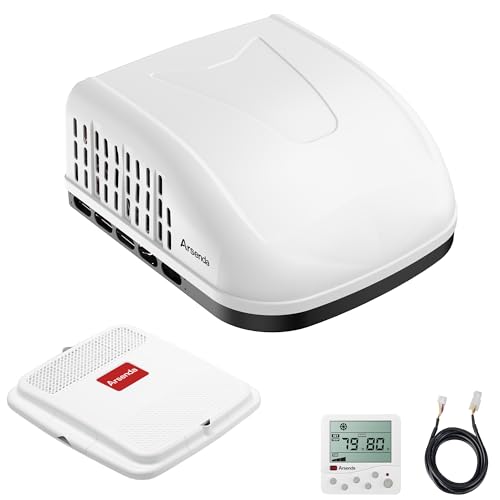
Arsenda 18000 BTU RV Air Conditioner

Arsenda 18000 BTU RV Air Conditioner
  • 18,000 BTU, 10,236 BTU heat
  • Up to 680 sq ft
  • 50 dB, 115V AC plus 12V DC
Check price on Amazon for Arsenda 18000 BTU RV Air Conditioner (opens in a new tab)
Best for: Large coaches wanting 18,000 BTU and a heat pump for under $860.

Our take

Fifth wheels, large trailers and Class A coaches that need more cooling than a 16,000 BTU unit, with enough heat for spring and fall, are the right homes.

Why it made the shortlist

At $859.00 the Arsenda 18K Plus rates 18,000 BTU of cooling with 10,236 BTU of heat pump heating, and its listing says it covers up to 680 square feet. A 50 dB rating is stated, and the unit runs on 115V AC plus 12V DC. The pricing is moderate for 18,000 BTU with a working heat pump.

Falling $113.80 under the TOSOT, it adds 2,000 BTU of cooling and trades 2,264 BTU of heat output and 7 dB of quiet. Big interiors make that a sensible exchange, since extra cooling capacity matters more than a lower dB figure in a long living area. The 680 square foot claim gives a number to size against.

A generator or an inverter on hand makes it simple to power, and 50 dB is a stated figure rather than a guess. A 680 square foot claim gives owners of long interiors a number to compare with their floor plan.

What works

  • 18,000 BTU for big interiors
  • Heat pump with 10,236 BTU heating
  • Quiet at 50 dB

Watch out for

  • Needs generator or inverter
  • No power draw stated
04

Best Value Heat Pump · 4 of 6

Arsenda RV Air Conditioner 18000 BTU

Arsenda RV Air Conditioner 18000 BTU
  • 18,000 BTU, 10,236 BTU heat
  • 115V AC plus 12V DC
  • 23 to 115 degrees F range
Check price on Amazon for Arsenda RV Air Conditioner 18000 BTU (opens in a new tab)
Best for: Budget-minded owners of big rigs who still want heat pump heating.

Our take

Big-rig owners who want a heat pump and a tight total spend can stop here and put $86 toward installation hardware or a quality power cable.

Why it made the shortlist

Listed at $773.10, the Arsenda 18K Value rates 18,000 BTU of cooling with 10,236 BTU of heat pump heating, matching the dearer Arsenda on headline specs. A stated operating range of 23 to 115 degrees F tells a buyer how far into the shoulder seasons it can work, and the construction is described as rugged and UV resistant.

Beside the $859.00 Arsenda 18K Plus, the capacity and heating figures are identical and the price is $85.90 lower. That leaves the decision with the buyer, because the Plus prints a 50 dB figure and this version prints none. For anyone who cares more about cost per BTU than a decibel number, this is the stronger value.

The stated temperature range suits spring and fall trips well, and the rugged shell is built for year-round roof exposure. Cheapest route to an 18,000 BTU heat pump is exactly what this listing delivers.

What works

  • 18,000 BTU with heat pump heating
  • Rugged UV-resistant construction

Watch out for

  • Needs both 115V AC and 12V DC
  • Noise figure not stated
05
Best for: Off-grid campers who want some heat from a battery-powered roof unit.

Our take

Van lifers, solar-powered trailer owners and boondockers with a 300Ah-class battery bank get the best use from it.

Why it made the shortlist

Priced at $599.00, this 12V unit offers 11,000 BTU of cooling and 3,500 BTU of heating, with a stated 45 dB operating level. It fits a standard 14 by 14 inch roof opening, and the listing quotes a runtime based on a 300Ah battery. A heating function on a DC rooftop unit at this price gives van and small-trailer owners a second season of use.

Sitting $174 under the Arsenda 18K Value, it trades capacity for battery independence, running without a generator or shore power. A 3,500 BTU heating stage suits a van or small trailer, where it takes the chill off in the shoulder seasons. Overnight operation stays calm at the stated 45 dB, and no generator or shore power is needed.

A rooftop DC unit that both cools and heats lets one appliance cover most of the camping year. The standard roof opening keeps installation straightforward, and a 300Ah bank gives a clear sizing target for the electrical plan before any money is spent.

What works

  • Adds 3,500 BTU of heating to the cooling
  • Runtime quoted on a 300Ah battery
  • Fits standard 14 by 14 inch roof openings
  • Stated 45 dB operation

Watch out for

  • Runtime is a manufacturer claim
  • Battery bank must be large
06

Best Budget Backup · 6 of 6

110V Portable Air Conditioner

Best for: Tents and small rigs that need cooling and heating without installation.

Our take

A tent camper, a van sleeper or an owner with a failed rooftop unit who needs relief this weekend will all find it useful.

Why it made the shortlist

At $384.90 the 110V portable is the least expensive pick and the one that needs no installation. It lists 5,000 BTU, six operating modes covering cooling and heating, and a 490W power draw. It is sized for tents and small rigs, and the low wattage makes it easy to power from a campground outlet or a modest generator.

Dropping $214 below the 12V 11,000 BTU roof unit, it gives up capacity and permanence in exchange for portability. Those traits suit it as a backup or second-zone unit for owners of a rig that already has a rooftop air conditioner. The 490W draw is low enough for a small generator to carry comfortably, which keeps the fuel plan simple on a long weekend.

Setting it down and routing the hose takes minutes. At under $400 it also shows how much cooling a buyer gets before reaching for a heat pump, and its heating mode gives a taste of what the roof units do at larger scale.

What works

  • Portable, no install
  • Fits tents and small rigs
  • Low 490W power draw
  • Cooling and heating modes

Watch out for

  • Portable, not a rooftop unit
  • Needs venting setup

Methodology

How We Built This Shortlist

Each pick was assessed across 5 criteria weighted for real-world use.

01

Stated heating output

We separated units that print a heating BTU figure from units that only name a heat mode or nothing at all. A stated number such as 12,500 or 10,236 BTU lets a buyer judge real use. Cooling-only units were scored as summer equipment.

02

Noise figures

Based on product specs, we compared decibel ratings across the picks. The TOSOT at 43 dB and the 12V 11,000 BTU at 45 dB stood out. A missing noise figure was treated as an unknown rather than a good result.

03

Build details

At this price a listing should say what the unit is made of. We credited the HIPS shell, UV resistance and R32 refrigerant named on the FOGATTI and the rugged shell described on the Arsenda. Vague claims of strong build earned little weight.

04

Installation completeness

We compared the hardware supplied and the roof opening required. A complete install kit, such as the one with the TOSOT, and a standard 14.25 or 14 by 14 inch opening count in a unit's favor. A kit that has to be sourced separately adds cost and delay.

05

Price steps within the shelf

The picks span $384.90 to $972.80, so we looked at what each price step adds. The $859 Arsenda and the $773 Arsenda share headline specs, which makes the $86 gap a clean test of what a decibel figure is worth. We kept that comparison front and center when ranking the two.

Decision guide

Match an RV Air Conditioner Under $1,000 to Your RV

By Heating Need

Heat is the new variable at this price, so start with how much of it you want from the roof unit.

Your heating needPickWhy
Winter heat from the air conditionerTOSOT 1600012,500 BTU of heat pump heating
Big rig and some heatArsenda 18K Plus18,000 BTU cooling with 10,236 BTU heating
Big rig, heat, lowest costArsenda 18K ValueThe same figures for $85.90 less
A light chill-off on battery12V 11000 BTU3,500 BTU heating from a 12V roof unit
No heat, a furnace insteadFOGATTI 16KCooling-only build with a rugged shell

By Budget

The picks run from $384.90 to $972.80, and the steps between them are worth reading.

SpendPickWhat it buys
Around $385110V PortableCooling and heating with no installation
Around $59912V 11000 BTUA 12V roof unit with 3,500 BTU of heat
Around $773Arsenda 18K Value18,000 BTU and heat pump heating
Around $859Arsenda 18K PlusThe same output with a stated 50 dB
Around $950 to $973FOGATTI 16K or TOSOT 16000A rugged cooling shell, or a quiet 43 dB heat pump

Quiet Rooftop vs Capacity Rooftop

The top of this shelf forces a choice between a low decibel rating and more BTU for the money.

Quiet rooftop

TOSOT 16000 at 43 dB and 12V 11000 BTU at 45 dB give the lowest stated noise. They suit light sleepers and small rigs where the compressor is close to the bed.

Capacity rooftop

Arsenda 18K Plus and Arsenda 18K Value deliver 18,000 BTU for large interiors. Arsenda 18K Plus lists 50 dB, and the Value version lists none, so it is a bet on capacity.

If you sleep lightly, buy TOSOT 16000; if you cool a large coach, buy Arsenda 18K Value.

By Roof Opening

A direct swap is the cheapest installation, so match the opening to the unit.

Your openingPickWhat the listing says
Standard 14.25 inch ventTOSOT 16000Fits a 14.25 inch roof opening with a hardware kit
Standard 14.25 inch vent, big rigArsenda 18K Value18,000 BTU on a 14.25 inch opening
14 by 14 inch vent12V 11000 BTUFits standard 14 by 14 inch openings
Non-ducted ceiling assemblyFOGATTI 16KNon-ducted fit with dual compressors
No roof work wanted110V PortableSits on the floor and vents through a hose

For Cold-Weather Camping Specifically

Cold mornings expose the difference between a cooling-only unit and a heat pump.

Look for

A stated heating BTU and a stated operating range. Arsenda 18K Value lists a 23 to 115 degree F range and TOSOT 16000 lists 12,500 BTU of heat.

In this comparison

TOSOT 16000 gives the most heat, Arsenda 18K Plus gives heat for a big rig, and 12V 11000 BTU gives a gentle heating stage for a van off the grid.

When to Spend More

The top of this shelf is $972.80, and it is worth knowing when to go all the way.

Spend more if

You camp year-round and want a quiet heat pump from one roof unit. TOSOT 16000 and Arsenda 18K Plus are the strongest answers, and both justify the money through stated heating and noise.

Save if

You camp in summer, or you already have a furnace. Arsenda 18K Value, 12V 11000 BTU or 110V Portable cover cooling for much less.

FAQ

Before You Bring One Home

Does an RV heat pump work in freezing weather?

Arsenda 18K Value states 23 to 115 degrees F of operating range, and the listing makes no heating promise below it. Plan on a furnace or a space heater when temperatures fall under that range. The other listings print no range, so ask before relying on them in freezing weather.

Why is heating BTU so much lower than cooling BTU?

That is how these listings rate their heat pumps. TOSOT pairs 16,000 cooling with 12,500 heating, and the Arsenda units pair 18,000 with 10,236. Compare the heating figure with the heat your rig loses on a cold night.

Is 43 dB meaningfully quieter than 50 dB?

For a sleeper, definitely. A 7 dB gap is easy to notice in a small rig. The TOSOT at 43 dB suits a bedroom directly below the roof unit, while the Arsenda at 50 dB is fine in a larger coach.

Do the 18,000 BTU units need a generator?

They need a 115V supply, which comes from shore power, a generator or an inverter. Arsenda 18K Plus calls for 115V AC plus 12V DC and gives no power draw. Size the supply with margin and ask the seller for the running wattage.

Is the 12V 11,000 BTU unit a real heater?

Think of it as a light heating stage. At 3,500 BTU of heat it takes the chill off a van or small trailer, but it will not warm a large rig. Runtime is quoted on a 300Ah battery, which is a manufacturer claim.

Can a $385 portable replace a $950 rooftop?

For a small space, sometimes. The 110V Portable lists 5,000 BTU, six modes and a 490W draw. It cannot cool a large rig, but it works as a backup or a second zone.

Bottom line

The short version

Browse more rv air conditioners under $1,000 on Amazon →
Bowen Higgins, RV Editor at RV Gear Lab

About the author

Bowen Higgins

RV Editor at RV Gear Lab

Bowen covers RV power, water systems, towing and leveling, upkeep and interior comfort, with a focus on matching gear to the rig, the hookups and the way you actually travel.

More from Bowen →Editorial standards

Keep reading

Related guides