

We research everything we recommend. When you buy through our links, we may earn a commission. Learn more

Buying guide · 10 min read · Updated October 2, 2026

6 Best 12 Volt RV Battery Monitors Without a Shunt in 2026: A Practical RV Guide

Six voltage-based 12V battery monitors for RV starter and house batteries compared on what voltage can and cannot tell you, from $9.99 to $47.99, no shunt.

Bowen HigginsBy Bowen HigginsRV Editor at RV Gear Lab6 products comparedSpec-sheet researched

At a glance

Our top picks

Not every RV owner needs a shunt and a color screen. If you just want to know whether the 12 volt battery under the step is healthy, or whether the house bank is sagging, a voltage-based monitor that clips on or panel-mounts for $10 to $50 answers the question. The catch is understanding what voltage can and cannot tell you, because a reading of 12.8 volts means different things on a lead acid battery and a lithium one.

We compared six voltage-based 12 volt monitors from $9.99 to $47.99: three Bluetooth battery testers that stay clamped on the terminals and three panel or plug-in meters. Most are sold for cars, so we read each listing for what applies to RV batteries and what does not, and where a unit adds temperature or history. Full shunt-based monitors, which count amp-hours, are covered in our sibling guides. Treat these as health and voltage gauges, not fuel gauges.

RV Gear Lab field notes

The Rig Fit Check

Start with the job
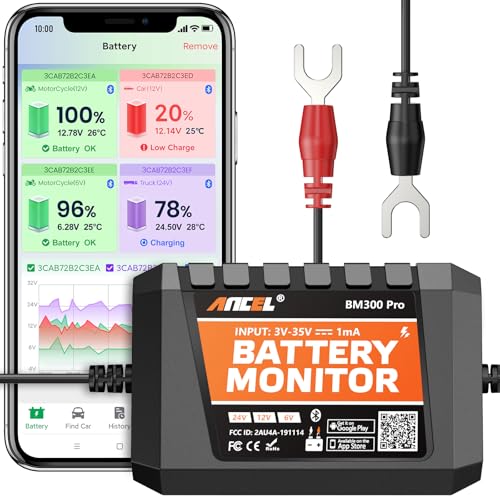
ANCEL BM300 Pro Bluetooth Battery Monitor for 6V, 12V and 24V Systems leads this shortlist for chassis or house batteries needing a history log. Use that fit as a reference point, then compare the alternatives against your own space and workload.
Specs that separate the picks
The first details to compare are Voltage, SOC estimate, temperature, 6V, 12V, 24V Bluetooth, 12V Bluetooth tester. Confirm the exact model and included components before ordering.
Trade-off to plan for
State of charge is estimated from voltage only

Before you buy

What Matters Before You Choose a 12 Volt RV Battery Monitor Without a Shunt

Key buying criteria so you get the right fit the first time.

  1. 01

    Why voltage is a poor fuel gauge

    Battery voltage falls under load and recovers at rest, and a rested lead acid battery moves only about a volt between full and empty. A lithium iron phosphate battery sits near 13 volts across most of its charge and only drops sharply at the end. Treat voltage readings as a health check and use a shunt monitor when you need a real percentage.

  2. 02

    Battery chemistry setting

    A monitor that assumes a lead acid voltage curve will show a lithium battery as nearly empty or nearly full at the wrong times. Some units let you program the voltage that corresponds to each percent. Check the listing for lithium support and a programmable table, not just a compatible battery type list.

  3. 03

    Idle current draw

    A monitor that draws 1 milliamp uses roughly 24 milliamp-hours a day, a tiny amount, while 15 milliamps uses about 360 milliamp-hours a day, which matters over a winter in storage. A rig parked for four months would lose about 43 amp-hours at that rate. Read the listing for an idle or standby figure and wire panel meters through a switch.

  4. 04

    Bluetooth range and history

    Bluetooth only reaches your phone within roughly 10 to 30 feet, so a log stored on the monitor and synced later is what actually gives you a record of the weeks you were away. The BM300 Pro and BM7 list 72 days of storage. Check for stored history rather than only live readings.

  5. 05

    Temperature reading source

    A temperature figure is only useful if it measures the battery. The DROK reads its own internal temperature, not the battery's or the air around it, and the clamp-on units read at the terminal. Check what the listing says the sensor is measuring.

  6. 06

    Car features versus RV needs

    Cranking and charging tests apply to a starter battery during engine starts, which suits a motorhome's chassis battery but not a house bank that is never cranked. A monitor sold for cars may still report voltage fine. Check which features apply to the battery you are actually watching.

Our standards

Why You Can Trust RV Gear Lab

At RV Gear Lab, we compare products based on rig fit and power or hookup compatibility, verified specifications, usability, setup requirements, weight, durability, and real-world trade-offs. We do not rank products purely on marketing claims or commission rates.

We have not personally tested every product listed. Where hands-on testing is not available, recommendations are based on verified manufacturer specifications, product documentation, use-case fit, and comparative research.

How we review RV gear →

Detailed reviews

The 6 best 12 volt rv battery monitors without a shunt, explained

01
ANCEL BM300 Pro Bluetooth Battery Monitor for 6V, 12V and 24V Systems
  • Voltage, SOC estimate, temperature
  • Bluetooth 5.3, 72-day history
  • About 1mA draw, IP67
Check price on Amazon for ANCEL BM300 Pro Bluetooth Battery Monitor for 6V, 12V and 24V Systems (opens in a new tab)
Best for: Chassis or house batteries needing a history log

Our take

Pick this if you want a clip-on monitor with a record of the last 72 days for a house or chassis battery.

Why it made the shortlist

The ANCEL BM300 Pro clamps onto one battery and reports voltage, estimated state of charge and temperature through its app, over Bluetooth 5.3. Its listing says that on supported 12 and 24 volt vehicle systems it also reviews cranking and charging voltage tests, that it stores 72 days of history while disconnected and syncs when you reconnect, and that one phone can view up to four monitors. It draws about 1 milliamp and has an IP67 housing with reverse-polarity and short-circuit protection.

It ranks first at $47.99 because it is the most documented: a stated idle draw, a stored history, a temperature reading and clear limits.

What works

  • Stores 72 days of history while disconnected
  • States that Bluetooth range is the only link
  • Supports 6, 12 and 24 volt systems
  • Reverse-polarity and short-circuit protection are built in

Watch out for

  • State of charge is estimated from voltage only
  • Each unit monitors just one battery
The catch
The caveat is that state of charge is an estimate from voltage, and one monitor watches only one battery.
02
Best for: Buyers comparing capacity, compatibility, included components and storage needs

Our take

Choose it for the same clip-on function as the BM300 Pro at a lower price.

Why it made the shortlist

The BM7 is a Bluetooth monitor for 6, 12 and 24 volt batteries that reports power, temperature, voltage, cranking and charging system tests, trip records and 72 days of data storage. Its listing says it can monitor four batteries at once in its app, claims accuracy over 99.6 percent, has an IP67 fireproof ABS shell with reverse-connection and short-circuit protection, and draws about 1 milliamp. It sends an app alarm if a battery behaves abnormally within about 10 meters.

It ranks second at $39.99, $8.00 below the ANCEL BM300 Pro and $14.51 above the BM200. The 10 meter alarm range means no warning if you are further from the rig.

What works

  • Costs $8.00 less than the BM300 Pro
  • Stores 72 days of voltage and temperature data
  • App can watch four batteries at once
  • IP67 fireproof shell resists water and heat

Watch out for

  • Accuracy figure is a claim with no stated method
  • Alarms only reach you within about 10 meters
03
Best for: Motorhome chassis batteries on a tight budget

Our take

ANCEL BM200 Bluetooth Battery Monitor, 12V Automotive Car Battery Tester is the better fit when motorhome chassis batteries on a tight budget.

Why it made the shortlist

Its listing says it monitors up to four devices in the app, has an IP67 laser-finished case with reverse-polarity and short-circuit protection, draws about 1.5 milliamps and works within 15 to 30 feet. It supports lead acid and lithium 12 volt batteries.

It ranks third at $25.48, $22.51 below the BM300 Pro and $14.51 below the BM7.

What works

  • Costs about half the BM300 Pro
  • Cranking test checks the chassis starter battery
  • Records data every two minutes in the app
  • IP67 case and polarity protection are listed

Watch out for

  • Idle draw is 1.5 milliamps, higher than rivals
  • Built for cars, so house-bank use is limited
The catch
It lacks the temperature stated by the others, and its listing frames it as a car tool, so the cranking and charging tests apply to engine-starting batteries rather than house banks.
04
DROK RV Battery Monitor 12V LCD Display, 10-100V, Temperature Gauge
  • 10 to 100V LCD meter
  • Programmable percent table
  • Internal temperature, not battery
Check price on Amazon for DROK RV Battery Monitor 12V LCD Display, 10-100V, Temperature Gauge (opens in a new tab)
Best for: Permanent voltage readout with a custom curve

Our take

Choose it if you want a permanent readout inside the rig with a custom voltage-to-percent map.

Why it made the shortlist

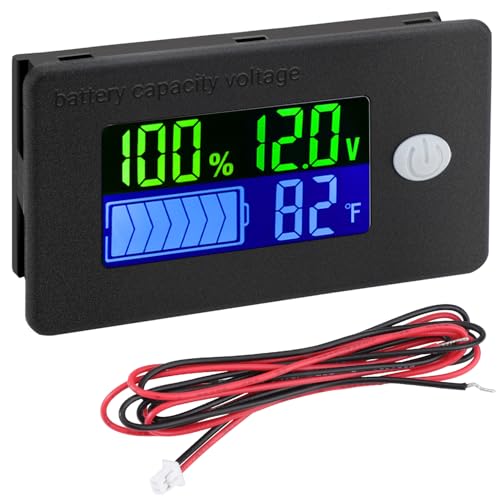
The DROK is a wired LCD meter for 10 to 100 volt batteries that reads battery voltage and capacity percent and shows the meter's own internal temperature in Fahrenheit. The listing says it works with lithium, lead acid, lithium iron phosphate and Ni-MH batteries, lets you program the percentage that corresponds to each voltage, and defaults to a 12 volt lead acid curve. It costs $17.49.

It ranks fourth because it is a plain, permanent display, $7.99 below the ANCEL BM200 and $1.51 above the Linkstyle.

What works

  • Programmable voltage-to-percent map suits lithium batteries well
  • Works across 12, 24, 36, 48 and 60 volts
  • Wired panel display needs no phone
  • Costs only $17.49 for a permanent wired display

Watch out for

  • Temperature is the meter's own, not the battery's
  • Default curve assumes lead acid until you change it
05
Best for: Vans and bunks wanting a voltage display with USB

Our take

Pick this if you want a combined voltage display and charge port in one panel.

Why it made the shortlist

The Linkstyle meter reads DC 8 to 30 volts and shows battery capacity from 20 to 100 percent with a stated accuracy of plus or minus 1 percent and a 500 millisecond refresh. Its listing adds dual USB ports, 18 watt USB-A and 18 watt Type-C, a customizable low-voltage alarm where the number flashes, and power-off memory.

It ranks fifth at $15.98, $1.51 below the DROK and $5.99 above the DaierTek. The USB ports make it a useful panel in a van or bunk. The idle draw of up to 15 milliamps is far higher than the 1 milliamp Bluetooth monitors, so it is better wired through a switch than left on over a winter.

What works

  • Adds 18 watt USB-A and Type-C charging ports
  • Low-voltage alarm threshold can be customized by the user
  • Memory keeps your settings after power is removed
  • Costs only $15.98 for display plus ports

Watch out for

  • Idle draw up to 15 milliamps drains in storage
  • Capacity range starts at 20 percent
06
Best for: A simple glance gauge on a switch panel

Our take

Choose it for a simple panel readout at the lowest price.

Why it made the shortlist

The DaierTek is a round 29 millimeter panel voltmeter with a three-digit blue LED display, rated DC 8 to 48 volts and 0.1 volt resolution. Its listing says it is waterproof and ships with wires, two mounting screws, a panel and a nylon nut for mounting in a 29 millimeter hole. It costs $9.99.

It is $5.99 below the Linkstyle and $38.00 below the ANCEL BM300 Pro. For a single glance at the house battery from a switch panel, voltage resolution of 0.1 volt is enough to see a lead acid battery sag.

What works

  • Costs only $9.99 for a permanent readout
  • Resolution of 0.1 volt shows lead acid sag
  • Includes screws, wires, panel and nylon nut
  • Waterproof design suits damp mounting locations

Watch out for

  • Shows voltage only with no percent or alarm
  • Listing gives no idle current figure

Methodology

How We Built This Shortlist

Each pick was assessed across 5 criteria weighted for real-world use.

01

What voltage can honestly tell you

We checked whether each listing presents state of charge as an estimate from voltage, and noted which units pretend to a precision a voltage reading cannot give.

02

Battery chemistry support

We looked at lead acid and lithium support and whether a unit lets you adjust the voltage-to-percent map for lithium's flat curve.

03

Idle current draw

We compared listed idle draw, about 1 milliamp for Bluetooth clamps against up to 15 milliamps for the USB panel, since monitors run for months in storage.

04

History, alerts and range

We compared stored history, app alerts and Bluetooth range against wired displays that show only the present reading.

05

Fit to an RV battery

We noted car-centric features such as cranking tests, and which units actually suit a house bank or chassis battery rather than a car.

Decision guide

Match a 12 Volt RV Battery Monitor Without a Shunt to Your RV

By Which Battery You Are Watching

Your situationRecommended pickWhy
Chassis starter battery on a motorhomeANCEL BM200Cranking and charging tests for $25.48
House battery, want history and temperatureANCEL BM300 Pro72-day history and temperature at about 1mA
Several batteries, want one appBM7 BluetoothApp watches four batteries for $39.99
Lithium house bank with a permanent displayDROK Panel MeterProgrammable voltage-to-percent map
Van or bunk wanting a display and charge portsLinkstyle USBTwo 18 watt USB ports with a display

By Budget

BudgetRecommended pick
Under $10DaierTek Round ($9.99)
$15 to $26Linkstyle USB ($15.98), DROK Panel Meter ($17.49) or ANCEL BM200 ($25.48)
$39 to $48BM7 Bluetooth ($39.99) or ANCEL BM300 Pro ($47.99)

Bluetooth Clamp vs Wired Panel Meter

Bluetooth clamp

A small module clips on the terminals, uses about 1 milliamp and logs history to an app, but only reaches your phone within roughly 10 meters. The ANCEL BM300 Pro, BM7 and ANCEL BM200 work this way.

Wired panel meter

A permanent display in the rig shows voltage at a glance without a phone, but has no history and usually draws more current. The DROK Panel Meter, Linkstyle USB and DaierTek Round are panel units.

Most owners get more from a Bluetooth clamp; choose a panel meter if you want a permanent glance gauge and no phone.

By What You Want to Know

The question you are askingRecommended pick
Is my battery sagging or healthy right nowDaierTek Round or DROK Panel Meter
How did the battery behave over the last weeksANCEL BM300 Pro or BM7 Bluetooth
Is my alternator charging the chassis batteryANCEL BM200
How cold is the battery bayANCEL BM300 Pro (temperature reading)

For a Lithium House Bank Specifically

Look for

A way to adjust the voltage-to-percent map, since lithium iron phosphate stays near 13 volts across most of its charge and a lead acid curve will mislead. Voltage-only tools should be treated as a rough health check, with a shunt for real state of charge.

In this comparison

The DROK Panel Meter lets you program the percentage for each voltage, and the ANCEL BM300 Pro estimates state of charge but still from voltage, so neither replaces a shunt.

When to Spend More

Spend more if

You want history and a temperature reading you can trust to be on the battery; the ANCEL BM300 Pro costs $22.51 more than the BM200 and logs 72 days. Spend on a shunt guide if you need real state of charge.

Save if

You only need to see if voltage is sagging; the DaierTek Round at $9.99 or the DROK Panel Meter at $17.49 does it with no app.

FAQ

Before You Bring One Home

Can a voltage monitor tell me how much battery is left?

Only roughly. On lead acid a rested voltage maps loosely to charge, but under load or on lithium it misleads. For a real percentage you need a shunt-based monitor, which counts amp-hours.

Will these monitors work on a 12 volt lithium RV battery?

They show voltage correctly, but percent figures built for lead acid will be wrong. The DROK lets you program the percentage per voltage, and the ANCEL units list lithium support, but treat percentages as estimates.

Is the ANCEL BM300 Pro worth $22.51 more than the BM200?

If you want a temperature reading, a 72-day history and a lower 1 milliamp draw, yes. If you only need a cranking and voltage check on a chassis battery, the BM200 at $25.48 is enough.

How do I install a clip-on Bluetooth battery monitor?

Attach the red lead to the positive terminal and the black lead to the negative, secure both leads, pair the phone through the app and set the battery type. Mount it away from thick metal for the best signal.

Do these monitors drain my battery in storage?

The Bluetooth clamps list about 1 milliamp, which is small, while the Linkstyle lists up to 15 milliamps while not charging. For a long storage period, disconnect a panel meter or wire it through a switch.

Can I use one monitor on multiple batteries?

Each Bluetooth unit monitors a single battery, but the app can show up to four units at once. For several batteries you need one monitor per battery.

Bottom line

The short version

Browse more 12 volt rv battery monitors without a shunt on Amazon →
Bowen Higgins, RV Editor at RV Gear Lab

About the author

Bowen Higgins

RV Editor at RV Gear Lab

Bowen covers RV power, water systems, towing and leveling, upkeep and interior comfort, with a focus on matching gear to the rig, the hookups and the way you actually travel.

More from Bowen →Editorial standards

Keep reading

Related guides