

We research everything we recommend. When you buy through our links, we may earn a commission. Learn more

Buying guide · 11 min read · Updated October 2, 2026

6 Best RV Battery Monitors With Shunt and Display in 2026: A Practical RV Guide

Six shunt-based RV battery monitors with a wired display compared on shunt amps, accuracy claims, screen size and setup, from $41.99 to $65.59, no app needed.

Bowen HigginsBy Bowen HigginsRV Editor at RV Gear Lab6 products comparedSpec-sheet researched

At a glance

Our top picks

A battery voltage reading is a poor fuel gauge, because voltage sags under load and bounces back at rest, and on a lithium battery it barely moves until the pack is nearly empty. A shunt-based monitor fixes that by measuring the current flowing in and out through a precision resistor on the negative cable and counting amp-hours. The result is a state-of-charge percentage that actually tracks what you used.

This guide covers the classic version of that tool: a shunt wired to a dedicated display with its own screen, no phone required. We compared six units from $41.99 to $65.59 on shunt amp rating, stated accuracy, screen, cable length, alarms and standby draw. The price spread is only about $24, so the choice comes down to current headroom, readability and how much setup the listing admits to. Bluetooth and WiFi models are in our other guides.

RV Gear Lab field notes

The Rig Fit Check

Start with the job
Renogy 500A Battery Monitor with Shunt, Battery Meter leads this shortlist for most RVs wanting a plain wired monitor. Use that fit as a reference point, then compare the alternatives against your own space and workload.
Specs that separate the picks
The first details to compare are 500A shunt, 1% accuracy, 500A, 2.4 in color screen, 500A, 3.5 in color screen. Confirm the exact model and included components before ordering.
Trade-off to plan for
Display is basic compared with color screens

Before you buy

What Matters Before You Choose an RV Battery Monitor With Shunt and Display

Key buying criteria so you get the right fit the first time.

  1. 01

    Why a shunt beats voltage

    A shunt is a precision resistor on the battery's negative cable, and the monitor measures the tiny voltage across it to calculate current, then counts amp-hours in and out. Voltage alone sags under load and hides how much charge is left, especially on lithium. Check that the listing says shunt and coulomb counting, not just battery tester.

  2. 02

    Shunt amp rating

    The shunt must carry the largest current your system can draw, including inverter surges. A 12 volt 2,000 watt inverter draws roughly 170 amps, and a 3,000 watt one about 250. Choose a rating above your peak, such as 500 amps for large inverters, and check the shunt rating rather than the display's marketing range.

  3. 03

    Accuracy and drift

    Accuracy claims here run from 0.5 to 1 percent, but any counter slowly drifts and needs a resync when the battery reaches a full charge. A monitor without an easy 100 percent sync will gradually show wrong numbers. Look for a sync step in the listing and plan to run a full charge now and then.

  4. 04

    Setup effort

    Installing a shunt means disconnecting the battery, placing the shunt on the main negative, moving all loads and chargers to the load side of the shunt, then entering your battery capacity. A missed wire makes the amp-hour count wrong. Look for included wrenches, ground loop wire and a clear manual, and check cable length against your mounting plan.

  5. 05

    Standby draw

    The monitor stays on all the time, so its idle current drains your battery during storage. Listed values here range from about 50 microamps to 1 milliamp, and 1 milliamp is roughly 24 milliamp-hours per day. Check the listing for a standby figure and a sleep or screen-off feature.

  6. 06

    Alarms and data retention

    A low-capacity or low-voltage alarm warns you before a lithium battery's BMS cuts off or a lead acid battery goes too deep. Units that store data on power loss keep your amp-hour count if the battery disconnects. Look for programmable alarms, and note whether the 20 percent alarm threshold is fixed or adjustable.

Our standards

Why You Can Trust RV Gear Lab

At RV Gear Lab, we compare products based on rig fit and power or hookup compatibility, verified specifications, usability, setup requirements, weight, durability, and real-world trade-offs. We do not rank products purely on marketing claims or commission rates.

We have not personally tested every product listed. Where hands-on testing is not available, recommendations are based on verified manufacturer specifications, product documentation, use-case fit, and comparative research.

How we review RV gear →

Detailed reviews

The 6 best rv battery monitors with shunt and display, explained

01
Best for: Most RVs wanting a plain wired monitor

Our take

Pick this if you want a plain, brand-name shunt monitor with room for a large inverter.

Why it made the shortlist

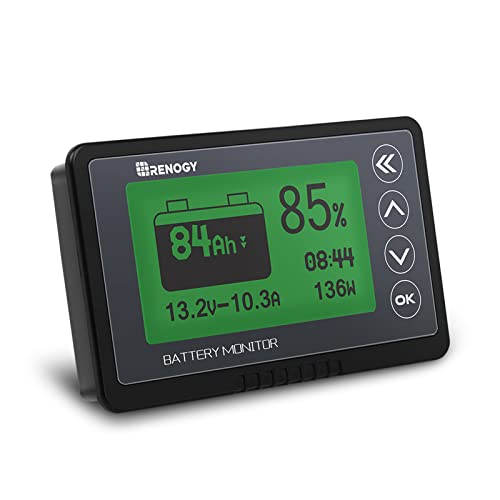
The Renogy 500A monitor pairs a 500 amp shunt with a backlit display showing voltage, current, consumed power, battery capacity and battery degradation rate. Its listing claims 1 percent accuracy, high and low capacity alarms that flash the backlight, compatibility with lead acid, lithium iron phosphate and lithium-ion batteries at 12, 24 and 48 volts, a transparent shunt holder and a 20 foot shielded cable.

It ranks first at $63.10 because a recognizable brand, the longest included cable at 20 feet and a 500 amp shunt come in one box. It is $2.49 below the BINTA, which adds a bigger screen and a temperature reading.

What works

  • Includes a 20 foot shielded cable for remote mounting
  • 500 amp shunt leaves headroom for a big inverter
  • Works with lithium, AGM, gel and lead acid
  • Low and high capacity alarms flash the backlight

Watch out for

  • Display is basic compared with color screens
  • Listing mentions no temperature reading on the display
02
Best for: Owners who want a color display without paying more

Our take

Choose it for a readable color display at a plain price.

Why it made the shortlist

The LNEX 500A monitor uses a 2.4 inch color backlit screen and a 500 amp shunt, supports 8 to 100 volt systems, and stores the latest readings automatically when power is lost. Its listing describes programmable high and low alarms, adjustable brightness, a transparent shunt holder with marked positive and negative, and a 16 foot shielded wire.

It is $21.00 above the Coolschmax and $2.60 below the BINTA, which has a larger 3.5 inch screen. Its data storage on power loss means a battery that drops out will not wipe your amp-hour count.

What works

  • Color screen reads easily in bright light
  • Stores latest data when power is lost
  • Marked shunt holder helps prevent reversed wiring
  • Brightness adjusts to save power at night

Watch out for

  • Cable is 16 feet, four feet shorter than Renogy
  • Listing states no numeric accuracy figure
The catch
It ranks second at $62.99, $0.11 below the Renogy 500A, and trades a 4 foot shorter cable for a color screen.
03
BINTA 500A Battery Monitor with Shunt, 8-100V, 3.5 Inch Color Screen
  • 500A, 3.5 in color screen
  • Curve and history views
  • Plus or minus 0.5% current claim
Check price on Amazon for BINTA 500A Battery Monitor with Shunt, 8-100V, 3.5 Inch Color Screen (opens in a new tab)
Best for: Owners who want trend curves and temperature

Our take

Pick this if you want trend curves and temperature on the screen.

Why it made the shortlist

The BINTA 500A monitor has a 3.5 inch color LCD with four display modes: simple, full data, curve and historical data. Its listing shows voltage, current, power, remaining capacity, runtime and ambient temperature, claims plus or minus 0.5 percent current accuracy and plus or minus 1 percent voltage accuracy over 0 to 500 amps and 8 to 100 volts, and stores the latest test data during power loss. The kit includes a 10 foot shielded cable, a ground loop wire and an installation wrench.

It ranks third at $65.59, the highest in this group, $2.49 above the Renogy and $23.60 above the Coolschmax. What it adds is the largest screen, curve and history views and a temperature reading, along with the tightest accuracy claim. Its 10 foot cable is half the length of the Renogy cable.

What works

  • Largest screen here at 3.5 inches
  • Four display modes include curve and history
  • Shows ambient temperature alongside remaining capacity
  • Tightest stated accuracy at 0.5 percent current

Watch out for

  • Ten foot cable is half the length Renogy includes
  • Costs the most here at $65.59
04
Best for: Damp bays and marine-style mounting

Our take

Choose it if the monitor mounts somewhere damp such as a marine or open bay.

Why it made the shortlist

The AILITRON TR24 uses a 350 amp pure copper shunt, an IP68-rated sealed body and a TFT color screen, and its listing says it handles continuous loads for 3,000 to 5,000 watt inverters. It claims plus or minus 1.0 percent accuracy, SOC percent, amp-hours and real-time watts, an 8 to 100 volt range, customizable high and low voltage and low-capacity alarms and an audible buzzer.

It ranks fourth at $62.55, the lowest of the 500 and 350 amp group, $0.55 below the Renogy and $20.55 above the AILI TR16, which lists a similar shunt for less. The IP68 body is what sets it apart, useful if the display mounts in a wet bay.

What works

  • IP68 sealed body suits damp mounting spots
  • Copper shunt is described for continuous high current
  • Customizable alarms with an audible buzzer
  • Shows SOC percent, amp-hours and real-time watts

Watch out for

  • 350 amp shunt limits very large 12V inverters
  • Costs $20.55 more than the AILI TR16
05
Best for: Travel trailers with modest inverter loads

Our take

Pick this if your system peaks below 300 amps, which covers most travel trailers, and you want low cost with a temperature reading.

Why it made the shortlist

The Coolschmax CZ212 monitor includes a 300 amp 75 millivolt shunt on an acrylic base, a 2.4 inch TFT screen and coulomb counting with a 16-bit converter. Its listing shows state of charge in amp-hours and percent, voltage, current, power, temperature and remaining time, with programmable voltage alarms and a low-capacity alarm at 20 percent. It claims one-time setup, with a long press to sync 100 percent on a full battery, standby draw of 1 milliamp and memory that survives power-off.

It ranks fifth at $41.99, which is $21.11 below the Renogy and $23.60 below the BINTA, and gives up 200 amps of shunt rating against the 500 amp units. It costs $0.01 less than the AILI TR16, whose shunt is rated 350 and 500 amps. Its temperature reading and a listed one-time setup are its advantages at the price.

What works

  • Shows temperature and remaining time on one screen
  • Costs about $21 less than the Renogy
  • Long-press sync sets 100 percent on a full battery
  • Standby draw is listed at about 1 milliamp

Watch out for

  • 300 amp shunt limits larger inverter loads
  • Low-capacity alarm is fixed at 20 percent
06
Best for: Storage-heavy rigs where standby draw matters

Our take

Choose it if you want a 500 amp shunt at the lowest price and care about parasitic draw during storage.

Why it made the shortlist

The AILI TR16 includes a 350 and 500 amp precision shunt, a 2 meter extension cable and a backlit LCD, supports 8 to 120 volts, and shows state of charge, voltage, current and remaining capacity up to 999 amp-hours. Its listing states a very low standby draw of 50 to 60 microamps, memory retained after power-off, self-powering from 8 to 80 volts and a 30-day return period.

It ranks last at $42.00, $0.01 above the Coolschmax. It is $21.10 below the Renogy 500A and $23.59 below the BINTA, and its 2 meter cable is the shortest listed here.

What works

  • Lowest listed standby draw at 50 to 60 microamps
  • 500 amp shunt option at only $42.00
  • Programmable capacity up to 999 amp-hours
  • Self-powered from 8 to 80 volts, no extra supply

Watch out for

  • Cable is only about 2 meters, 6.5 feet
  • Plain LCD without temperature or color screen

Methodology

How We Built This Shortlist

Each pick was assessed across 5 criteria weighted for real-world use.

01

Shunt rating versus your peak current

We compared the shunt amp rating, 300, 350 or 500, against the continuous and peak currents a typical RV inverter can pull.

02

Stated accuracy and measurement method

We recorded accuracy claims, 0.5, 1 and 1 percent, and noted which listings describe coulomb counting rather than just voltage.

03

Display and readings

We compared screen size, color versus monochrome, and extras such as temperature, runtime, curve and history views.

04

Cable length and installation

We noted included cable length, which ranges from about 6.5 feet to 20 feet, plus holder, wrench and sync steps that affect first setup.

05

Alarms and idle draw

We checked programmable alarms, data retention on power loss, and listed standby draw, since a monitor runs around the clock on your batteries.

Decision guide

Match an RV Battery Monitor With Shunt and Display to Your RV

By Peak Inverter Current

Your situationRecommended pickWhy
Large inverter or heavy loads over 300 ampsRenogy 500A500 amp shunt and a 20 foot cable
Mid-size inverter, about 350 ampsAILITRON TR24350 amp copper shunt in a sealed body
Small trailer, modest loads under 300 ampsCoolschmax 300A300 amp shunt at $41.99 with temperature
Want a 500 amp shunt at the lowest priceAILI TR16Includes a 350 and 500 amp shunt for $42.00
Want a color screen and 500 ampsLNEX Color 500A2.4 inch color screen for $62.99

By Budget

BudgetRecommended pick
$40 to $45Coolschmax 300A ($41.99) or AILI TR16 ($42.00)
$62 to $64AILITRON TR24 ($62.55), LNEX Color 500A ($62.99) or Renogy 500A ($63.10)
About $66BINTA 3.5in ($65.59)

Basic Display vs Data Display

Basic display

A backlit screen with the essentials of voltage, current and state of charge, which is all most owners read. The Renogy 500A and AILI TR16 are examples, with simple, readable numbers.

Data display

A larger color screen with trend curves, history and temperature that lets you see usage over time. The BINTA 3.5in offers curve and history views, and the Coolschmax 300A and BINTA both show temperature.

Most owners get what they need from a basic display; choose a data display if you like to study your charge and discharge patterns.

By Install Location

Where the display goesRecommended pick
Far from the battery, long cable runRenogy 500A (20 ft cable)
Damp compartment or open bayAILITRON TR24 (IP68)
Right next to the batteryBINTA 3.5in (10 ft cable) or AILI TR16
Mid-distance, color displayLNEX Color 500A (16 ft cable)

For a Lithium Battery Upgrade Specifically

Look for

A true coulomb counting shunt that supports LiFePO4, a way to sync 100 percent on a full charge, and enough shunt amps for your inverter. Lithium voltage stays flat, so a voltage-only meter cannot tell you how much is left.

In this comparison

The Renogy 500A lists lithium iron phosphate support, the Coolschmax 300A offers a one-press 100 percent sync, and the AILITRON TR24 lists LiFePO4 along with AGM and lead acid.

When to Spend More

Spend more if

You want trend curves and a larger screen; the BINTA 3.5in costs $23.60 more than the Coolschmax 300A. Spend on the Renogy 500A if you need a 500 amp shunt with a long cable from a known brand.

Save if

Your system peaks under 300 amps; the Coolschmax 300A at $41.99 or the AILI TR16 at $42.00 cover the essentials for about $21 less.

FAQ

Before You Bring One Home

Do I need a shunt-based monitor or is a voltmeter enough?

A voltmeter shows voltage only, which is a rough guide on lead acid and nearly useless on lithium, where voltage stays flat over most of the range. A shunt counts amp-hours, so it can show percent remaining and time left. If you boondock on lithium, a shunt is the tool to get.

What is the biggest installation mistake with shunt monitors?

Leaving a load or charger wired to the battery side of the shunt. Every negative path must go through the shunt, or the amp-hour count drifts. Trace each negative wire before you finish.

Is the BINTA worth $23.60 more than the Coolschmax?

If you like a bigger screen, curve and history views and a 500 amp shunt, yes. If your loads stay below 300 amps and you mostly want a percent readout, the Coolschmax at $41.99 gives you temperature and remaining time.

How do I calibrate a shunt battery monitor?

Enter your battery capacity in amp-hours, charge the battery fully until the charger reaches float, then set the monitor to 100 percent using its sync step. Zero the current with all loads off if the monitor offers it.

Will a shunt monitor drain my battery?

A little. Listed idle draw ranges from 50 to 60 microamps on the AILI TR16 to about 1 milliamp on the Coolschmax. That is small next to a fridge, but add it to your parasitic budget if the rig sits for months.

Does the monitor need to match my battery voltage?

Check the supported range. The units here cover 8 to 100 volts or more, so they work on 12, 24 and 48 volt banks, but the shunt and display must be set to the right battery type and capacity.

Bottom line

The short version

Browse more rv battery monitors with shunt and display on Amazon →
Bowen Higgins, RV Editor at RV Gear Lab

About the author

Bowen Higgins

RV Editor at RV Gear Lab

Bowen covers RV power, water systems, towing and leveling, upkeep and interior comfort, with a focus on matching gear to the rig, the hookups and the way you actually travel.

More from Bowen →Editorial standards

Keep reading

Related guides