

We research everything we recommend. When you buy through our links, we may earn a commission. Learn more

Buying guide · 11 min read · Updated October 2, 2026

6 Best 200Ah RV Batteries in 2026: A Practical RV Guide

Five 12V 200Ah LiFePO4 batteries and one AGM compared on usable watt-hours, listed weight, size and BMS current, from $270 to $317.

Bowen HigginsBy Bowen HigginsRV Editor at RV Gear Lab6 products comparedSpec-sheet researched

At a glance

Our top picks

Two batteries both labelled 12V 200Ah can differ by more than 20 pounds and by more than 1,000 watt-hours of energy you can really use. In lithium, 200Ah at 12.8 volts is 2,560 watt-hours and most of it is available. In lead-acid, the rating is usually quoted at a slow 20-hour discharge and drops sharply at heavier loads, and only about half is safe to use. So the amp-hour number is the start of the comparison, not the end of it.

We compared six 200Ah options priced from $269.99 to $316.59: five LiFePO4 batteries and one AGM lead-acid as the cross-chemistry yardstick. Each is judged on usable watt-hours, listed weight and dimensions, the current the battery management system allows, and what the listing leaves unsaid. The aim is to show what 200Ah really means in a travel trailer, and which listings back the number with data.

RV Gear Lab field notes

The Rig Fit Check

Start with the job
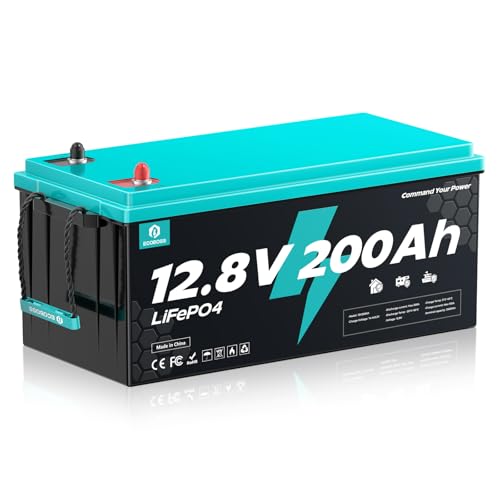
ECOBOSS 12V 200Ah LiFePO4 Battery with 200A Smart BMS leads this shortlist for large-inverter RVs that need documented limits. Use that fit as a reference point, then compare the alternatives against your own space and workload.
Specs that separate the picks
The first details to compare are 2,560Wh, 200A BMS, 50.5 lb, 13.35 inches long, 58.86 lb, 20.08 inches. Confirm the exact model and included components before ordering.
Trade-off to plan for
Weight and dimensions are not listed

Before you buy

What Matters Before You Choose a 200Ah RV Battery

Key buying criteria so you get the right fit the first time.

  1. 01

    Amp-hours versus watt-hours

    Amp-hours measure charge, but energy is amp-hours times volts, so 200Ah at 12.8V is 2,560Wh while 200Ah AGM at 12V is 2,400Wh nominal. The AGM's rating also assumes a slow 20-hour discharge, and the Renogy listing shows 152.9Ah at the 3-hour rate. Compare watt-hours at your own load, not the label.

  2. 02

    BMS continuous current

    The battery management system caps output, and 150A at 12.8V supports about 1,920 watts while 200A supports about 2,560 watts. A 2,000-watt inverter at full draw pulls close to 190 amps, which can trip a 150A BMS. Look for the continuous figure, not just a peak, and read the title and bullets for contradictions.

  3. 03

    Weight and listed ratios

    Listings claim to be one third or one half the weight of lead-acid, which cannot both be true for the same 200Ah. The yeagulch's 58.86 pounds at one third implies about 177 pounds of lead-acid, and the E-LekTech's 50.5 pounds at one half implies about 101. Check the actual number in pounds and the AGM's data sheet.

  4. 04

    Physical size and fit

    A 200Ah lithium can be 20 inches long like the yeagulch or about 13 like the E-LekTech listing, a volume difference of roughly 27 percent. A battery that does not fit the tray costs a bracket or a new box. Measure length, width, height and terminal location, and treat a surprisingly small listing as something to confirm.

  5. 05

    Cold behavior

    Lithium pauses charging near 32°F, and the ECOBOSS publishes a 32°F to 113°F charge range and a restart at 41°F. Without that, a winter bank may refuse shore power or solar. Look for the numbers, and plan on AGM or a heated bay if you camp in freezing weather.

  6. 06

    Warranty and expansion

    A warranty of ten years from the E-LekTech stands against vague extensive claims. Expansion limits also differ, with 4S4P for the ECOBOSS and 6S6P for the E-LekTech and Paoweric. Read the warranty line and the maximum configuration, and never mix brands in one bank.

Our standards

Why You Can Trust RV Gear Lab

At RV Gear Lab, we compare products based on rig fit and power or hookup compatibility, verified specifications, usability, setup requirements, weight, durability, and real-world trade-offs. We do not rank products purely on marketing claims or commission rates.

We have not personally tested every product listed. Where hands-on testing is not available, recommendations are based on verified manufacturer specifications, product documentation, use-case fit, and comparative research.

How we review RV gear →

Detailed reviews

The 6 best 200ah rv batteries, explained

01
Best for: Large-inverter RVs that need documented limits

Our take

Pick it when you need a clear picture of current and temperature limits for a 2,000W inverter and an outdoor-ish bay.

Why it made the shortlist

The ECOBOSS 12V 200Ah comes with the most complete operating data of the group: a 200A BMS that supports 200A continuous discharge and a 100A maximum charge, a charging range of 32°F to 113°F that pauses below 32°F and resumes at 41°F, and a discharge range of minus 4°F to 149°F. It carries an IP65 rating, claims 15,000 plus cycles and expands as 4S4P to 51.2V 800Ah.

At $298.99 it is $29.00 more than the E-LekTech and $17.60 less than the yeagulch, giving about $117 per nominal kilowatt-hour. Against the Rvpozwer at $305.99 it saves $7.00 and publishes stronger thermal numbers. The listing gives no weight or dimensions, which is the main gap against the yeagulch and E-LekTech.

What works

  • Continuous 200A discharge supports a large inverter
  • Charge and discharge temperature ranges both published
  • Costs $17.60 less than the yeagulch

Watch out for

  • Weight and dimensions are not listed
  • Charging stops at 32°F with no heater
02

Best Lightest With 10-Year Warranty · 2 of 6

E-LekTech 12V 200Ah LiFePO4 Battery with 150A BMS

Best for: Smaller inverters and long-warranty buyers

Our take

Pick it for the longest warranty and the lowest price per kilowatt-hour.

Why it made the shortlist

The E-LekTech 12V 200Ah lists a weight of 50.5 pounds and dimensions of 13.35 by 7.6 by 9.84 inches, with a 150A BMS and support for up to 6S6P. The seller states a 10-year warranty and claims more than 10,000 cycles.

At $269.99 it matches the Paoweric, and is $29.00 below the ECOBOSS and $46.60 below the yeagulch, which works out to about $105 per nominal kilowatt-hour, the lowest here.

What works

  • Ten-year warranty is the longest in this roundup
  • Lightest 200Ah here at 50.5 pounds
  • About $105 per nominal kilowatt-hour, tied lowest
  • Dimensions are published for tray planning

Watch out for

  • 150A BMS limits inverters to about 1,900 watts
  • Listing does not publish cold-charging limits
The catch
It is the lightest 200Ah in the roundup and the only one with a written decade of coverage.
03

Best Documented Size and Cycles · 3 of 6

yeagulch 12V 200Ah LiFePO4 Battery with 200A BMS

Best for: Owners who want weight, size and cycles in writing

Our take

Pick it for the cleanest cycle data and a 200A BMS in a long tray.

Why it made the shortlist

The yeagulch 12V 200Ah weighs about 58.86 pounds and measures 20.08 by 8.07 by 8.46 inches, which is long and narrow, with a 200A BMS and an automatic high and low temperature cut-off. The listing gives 4,000 cycles at 100 percent depth, 6,000 at 80 percent and up to 15,000 at 60 percent, and says four in parallel reach 800Ah. A note advises against using it as a starting or golf-cart battery.

At $316.59 it is the most expensive here, $46.60 above the E-LekTech and $17.60 above the ECOBOSS. The listing says it is roughly one third the weight of comparable lead-acid, which implies about 177 pounds for the lead-acid equivalent, an estimate that conflicts with the E-LekTech's half-the-weight claim.

What works

  • Cycle counts listed at 100, 80 and 60 percent
  • 200A BMS supports roughly 2,500 watts continuous
  • Size and weight are published for planning
  • Expands to 800Ah with four in parallel

Watch out for

  • Most expensive 200Ah here at $316.59
  • Over 20 inches long needs a long tray
04
Best for: Buyers comparing capacity, compatibility, included components and storage needs

Our take

Pick it for a 200A battery that is cheaper than the yeagulch and more detailed than the Paoweric.

Why it made the shortlist

The Rvpozwer 12V 200Ah states 2,560Wh maximum, a 200A smart BMS and a cycle curve of 4,000 at 100 percent depth, 6,000 at 80 percent and 15,000 at 60 percent. It says it meets Group 31 standards, which is unusual for 200Ah so the real size deserves checking, lists operation from minus 4°F to 149°F and expands to 800Ah in parallel. The warranty is described as extensive without a number.

At $305.99 it is $7.00 more than the ECOBOSS and $10.60 less than the yeagulch.

What works

  • 200A BMS at $10.60 less than the yeagulch
  • Cycle counts listed at three depths
  • Carry handle on the case helps installation
  • Expandable to 800Ah with four in parallel

Watch out for

  • Weight is not published
  • Warranty length is described but not stated
05

Best Budget Alternative · 5 of 6

Paoweric 12V 200Ah LiFePO4 Battery with 150A BMS

Best for: Buyers comparing capacity, compatibility, included components and storage needs

Our take

The strongest case for Paoweric 12V 200Ah LiFePO4 Battery with 150A BMS is expands to 6S6P for big banks.

Why it made the shortlist

The Paoweric 12V 200Ah has a 150A BMS with five listed protections, supports up to 6S6P and claims more than 10,000 charge and discharge cycles. It markets energy density at least 300 percent above lead-acid. The excerpt gives no weight, dimensions, warranty length or temperature limits.

At $269.99 it matches the E-LekTech and is $29.00 below the ECOBOSS. Against the E-LekTech it loses on information, since the E-LekTech gives weight, size and a 10-year warranty for the same price. It does share the 150A limit of about 1,900 watts. Its cycle claim has no depth attached, so the 10,000 figure may refer to a shallow cycle.

What works

  • Expands to 6S6P for big banks
  • Five protections handled by the BMS

Watch out for

  • Weight, size and warranty are not in the listing
  • Cycle claim gives no depth of discharge
06

Best Lead-Acid Yardstick · 6 of 6

Renogy 12V 200Ah Deep Cycle AGM Battery

Renogy 12V 200Ah Deep Cycle AGM Battery
  • 200Ah at 20-hour rate
  • 152.9Ah at 3-hour rate
  • Sealed AGM, upright
Check price on Amazon for Renogy 12V 200Ah Deep Cycle AGM Battery (opens in a new tab)
Best for: Cold bays and anyone comparing lead-acid honestly

Our take

Pick it as a cold-bay battery or to see why the lithium numbers matter.

Why it made the shortlist

The Renogy 12V 200Ah AGM lists reference capacities of 200Ah at the 20-hour rate, 190.5Ah at 10 hours, 172.3Ah at 5 hours and 152.9Ah at 3 hours, so the usable amp-hours fall as the load rises. At 12 volts, 2,400Wh nominal becomes about 1,835Wh at the 3-hour rate, and a common 50 percent limit keeps real use near 1,200Wh before heavy-load losses. It is sealed, maintenance free and installs upright.

At $296.30 it is $26.31 more than the E-LekTech yet delivers roughly half the usable energy, about $247 per usable kilowatt-hour at 50 percent, against about $105 to $124 per nominal lithium kilowatt-hour. The listing gives no weight, so the lead-acid penalty must be inferred. Its advantage is that it charges in freezing weather.

What works

  • Capacity listed at four discharge rates
  • Self-discharge below 3 percent a month
  • Sealed AGM design needs no watering ever
  • Still accepts charge in cold below 32°F

Watch out for

  • Only about 1,200Wh safely usable at 50 percent
  • Weight is not stated and likely high

Methodology

How We Built This Shortlist

Each pick was assessed across 5 criteria weighted for real-world use.

01

Usable watt-hours

We converted 200Ah to 2,560Wh for lithium and 2,400Wh nominal for AGM, applied a depth limit by chemistry, and used the listed discharge-rate table for the Renogy AGM.

02

Weight and dimensions

We recorded the listed weight and size, computed volume for comparison, and flagged listings that omit them or whose ratio claims contradict one another.

03

BMS current and inverter fit

We converted the BMS amp rating to watts at 12.8 volts to show which batteries can feed a 1,500, 2,000 or 3,000 watt inverter.

04

Temperature and enclosure

We compared charge and discharge temperature limits and any IP rating, noting where only a vague all-weather phrase appears.

05

Price per kilowatt-hour and warranty

We divided price by nominal or usable energy and compared warranty length against that price.

Decision guide

Match a 200Ah RV Battery to Your RV

By Inverter Size

Your situationRecommended pickWhy
3,000W inverter, heavy loadsECOBOSS 200Ah200A continuous, 100A max charge, documented
2,000W inverter, short burstsRvpozwer 200Ah200A BMS at $305.99
Up to 1,500W inverterE-LekTech 200Ah150A BMS is enough and the price is lowest
Inverter around 1,000W or lessPaoweric 200Ah150A limit matches small loads at $269.99
Mostly small DC loads, cold bayRenogy AGM 200AhAccepts charge below freezing

By Budget

BudgetRecommended pick
$270E-LekTech 200Ah or Paoweric 200Ah
$296Renogy AGM 200Ah
$299 to $306ECOBOSS 200Ah or Rvpozwer 200Ah
$317yeagulch 200Ah

Lithium vs AGM at 200Ah

LiFePO4

2,560Wh with most of it usable, much lighter, and 4,000 to 10,000 plus cycles claimed. Covers the ECOBOSS, E-LekTech, yeagulch, Rvpozwer and Paoweric.

AGM lead-acid

Roughly 1,200Wh safely usable from 2,400Wh nominal, heavy, but charges below freezing and has a simple charge profile. The Renogy AGM 200Ah is the one here.

Most RV owners should default to lithium at 200Ah, because the AGM equivalent weighs far more for about half the usable energy.

By Weight and Tray Size

Your constraintRecommended pick
Lightest possible, shorter trayE-LekTech 200Ah
Long, narrow tray over 20 inchesyeagulch 200Ah
Unknown tray, will measureECOBOSS 200Ah, confirm dimensions first
Group 31 tray, confirm real sizeRvpozwer 200Ah

For Replacing Two 100Ah Batteries Specifically

Look for

A BMS rating at or above your inverter's draw and dimensions that fit the space. Two 100Ah batteries held 2,560Wh; one 200Ah must match that energy and carry the current of both on one BMS.

In this comparison

The ECOBOSS 200Ah and Rvpozwer 200Ah offer 200A of BMS current, while the E-LekTech 200Ah is the compact lightweight swap.

When to Spend More

Spend more if

You run a large inverter or want proven data: the ECOBOSS 200Ah costs $29.00 more than the E-LekTech and gives 200A, and the yeagulch 200Ah adds size and cycle detail.

Save if

Your inverter is under 1,500 watts: the E-LekTech 200Ah at $269.99 has a 10-year warranty.

FAQ

Before You Bring One Home

Is one 200Ah battery better than two 100Ah?

A single 200Ah has fewer connections and one BMS, but that BMS must carry the full load. Two 100Ah batteries each carry half, and the ECOBOSS 200A rating needs to match your inverter. Choose by inverter size.

Why do 200Ah lithium batteries weigh so differently?

Listings range from 50.5 to 58.86 pounds, and cell count, case design and BMS differ. A surprisingly light or small listing is worth confirming with the seller before purchase.

Is the ECOBOSS worth $29 more than the E-LekTech?

If you run a 2,000W or larger inverter, yes, because 200A continuous beats 150A. For a 1,000W inverter and a heated bay, the E-LekTech's 10-year warranty is better value.

Can I run an air conditioner from one 200Ah battery?

Briefly. A 1,500W air conditioner draws about 117 amps at 12.8V, so 2,560Wh lasts roughly 1.4 hours at 80 percent usable, an estimate before inverter losses. Plan on shore power or a bigger bank.

How do I charge a 200Ah lithium battery from the converter?

Use a converter with a lithium mode near 14.4 to 14.6 volts, or a DC-DC charger. A lead-acid profile can leave the battery undercharged. Check the converter manual first.

How do I store a 200Ah lithium battery in winter?

Store at about half charge, disconnected, in a space above the low-temperature limit if possible. Top it up every couple of months and avoid charging below 32°F.

Bottom line

The short version

Browse more 200ah rv batteries on Amazon →
Bowen Higgins, RV Editor at RV Gear Lab

About the author

Bowen Higgins

RV Editor at RV Gear Lab

Bowen covers RV power, water systems, towing and leveling, upkeep and interior comfort, with a focus on matching gear to the rig, the hookups and the way you actually travel.

More from Bowen →Editorial standards

Keep reading

Related guides