

We research everything we recommend. When you buy through our links, we may earn a commission. Learn more

Buying guide · 11 min read · Updated October 2, 2026

5 Best Budget 1000 Watt RV Inverters in 2026: A Practical RV Guide

Five pure sine 1000 watt RV inverters compared on continuous watts, outlets, protections and transfer switches for everyday small loads off a 12 volt bank.

Bowen HigginsBy Bowen HigginsRV Editor at RV Gear Lab5 products comparedSpec-sheet researched

At a glance

Our top picks

A 1000 watt inverter is the size for the loads that make a camper feel like home without needing a big battery bank: a laptop and monitor, a television, a CPAP machine, a drip coffee maker run in short bursts, a phone and tablet charging station. It will not run a roof air conditioner, and at this size you are buying a small, simple box. That simplicity is a strength, since fewer features mean fewer settings to get wrong and a lower price for the same continuous output. The decisions that remain are about waveform, protections and how the unit behaves when it is idle.

Budget at 1000 watts splits into two kinds of buyer. One wants the cheapest clean power for a van or trailer with a handful of light loads and no changeover wiring. The other wants a unit that also acts as a transfer switch, so shore power passes through and the inverter takes over when the pedestal goes quiet. Both buyers are served below, and we say which pick belongs to which, along with what each step up on price actually adds to a small rig and what you can skip.

Every pick here is a pure sine wave unit, and that is the first filter, not a nicety. We compared listings and product specs, ranking by safety marks, outlet layout, protections and how each handles an idle draw, and we place each pick by band instead of by figure. A good small inverter is a quiet, well-protected box that sips power when idle, and that is the lens we applied. Continuous watts decide the class, so the peak ratings on these listings are read as brief allowances, never as the headline. Read the specs, not the marketing.

RV Gear Lab field notes

The Rig Fit Check

Start with the job
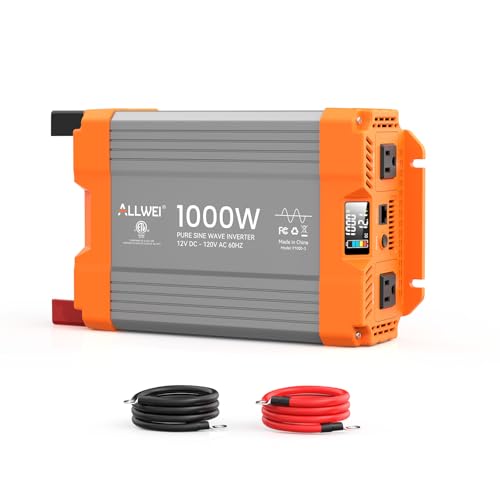
ALLWEI 1000W Pure Sine Wave Power Inverter 12V DC to 120V AC, ETL Listed to UL 458 leads this shortlist for Vans and trailers running laptops, a TV and a CPAP machine.. Use that fit as a reference point, then compare the alternatives against your own space and workload.
Specs that separate the picks
The first details to compare are 1000W continuous, 2000W peak, 3-4% THD pure sine output, 1000W continuous pure sine, 60 Hz. Confirm the exact model and included components before ordering.
Trade-off to plan for
No transfer switch or Bluetooth control

Before you buy

What Matters Before You Choose a Budget 1000 Watt RV Inverter

Key buying criteria so you get the right fit the first time.

  1. 01

    Pure sine, and why modified sine is a risk

    A pure sine inverter produces the same smooth waveform as a wall outlet, while a modified sine unit produces a blocky approximation that is acceptable for simple resistive loads only. Modified sine can cause humming and overheating and, in some cases, damage motors, medical devices and anything with a variable-speed compressor. That makes the choice a hardware-protection question, not a taste question. Every pick in this guide states pure sine in its title, so look for that phrase in any other 1000 watt listing before you buy.

  2. 02

    Continuous watts against the peak figure

    Continuous watts is the load the inverter can carry indefinitely, and it is the number to match against what you will run at once. The 2000 watt peak on these listings is a brief allowance for motor start-up, and surge figures are quoted loosely and for varying durations. Add up the running watts of everything you plan to power together, then keep that total below 1000 with some margin. Think laptop, television and CPAP at 1000 watts, not an air conditioner or a full-size microwave.

  3. 03

    DC current draw and the battery cable

    Roughly 83 amps leave a 12 volt bank for a 1000 watt load before conversion losses, and that current has to travel through the DC cable without heating it. Undersized or over-long cable overheats and drops voltage, and the inverter can shut off under load. Read the manual for the recommended cable gauge and maximum run length, and mount the inverter near the battery. Treat the cable and a fuse as part of the purchase.

  4. 04

    Idle draw and a way to switch it off

    Even with nothing plugged in, an inverter uses power to keep its circuits live, and over a night that drains a small bank noticeably. Ultra-low no-load loss is described on the ALLWEI 1000W listing, and the Renogy units add remote control. On a modest battery, a remote on-off switch or an app control matters more than an extra outlet. Look for a stated no-load or standby figure in the specifications rather than the marketing copy.

  5. 05

    Outlet layout and ports

    The right face depends on what you plug in. A pair of AC outlets covers a laptop charger and a lamp, a hardwired terminal like the Vansdon 1000W's lets you feed a dedicated outlet or fixed appliance, and a 30 watt USB-C port can charge a laptop with no brick. The Renogy PUH adds a third outlet and a DC port. Count your plugs before you choose, because a power strip adds loss and a point of failure.

  6. 06

    Listed safety marks and protections

    Safety listings and certifications tell you that someone outside the seller has tested the unit to a standard, while an unmarked inverter relies on the seller's word. ETL listing to UL 458 is named for the ALLWEI 1000W, and the Renogy units name UL, CE and FCC certification. Protections such as low-voltage shutdown, over-temperature and short circuit are what save a battery or a harness in a fault. Prefer a listing that names its marks over one that merely says safe.

Our standards

Why You Can Trust RV Gear Lab

At RV Gear Lab, we compare products based on rig fit and power or hookup compatibility, verified specifications, usability, setup requirements, weight, durability, and real-world trade-offs. We do not rank products purely on marketing claims or commission rates.

We have not personally tested every product listed. Where hands-on testing is not available, recommendations are based on verified manufacturer specifications, product documentation, use-case fit, and comparative research.

How we review RV gear →

Detailed reviews

The 5 best budget 1000 watt rv inverters, explained

01
Best for: Vans and trailers running laptops, a TV and a CPAP machine.

Our take

The universal 12 volt design suits starter, RV auxiliary and deep-cycle batteries, and the listing describes ultra-low no-load loss, the spec that matters for a rig left switched on overnight.

Why it made the shortlist

The ALLWEI 1000W carries an ETL listing to UL 458 right in its product title, a recognizable safety mark that many bare imports leave off. It delivers 1000 watts continuous with a 2000 watt peak for motor-style start-ups, and the pure sine output suits CPAP machines, televisions, laptops and projectors. Eight protections cover high and low voltage, over and under temperature, overload and over-current.

Cooling fans adjust their speed by load and temperature inside an aluminum alloy housing, so the fan can stay quiet at light loads, welcome in a bunk-side install. Next to the WZRELB 1000W, the entry pick, it adds the listed safety mark and the eight-fold protection set, and next to the Vansdon 1000W it keeps things simple with a plain two-outlet face.

Choose it as the default small inverter for a van or trailer with light loads. It is the most balanced box here for an owner who wants a safety mark, simple operation and a fair outlay.

What works

  • ETL listing to UL 458 shown in the title
  • Eight protections including overload and over-temperature
  • Fans adjust speed to load and temperature
  • Low no-load loss described in the listing

Watch out for

  • No transfer switch or Bluetooth control
  • Idle draw figure is not given as a number
02
Vansdon 1000W Pure Sine Wave Inverter 12V DC to 120V AC Power Inverters
  • 3-4% THD pure sine output
  • 2 AC outlets plus hardwired terminal
  • 30W USB-C and 5V 2.1A USB
Check price on Amazon for Vansdon 1000W Pure Sine Wave Inverter 12V DC to 120V AC Power Inverters (opens in a new tab)
Best for: Owners powering sensitive electronics from a sagging battery.

Our take

The hardwired terminal opens a path to feeding a dedicated outlet or a fixed appliance without a plug.

Why it made the shortlist

The Vansdon 1000W lists up to 91 percent conversion efficiency and a total harmonic distortion of 3 to 4 percent, the number that tells you how clean the waveform is. Surge is rated at 2000 watts, and the face carries 2 AC outlets, a hardwired terminal for high-current tools, a 5 volt 2.1 amp USB port and a 30 watt USB-C port.

Its regulated output keeps 115 to 120 volts while input stays at 12 volts or above and holds at least 110 volts even when input sags to 10 to 11 volts, a useful behavior as a small bank runs down. Two aluminum heat sinks give it dual cooling, and the layout adds more charging ports than the ALLWEI 1000W.

Choose it when the loads are laptops, cameras and phones, and you want clean output plus a USB-C port that charges a modern laptop directly. The mix of ports means less clutter from chargers and adapters in the cabin, a small win in a tight rig.

What works

  • Low 3 to 4 percent distortion listed
  • Holds 110 volts or more at 10 to 11 volt input
  • Hardwired terminal alongside two outlets
  • 30 watt USB-C port for laptops and phones

Watch out for

  • No transfer switch for shore power
  • Listing makes no UL or ETL claim in its headline
03
WZRELB 1000W Pure Sine Wave Inverter 12V DC to 110V 120V AC with LED Display
  • 1000W continuous pure sine, 60 Hz
  • LED display for DC voltage
  • 2 AC outlets, aluminum housing
Check price on Amazon for WZRELB 1000W Pure Sine Wave Inverter 12V DC to 110V 120V AC with LED Display (opens in a new tab)
Best for: The cheapest pure sine power for a few small loads.

Our take

Choose it for a weekend camper with a few light loads, where the lowest outlay on a pure sine unit matters most.

Why it made the shortlist

The WZRELB 1000W is the entry pick of this shortlist and still delivers a pure sine output at 1000 watts continuous, 60 Hz, single phase. An LED display shows DC voltage in real time, which doubles as a battery gauge and tells you when the bank is sagging. Two AC outlets handle a laptop charger and a lamp at once.

A built-in soft starter makes the AC voltage rise smoothly, which the listing says softens the instantaneous surge on connected appliances. All-aluminum housing plus a cooling fan carry the heat away, and the maximum output current is stated as 8.33 amps, consistent with 1000 watts at 120 volts. That is a plain, easy-to-check figure. It is a plain spec that makes sizing a load simple.

It is a sensible first inverter for a new camper owner.

What works

  • LED readout of battery voltage
  • Built-in soft starter smooths AC rise
  • All-aluminum housing and cooling fan

Watch out for

  • No safety listing named in the headline
  • Only a DC voltage display, no wattage readout
The catch
Compared with the ALLWEI 1000W it gives up the listed safety mark in exchange for a lower position on price, and the DC voltage readout is a small convenience the others lack.
04
Best for: Rigs that move between shore power and battery without flipping anything.

Our take

Against the Renogy REGO it offers an extra outlet and a DC port at a lower position on price, and against the ALLWEI 1000W it adds the changeover function and monitoring.

Why it made the shortlist

The Renogy PUH adds a built-in UPS-style transfer switch to a 1000 watt pure sine inverter, so power shifts between shore supply and battery without you touching a switch. It is rated at 2000 watts of surge with 92 percent efficiency and carries UL, CE and FCC certification with protections for over-voltage, over-current, short circuit and overheating.

Bluetooth and the Renogy app show settings, real-time load and error codes, and a remote controller is included for turning the unit on and off from inside the rig. The face carries 3 AC outlets, an AC terminal, a DC port and a 5 volt 2.1 amp USB port, a wider spread than the cheaper picks.

Choose it for a rig where a refrigerator or router should stay powered through the switch from pedestal to battery. It is the practical middle of the transfer-switch pair.

What works

  • Transfer switch changes over without user action
  • UL, CE and FCC certification listed
  • App shows load and error codes
  • Three outlets, a terminal and a DC port

Watch out for

  • Costs noticeably more than the bare inverters here
  • Larger feature set to configure
05
RENOGY REGO 1000W Pure Sine Wave Inverter with Transfer Switch and Bluetooth
  • 1000W pure sine, 92% efficient
  • 20 millisecond auto transfer switch
  • App control plus wired remote
Check price on Amazon for RENOGY REGO 1000W Pure Sine Wave Inverter with Transfer Switch and Bluetooth (opens in a new tab)
Best for: Owners who want a 20 millisecond changeover and wired remote.

Our take

Next to the Renogy PUH it states the changeover time outright, which gives a hard number to compare, and the wired remote is a firm alternative to a wireless one.

Why it made the shortlist

The Renogy REGO lists a 20 millisecond automatic transfer switch that moves between grid power and battery backup fast enough that critical devices stay on. This 1000 watt pure sine inverter has 92 percent conversion efficiency, UL, CE and FCC certification and a six-layer protection system that includes overload, short circuit and overheat.

Settings such as voltage, load and error codes appear in the Renogy app over Bluetooth, and a wired remote comes in the box. Two AC outlets, a 5 volt 2.1 amp USB port and an AC terminal block make up the face, a layout that suits feeding a small dedicated circuit. That terminal block suits an owner who wants a neat, fixed connection.

The step up to the most expensive pick here buys the stated 20 millisecond transfer and the cleanest control package. Routers or medical devices that must keep running through the switch are what this pick is for.

What works

  • States a 20 millisecond transfer time
  • Six-layer protection system listed
  • UL, CE and FCC certification
  • Wired remote included

Watch out for

  • Two outlets are fewer than the PUH offers

Methodology

How We Built This Shortlist

Each pick was assessed across 5 criteria weighted for real-world use.

01

Waveform and what it protects

Every pick here outputs pure sine, so the question became how clean the sine is and what the listing says about the loads it suits. We looked for distortion figures, regulated output and named sensitive devices such as CPAP machines. Modified sine units were excluded, since motors, medical devices and variable-speed compressors can be damaged by them.

02

Continuous watts first

We ranked by continuous output and treated the 2000 watt peak ratings as brief motor-startup allowances. Surge figures are quoted loosely and for unequal durations, so they never decided a placement. Where a listing named an efficiency figure, we noted it as a maker claim.

03

Safety marks and protections

A listing that names a safety standard or certification, such as ETL to UL 458 or UL, CE and FCC, carries more weight than one that only claims safe design. We counted named protections, including overload, over-temperature, low-voltage shutdown and reverse polarity, and compared the cooling approach. Named protections ranked above generic claims of safe design.

04

Idle draw and switching

An inverter left on all night drains the bank even with nothing plugged in, so we looked for no-load loss descriptions, remotes and on-off controls. A remote or app that can switch the unit off from the bunk earns a place on a small bank. Units that can be switched off remotely ranked above units that need a trip to the box.

05

Outlets and extras

We compared AC outlets, hardwired terminals, USB-C and USB ports and displays against what a van or small trailer actually plugs in. Transfer switches and Bluetooth control were treated as upgrades for a particular buyer, not as defaults. A busy face did not earn points unless the buyer would actually use the ports.

Decision guide

Match a Budget 1000 Watt RV Inverter to Your RV

By Running Load

Total the running watts of everything that will be on together, then read across to the pick that suits the pattern.

Your typical loadPickWhy
Laptop, TV and a CPAP machine in a vanALLWEI 1000WPure sine, listed safety mark and a calm fan at light loads.
Laptops, cameras and phones, with USB-C chargingVansdon 1000WLow listed distortion and a 30 watt USB-C port.
A couple of light loads on weekends, lowest outlayWZRELB 1000WPure sine at the entry of this shortlist with a voltage readout.
Router and refrigerator that must stay on through changeoverRenogy PUHBuilt-in transfer switch with remote and app.
Devices that cannot blink during changeoverRenogy REGOStates a 20 millisecond transfer time.

By Budget

The cost spread at this size is mostly about transfer-switch features, not wattage. We place each pick by band.

Price bandPickWhat the money buys
Entry of this shortlistWZRELB 1000WPure sine, an LED voltage readout and a soft starter.
Lower-mid of this shortlistALLWEI 1000WA listed safety mark and a named eight-fold protection set.
Mid of this shortlistVansdon 1000WLow distortion, regulated output and USB-C.
Upper-mid of this shortlistRenogy PUHA transfer switch, app control and a wider port spread.
Top of this shortlistRenogy REGOA stated 20 millisecond transfer and a wired remote.

Bare Inverter vs Transfer Switch Model

The biggest functional split here is whether the inverter also handles the changeover between shore power and battery.

Bare inverter

The ALLWEI 1000W, Vansdon 1000W and WZRELB 1000W convert battery power to AC and do nothing else. You plug devices straight in, and any shore-power switching is manual or built elsewhere. They sit lower on price and are easier to install.

With transfer switch

The Renogy PUH and Renogy REGO fold an automatic transfer switch into the box, so the rig moves between pedestal and battery power without a flip. They suit a refrigerator, router or medical device that must not drop out, and they cost noticeably more.

Pick the ALLWEI 1000W for plug-in loads; pick the Renogy PUH if changeover should happen by itself.

By Idle Behavior and Control

On a small bank, how you switch the inverter off matters as much as how it runs.

Your priorityPickWhy
Low standby loss on a small bankALLWEI 1000WThe listing describes ultra-low no-load loss.
Remote switching from the bunkRenogy PUHA remote controller is included, with app monitoring.
Wired remote on the wallRenogy REGOA wired remote comes in the box.
A voltage readout to watch the batteryWZRELB 1000WAn LED display shows DC voltage in real time.
Stable output as the battery sagsVansdon 1000WOutput holds 110 volts or more at 10 to 11 volt input.

For a CPAP Machine Specifically

A CPAP machine is a medical device, so waveform and reliability come first.

Look for

Pure sine output, named protections as on the ALLWEI 1000W and a way to switch the inverter off without unplugging the machine. Also plan a bank big enough for the whole night plus the inverter's own idle use.

In this comparison

The ALLWEI 1000W names CPAP machines among its sensitive loads and lists low no-load loss. The Renogy REGO adds a fast stated transfer if the rig also has shore power, and the Vansdon 1000W holds output steady if the battery sags.

When to Spend More

At 1000 watts the extra outlay buys functions, not watts.

Spend more if

You want changeover to happen by itself or you want an app and remote. The Renogy PUH adds that for a moderate step up, and the Renogy REGO adds a stated 20 millisecond transfer and wired remote.

Save if

The loads are plug-in and a switch on the wall will do. The ALLWEI 1000W or WZRELB 1000W cover the same 1000 watt pure sine ground at the entry of this shortlist.

FAQ

Before You Bring One Home

What can a 1000 watt RV inverter run?

It suits laptops, televisions, a CPAP machine, phone and tablet chargers, a router and short bursts from small appliances, as long as the running watts of everything on together stay under 1000. It will not run a roof air conditioner or a full-size microwave. Add up your loads before choosing the size.

Does pure sine matter if I only charge phones?

For simple resistive loads a modified sine unit can work, but pure sine is the safe default. Modified sine can cause humming and overheating and can damage motors, medical devices and anything with a variable-speed compressor. All five picks here are pure sine, so you do not have to decide case by case.

Is the 2000 watt peak rating the number I should use?

No. Match your loads to the continuous rating, which is 1000 watts here. The peak figure is a brief allowance for motor start-up, and manufacturers quote it loosely and for different durations, so use it only to judge whether a motor load can start.

What cable size does a 1000 watt inverter need?

A 1000 watt load draws roughly 83 amps from a 12 volt bank before losses, so the DC cable has to be heavy and short. The listing's manual gives the recommended gauge and maximum run, which is the number to follow. An undersized cable overheats and can cause the inverter to shut down under load.

Is the Renogy PUH worth it over the ALLWEI 1000W?

It is worth it if you want a built-in transfer switch, an app and a remote, because the PUH switches between shore power and battery without help. If you plug devices straight in and flip your own switches, the ALLWEI 1000W gives the same continuous rating and a listed safety mark for noticeably less.

Will an inverter drain my battery with nothing plugged in?

Yes, an inverter that is left on uses some power even at no load, and over a night that adds up on a small bank. Switch it off when it is not in use, or choose a unit with a remote or app switch such as the Renogy PUH or Renogy REGO. The ALLWEI 1000W listing describes low no-load loss, which helps.

Bottom line

The short version

Browse more budget 1000 watt rv inverters on Amazon →
Bowen Higgins, RV Editor at RV Gear Lab

About the author

Bowen Higgins

RV Editor at RV Gear Lab

Bowen covers RV power, water systems, towing and leveling, upkeep and interior comfort, with a focus on matching gear to the rig, the hookups and the way you actually travel.

More from Bowen →Editorial standards

Keep reading

Related guides