

We research everything we recommend. When you buy through our links, we may earn a commission. Learn more

Buying guide · 11 min read · Updated October 2, 2026

5 Best Budget 3000 Watt RV Inverters in 2026: A Practical RV Guide

Five 3000 watt pure sine RV inverters and inverter-chargers compared on bank demand, cabling, surge duration and charger options for a heavy-load build.

Bowen HigginsBy Bowen HigginsRV Editor at RV Gear Lab5 products comparedSpec-sheet researched

At a glance

Our top picks

Buy a 3000 watt inverter and the box is the easy part. At 12 volts, that much power pulls roughly 250 amps or more from the battery bank at full load, which means heavy cable, a serious fuse, and a bank that can deliver the current without sagging. Budget at this size is mostly about not wasting money on the wrong half of the system. Sizing the bank and the cable first protects you from buying a 3000 watt box that your battery cannot feed. The sections below keep that order of operations in view as they compare five units.

Three kinds of 3000 watt unit appear in this guide. The cheapest are bare inverters that convert battery power and nothing else, a step up adds a battery charger in the same box, and the top of this shortlist adds an automatic transfer switch and surge ratings with a stated duration. We evaluated listings and product specs to place each of them. Each step up buys a distinct function, and the reasoning below says whether you need it. A bare unit is fine when the rest of the system already exists.

A 3000 watt unit suits a microwave, a coffee maker, power tools or an induction cooktop in a rig with a lithium bank, and with a soft start it can come within reach of a roof air conditioner. Nothing here will make a lead-acid pair of batteries behave, so size the bank first and treat the inverter as the last decision. That order keeps a bargain inverter from becoming an expensive electrical problem, and it keeps the budget on the parts that decide how the system behaves under load. Cable and fusing belong in the same budget.

RV Gear Lab field notes

The Rig Fit Check

Start with the job
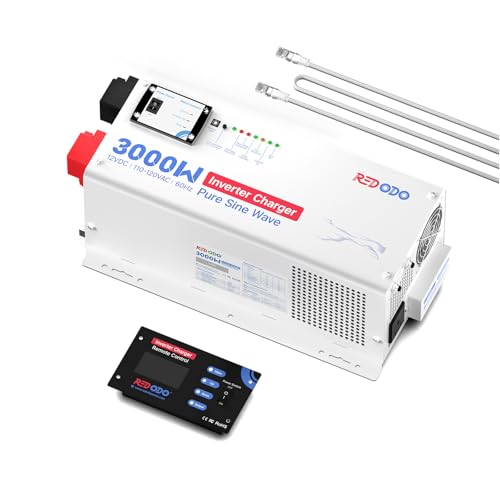
Redodo 3000W Inverter Charger, 12V DC to 110-120V AC, 9000W Peak, LCD Screen leads this shortlist for Lithium-bank rigs wanting inverter and charger in one budget box.. Use that fit as a reference point, then compare the alternatives against your own space and workload.
Specs that separate the picks
The first details to compare are 3000W continuous, 9000W peak, 3000W continuous, 6000W peak, 3000W continuous, 6000W surge. Confirm the exact model and included components before ordering.
Trade-off to plan for
Peak duration is not stated

Before you buy

What Matters Before You Choose a Budget 3000 Watt RV Inverter

Key buying criteria so you get the right fit the first time.

  1. 01

    A bank that can feed the current

    A 3000 watt load on a 12 volt bank draws roughly 250 amps or more before conversion losses, and that is a continuous demand, not a spike. Lead-acid batteries sag hard under that current and shorten their own life, while a lithium bank with a capable battery management system holds voltage. Look at the bank's continuous discharge rating before choosing the inverter. If the bank cannot supply the amps, the inverter will shut down on low voltage no matter what its label says.

  2. 02

    Inverter-charger or bare inverter

    A bare inverter converts battery power and stops there, so you need a separate charger and your own wiring for shore power. An inverter-charger combines the two, and a built-in automatic transfer switch lets the rig move between shore, generator and battery with no one flipping anything. The Redodo 3000W adds a 45 amp charger, and the AIMS units add a 100 amp charger plus a transfer switch. Decide whether you want one chassis or two before comparing prices.

  3. 03

    Cable gauge, fusing and run length

    DC cable is part of the purchase, not an accessory. Cable that is undersized or over-long heats up and drops voltage, which can make the inverter shut off under load, and a fault on a bank this large needs a correctly rated fuse close to the battery. Read the manual for the recommended gauge and maximum run, keep the inverter near the bank, and price the cable and fuse into the total. A cheap inverter on thin cable is a hazard.

  4. 04

    How long the surge lasts

    Surge ratings describe a brief burst for motor start-up, and listings quote them loosely, so the useful question is how long. The AIMS listings state 9000 watts for up to 20 seconds, while the Redodo, ALLWEI and LCYMW listings give a peak figure without a duration. A compressor or well-pump motor needs the burst to last until the motor spins up. Compare continuous ratings first, then use stated durations to break ties.

  5. 05

    Transfer switch and shore integration

    An automatic transfer switch decides which source feeds the rig's outlets and can pass shore power through while charging the bank. A 50 amp transfer switch and direct-connect terminals are named on the AIMS listings, and the Redodo listing frames its unit as an uninterruptible supply. None of this exists on a bare inverter, so shore power and inverter power stay separate circuits. Match the switch's amp rating to your inlet and to the loads that must stay up.

  6. 06

    What 3000 watts really runs

    Add up the running watts of what will be on at the same moment, and then give the largest motor load a separate start-up allowance. A microwave, a coffee maker and a few small appliances fit easily, while a roof air conditioner needs a soft start and a bank that can carry its running load for hours. Idle draw matters too, because an inverter left on at this size drains a bank even with nothing plugged in. A power save mode like the AIMS Remote Bundle's earns its keep.

Our standards

Why You Can Trust RV Gear Lab

At RV Gear Lab, we compare products based on rig fit and power or hookup compatibility, verified specifications, usability, setup requirements, weight, durability, and real-world trade-offs. We do not rank products purely on marketing claims or commission rates.

We have not personally tested every product listed. Where hands-on testing is not available, recommendations are based on verified manufacturer specifications, product documentation, use-case fit, and comparative research.

How we review RV gear →

Detailed reviews

The 5 best budget 3000 watt rv inverters, explained

01
Best for: Lithium-bank rigs wanting inverter and charger in one budget box.

Our take

That combination makes it the practical center of this shortlist for a build that has shore power and a lithium bank.

Why it made the shortlist

The Redodo 3000W folds a 3000 watt pure sine inverter and a 45 amp battery charger into one unit, which the listing frames as an uninterruptible power supply for the rig. Continuous output is 3000 watts with a peak of 9000 watts, enough for a microwave or a table saw start-up. This pick puts the charger and the inverter in a single install.

Charging profiles cover gel, AGM, sealed lead-acid and 12.8 volt LiFePO4 batteries, so one unit serves a bank you might change later. A remote control and an LCD show output voltage, AC input and status, which beats guessing from the fan noise. Sitting between the bare inverters and the AIMS units on price, it adds the charger without the heavy step up.

Choose it when you want one box that charges the bank from the pedestal and inverts from it when the pedestal is gone. For an owner moving off a basic converter, it is the simplest big upgrade in this guide.

What works

  • Inverter and 45 amp charger in one box
  • Charging profiles include LiFePO4 and AGM
  • Remote and LCD show voltage and status

Watch out for

  • Peak duration is not stated
  • Charger is weaker than the AIMS 100 amp units
02
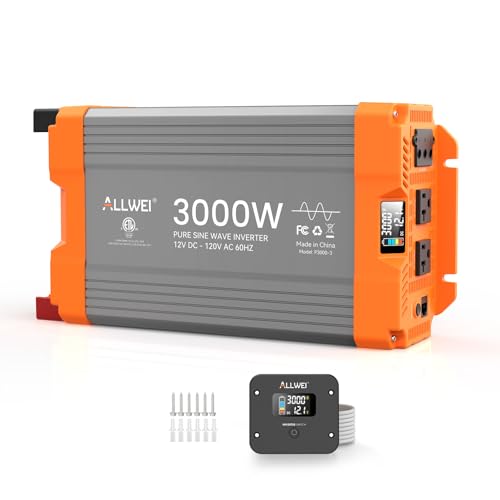
ALLWEI 3000 Watt Pure Sine Wave Inverter 12V DC to 120V AC, 6000W Surge
  • 3000W continuous, 6000W peak
  • 30A hardwire plus dual 20A sockets
  • LCD, remote, eight protections
Check price on Amazon for ALLWEI 3000 Watt Pure Sine Wave Inverter 12V DC to 120V AC, 6000W Surge (opens in a new tab)
Best for: A bare 3000 watt inverter feeding a hardwired 30 amp circuit.

Our take

Its listing mentions heavy loads such as window air conditioners, an indication of the starting demand it aims to handle.

Why it made the shortlist

The ALLWEI 3000W is the entry pick of this shortlist, a bare pure sine inverter with 3000 watts continuous and 6000 watts peak for start-up loads. Dual 20 amp AC sockets cover plug-in loads, and a 30 amp hardwire port lets it feed an RV subpanel or a dedicated outlet without cord and plug. A remote control and an LCD for input and output voltage, battery level and output power come with it.

Eight protections cover high and low voltage, over and under temperature, overload and over-current, and intelligent fans adjust with load inside an aluminum alloy housing. In place of the LCYMW 3000W's extra outlets, it offers the hardwire port, a better match to a fixed installation. Fans and an aluminum body carry the heat of a high-wattage unit away from the case.

A hardwired 30 amp feed from a large lithium bank is its home, where the lowest outlay on 3000 watts of pure sine matters and the charger lives in a separate box. That pairing keeps the whole system simple to understand.

What works

  • 30 amp hardwire port for a fixed feed
  • Dual 20 amp sockets on the face
  • Remote and LCD with battery level and output power

Watch out for

  • No charger or transfer switch included
  • Readings may deviate under some conditions
03
LCYMW Pure Sine Wave Inverter 3000W 12V Power Inverter 12V DC to 120V AC, Surge 6000W
  • 3000W continuous, 6000W surge
  • Three 15A plus one 20A outlet
  • 94% efficiency, remote controller
Check price on Amazon for LCYMW Pure Sine Wave Inverter 3000W 12V Power Inverter 12V DC to 120V AC, Surge 6000W (opens in a new tab)
Best for: Plug-in loads across several appliances at once.

Our take

Against the ALLWEI 3000W it trades the 30 amp hardwire port for more plug-in outlets, so it fits a van or camper where appliances plug in rather than feed a panel.

Why it made the shortlist

The LCYMW 3000W is a pure sine inverter rated 3000 watts continuous with 6000 watts of surge and up to 94 percent conversion efficiency, a figure the listing ties to cooler operation and less waste. The face carries three 15 amp AC outlets plus a 20 amp outlet, so a handful of appliances can run without a power strip.

A selector lets you switch between 50 and 60 Hz and between 110 and 120 volts, which suits an owner who also travels with equipment built for other grids. A remote controller is included, and protections cover undervoltage, overvoltage, overload, over-temperature, short circuit and reverse connection. Reverse-connection protection is a useful guard against a swapped battery lead during the install.

With a microwave, a coffee maker and a few small appliances as the loads, and the lowest-cost route with several outlets as the goal, this is the one to pick.

What works

  • Four outlets without a power strip
  • Reverse-connection protection listed
  • Switchable 50 or 60 Hz and 110 or 120 volts
  • Remote controller included

Watch out for

  • No hardwire port for a subpanel
  • No charger or transfer switch in the box
04
AIMS 3000W 12V Pure Sine Inverter Charger with Transfer Switch 120/240V ETL
  • 3000W, 9000W surge for 20 seconds
  • 100A charger, 50A transfer switch
  • Seven charging profiles
Check price on Amazon for AIMS 3000W 12V Pure Sine Inverter Charger with Transfer Switch 120/240V ETL (opens in a new tab)
Best for: Rigs that need a charger and a 50 amp changeover in one chassis.

Our take

It is among the most expensive picks here, and the step up from the Redodo 3000W buys a 100 amp charger, a 50 amp transfer switch and a surge duration in writing.

Why it made the shortlist

The AIMS ETL Charger is a 3-in-1 system: a pure sine inverter, a 100 amp battery charger and a 50 amp automatic transfer switch in one integrated unit. Surge is rated at 9000 watts for up to 20 seconds, a duration the listing spells out, which makes the headroom easy to compare against a motor load.

Power-factor-corrected charging delivers up to 100 amps at 12 volts, and the maker says it draws 20 to 30 percent less AC energy than a standard charger, which helps keep breakers and a small generator from tripping. Seven charging profiles include lithium, and the title names ETL listing. The unit is built to hold up to heavy loads and long run times.

Long off-grid stretches with a big bank and a generator justify it, since a heavy-duty all-in-one is worth the outlay there.

What works

  • Surge duration stated as 20 seconds
  • 100 amp charger and 50 amp transfer switch
  • Charger supports lithium among seven profiles
  • ETL named in the listing title

Watch out for

  • Costs several times the bare inverters
  • Large chassis needs real mounting space
05
AIMS 3000W 12V Pure Sine Inverter Charger with Bluetooth Monitor and LCD Remote
  • 3000W, 9000W surge for 20 seconds
  • 100A charger, eight battery types
  • Power save mode, auto gen start
Check price on Amazon for AIMS 3000W 12V Pure Sine Inverter Charger with Bluetooth Monitor and LCD Remote (opens in a new tab)
Best for: A single-cable-set install with a remote and generator auto start.

Our take

Auto generator start and a single set of cables round out the whole package.

Why it made the shortlist

The AIMS Remote Bundle pairs a 3000 watt, 12 volt pure sine inverter charger with a compatible LCD remote, and the title adds a Bluetooth monitor. Output is 3000 watts continuous with 9000 watts of surge for 20 seconds, delivered by a low-frequency design with an automatic transfer switch and a 100 amp smart charger.

The charger handles eight battery technologies, and a charge-current control dial plus DIP switches set priorities between sources. An AC direct-connect terminal block simplifies the shore-power wiring, conformal coating protects the circuit board and a power save mode trims idle draw, which matters for a bank that stays on overnight. Everything needed to configure the unit sits on the front panel and the remote.

Against the AIMS ETL Charger it adds the remote and the setup controls, and it is the most expensive pick here. A full-time rig that runs generator, shore and battery in rotation and wants every setting within reach is the match.

What works

  • Power save mode trims idle draw
  • LCD remote and Bluetooth monitor bundled
  • Auto generator start and priority switches
  • Conformal-coated circuit board

Watch out for

  • Most expensive pick in this guide
  • Many settings to learn at first

Methodology

How We Built This Shortlist

Each pick was assessed across 5 criteria weighted for real-world use.

01

What the bank must deliver

At 3000 watts the inverter's real cost is the battery bank and cable behind it. We noted each unit's stated draw and what the listing says about battery chemistry, and we ranked units that name their battery compatibility above those that do not. Lithium-friendly units scored higher, because a lead-acid bank sags under this load.

02

Continuous output and surge duration

Continuous watts decided the class; surge was judged by whether the listing states how long the peak lasts. A 9000 watt figure with a 20 second duration is something you can compare, while a bare peak number is not. We treated all surge ratings as brief allowances for motor start-up. Surge never decided a ranking by itself.

03

Bare inverter or inverter-charger

We separated bare inverters from units that add a charger or a transfer switch, because the buyer and the install differ. A bare unit needs separate charging and wiring, while an inverter-charger can move the rig between shore, generator and battery by itself. We weighed that convenience against the added cost.

04

Wiring and mounting

Hardwire ports, terminal blocks, outlet counts and the number of cable sets required all shape the install. We compared those against what a typical large-rig build needs, from a fixed subpanel feed to plug-in appliances. Fewer separate cable sets scored higher.

05

Where the budget ends

Because the subject is budget, we marked where each step up in price buys a function, such as a charger, a transfer switch or a monitoring remote. The bare inverters sit at the entry, Redodo mid-pack and the AIMS units at the top, and each placement says what the money adds. The comparison always asks what the extra outlay buys that you would otherwise supply yourself.

Decision guide

Match a Budget 3000 Watt RV Inverter to Your RV

By Build Type

Start with what the system must do, because the build decides whether a bare inverter or an inverter-charger is the right size of spend.

Your buildPickWhy
Lithium bank, shore power and a charger wanted in one boxRedodo 3000WInverter and a 45 amp charger with LiFePO4 profiles.
Fixed subpanel feed from a separate chargerALLWEI 3000WA 30 amp hardwire port at the entry of this shortlist.
Plug-in microwave, coffee maker and small appliancesLCYMW 3000WFour outlets without a power strip.
Long off-grid stretches with generator, shore and batteryAIMS ETL ChargerA 100 amp charger and a 50 amp transfer switch.
Full-time rig wanting remote, monitor and auto generator startAIMS Remote BundleBluetooth monitor, LCD remote and power save mode.

By Budget

Price at 3000 watts steps up in clear bands, each adding a function. We place each pick by band, not by figure.

Price bandPickWhat the money buys
Entry of this shortlistALLWEI 3000WA bare pure sine inverter with a hardwire port and remote.
Entry of this shortlist, alternateLCYMW 3000WThe same class with four plug-in outlets.
Mid of this shortlistRedodo 3000WA built-in 45 amp charger and LiFePO4 profiles.
Top of this shortlistAIMS ETL ChargerA 100 amp charger, a 50 amp transfer switch and a stated 20 second surge.
The most expensive pick in this guideAIMS Remote BundleA remote, Bluetooth monitor, auto generator start and power save mode.

Bare Inverter vs Inverter-Charger

This is the decision that splits the shortlist, and it is mostly about what else lives in your rig.

Bare inverter

The ALLWEI 3000W and LCYMW 3000W convert battery power and nothing more. They suit a rig that already has a separate converter or charger, and they sit at the entry of this shortlist with the simplest install.

Inverter-charger

The Redodo 3000W, AIMS ETL Charger and AIMS Remote Bundle combine inversion with charging, and the AIMS units add an automatic transfer switch. They save a charger and wiring and give seamless changeover, at a clearly higher outlay.

Pick the ALLWEI 3000W if a charger already exists; pick the Redodo 3000W to buy the charger and inverter once.

By Battery Chemistry

Chemistry decides how well a bank survives a 250 amp load, so match the inverter's charger to what you own.

Your bankPickWhy
12.8 volt LiFePO4 bankRedodo 3000WIts listing names LiFePO4 among supported battery types.
Mixed or changing chemistries over timeAIMS Remote BundleIts charger handles eight battery technologies.
Lithium with lead-acid in reserveAIMS ETL ChargerSeven charging profiles include lithium.
Charger already installed separatelyALLWEI 3000WA bare inverter leaves charging to the existing system.
AGM bank on a tight budgetLCYMW 3000WA bare inverter at the entry of this shortlist.

For a Roof Air Conditioner Specifically

Running a rooftop unit is the hardest job a 3000 watt inverter takes on, and it needs help.

Look for

A stated surge duration, as on the AIMS ETL Charger, a lithium bank rated for the continuous current and a soft start on the compressor. A soft start cuts startup draw only, not running draw, so the inverter must still carry the unit's running watts.

In this comparison

The AIMS ETL Charger states 9000 watts for up to 20 seconds, the best-documented headroom here. The ALLWEI 3000W listing mentions window air conditioners among its target loads, and the Redodo 3000W adds the charger for recovery.

When to Spend More

At this size the step up is about the charger and the changeover, not about extra watts.

Spend more if

You want the charger and transfer switch handled for you, or you run a generator regularly. The Redodo 3000W adds a charger, and the AIMS ETL Charger and AIMS Remote Bundle add a 100 amp charger and automatic changeover.

Save if

You already have a charger and a subpanel. The ALLWEI 3000W or LCYMW 3000W give 3000 watts of pure sine at the entry of this shortlist, and the saving can go into cable and fusing.

FAQ

Before You Bring One Home

How big a battery bank does a 3000 watt inverter need?

At full load it draws roughly 250 amps or more from a 12 volt bank, so the bank must be able to deliver that continuously. A lithium bank with a capable battery management system holds voltage under that current, while lead-acid sags and wears out quickly. Check the bank's continuous discharge rating before choosing the inverter.

Do I need an inverter-charger, or is a bare inverter enough?

A bare inverter is enough if you already have a charger and handle shore power separately, as the ALLWEI 3000W and LCYMW 3000W assume. An inverter-charger such as the Redodo 3000W combines the two and saves a box and wiring. The AIMS units add an automatic transfer switch for seamless changeover.

Is a 9000 watt surge rating the number that matters?

No. Continuous watts is the number to match, and surge is a brief rating for motor start-up. The AIMS listings state 9000 watts for up to 20 seconds, which at least tells you the duration, while peak figures without a duration are harder to compare. Use the continuous rating first.

What cable does a 3000 watt 12 volt inverter need?

Very heavy, very short cable with a correctly rated fuse near the battery. Undersized or over-long cable overheats and drops voltage, and the inverter can shut off under load. The manual gives the recommended gauge and maximum run, which is the figure to follow, and the cost belongs in your budget.

Can a 3000 watt inverter run my RV air conditioner?

It can come within reach if the air conditioner has a soft start, the bank is large and lithium, and the inverter can carry the running load, not only the start. A soft start lowers startup draw only. Match the continuous rating to the air conditioner's running watts and check the surge headroom.

Is the AIMS ETL Charger worth the step up from the Redodo 3000W?

It is if you need a 100 amp charger, a 50 amp transfer switch and a stated 20 second surge, which suits long off-grid stretches with a generator. For a van or camper with shore power and a lithium bank, the Redodo 3000W gives the inverter and charger in one box for a much lower outlay.

Bottom line

The short version

Browse more budget 3000 watt rv inverters on Amazon →
Bowen Higgins, RV Editor at RV Gear Lab

About the author

Bowen Higgins

RV Editor at RV Gear Lab

Bowen covers RV power, water systems, towing and leveling, upkeep and interior comfort, with a focus on matching gear to the rig, the hookups and the way you actually travel.

More from Bowen →Editorial standards

Keep reading

Related guides