

We research everything we recommend. When you buy through our links, we may earn a commission. Learn more

Buying guide · 11 min read · Updated October 2, 2026

5 Best Budget Flexible Solar Panels for RV in 2026: A Practical RV Guide

Five flexible solar panels and kits for curved RV roofs compared on bend radius, weight, weatherproofing and wattage, with what the low price gives up.

Bowen HigginsBy Bowen HigginsRV Editor at RV Gear Lab5 products comparedSpec-sheet researched

At a glance

Our top picks

Curved fiberglass roofs, rounded van tops and bimini covers are the reason flexible panels exist. A rigid glass module needs a flat mount and an aluminum frame, while a thin ETFE or PET panel can be glued or grommeted to a surface that bends away from it.

That freedom has a cost in lifespan and heat, which is where budget flexible panels get judged. Without an air gap, a panel stuck flat to a roof runs hotter, and heat reduces output. The shortlist below leans on what each listing says about cell type, build material and how the panel attaches, since those details decide how long the panel will still perform.

We evaluated five panels and kits by comparing their stated bend limits, thickness, weight and controller options. Rather than quote prices, we describe each pick's position. The entry pick is a 100 watt panel at the low end, and the top is a two-panel 200 watt kit, with a clear mechanism behind every step between them.

RV Gear Lab field notes

The Rig Fit Check

Start with the job
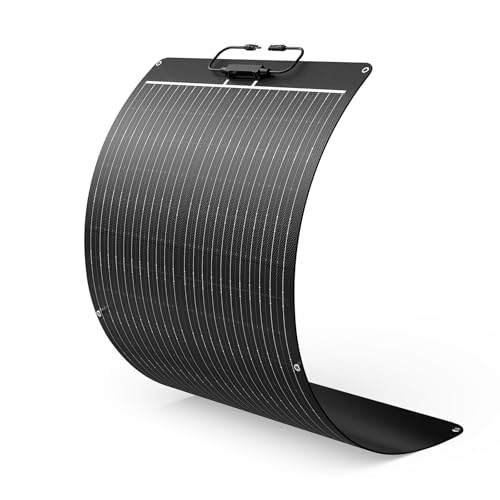
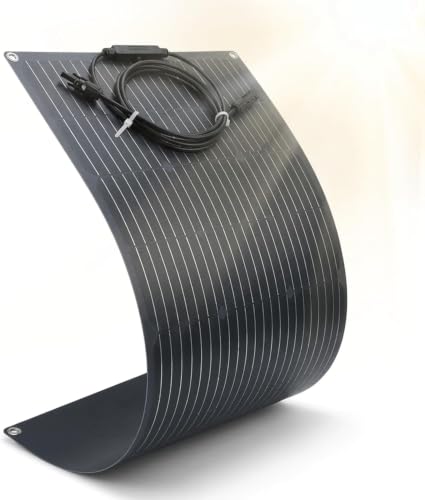
Holdwell S 100W Flexible Solar Panel for RV, Semi-Flexible Monocrystalline leads this shortlist for First-time flexible buyers covering a curved camper roof with one lightweight panel.. Use that fit as a reference point, then compare the alternatives against your own space and workload.
Specs that separate the picks
The first details to compare are 100W, 3.97 lb, 2.5mm PET, 50W, 0.1 inch thick, black, Two 200W ETFE panels. Confirm the exact model and included components before ordering.
Trade-off to plan for
Single panel gives modest output

Before you buy

What Matters Before You Choose a Budget Flexible Solar Panel for RV

Key buying criteria so you get the right fit the first time.

  1. 01

    Flexible Versus Semi-Flexible

    A truly flexible thin panel can bend to a deep arc, but a semi-flexible panel with a stiffer laminate only follows a gentle curve. Forcing a stiffer panel too far can crack cells and cut output permanently. One kit here lists a 30 degree maximum and others list up to 240 degrees. Match the listed bend to the roof curve you actually have.

  2. 02

    Heat and Mounting Gap

    Panels bonded flat to a roof cannot shed heat, and hot cells produce less power while aging faster. A small air gap or a ventilated mount keeps the panel cooler. Adhesive tape or grommet attachment changes that trade. Look at how the listing says to mount the panel and whether it mentions airflow.

  3. 03

    Controller Type and Sizing

    A controller regulates charge into the battery, and MPPT units can recover more energy than PWM units, with vendors claiming 20 to 30 percent. A kit that bundles a 40 amp controller saves a separate purchase. Panels with published voltage figures let you size an MPPT correctly. Look for amp rating and controller type in the listing.

  4. 04

    Surface and Weather Rating

    ETFE coatings resist yellowing and hail, while PET is a thinner laminate. An IP67 rating on the junction box means rain and dust are blocked. Marine-grade claims matter for boats and bimini covers. Locate the specific rating on the junction box and the coating name.

  5. 05

    Weight and Roof Load

    Flexible panels are quoted as 50 to 70 percent lighter than rigid glass panels. That matters for older trailers, vans with payload limits and one-person installs. A 200 watt panel at about seven pounds is easy to move, while two panels of four pounds each spread the load. Compare weights per panel.

  6. 06

    Wattage Layout on a Real Roof

    Watts are only useful if they fit around vents, skylights and AC units. One large panel is simpler to wire, while two smaller panels fit around obstacles. Series-parallel wiring changes voltage, so keep within your controller's limit. Measure the clear roof area before choosing between one and two panels.

Our standards

Why You Can Trust RV Gear Lab

At RV Gear Lab, we compare products based on rig fit and power or hookup compatibility, verified specifications, usability, setup requirements, weight, durability, and real-world trade-offs. We do not rank products purely on marketing claims or commission rates.

We have not personally tested every product listed. Where hands-on testing is not available, recommendations are based on verified manufacturer specifications, product documentation, use-case fit, and comparative research.

How we review RV gear →

Detailed reviews

The 5 best budget flexible solar panels for rv, explained

01
Best for: First-time flexible buyers covering a curved camper roof with one lightweight panel.

Our take

Buyers with a fiberglass or curved roof and a modest budget will find the best balance of wattage, weight and price here.

Why it made the shortlist

This 100 watt panel uses monocrystalline cells with a stated 23 percent efficiency under a 2.5 millimeter PET surface. Within this group it is the entry pick here on price among the actual panels, and it weighs 3.97 pounds, light enough for one person to place on a roof.

Pre-drilled mounting holes and MC4 connectors keep installation simple.

A 180 to 240 degree bendable body lets it follow rounded caps and boat hulls.

IP67 sealing and an ETFE-style coating defend against rain, dust and scratches.

One of these covers a battery maintenance job or a small lighting and fan load, and a second can be added later in parallel.

What works

  • Very light for one-person install
  • Bends to follow curved roofs
  • Pre-drilled holes and MC4 plugs

Watch out for

  • Single panel gives modest output
  • Hot roofs reduce flat-mount output
02
Best for: Van and bimini owners who want a flat, nearly invisible trickle charger for a 12 volt battery.

Our take

Owners who value looks and a tidy install over total wattage choose this one, especially on a bimini or van roof.

Why it made the shortlist

Callsun builds this 50 watt panel with 11 busbar monocrystalline cells rated at 23 percent efficiency and bypass diodes.

It costs slightly more than the Holdwell 100W despite half the wattage.

The step up over the other low-cost panel buys a marine-grade ETFE coating that resists hail and yellowing, up to 240 degrees of flexibility and a stated compatibility list that names EcoFlow, Jackery, Bluetti and GoLabs power stations.

It is described as 50 percent lighter than rigid.

Battery maintenance is the target job: keeping a stored RV or boat battery topped off through a season.

What works

  • Nearly flush all-black profile
  • Marine-grade ETFE coating
  • Bypass diodes help with shade
  • Fits many power station inputs

Watch out for

  • Low wattage for the money
  • Cannot run real loads alone
03
Best for: Van and RV roofs that need real capacity plus a controller in one bundle.

Our take

Full-time van lifers and RV owners who want to stop thinking about parts will appreciate the bundle.

Why it made the shortlist

This kit pairs two 200 watt monocrystalline flexible panels with a 40 amp charge controller for 400 watts in total. Mid-pack on price, it is the cheapest route to a complete flexible array here.

The ETFE layer is described as highly reflective, with a bend of up to 30 degrees.

Over the single-panel picks, the step up buys roughly four times the wattage of the Holdwell 100W and a controller that is already matched. Panels are quoted as 70 percent lighter than traditional modules and rated for wind and snow loads of 2400 and 5400 pascals.

A 40 amp controller can regulate a meaningful battery bank, so this kit suits refrigerators, lights and laptops through a day.

What works

  • Controller included and matched
  • Four times the power of one 100W panel
  • Rated for wind and snow loads
  • Light compared with glass panels

Watch out for

  • Limited bend of 30 degrees
  • Two panels need roof space
04
Best for: Owners who want a lot of wattage on one lightweight panel with clear voltage specs.

Our take

Buyers who already own a controller or prefer to pick their own get exact numbers to size it by.

Why it made the shortlist

One 200 watt semi-flexible panel with 21.9 percent cell efficiency and a 2.5 millimeter PET surface, measuring 53.1 by 30.1 inches and weighing 6.94 pounds. It lands in the upper third on price and gives the most wattage per panel here.

Over the 400W Flex Kit, it trades the second panel and the controller for a single clean unit with published electrical numbers: a 23.8 volt maximum power voltage and a 28.6 volt open-circuit voltage. Those figures pair best with an MPPT controller on a 12 volt bank.

IP67 sealing is stated across minus 20 to 65 degrees Celsius.

A long curved roof with room for one big panel is the ideal match, with MC4 plugs ready for an MPPT controller.

What works

  • Most wattage in a single panel
  • Published voltage specs for sizing
  • Wide temperature range listed
  • One-person install with grommets

Watch out for

  • Controller not included
  • PET surface wears faster than glass
05
Best for: RV, boat and cabin owners who want two matched 100 watt panels for flexible layout.

Our take

Boat owners and van lifers with irregular surfaces get the most from this arrangement.

Why it made the shortlist

A pair of 100 watt panels with 9 busbar A-grade monocrystalline cells, rated up to 23 percent efficiency, each measuring 36.22 by 23.22 inches and 4.4 pounds.

The ETFE layer is chosen for light transmission and service life.

Each carries an IP67 junction box against water and dust.

Metal pre-drilled holes let you hang them quickly.

Splitting 200 watts across two panels gives more layout freedom on a cluttered roof and some resilience if one is shaded.

What works

  • Two panels fit around roof obstacles
  • Light at 4.4 pounds each
  • High rated cell efficiency
  • ETFE layer for long service life

Watch out for

  • Most expensive pick here
  • Needs your own controller
The catch
Past the single Holdwell 200W, the step up buys two smaller panels that can be placed around vents and skylights, and a total weight not far above one big panel.

Methodology

How We Built This Shortlist

Each pick was assessed across 5 criteria weighted for real-world use.

01

Bend and thickness

We read each listing for its maximum bend angle and thickness, since the use case is a curved roof. A panel that flexes 30 degrees fits very different surfaces from one that flexes 240 degrees. We favored builds that matched curved-roof and bimini installs.

02

Surface material

ETFE and PET surfaces behave differently under sun, hail and scratching. We compared the material named in each listing and the ingress rating of the junction box. A sealed surface with a stated temperature range scored higher than a general waterproof claim.

03

Weight and handling

Weight decides who can install it, and light panels let one person do the job. We compared pounds per panel and total kit weight. A light panel on a roof also reduces load on the mounting surface.

04

Electrical information

Panels that publish voltage figures can be matched to a controller without guessing. We favored listings with maximum power and open-circuit voltage. Kits that bundle a controller were credited for convenience.

05

Position on price

We ranked each pick by where it sits relative to the others and what the extra cost buys. Wattage, a bundled controller, a second panel and a coating each justified a step up. A pick that could not explain its position slipped down the list.

Decision guide

Match a Budget Flexible Solar Panel for RV to Your RV

By Roof Shape

The curve of your roof decides how much flex you need.

Roof or surfaceBest pickWhy
Gently curved fiberglass roofHoldwell 100WLight, bends 180 to 240 degrees
Rounded van or bimini topCallsun 50WFlush black profile with ETFE
Large flat-ish trailer roofHoldwell 200WOne big 200W panel
Roof crowded with ventsTopunive 2x100WTwo panels fit around obstacles
Big roof, want controller included400W Flex KitTwo 200W panels with a 40A controller

By Budget

Bands below are relative to this shortlist.

BandPickWhat you get
Entry of this shortlistHoldwell 100WGood wattage for the lowest panel cost
LowCallsun 50WA small trickle charger with a stealth finish
Mid400W Flex Kit400 watts and a controller in one bundle
Upper-midHoldwell 200WA single large panel with published voltages
TopTopunive 2x100WTwo matched panels for layout flexibility

One Big Panel vs Two Small Panels

A single panel is simple, while a pair is flexible.

One big panel

Holdwell 200W has fewer connections and one wiring run, ideal for a clear roof section.

Two small panels

Topunive 2x100W and 400W Flex Kit split the area, fit around obstacles and keep partial output if one panel is shaded.

On a cluttered roof pick Topunive 2x100W, on a clear one pick Holdwell 200W.

By Controller Situation

Whether you already own a controller changes the right buy.

SituationPickReason
Already own an MPPT controllerHoldwell 200WPublished voltages make matching easy
Need controller in the box400W Flex KitA 40 amp unit is included
Feeding a power stationCallsun 50WListed compatible with several brands
Want to add a panel laterHoldwell 100WEasy to pair in parallel

For Van Life Specifically

Vans reward a low, tidy, lightweight installation.

Look for

A thin, dark, lightweight panel with a high ingress rating and a bend that matches the roof curve.

In this comparison

Callsun 50W is the stealthiest, Holdwell 100W is the best balance, and 400W Flex Kit covers real loads.

When to Spend More

Choose a higher rung only when capacity or a bundle pays off.

Spend more if

You run a fridge or work remotely, so Holdwell 200W or 400W Flex Kit gives the wattage.

Save if

You only top off a stored battery, where Holdwell 100W or Callsun 50W is plenty.

FAQ

Before You Bring One Home

Do flexible panels last as long as rigid ones?

Generally no. Rigid glass panels commonly carry longer warranties and handle heat better. Flexible panels run hotter when bonded flat and have shorter typical lifespans. Their advantage is fit and weight, so choose them when the roof curves or payload matters.

How should I attach a flexible solar panel?

Options are adhesive, butyl tape or corner grommets and screws, depending on the panel. Clean the surface and avoid sealing the whole underside if you can leave airflow. Follow the maker's instructions for the panel's attachment method. Some panels such as the Holdwell 200W list corner grommets.

Can I connect two flexible panels together?

Yes, in parallel or series. Series wiring raises the voltage, and a controller must handle the combined open-circuit voltage, which rises in cold weather. Parallel wiring keeps the voltage the same and raises current. Check your controller's input limits.

Is the 400 watt kit worth it over one 100 watt panel?

If you run a fridge, fans and a laptop, yes, since four times the wattage and a 40 amp controller cover real daily loads. A single Holdwell 100W is better for maintenance charging. The kit also needs more roof area.

Will a flexible panel work with my power station?

Many do, if the panel's voltage and connector fit the station's solar input. The Callsun 50W lists compatibility with several brands. A matching plug alone does not prove the voltage is safe, so check the input range.

How much flex is too much?

Bending past the stated limit can crack cells and reduce output. Stated figures range from 30 degrees on the kit to 240 degrees on the lighter panels. Choose a panel whose rating comfortably exceeds your roof curve.

Bottom line

The short version

Browse more budget flexible solar panels for rv on Amazon →
Bowen Higgins, RV Editor at RV Gear Lab

About the author

Bowen Higgins

RV Editor at RV Gear Lab

Bowen covers RV power, water systems, towing and leveling, upkeep and interior comfort, with a focus on matching gear to the rig, the hookups and the way you actually travel.

More from Bowen →Editorial standards

Keep reading

Related guides