

We research everything we recommend. When you buy through our links, we may earn a commission. Learn more

Buying guide · 11 min read · Updated October 2, 2026

6 Best Budget Lightweight Solar Panels for RV in 2026: A Practical RV Guide

Six lighter, compact RV solar panels and kits compared by footprint, rated efficiency and controller type, so payload and roof space stay under control.

Bowen HigginsBy Bowen HigginsRV Editor at RV Gear Lab6 products comparedSpec-sheet researched

At a glance

Our top picks

Weight on an RV roof is not a vanity metric. Every pound sits high, shifts the center of gravity and counts against the cargo carrying capacity printed on the door jamb, so a payload-limited camper gains from a lighter solar array. The catch is that truly light panels are usually flexible, and flexible panels belong in a separate guide.

This list covers the middle ground: rigid, glass-fronted modules chosen for a compact footprint and high cell efficiency. A panel that makes more watts per square foot lets you carry fewer panels for the same output, which is the other way of saving weight. Only one listing states a per-panel weight, so we lean on size and efficiency claims, and we say where a figure is missing.

We evaluated six picks by footprint, cell technology and whether a controller is bundled. Price is described by position: the entry pick is a 20 watt maintainer, the mid-pack options are 100 watt kits, and the top slot is a pair of 200 watt bifacial panels. Every step up is tied to a mechanism.

RV Gear Lab field notes

The Rig Fit Check

Start with the job
20W 12V Solar Panel Kit Trickle Maintainer with MPPT Controller, IP68 leads this shortlist for Owners of a stored RV, boat or trailer who only need to hold a battery topped up.. Use that fit as a reference point, then compare the alternatives against your own space and workload.
Specs that separate the picks
The first details to compare are 20W monocrystalline, IP68, 31.8 x 27.5 x 1.18 inches, 100W tempered glass, MPPT. Confirm the exact model and included components before ordering.
Trade-off to plan for
Twenty watts cannot run loads

Before you buy

What Matters Before You Choose a Budget Lightweight Solar Panel for RV

Key buying criteria so you get the right fit the first time.

  1. 01

    Watts Per Square Foot

    More watts from the same area means fewer panels for a given output, and fewer panels means less weight and less roof penetration. A 25.6 percent N-type cell makes noticeably more power per square foot than an older cell of lower efficiency. Over a travel trailer's life that difference decides whether the array fits at all. Divide watts by length times width from the listing to compare.

  2. 02

    Payload and Center of Gravity

    Roof weight raises the center of gravity and uses cargo capacity, so a roof full of heavy glass reduces what you can carry inside. The Callsun panels weigh 23.8 pounds each, so a pair adds nearly 48 pounds plus brackets. A compact 100 watt panel is far lighter. Find the weight in the listing and add mounting hardware to it.

  3. 03

    Compact Outline Versus Standard Outline

    A square 31.8 by 27.5 inch panel fits between vents where a long standard panel cannot. Odd roof layouts reward smaller modules even at the same wattage. Dimensions listed to the tenth of an inch let you plan exactly. Lay out cardboard cutouts at the stated size before buying.

  4. 04

    Shade Tolerance

    Ordinary panels lose most output when a single cell group is shaded, and roofs are full of shade from vents, AC units and rails. A split-cell design isolates the shaded half and lets the other half work. That can double the output on a cluttered roof. Look for words like anti-shade, half-cut, bypass diodes or TwinCell.

  5. 05

    Controller Type

    An MPPT controller adjusts voltage to extract more energy than a PWM unit, with vendors claiming 20 to 30 percent more. PWM units are cheaper and adequate for small arrays. Larger series strings need MPPT because PWM cannot use voltage above battery level. Spot the controller type and amp rating on every kit.

  6. 06

    Wiring Quality and Voltage Loss

    Thin or copper-clad wire wastes energy as heat over a long roof run. Thick oxygen-free copper in 11 AWG reduces loss, and quality MC4 pins keep connections cool. These details add up to a few percent of output. Read the cable gauge and connector description, not just the wattage.

Our standards

Why You Can Trust RV Gear Lab

At RV Gear Lab, we compare products based on rig fit and power or hookup compatibility, verified specifications, usability, setup requirements, weight, durability, and real-world trade-offs. We do not rank products purely on marketing claims or commission rates.

We have not personally tested every product listed. Where hands-on testing is not available, recommendations are based on verified manufacturer specifications, product documentation, use-case fit, and comparative research.

How we review RV gear →

Detailed reviews

The 6 best budget lightweight solar panels for rv, explained

01
20W 12V Solar Panel Kit Trickle Maintainer with MPPT Controller, IP68
  • 20W monocrystalline, IP68
  • MPPT controller, 8 protections
  • Adjustable 360 degree bracket
Check price on Amazon for 20W 12V Solar Panel Kit Trickle Maintainer with MPPT Controller, IP68 (opens in a new tab)
Best for: Owners of a stored RV, boat or trailer who only need to hold a battery topped up.

Our take

Storage-lot owners and weekend campers who want to avoid a dead battery find the best value here.

Why it made the shortlist

A 20 watt monocrystalline panel pairs with an MPPT controller featuring eight protection functions, and both panel and controller carry an IP68 rating. Priced at the entry of this guide, it adds almost nothing to roof load.

LED indicators show charge status at a glance.

An adjustable mount bracket offers 360 degrees of flexibility so the panel can be aimed at the sun, and all connections are labeled for quick setup.

Compared with a 100 watt panel, it is the minimum viable solar fit for a parked rig.

A tiny array like this keeps a lead-acid or lithium battery from sulking through a storage season.

What works

  • Adds almost no weight to the roof
  • Controller included with LED status
  • Adjustable bracket aims at the sun

Watch out for

  • Twenty watts cannot run loads
  • Too small for daily camping
02
Best for: RV owners with limited roof area who want a compact, proven 100 watt rigid panel.

Our take

Anyone with a short roof, a van or a camper with limited free space get the most from the compact outline.

Why it made the shortlist

By cost, this one sits second from the bottom on price.

Every cell is stated to pass 100 percent EL testing.

Set against the 20W Maintainer Kit, the step up buys five times the wattage on a glass-and-frame module rated for 2400 pascal wind and 5400 pascal snow loads. IP65 connectors and junction box guard the electrical parts.

A five-year product assurance and an 80 percent output retention after 25 years are quoted.

What works

  • Compact footprint saves roof space
  • Every cell passes EL testing
  • Five-year product assurance
  • Rated for wind and snow loads

Watch out for

  • No controller included
  • Single panel gives modest output
The catch
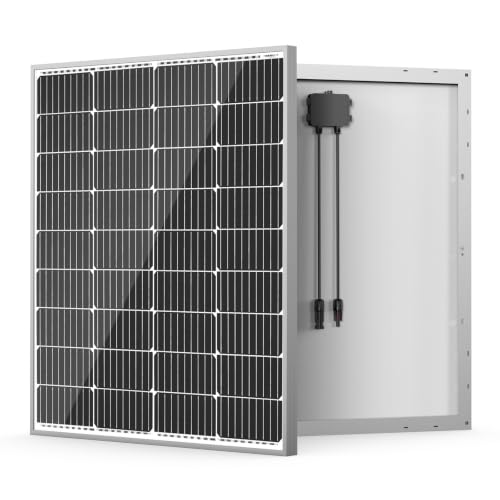
Measuring 31.8 by 27.5 by 1.18 inches, the HQST square design is listed as 11 percent smaller than a traditional 100 watt panel, with 9 busbar Grade A+ cells at up to 23 percent efficiency.
03
SOLPERK 100W 12V Solar Battery Charger with MPPT Controller Kit
  • 100W tempered glass, MPPT
  • Alligator clips and mounts included
  • One year service, lifetime support
Check price on Amazon for SOLPERK 100W 12V Solar Battery Charger with MPPT Controller Kit (opens in a new tab)
Best for: First-time buyers who want a waterproof panel and MPPT controller connected out of the box.

Our take

Beginners who want one box and one afternoon of work, with no controller shopping, get the simplest route.

Why it made the shortlist

SOLPERK supplies a 100 watt panel with low-iron tempered glass, a corrosion-resistant aluminum frame and an MPPT controller already wired to it. The listing quotes over 30 percent more power than a standard controller. As for price, this model sits mid-pack on price.

Alligator clips and O-rings come in the box.

A one year after-sale service and lifetime technical support are stated.

What works

  • MPPT controller already connected
  • Everything included for mounting
  • Low-iron glass with rust-proof frame
  • Status lights show charging

Watch out for

  • Efficiency claim sounds optimistic
  • Controller size limits expansion
04
Best for: Owners building a first full RV array who want Z-brackets, cables and a controller together.

Our take

Buyers ready to commit to a real array on a trailer or van find it the most complete package.

Why it made the shortlist

Two 100 watt panels arrive with the Wanderer 30 amp PWM controller, cables and Z-brackets. The kit is listed as producing around 1000 watt-hours a day under five hours of direct sun, and it sits in the upper third on price.

The controller works with sealed, gel, flooded and lithium batteries.

Multi-layer laminations protect the cells from physical damage.

Splitting 200 watts across two panels keeps each module small and easy to lift onto a roof.

What works

  • Complete kit with brackets and cables
  • Controller supports lithium and lead-acid
  • Two small panels are easy to lift
  • Full set of electrical protections

Watch out for

  • PWM wastes some harvest
  • Needs roof area for two panels
05
Best for: Owners who want IP68 sealed N-type panels and thick copper leads for a 12 volt build.

Our take

The strongest case for 200 Watt Solar Panels N-Type 18BB 25.6% High-Efficiency, 2pcs 200W IP68 is high rated N-type cell efficiency.

Why it made the shortlist

Each AeternaSol panel uses N-type 18 busbar cells with 25.6 percent stated efficiency, an IP68 potted junction box and an aluminum alloy frame. Judged on price, it sits just below the Renogy kit on price per set.

MC4 connectors use galvanized copper pins in a PPO shell.

Those details limit voltage loss on a longer roof run.

An exclusive potting technology is said to prevent water or steam entering the box.

What works

  • High rated N-type cell efficiency
  • Thick copper leads cut voltage loss
  • IP68 sealed junction box
  • Sturdy aluminum alloy frame

Watch out for

  • No controller included
  • Weight not stated in the listing
06
Callsun N-Type 16BB 400W Bifacial Solar Panel, 2Pcs 200 Watt, 12V/24V
  • Two 200W panels, 25.6% rated
  • 51.3 x 30.3 x 1.4 inches each
  • 23.8 lb each, TwinCell design
Check price on Amazon for Callsun N-Type 16BB 400W Bifacial Solar Panel, 2Pcs 200 Watt, 12V/24V (opens in a new tab)
Best for: Anyone with a bigger roof wanting a bifacial pair that keeps working in partial shade.

Our take

Callsun N-Type 16BB 400W Bifacial Solar Panel, 2Pcs 200 Watt, 12V/24V is the better fit when anyone with a bigger roof wanting a bifacial pair that keeps working in partial shade.

Why it made the shortlist

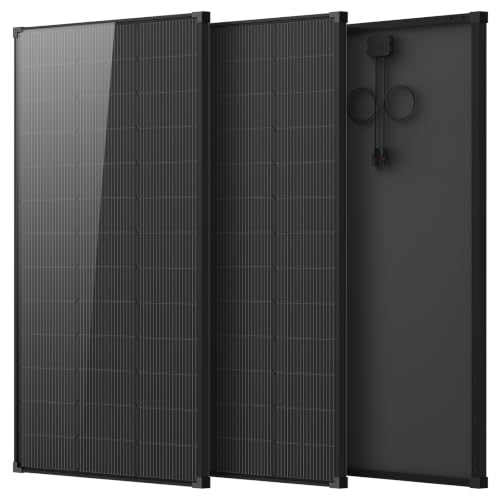
Two 200 watt panels with N-type 16 busbar cells, rated at 25.6 percent, make 400 watts when paired in series. Each measures 51.3 by 30.3 by 1.4 inches and weighs 23.8 pounds. Overall it is the most expensive pick in this guide.

Series wiring reaches 47.48 volts Vmp and 54.62 volts Voc.

That suits roofs with vents and rails casting shadows.

A dual-module parallel layout and series option give wiring flexibility for portable power stations.

What works

  • TwinCell design resists partial shade
  • Bifacial rear captures reflected light
  • High rated N-type efficiency
  • Series option reaches 400 watts

Watch out for

  • Most expensive in this guide
  • Each panel weighs nearly 24 pounds
The catch
Those who want maximum output per roof area and fewer shading losses are the target.

Methodology

How We Built This Shortlist

Each pick was assessed across 5 criteria weighted for real-world use.

01

Footprint and weight

We compared stated dimensions and any listed weight for each pick, since the topic is roof load and space. Only one listing gives a per-panel weight, so the others were judged on size and wattage. A compact outline counted as a form of weight saving.

02

Cell technology

We noted the cell type, busbar count and rated efficiency. N-type and A+ grade cells gave more output per area, which means fewer panels. We treated efficiency figures as maker claims.

03

Controller and wiring

We checked whether an MPPT or PWM controller is included, and what cable and connectors ship. A kit with matched parts saves cost and guesswork. Thick copper leads were credited.

04

Durability ratings

We looked at IP ratings, wind and snow loads and frame material. A lightweight panel that cannot survive weather gains nothing. Stated loads in pascals gave a common yardstick.

05

Position on price

We placed each pick relative to the rest and named what each step up buys. Panel count, cell type, a controller or shade tolerance each justified a move. Picks without a clear reason slipped down the list.

Decision guide

Match a Budget Lightweight Solar Panel for RV to Your RV

By Roof Space

The room you have sets the wattage you can fit.

Roof situationBest pickWhy
Almost no space20W Maintainer KitTiny panel, adjustable bracket
One short free patchHQST 100WSquare compact outline
Short patch, want controller includedSOLPERK 100WMPPT bundled
Room for two panelsRenogy 200W KitTwo 100 watt modules, brackets included
Long roof, shade from ventsCallsun 400W PairTwinCell panels, 400 watts

By Budget

Bands are relative to this shortlist.

BandPickWhat you get
Entry of this shortlist20W Maintainer KitA battery keeper with MPPT
LowHQST 100WA compact panel with solid ratings
MidSOLPERK 100WPanel and MPPT controller together
Upper-midRenogy 200W KitTwo panels and a 30 amp controller
Upper-midAeternaSol 200WN-type cells and heavy copper wiring
TopCallsun 400W PairBifacial, shade-tolerant 400 watts

Fewer Big Panels vs More Small Panels

Panel count changes weight distribution and shade behavior.

Fewer, larger panels

Callsun 400W Pair and AeternaSol 200W deliver more watts per panel, with fewer mounts but heavier individual lifts.

More, smaller panels

Renogy 200W Kit and HQST 100W spread load, fit around obstacles and are easy to carry up a ladder.

On a cluttered roof choose Renogy 200W Kit, on a clear one choose Callsun 400W Pair.

By Existing Equipment

What you already own shapes the cheapest build.

You already havePickReason
A good MPPT controllerAeternaSol 200WPanel only, high efficiency
A controller and short wiringHQST 100WCompact panel only
Nothing yetRenogy 200W KitBrackets, cable and controller
A parked battery only20W Maintainer KitTrickle charging with protections

For Payload-Limited Campers Specifically

Every pound off the roof helps cargo capacity.

Look for

High efficiency, a compact outline and a stated weight so you can add it to your payload sums.

In this comparison

HQST 100W is the most compact, 20W Maintainer Kit adds almost nothing, and Callsun 400W Pair states a clear 23.8 pound weight.

When to Spend More

Spend up when output per roof area is the constraint.

Spend more if

Your roof is crowded with shade, so Callsun 400W Pair or AeternaSol 200W pays back in harvest.

Save if

You need to keep a battery alive, where 20W Maintainer Kit or HQST 100W is enough.

FAQ

Before You Bring One Home

Are these panels actually lightweight?

They are rigid, glass-fronted panels, so they are heavier than flexible ones. Only the Callsun listing gives a per-panel weight, at 23.8 pounds. The advantage here is output per square foot, which cuts the number of panels you carry.

How much weight does a roof panel add overall?

Add the panel, mounting brackets, sealant and cable. A pair of 23.8 pound panels is nearly 48 pounds before hardware. Compare that against your cargo capacity on the door sticker.

Is PWM or MPPT better for a small array?

For 100 watts or less, PWM is often adequate and cheaper. MPPT recovers more as the array grows, and vendors claim 20 to 30 percent more harvest. The SOLPERK 100W bundles MPPT, and the Renogy 200W Kit ships with PWM.

Does shade really hurt a panel that much?

Yes, a shaded section of a conventional panel can drag output down well beyond its area. Split-cell designs such as the Callsun TwinCell isolate the shaded half. On cluttered roofs, that matters more than a few points of efficiency.

Can I add a second panel later?

Usually yes, in parallel, if the controller can handle the current. A 30 amp controller like the one in the Renogy 200W Kit has headroom. Match panel specs when you expand.

Is a bifacial panel useful on a roof?

The rear face collects reflected light, which helps over a light roof or when tilted. Over a flat mount the gain is small. Treat it as a bonus rather than the reason to buy.

Bottom line

The short version

Browse more budget lightweight solar panels for rv on Amazon →
Bowen Higgins, RV Editor at RV Gear Lab

About the author

Bowen Higgins

RV Editor at RV Gear Lab

Bowen covers RV power, water systems, towing and leveling, upkeep and interior comfort, with a focus on matching gear to the rig, the hookups and the way you actually travel.

More from Bowen →Editorial standards

Keep reading

Related guides