

We research everything we recommend. When you buy through our links, we may earn a commission. Learn more

Buying guide · 11 min read · Updated October 2, 2026

6 Best Budget Solar Charge Controllers With Bluetooth in 2026: A Practical RV Guide

Six budget solar charge controllers with Bluetooth for RVs, vans and camp rigs, compared on charge amps, panel limits, lithium support and load modes.

Bowen HigginsBy Bowen HigginsRV Editor at RV Gear Lab6 products comparedSpec-sheet researched

At a glance

Our top picks

At a glance · 6 picks

Bluetooth on a solar controller solves a small, real problem: the unit usually sits behind a panel or in a cabinet where nobody wants to crawl to read a screen. A phone app shows panel voltage, charge current and battery state from the couch, and some store history so you can see how yesterday went. At this price the feature arrives on PWM controllers, which is worth saying plainly, because it limits how much solar the unit can use and how much of a larger roof it can ever harvest.

Every pick below is PWM, in the 20 to 30 amp class, so the sensible array is a couple of panels matched to a 12 or 24 volt bank. A 20 amp unit on a 12 volt battery supports roughly 240 watts of panels, and a 30 amp unit about 360 watts, which is a van or small trailer rather than a big fifth wheel roof. Bluetooth on an MPPT unit sits well above this shortlist on price, and it belongs to a bigger roof than any of these units can serve.

We compared how each listing describes its app, battery support, panel voltage limit and load output, since those decide whether the Bluetooth link is useful day to day. Several share a similar phone app, so the ranking leans on what the hardware adds around it, such as a screen, a wider voltage range or a better load output. The entries also flag where a listing leaves a spec out, so you can ask before ordering instead of discovering the gap in the field after the panels are already up and the wiring is closed behind a cabinet panel.

RV Gear Lab field notes

The Rig Fit Check

Start with the job
ECO-WORTHY 30A 12/24V PWM Solar Charge Controller with Bluetooth, Solar Panel Battery Intelligent Regulator with Dual USB Ports Auto leads this shortlist for Vans and small trailers wanting a screen, an app and a recognizable brand.. Use that fit as a reference point, then compare the alternatives against your own space and workload.
Specs that separate the picks
The first details to compare are 30A PWM, 12V/24V auto, 20A PWM, 12V/24V auto-detect, 30A PWM, 12V/24V auto-match. Confirm the exact model and included components before ordering.
Trade-off to plan for
PWM wastes extra panel voltage

Before you buy

What Matters Before You Choose a Budget Solar Charge Controller With Bluetooth

Key buying criteria so you get the right fit the first time.

  1. 01

    What Bluetooth Actually Shows You

    Bluetooth is only as useful as the numbers in the app. The better listings name PV input voltage, battery state, charging current, load status and history, while a weaker one promises remote monitoring and shows little. The LM Solar 20A lists battery percentage and historical energy statistics, which is the level worth paying for. Read the bullets for the specific values the app displays, and treat a bare Bluetooth claim as a pairing feature rather than a monitoring one.

  2. 02

    PWM Economics at 20 to 30 Amps

    A PWM controller connects the panel straight to the battery and pulls the panel's voltage down to the battery's, so the surplus voltage is lost. The amp rating times the bank voltage gives the usable panel power, roughly 240 watts for 20 amps and 360 watts for 30 amps on a 12 volt battery. PWM is adequate for a small panel in warm sun, which is the typical van or weekend rig. Match panels to the battery voltage, since a higher-voltage panel wastes the difference.

  3. 03

    Panel Voltage Limits and Series Wiring

    Each controller has a maximum solar input voltage, and exceeding it damages the unit. The Compact 20A lists 50V, which rules out putting two 12 volt panels in series, while the Vixkpirr 30A lists 100V. Panel voltage rises in cold weather, so leave margin below the printed ceiling. If a listing gives no ceiling, wire panels in parallel and ask the seller before connecting a series string.

  4. 04

    Pairing, App Security and Range

    Bluetooth range is short, so the app works inside or beside the rig rather than from across a campground. Several of these controllers share a phone app with a printed default password, and a default password is worth changing if the app lets you. Check that the app is available for your phone, iOS or Android, and that it can update settings rather than just display them. A controller with a screen still works when the phone does not.

  5. 05

    Lithium Profile and Low-Temperature Behavior

    Lithium iron phosphate needs a true lithium setting, with an absorption voltage near the battery maker's figure and no equalization stage. Several listings say lithium compatible, while a custom or user profile is the safer sign that the voltages can be set correctly. Charging a lithium battery below freezing can damage it, and only a controller that reads battery temperature can protect it. Look for a named lithium mode or custom voltages and a temperature sensor.

  6. 06

    Load Output Versus Charge Rating

    The load terminal is a separate output from the charge input, and its rating is usually lower than the charge amps. The ECO-WORTHY 30A lists a 10A discharge current, while the Compact 20A lists a 20A load output. Load modes such as dusk-to-dawn, timed and manual turn that terminal into a lighting switch. Add up the lights or pump you plan to run from it and stay under the load rating, not the charge rating.

Our standards

Why You Can Trust RV Gear Lab

At RV Gear Lab, we compare products based on rig fit and power or hookup compatibility, verified specifications, usability, setup requirements, weight, durability, and real-world trade-offs. We do not rank products purely on marketing claims or commission rates.

We have not personally tested every product listed. Where hands-on testing is not available, recommendations are based on verified manufacturer specifications, product documentation, use-case fit, and comparative research.

How we review RV gear →

Detailed reviews

The 6 best budget solar charge controllers with bluetooth, explained

01
Best for: Vans and small trailers wanting a screen, an app and a recognizable brand.

Our take

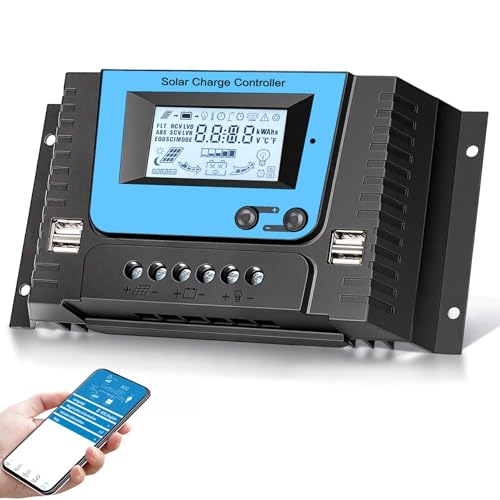
The Bluetooth link allows app integration and operation from a distance within range, and the LCD supports mode switching and parameter configuration directly.

Why it made the shortlist

The ECO-WORTHY is a 30A 12V and 24V PWM controller with built-in Bluetooth and an LCD, so the readout is readable at the unit and on a phone. A built-in industrial microcontroller manages the charging, and voltage and current measurements carry an error margin of less than 1%, a precision figure few budget listings publish.

It charges lead-acid, gel and lithium iron phosphate batteries and uses fully three-stage PWM charge management, which protects the battery's life over many seasons. A 10A discharge output controls loads, and dual USB ports top up phones, while short-circuit, open-circuit, reverse and overload protection are all included, which makes a first solar install noticeably safer and calmer.

It leads the shortlist by pairing the largest rating in the guide with the most precise measurement claim, a good combination for a 12V van with two or three panels and a mixed set of loads.

What works

  • Screen and app together for easy checks
  • Measurement error stated under 1%
  • Dual USB ports and a 10A load output
  • Lead-acid, gel and LiFePO4 supported

Watch out for

  • PWM wastes extra panel voltage
  • Charge routine is three-stage only
  • Supports 12V and 24V banks only
02
Best for: Small lithium rigs that want battery percentage on a phone.

Our take

A top-mounted LCD shows panel voltage, battery voltage, charging amps and fault codes for quick diagnostics, and a side USB port gives a trickle of 5V for a phone.

Why it made the shortlist

This 20A controller uses built-in Bluetooth low energy with the LM Solar app on iOS and Android, showing PV input voltage, battery state of charge, charging current, load status and historical energy statistics. A battery percentage readout on a 20A unit is a convenience that lithium owners notice quickly, because voltage alone says little about a LiFePO4 pack.

Charging follows a microprocessor-controlled bulk, absorption and float sequence, and the unit auto-detects 12V or 24V when the battery is connected first. Sealed, gel, flooded and LiFePO4 lithium batteries are listed as compatible, so the same controller fits a lead-acid bank today and a lithium swap later without replacing anything on the wall or in the cabinet.

Reverse polarity is fuse-protected, so a miswire leaves the controller intact. This is the clearest listing for a small lithium setup, and it sits above the cheapest 20A picks on price.

What works

  • Battery percentage and history in the app
  • LCD shows fault codes for diagnostics
  • Fuse-protected reverse polarity
  • Auto-detects 12V or 24V on connection

Watch out for

  • USB port gives a trickle of power
  • App quality depends on the phone
03
Best for: Rigs that run lights or a pump from the controller's load terminal.

Our take

Three-stage PWM charging runs at a 30A rating, the same current as the ECO-WORTHY 30A, at a lower price tier.

Why it made the shortlist

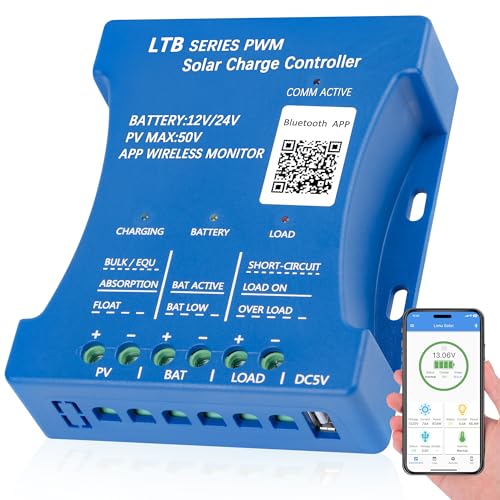
The LiMu 30A is a PWM controller whose headline feature is seven load modes: Keep On, Manual, Light, Light plus Timer and more. That turns the load terminal into a dusk-to-dawn switch or a timed output for lighting and small pumps, without a separate timer relay, which saves a component and a few connections in a tight cabinet.

Wireless control comes through the LiMu Solar app, which monitors charging and adjusts settings from a phone. The controller auto-matches 12V and 24V batteries when the battery is connected first, and it supports five battery types, sealed, gel, flooded, LiFePO4 and lithium, with a custom setting for user-defined voltages that suits unusual banks and newer lithium packs.

This is a practical choice for a camper who wants automated lighting or a timed fan next to the solar charging, and the app puts every setting within reach of a phone, so nothing needs a screwdriver after installation.

What works

  • Seven load modes replace a timer relay
  • Custom battery type for odd voltages
  • App adjusts load and charge settings

Watch out for

  • No LCD is listed, just LED lights
  • Default app password should be changed
  • PWM cannot harvest extra panel voltage
04
Best for: Higher-voltage banks, from 12V to 48V, on a PWM budget.

Our take

A backlit display and built-in Bluetooth give two ways to see the numbers, and four USB ports at 5V and 2.5A charge phones and small devices around the rig.

Why it made the shortlist

The Vixkpirr 30A auto-detects 12V, 24V, 36V and 48V systems, the widest bank range in the shortlist, and lists a 100V maximum PV input with recommended panel power of 360W at 12V, 760W at 24V and 1170W at 36V. Those printed numbers make it unusually easy to plan an array around before any panels are bought.

Four-stage PWM charging runs fast, boost, float and equalization, and the unit also supports lead-acid, gel and lithium iron phosphate batteries. A temperature sensor and aluminum heat sink handle thermal behavior, and short-circuit, open-circuit and reverse-connection protection are built in, which together make the unit tolerant of a hot cabinet and of beginner wiring slips.

It sits near the middle of the shortlist on price and suits an owner running a 24V bank who still wants a lower-cost PWM controller with a decent display and app.

What works

  • Handles 12V, 24V, 36V and 48V banks
  • Panel power printed for each voltage
  • Four-stage charging includes equalization
  • Backlit display plus Bluetooth app

Watch out for

  • A 100V ceiling is wasted on a PWM design
  • Equalization stage suits lead-acid banks
  • Four USB ports add clutter
05
Best for: A single 100W to 200W panel on a weekend camper battery.

Our take

At a 20A rating it matches roughly 240 watts at 12V, which suits one or two panels on a weekend camper.

Why it made the shortlist

This 20A PWM controller connects over Bluetooth to the LiMu Solar app for real-time monitoring and settings, and it auto-matches 12V and 24V batteries when the battery is connected first. The step-by-step wiring guidance in the listing, battery first, then panel, then load, suits a first-time installer who wants to avoid expensive mistakes and a blown fuse.

Intelligent three-level PWM charging serves five battery types: sealed, gel, flooded, LiFePO4 and lithium, with a settings page that lets the user define a custom battery profile for unusual voltages. Seven load modes cover Keep On, Manual, dusk-to-dawn Light and timed outputs, so a camper can run a lamp, a small fan or a vent timer straight from the controller.

It costs less than the LiMu 30A, and it keeps the same app and the same load modes, so it is the sensible pick for an owner whose array will stay small and who wants every software feature of its bigger sibling.

What works

  • Same app and load modes as the 30A
  • Clear connect-the-battery-first wiring guide
  • Five battery types plus custom setting
  • Suits a weekend camper panel well

Watch out for

  • 20A caps solar near 240W at 12V
  • No LCD is listed, just LED lights
  • Default app password should be changed
06
Best for: Tight installs and a single small panel on a lithium or lead-acid battery.

Our take

The body measures 115 by 95 by 30 millimeters, small enough for a cramped cabinet, and it carries a 20A load output plus a 5V 1.5A USB port.

Why it made the shortlist

The Compact 20A is the entry pick and the cheapest way to add app monitoring to a small solar system. It runs intelligent three-stage PWM charging, auto-identifies 12V and 24V systems, and monitors wirelessly through the LiMu Solar app, with six load modes including light control and timing, all in a body that disappears into a cabinet.

It lists a 50V maximum solar voltage, charging voltage accuracy of plus or minus 0.5%, and seven protection levels with over-voltage cut-off at 29.6V and under-voltage disconnection at 11.2V. Those published thresholds let a buyer see exactly where it protects the battery, which is rare for a unit at the bottom of a price list.

A three-color LED shows status at a glance. That makes it the right choice for a van or tent-trailer with one small panel where size and cost count most, and where a phone is always nearby.

What works

  • Compact 115 by 95 mm body fits tight cabinets
  • Protection thresholds are published openly
  • Charging voltage accurate to 0.5%

Watch out for

  • 50V cap rules out series panel strings
  • LED lights only, no LCD
  • 20A caps solar near 240W at 12V

Methodology

How We Built This Shortlist

Each pick was assessed across 5 criteria weighted for real-world use.

01

What the Bluetooth Link Does

We started with the app, since Bluetooth that merely pairs is not a feature. We noted which listings name their app, which values it shows, and whether it can change settings. Battery percentage, charge current and history earned more credit than a bare connection claim. We based this on the listing text.

02

Technology and Amp Rating

We recorded whether each unit is PWM or MPPT and the stated charge rating. Every pick here is PWM, so the question became how much array it can use. We converted each rating to a rough panel wattage at 12V and 24V so the shortlist is easy to compare against a planned roof.

03

Panel Voltage Limits

We looked for a stated maximum solar voltage, because it decides whether panels can be wired in series. A low ceiling means parallel wiring. Units that print a ceiling and recommended wattage per bank voltage earned more credit than those that leave it out.

04

Battery Support and Protections

We checked which chemistries each listing names, whether a custom profile exists, and which protections it lists. Lithium owners need a real lithium or user mode and no forced equalization. We evaluated this from product specs and noted where a listing is silent.

05

Value Within This Shortlist

We placed each pick in a price band and asked what each step up buys: a larger charge rating, an LCD, a wider voltage range or a better-documented spec sheet. Price figures were used for ordering only and never to claim a saving. The cheapest unit is not always the right one, so the comparison also asks which entry fits your array.

Decision guide

Match a Budget Solar Charge Controller With Bluetooth to Your RV

By Panel Wattage and Charge Rating

A PWM controller's rating caps the useful panel power, so start with the wattage you plan to install.

Your panelsBest pickWhy
One 100W to 200W panel on a weekend rigLiMu 20A20A rating matches about 240W at 12V
A single small panel in a tight cabinetCompact 20A115 mm body and a published 50V solar limit
Two or three panels, up to about 360WECO-WORTHY 30A30A rating plus a screen and an app
A lithium rig that wants battery percentageLM Solar 20AApp shows state of charge and history
A 24V or 48V bank with a mid-size arrayVixkpirr 30ALists 760W at 24V and 12V to 48V detection

By Budget

The spread between these six is small, and the steps up buy a bigger rating, a screen or a wider voltage range.

Budget bandBest pickWhat it buys
Entry of this shortlistCompact 20AApp monitoring and published protection thresholds in a small body
Low-mid of this shortlistLiMu 20AThe same app plus seven load modes and a custom profile
Mid of this shortlistVixkpirr 30A30A, four-stage charging and 12V to 48V detection
Upper-mid of this shortlistLiMu 30AA 30A rating with seven load modes
Top of this shortlistECO-WORTHY 30AA screen, Bluetooth and a stated sub-1% measurement error

Screen Plus App vs App With LED Lights

The Bluetooth link is shared across these picks, so the real difference is what you get when the phone is not in your hand.

Screen plus app

The ECO-WORTHY 30A, LM Solar 20A and Vixkpirr 30A add an LCD or backlit display, so a glance at the controller gives voltage and current. That suits a rig where the controller is easy to see and a quick check is the norm.

App with LED lights

The LiMu 30A, LiMu 20A and Compact 20A report status through colored LEDs plus the phone app. They cost less and fit a controller tucked away in a cabinet, but the phone is the sole way to read exact numbers.

Pick the ECO-WORTHY 30A when you want a screen, or the LiMu 20A when the controller is hidden and the app is enough.

By Battery Voltage and Chemistry

Bank voltage and battery type narrow the field quickly, since not every listing covers every combination.

Your bankBest pickWhy
A 12V LiFePO4 pack with a phone-first routineLM Solar 20ALists LiFePO4 and shows state of charge
A 12V or 24V bank with custom voltagesLiMu 30AA custom battery type alongside five presets
A 36V or 48V bankVixkpirr 30AThe sole pick that auto-detects up to 48V
A basic lead-acid bank with a screenECO-WORTHY 30ALead-acid and gel supported with an LCD
A small 12V lithium camper batteryCompact 20ALists LiFePO4 with published voltage thresholds

For Weekend Campers and Van Builds Specifically

A small rig has few panels and few places to mount electronics, which shapes what matters here.

Look for

A charge rating that matches your panels, a lithium mode if you run LiFePO4, and a size that fits the cabinet. A load mode that runs the lights from the controller, as the LiMu 30A offers, saves a separate timer.

In this comparison

The LiMu 20A fits a weekend camper with one panel, the ECO-WORTHY 30A fits a van with two or three, and the Compact 20A fits a cramped tent-trailer cabinet.

When to Spend More

Spending more on this shortlist buys a bigger rating and a better display, and anything beyond it is a different class of controller.

Spend more if

Your array is above about 300 watts or you want a screen as well as the app. The ECO-WORTHY 30A and Vixkpirr 30A carry the biggest ratings, and a larger roof calls for an MPPT unit outside this guide.

Save if

You run one or two small panels and read the numbers on a phone. The Compact 20A or LiMu 20A covers that, and the savings can go toward a better battery fuse and cable.

FAQ

Before You Bring One Home

Why are all the Bluetooth controllers here PWM?

At this price, Bluetooth comes on PWM controllers. MPPT units with Bluetooth cost noticeably more and belong in a different tier. PWM is adequate for a small panel in warm sun, which describes most vans and weekend rigs, so the shortlist stays useful as long as your array is modest.

How many watts of solar can a 20A or 30A PWM controller use?

Multiply the amp rating by the battery voltage. That gives about 240 watts for 20 amps and 360 watts for 30 amps on a 12 volt battery, doubled on a 24 volt bank. The Vixkpirr 30A lists exactly 360W at 12V and 760W at 24V.

Can I check the controller from outside the rig?

Only within Bluetooth range, which is short. The app works from inside the rig or beside it, and it will not reach across a campsite. If you need remote access from anywhere, you need a WiFi or cellular module, which none of these listings include.

Should I change the default app password?

Yes, if the app allows it. The LiMu listings print an initial password in their instructions, so anyone reading the listing knows it. Changing it takes a minute and stops a neighbor's phone from pairing with your controller.

Can these controllers charge a LiFePO4 battery?

Each listing names lithium or LiFePO4, but a custom profile is the safer sign. The LiMu units and the LM Solar 20A offer lithium settings, and the Vixkpirr 30A runs a four-stage routine with equalization that you should avoid for lithium. Set the voltages to your battery maker's figures.

What is the load output for?

It is a separate terminal that switches loads such as lights or a small pump. The LiMu controllers offer seven load modes, including dusk to dawn and timed, so lights run from the controller itself. Keep the connected load under the stated load rating, which is lower than the charge rating.

Bottom line

The short version

Browse more budget solar charge controllers with bluetooth on Amazon →
Bowen Higgins, RV Editor at RV Gear Lab

About the author

Bowen Higgins

RV Editor at RV Gear Lab

Bowen covers RV power, water systems, towing and leveling, upkeep and interior comfort, with a focus on matching gear to the rig, the hookups and the way you actually travel.

More from Bowen →Editorial standards

Keep reading

Related guides