

We research everything we recommend. When you buy through our links, we may earn a commission. Learn more

Buying guide · 10 min read · Updated October 1, 2026

7 Best Group 24 Lithium RV Batteries in 2026: A Practical RV Guide

Group 24 LiFePO4 batteries that truly drop into a factory RV tray, compared on exact dimensions, BMS current, cold-charge cutoff, monitoring, and warranty.

Bowen HigginsBy Bowen HigginsRV Editor at RV Gear Lab7 products comparedSpec-sheet researched

At a glance

Our top picks

Group 24 is the battery tray most travel trailers and small motorhomes leave the factory with, and the appeal of a Group 24 lithium battery is simple: swap it in without cutting, drilling, or building a new box.

That only works if the battery really matches the roughly 10.2 x 6.6 x 8.3 inch BCI footprint. We compared 100Ah models that publish dimensions inside that envelope, then ranked them on BMS current, how they handle freezing temperatures, monitoring, and warranty backing.

RV Gear Lab field notes

The Rig Fit Check

Start with the job
LiTime 12V 100Ah Group 24 LiFePO4 Battery with Bluetooth leads this shortlist for buyers comparing capacity, compatibility, included components and storage needs. Use that fit as a reference point, then compare the alternatives against your own space and workload.
Specs that separate the picks
The first details to compare are 100Ah, 21.9 lbs, 150A BMS, 100Ah, 22.16 lbs. Confirm the exact model and included components before ordering.
Trade-off to plan for
Costs far more than other Group 24 picks

Before you buy

What Matters Before You Choose a Group 24 Lithium RV Battery

Key buying criteria so you get the right fit the first time.

  1. 01

    Verify Real Group 24 Size

    BCI Group 24 is roughly 10.2 x 6.6 x 8.3 inches, but lithium sellers sometimes use the label loosely. A battery even half an inch too tall can foul the hold-down or lid. Compare listed dimensions, including terminals, to your tray and box.

  2. 02

    Match BMS Current to Loads

    Most Group 24 lithium batteries use a 100A BMS, good for roughly a 1000W inverter. A 150A BMS stretches that to around 1500W. Check the continuous amp rating, and plan two batteries if you run a microwave or air fryer.

  3. 03

    Check the Cold-Charge Cutoff

    Charging LiFePO4 below 32F causes lithium plating that permanently reduces capacity. Tongue-mounted Group 24 batteries are fully exposed to cold air. Look for a stated charge cutoff of 32F, not a vague cold-protection claim.

  4. 04

    Look for Weather Resistance

    Open trays face rain, road spray, and in coastal areas, salt. IP65 or corrosion-resistant claims mean better sealed cases. Look for an IP rating in the listing, or keep the battery inside a vented box.

  5. 05

    Plan the Charging Profile

    A Group 24 lithium will often sit at partial charge on an older lead-acid converter. A lithium mode around 14.4 to 14.6V fixes that. Check your converter model and the battery's recommended charge voltage before installing.

  6. 06

    Watch for Activation Requirements

    Some batteries ship in sleep mode and need a lithium charger with 0V activation to wake up. Without it, the battery may look dead out of the box. Read the listing notes for first-charge instructions.

Our standards

Why You Can Trust RV Gear Lab

At RV Gear Lab, we compare products based on rig fit and power or hookup compatibility, verified specifications, usability, setup requirements, weight, durability, and real-world trade-offs. We do not rank products purely on marketing claims or commission rates.

We have not personally tested every product listed. Where hands-on testing is not available, recommendations are based on verified manufacturer specifications, product documentation, use-case fit, and comparative research.

How we review RV gear →

Detailed reviews

The 7 best group 24 lithium rv batteries, explained

01
Best for: Buyers comparing capacity, compatibility, included components and storage needs

Our take

It suits buyers who want a well-known brand and documented support.

Why it made the shortlist

The LiTime Group 24 is the safest all-round choice for a factory tray swap. At 21.9 lbs it is about 63 percent lighter than a lead-acid Group 24, and its BMS stops charging at freezing temperatures while also adding Bluetooth monitoring through the LiTime app.

That support is what you are paying for, since capacity and size are nearly identical across this list.

What works

  • Stops charging at freezing to protect cells
  • 5-year warranty plus 24/7 support
  • Bluetooth app pairs by QR code
  • 20+ BMS protections listed

Watch out for

  • Costs far more than other Group 24 picks
  • 100A BMS limits inverter to about 1000W
The catch
The price is the catch: at current pricing it is nearly double several capable rivals.
02
Best for: Owners running a 1200 to 1500W inverter from one battery

Our take

Pick it for a warm-weather rig with a mid-size inverter.

Why it made the shortlist

The GRENERPOWER 100Ah has the strongest BMS among the single Group 24 batteries here at 150A, so it can feed a slightly larger inverter than the 100A picks. It sticks to standard 10.24 x 6.61 x 8.31 inch dimensions and adds app alerts for faults and temperature.

In freezing weather, avoid charging it until the battery has warmed above 32F.

What works

  • 150A BMS beats the usual 100A limit
  • True Group 24 dimensions published
  • App shows SOC, temperature, and fault alerts

Watch out for

  • Cold cutoff stated at 23F, below ideal
  • Listing leans heavily toward golf cart use
The catch
Redodo below costs more and has a 100A BMS.
03
Best for: Tongue-mounted trays exposed to rain and road spray

Our take

It is a good fit for travel trailers with exposed tongue trays.

Why it made the shortlist

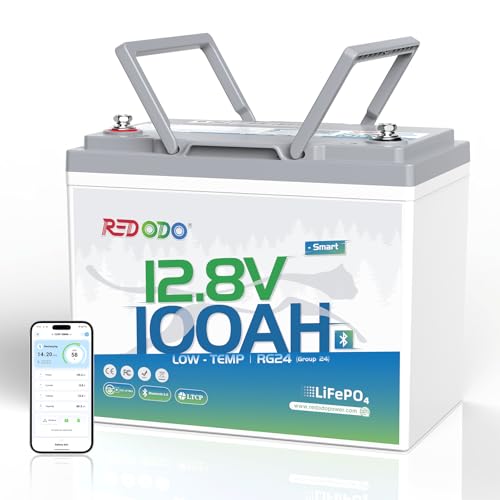
The Redodo Group 24 is built for harsh mounting spots. Its listing calls out waterproofing, salt spray, and corrosion protection along with a low-temperature cutoff, which matters for batteries sitting on an open trailer tongue.

Note the listing says the first charge needs a lithium charger with 0V activation.

What works

  • Waterproof, salt spray, and corrosion protection
  • Bluetooth shows voltage, current, and power
  • Up to 15,000 cycles at 60 percent depth

Watch out for

  • Requires a 0V capable lithium charger at first
  • No warranty length stated on listing
04
Best for: Buyers wanting IP65 and a warranty under $200

Our take

It suits owners who want water resistance and warranty coverage on a budget.

Why it made the shortlist

The HumsiENK 100Ah combines an IP65 rating, UL-tested cells, and a 5-year warranty for well under $200. Its 8.2 x 6.6 x 10.2 inch case fits standard Group 24 trays and loosely fits larger boxes too.

The ABKpower below states a clear 32F charge cutoff.

What works

  • Fits Group 24 through 31 boxes
  • 5-year warranty and 24-hour support

Watch out for

  • Low-temp shutdown temperature not specified
  • 100A BMS caps inverter size
05
Best for: Shoulder-season campers on a budget

Our take

It is a solid buy for spring and fall campers.

Why it made the shortlist

The ABKpower 100Ah is the cheapest pick here that clearly states it stops charging below 32F, the threshold that matters for LiFePO4 longevity. It also has an IP65 case and weighs 21 lbs.

The LIPULS below costs a little more with more detailed RV-oriented specs.

What works

  • Clear 32F charge cutoff stated
  • IP65 waterproof case
  • Lightest Group 24 here at 21 lbs

Watch out for

  • No warranty term on listing
  • Bluetooth shows voltage only per listing
06
Best for: Owners with a shunt monitor wanting a plain drop-in

Our take

It suits owners who already have a battery monitor installed.

Why it made the shortlist

The LIPULS 100Ah is the purest drop-in on this list. Its listing commits to BCI Group 24 dimensions of 10.23 x 6.61 x 8.30 inches and states it slots into Group 24, 27, or 31 compartments without modification.

It costs a bit more than the ABKpower, which adds an app and a stated 32F cutoff, so the LIPULS mainly wins on its precise drop-in dimensions.

Without one, a Bluetooth model is more useful for the same money.

What works

  • Exact BCI Group 24 dimensions published
  • Cylindrical cells help with heat management
  • Fits Group 24, 27, and 31 trays

Watch out for

  • No Bluetooth monitoring
  • Cold cutoff temperature not stated
07
Best for: Tight budgets swapping out a single lead-acid battery

Our take

It is a good starter battery for a weekend trailer on hookups.

Why it made the shortlist

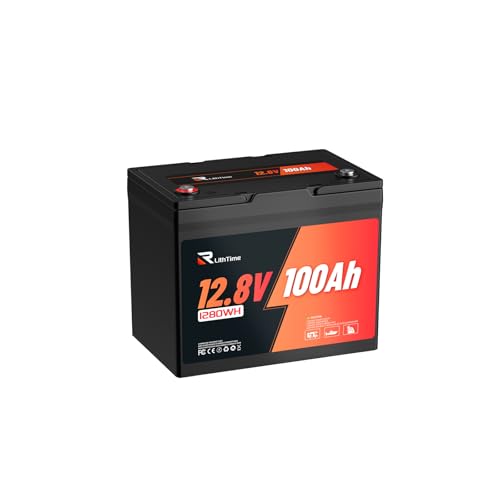
The RVLithTime Mini is the cheapest Group 24 lithium in this roundup. It measures 10.2 x 6.65 x 8.39 inches, has a 100A BMS, and clearly lists its charging range as 32F to 113F.

You are trading monitoring and support for the lowest upfront cost.

Pair it with an inexpensive shunt monitor if you plan to boondock.

What works

  • States charge range of 32F to 113F
  • Up to 15,000 cycles at 60 percent depth

Watch out for

  • No Bluetooth monitoring
  • No warranty term on listing
  • Not for starting or golf carts
The catch
It ranks last because, like the LIPULS above, it lacks Bluetooth and also omits a warranty term.

Methodology

How We Built This Shortlist

Each pick was assessed across 5 criteria weighted for real-world use.

01

Published Group 24 Dimensions

We only kept batteries whose listed size fits about 10.2 x 6.6 x 8.3 inches, the BCI Group 24 envelope.

02

BMS Current

We compared continuous BMS ratings, since 100A versus 150A decides how large an inverter one battery can run.

03

Cold-Charge Behavior

We ranked stated charging cutoffs at 32F above lower or unspecified values.

04

Weather Protection

We credited IP65, waterproof, or corrosion claims because many Group 24 trays sit on an open tongue.

05

Monitoring and Warranty

We weighed Bluetooth apps and stated warranty terms as real ownership value.

Decision guide

Match a Group 24 Lithium RV Battery to Your RV

By Mounting Location

Where the tray isPick
Open trailer tongueRedodo 12V 100Ah Group 24
Exposed tray on a budgetHumsiENK 12V 100Ah
Inside a sealed compartmentLIPULS 12.8V 100Ah
Interior bench seatLiTime 12V 100Ah Group 24
Outside, cold-climateABKpower 12V 100Ah

By Budget

BudgetPick
Under $135RVLithTime 12V 100Ah Mini
$150 to $170ABKpower 12V 100Ah or LIPULS 12.8V 100Ah
$175 to $195GRENERPOWER 12.8V 100Ah or HumsiENK 12V 100Ah
$250 to $270Redodo 12V 100Ah Group 24
Over $300LiTime 12V 100Ah Group 24

Bluetooth vs No Bluetooth

Built-in Bluetooth

An app shows charge, current, and alerts with no extra wiring. In this list: the LiTime 12V 100Ah Group 24, GRENERPOWER 12.8V 100Ah, Redodo 12V 100Ah Group 24, HumsiENK 12V 100Ah, and ABKpower 12V 100Ah.

No Bluetooth

Cheaper, but you need a shunt monitor since LiFePO4 voltage barely changes. That is the LIPULS 12.8V 100Ah and RVLithTime 12V 100Ah Mini.

Most owners should choose a Bluetooth model unless a shunt monitor is already installed.

By Inverter Size

InverterPick
None, 12V loads onlyRVLithTime 12V 100Ah Mini
Up to 1000WABKpower 12V 100Ah
1000 to 1500WGRENERPOWER 12.8V 100Ah
2000WTwo of the HumsiENK 12V 100Ah in parallel

For a Small Travel Trailer Swap Specifically

Look for

Group 24 dimensions, a 32F charge cutoff, Bluetooth, and a converter that has or can be switched to a lithium mode.

In this comparison

The ABKpower 12V 100Ah checks all three battery boxes at a budget price, which leaves room to upgrade the converter.

When to Spend More

Spend more if

You want long support and a well-documented brand. The LiTime 12V 100Ah Group 24 adds a 5-year warranty and insurance.

Save if

You camp on hookups and have a monitor. The RVLithTime 12V 100Ah Mini does the core job for less than half the price.

FAQ

Before You Bring One Home

Will a Group 24 lithium battery fit my existing battery box?

Usually yes if the listed dimensions are within about 10.2 x 6.6 x 8.3 inches. Check terminal height under the lid and confirm the hold-down strap length.

What mistake do people make swapping a Group 24 to lithium?

Leaving the converter on a lead-acid profile. The battery may never fully charge, so enable a lithium mode or upgrade the converter.

Is one Group 24 lithium worth it over two 6V lead-acid batteries?

For weight and usable energy, often yes: a 100Ah lithium gives nearly all its capacity, similar to the usable portion of two 6V golf cart batteries at a fraction of the weight. Two lead-acid 6Vs still store more total energy, so heavy boondockers may want two lithium batteries.

How do I install a Group 24 lithium battery?

Disconnect shore power and the battery switch, remove the old negative then positive cable, set the new battery in the tray, and connect positive then negative. Then update any converter or solar charge settings.

Can a Group 24 lithium battery start my motorhome engine?

No. These are deep-cycle house batteries, and several listings specifically say not to use them for starting. Keep the chassis battery separate.

How do I keep it healthy over winter?

Disconnect it or switch it off, store it around half charged, and do not charge it below 32F. Check it every few months.

Bottom line

The short version

Browse more group 24 lithium rv batteries on Amazon →
Bowen Higgins, RV Editor at RV Gear Lab

About the author

Bowen Higgins

RV Editor at RV Gear Lab

Bowen covers RV power, water systems, towing and leveling, upkeep and interior comfort, with a focus on matching gear to the rig, the hookups and the way you actually travel.

More from Bowen →Editorial standards

Keep reading

Related guides