

We research everything we recommend. When you buy through our links, we may earn a commission. Learn more

Buying guide · 10 min read · Updated October 2, 2026

6 Best MPPT Solar Charge Controller in 2026: A Practical RV Guide

Six MPPT-labeled solar charge controllers for RV and camper owners, from compact 10A units to 100A models, with notes on what each listing does say.

Bowen HigginsBy Bowen HigginsRV Editor at RV Gear Lab6 products comparedSpec-sheet researched

At a glance

Our top picks

MPPT controllers earn their keep by converting spare panel voltage into extra charge current, but the label alone does not tell you how well a given unit does it. This guide looks at six listings that use the MPPT label, from a compact 10A portable-panel unit to a 100A multi-voltage controller, and flags where a listing gives real tracking figures and where it does not.

This guide compares tracking efficiency claims, maximum PV voltage, battery chemistry support and extras like Bluetooth or low-temperature cut-off. Sparse listings are flagged plainly, with a recommendation to ask the seller for the missing numbers.

RV Gear Lab field notes

The Rig Fit Check

Start with the job
BougeRV MPPT Solar Charge Controller 40A leads this shortlist for Documented 40A unit. Use that fit as a reference point, then compare the alternatives against your own space and workload.
Specs that separate the picks
The first details to compare are 40A MPPT, 12V/24V, 60A MPPT, manual voltage, 20A MPPT, 12V/24V auto. Confirm the exact model and included components before ordering.
Trade-off to plan for
Rated load output is only 20A

Before you buy

What Matters Before You Choose an MPPT Solar Charge Controller

Key buying criteria so you get the right fit the first time.

  1. 01

    Stated tracking efficiency

    Tracking efficiency measures how closely the controller finds the panel's maximum power point, and figures of 98 to 99.5 percent are common on quality units. It matters because a poor tracker can waste much of the benefit MPPT is supposed to provide. Look for a numeric tracking or conversion figure on the listing, and be cautious when a very low-priced unit gives only the word MPPT.

  2. 02

    Voc headroom for cold mornings

    Open-circuit voltage rises as panels get colder, so a 22V panel can read higher than its label on a frosty morning. If the total of your series panels exceeds the controller's maximum PV input, it can be damaged. Add 20 to 25 percent to the panel Voc total and compare it to the limit, such as 95V, 100V or 145V.

  3. 03

    Array watts per battery voltage

    Listings often state a maximum PV wattage for each battery voltage, such as 600W at 12V and 1200W at 24V. Exceeding it can cause clipping, where excess power is simply not used. Match your total panel watts to the 12V figure if your bank is 12V.

  4. 04

    Cold-charging safeguards

    LiFePO4 batteries should not be charged below freezing, so a low-temperature cut-off or a BMS that blocks charging is valuable for winter camping. Without it, the controller may push current into a cold battery and shorten its life. Check whether the listing names a low-temp cut-off or a temperature sensor port.

  5. 05

    Monitoring that you will actually use

    Bluetooth and apps show solar watts, battery voltage and daily harvest, but some modules are sold separately. An LCD is more reliable when you are standing at the controller, while an app is better for a roof or a van interior. Check whether the Bluetooth hardware is included and what the range is.

Our standards

Why You Can Trust RV Gear Lab

At RV Gear Lab, we compare products based on rig fit and power or hookup compatibility, verified specifications, usability, setup requirements, weight, durability, and real-world trade-offs. We do not rank products purely on marketing claims or commission rates.

We have not personally tested every product listed. Where hands-on testing is not available, recommendations are based on verified manufacturer specifications, product documentation, use-case fit, and comparative research.

How we review RV gear →

Detailed reviews

The 6 best mppt solar charge controller, explained

01
BougeRV MPPT Solar Charge Controller 40A
  • 40A MPPT, 12V/24V
  • 95V max PV, 600W at 12V
  • Low-temp cut-off below 32F
Check price on Amazon for BougeRV MPPT Solar Charge Controller 40A (opens in a new tab)
Best for: Documented 40A unit

Our take

Best for a RV with a LiFePO4 house bank and about 600W of panels.

Why it made the shortlist

BougeRV's Sunflow is the best-documented MPPT here, with a named efficiency figure, a PV ceiling and a cold-charge safeguard. BougeRV's Sunflow is a 40A MPPT controller for 12V or 24V banks that accepts up to 600W of panels on 12V (1200W on 24V) and a maximum 95V PV input. Low-temperature cut-off below 32F stops charging a LiFePO4 battery in freezing weather, and an app connects within about 32 feet.

Its terminals take 15 to 8 AWG wire, so plan your cable run around that and fuse the battery side correctly.

What works

  • Cuts charging below 32F to protect LiFePO4
  • App monitoring within about 32 feet
  • Accepts 600W of panels on a 12V bank
  • Tracking efficiency listed up to 99.5%

Watch out for

  • Rated load output is only 20A
  • 95V PV ceiling limits long series strings
The catch
It stands above Renogy Rover 20A in rating (40A against 20A) and adds low-temperature cut-off, though it lacks the Rover's surge protection claims.
02
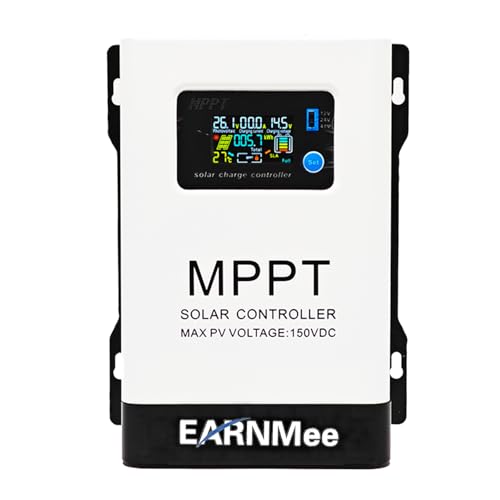
EARNMee 60A MPPT Solar Charge Controller
  • 60A MPPT, manual voltage
  • PV input to 145V
  • Fan-cooled, LCD readout
Check price on Amazon for EARNMee 60A MPPT Solar Charge Controller (opens in a new tab)
Best for: Large arrays

Our take

Best for large motorhomes and fifth wheels with big arrays.

Why it made the shortlist

EARNMee's 60A unit is the pick for large rigs, with 145V of PV input and manual voltage selection. EARNMee's 60A MPPT controller takes PV input of 18 to 145V on a 12V battery and lets you select 12V, 24V or 48V output manually. Temperature-controlled air cooling and an LCD with real-time system data round it out, and the listing names lead-acid, colloidal and lithium batteries.

Against VQP 100A it is more conservative in rating, which is likely closer to what a big RV actually needs.

What works

  • Handles big arrays with up to 145V PV input
  • Manual 12V, 24V or 48V battery selection
  • Temperature-controlled fan cooling under heavy load
  • LCD shows real-time system data

Watch out for

  • Battery voltage must be set by hand
  • Fan cooling adds a moving part
03
Best for: Small RV rooftops

Our take

Best for a van or small trailer with one to two panels.

Why it made the shortlist

Renogy's Rover 20A is a well-known 20A MPPT with documented temperature compensation and surge protection. The Rover 20A is a 12V/24V auto-detecting MPPT unit that accepts up to 260W on 12V (520W on 24V) with Voc up to 100V. The listing cites multi-peak tracking for shade, temperature compensation, a 6kV surge diode and four-stage charging with lithium recovery.

Compared with Bateria Power 10A it triples the array size it can take.

What works

  • Dual-peak tracking aimed at partial shade
  • Temperature compensation from -40F to 149F
  • 6kV lightning surge protection listed
  • Logs data for 365 days over Modbus

Watch out for

  • Bluetooth needs a BT2 module sold separately
  • Only 260W of panels fit on a 12V bank
The catch
Bluetooth only works with the BT2 module sold separately, so budget for it if you want phone monitoring.
04

Best Portable-Panel · 4 of 6

10Amp 12 Volt MPPT Solar Charge Controller

10Amp 12 Volt MPPT Solar Charge Controller
  • 10A MPPT, 12V only
  • 150W max PV, 30V Voc
  • LCD plus LED indicator
Check price on Amazon for 10Amp 12 Volt MPPT Solar Charge Controller (opens in a new tab)
Best for: Portable panels

Our take

Best for suitcase panels and small trailers.

Why it made the shortlist

Bateria Power's 10A model is sized for one small panel, with a 150W limit and 30V Voc ceiling. The listing says panel Voc must be at least 15V, and it includes an LCD and LED indicator in a compact body.

At 150W it is a portable-panel or small-trailer solution, not a roof-array controller.

What works

  • Mini body with LCD and LED indicator
  • Handles 12V lead-acid and LiFePO4 batteries
  • Sized for one or two small portable panels
  • Three-stage charging with float stage

Watch out for

  • 150W cap rules out any roof array
  • Panel Voc must be at least 15V
The catch
Next to VQP 100A it is far smaller and much more constrained.
05

Best Wide-Voltage · 5 of 6

100A MPPT Solar Charge Controller

100A MPPT Solar Charge Controller
  • 100A MPPT, auto 12V to 48V
  • Tracking up to 99%
  • LCD with dual USB
Check price on Amazon for 100A MPPT Solar Charge Controller (opens in a new tab)
Best for: Flexible voltage

Our take

Best for DIY builders who may change battery voltage later.

Why it made the shortlist

VQP's 100A controller covers 12V through 48V with a stated tracking efficiency of up to 99%. VQP's 100A MPPT controller auto-recognizes 12V, 24V, 36V and 48V systems and lists tracking efficiency of up to 99%. It adds light and time control modes, an LCD and two 5V USB ports, and works with lithium and lead-acid chemistries.

Light and time modes add flexibility you may not use.

What works

  • Auto-detects 12V, 24V, 36V and 48V systems
  • Light and time load-control modes
  • Works with lithium and lead-acid chemistries
  • LCD for status and parameter changes

Watch out for

  • Extra load modes add settings to learn
06
Best for: Ultra-low budget

Our take

Best for a budget secondary system where you accept limited detail.

Why it made the shortlist

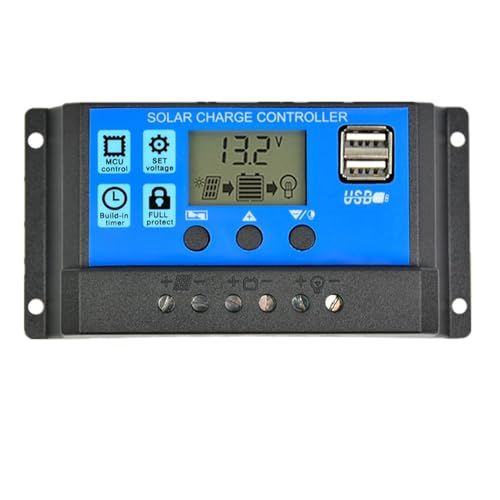
Dawnice's 30A listing sits at the very low end of the price range and is labeled with both PWM and MPPT in its title. Dawnice lists a 30A 12V/24V controller with auto parameter setting, an adjustable LCD, dual USB ports and timer settings. The title mentions both PWM and MPPT, and the listing carries no feature bullets or tracking-efficiency figure.

That makes it harder to compare with VQP 100A or the documented units above.

What works

  • Auto parameter setting for 12V or 24V
  • Adjustable LCD display
  • Timer setting and dual USB output

Watch out for

  • No feature bullets or efficiency figure listed
  • Title mentions both PWM and MPPT

Methodology

How We Built This Shortlist

Each pick was assessed across 5 criteria weighted for real-world use.

01

Tracking claims

This guide compares stated tracking or conversion efficiency across listings, noting where a number was given and where it was not.

02

PV voltage and wattage limits

Maximum PV input voltage and wattage per battery voltage were checked to see what array each unit can realistically accept.

03

Battery and temperature handling

Lithium compatibility, temperature compensation and cold-charge protection mattered for RV use in changing climates.

04

Monitoring and extras

LCD, Bluetooth, USB and parallel options were weighed as conveniences rather than core performance.

05

Documentation quality

Listings that give real specs ranked above those that only use the MPPT label.

Decision guide

Match an MPPT Solar Charge Controller to Your RV

By Array Size

Your situationRecommended pickWhy
One portable panel up to 150WBateria Power 10A10A MPPT with a 150W cap.
One or two panels, up to about 260W on 12VRenogy Rover 20A20A with documented 260W/12V limit.
Roof array near 600W on 12VBougeRV Sunflow 40ALists 600W at 12V and 95V PV.
Large array on a big rigEARNMee 60A60A with 145V PV input.
Very large or mixed-voltage buildsVQP 100A100A with 12V to 48V auto detect.

By Budget

BudgetRecommended pick
$0 to $40Dawnice 30A or VQP 100A
$30 to $70Bateria Power 10A or Renogy Rover 20A
$80 to $140EARNMee 60A or BougeRV Sunflow 40A

Documented vs Minimal Listings

Documented

A listing that gives tracking efficiency, PV limits and wiring specs lets you check the unit against your array before buying. BougeRV Sunflow 40A and Renogy Rover 20A are the most detailed here.

Minimal

A sparse listing may still work, but you cannot verify limits without asking. Dawnice 30A is the thinnest listing in this group, and Bateria Power 10A is narrow in scope.

Choose BougeRV Sunflow 40A or Renogy Rover 20A when you want documented specs, and treat Dawnice 30A as a pick for an inexpensive secondary system.

By Battery Voltage

VoltageRecommended pick
12V only, small systemBateria Power 10A
12V or 24V with auto detectRenogy Rover 20A
Manual 12V, 24V or 48VEARNMee 60A
Auto 12V to 48VVQP 100A

For Winter RV Camping Specifically

Look for

Look for low-temperature charge cut-off for lithium, temperature compensation for lead-acid and a PV input limit that leaves room for cold Voc.

In this comparison

BougeRV Sunflow 40A lists a cut-off below 32F, and Renogy Rover 20A lists temperature compensation across a wide range.

When to Spend More

Spend more if

Spend more if you plan to grow the array or run lithium in cold climates, where BougeRV Sunflow 40A or EARNMee 60A will not clip your panels.

Save if

Save if you have a single portable panel, where Bateria Power 10A does the job and Dawnice 30A is only worth considering if you can verify its specs with the seller.

FAQ

Before You Bring One Home

Can I use a 12V MPPT controller with a 24V battery?

Not unless the listing says so. Bateria Power 10A is for 12V only, while Renogy Rover 20A and BougeRV Sunflow 40A auto-detect 12V and 24V. Connecting a 12V-only unit to a higher-voltage bank can damage it.

What mistake do buyers make with a MPPT controller?

Exceeding the maximum PV voltage with a series string on a cold morning. Always add margin to the panel Voc total and keep it below the controller's limit.

Is a 99.9 percent efficiency claim believable?

Treat it as a tracking figure rather than total system efficiency. It describes how well the unit finds the maximum power point, not the losses in wiring and conversion. Compare it with the documented numbers on units like BougeRV Sunflow 40A.

What is the safest way to wire a MPPT controller?

Fuse the battery connection, connect the battery first, then the panels, and use wire sized for the amps. BougeRV Sunflow 40A lists terminals for 15 to 8 AWG, so match your cable to that. On a MPPT controller, double-check polarity at every terminal before powering up and use wire sized for the rated amps.

How should I maintain a MPPT controller?

On a MPPT controller, tighten terminals and inspect cable insulation at the start of each season, and keep vents, fans or heat-sink surfaces free of dust. Mostly just periodic checks. Tighten terminals, keep vents clear and watch for heat. A unit with a fan, like EARNMee 60A, may need dust cleaned out occasionally.

Bottom line

The short version

Browse more mppt solar charge controller on Amazon →
Bowen Higgins, RV Editor at RV Gear Lab

About the author

Bowen Higgins

RV Editor at RV Gear Lab

Bowen covers RV power, water systems, towing and leveling, upkeep and interior comfort, with a focus on matching gear to the rig, the hookups and the way you actually travel.

More from Bowen →Editorial standards

Keep reading

Related guides