

We research everything we recommend. When you buy through our links, we may earn a commission. Learn more

Buying guide · 10 min read · Updated October 2, 2026

6 Best PWM Solar Charge Controller in 2026: A Practical RV Guide

Six PWM solar charge controllers from 10A to 30A for RVs, vans and small off-grid systems, plus when PWM beats MPPT and where it falls short.

Bowen HigginsBy Bowen HigginsRV Editor at RV Gear Lab6 products comparedSpec-sheet researched

At a glance

Our top picks

PWM controllers are the simple, durable option: they connect the panel straight to the battery and hold it at the right voltage, which works best when the panel voltage already sits close to the battery's. This guide covers six PWM units from 10A to 30A for owners with one to three 12V-class panels who would rather not pay for tracking.

This guide looks at how each listing describes its charge stages, battery chemistry support, display and amp rating, and this guide ranks units that name a lithium profile above lead-acid-only ones for RV house banks. Where a spec is missing from a listing, this guide tells you to confirm it rather than guess.

RV Gear Lab field notes

The Rig Fit Check

Start with the job
Renogy Wanderer Li 30A PWM Solar Charge Controller 12V for Solar Panels leads this shortlist for 12V lithium or AGM. Use that fit as a reference point, then compare the alternatives against your own space and workload.
Specs that separate the picks
The first details to compare are 30A PWM, 12V only, 20A PWM, 12V. Confirm the exact model and included components before ordering.
Trade-off to plan for
12V only, with no 24V support

Before you buy

What Matters Before You Choose a PWM Solar Charge Controller

Key buying criteria so you get the right fit the first time.

  1. 01

    Panel voltage match

    A PWM controller pulls the panel voltage down to the battery's level, so any extra voltage above the battery is wasted as heat. A panel with a maximum power voltage near 18V into a 12V battery loses a meaningful share, while a panel with a voltage close to the battery loses little. Check the panel's Vmp on its label and compare it to the battery's charging voltage.

  2. 02

    Current rating and array size

    PWM current is essentially the panel's output current, so size the controller by dividing array watts by battery voltage and adding margin. 300W on a 12V battery is about 25A, so a 30A unit is comfortable while 20A is tight. Avoid buying a unit whose rating equals your array's output with no headroom.

  3. 03

    Lithium charge profile

    A LiFePO4 bank generally wants an absorption voltage of roughly 14.2 to 14.6V and no equalization stage. A PWM controller that offers only lead-acid profiles can undercharge or overcharge it. Look for a named lithium mode or a user-adjustable voltage.

  4. 04

    Idle battery drain

    Some controllers draw a small current from the battery around the clock, which matters during storage. Units that list zero consumption at night or under 10mA are better for long-term camping. Look for a stated figure rather than a vague low-power claim.

  5. 05

    Display and protection

    An LCD shows voltage and current, while LED lights only show status. Look for reverse-polarity, overcharge and short-circuit protection on the listing. Choose a display type you will actually read from the place you will mount the unit.

Our standards

Why You Can Trust RV Gear Lab

At RV Gear Lab, we compare products based on rig fit and power or hookup compatibility, verified specifications, usability, setup requirements, weight, durability, and real-world trade-offs. We do not rank products purely on marketing claims or commission rates.

We have not personally tested every product listed. Where hands-on testing is not available, recommendations are based on verified manufacturer specifications, product documentation, use-case fit, and comparative research.

How we review RV gear →

Detailed reviews

The 6 best pwm solar charge controller, explained

01
Best for: 12V lithium or AGM

Our take

Best for a 12V RV with one to three panels and a lithium or AGM bank.

Why it made the shortlist

Renogy's Wanderer Li is the most complete 12V PWM here, with a four-stage charge that lists lithium alongside lead-acid chemistries. Renogy's Wanderer Li is a 12V 30A four-stage PWM controller whose listing names lithium, AGM, gel and flooded batteries. It measures 5.5 by 3.9 by 1.8 inches and carries an IP32 waterproof rating, so it suits an indoor or protected compartment.

What works

  • Four-stage PWM charging with a lithium option
  • Compact 5.5 by 3.9 by 1.8 inch body
  • Names lithium, AGM, gel and flooded batteries
  • Bluetooth possible through a separate BT-1 module

Watch out for

  • 12V only, with no 24V support
  • Waterproofing is only IP32 rated
02
Best for: Small 12V arrays

Our take

Best for a small trailer or van with 200 to 250W of panels.

Why it made the shortlist

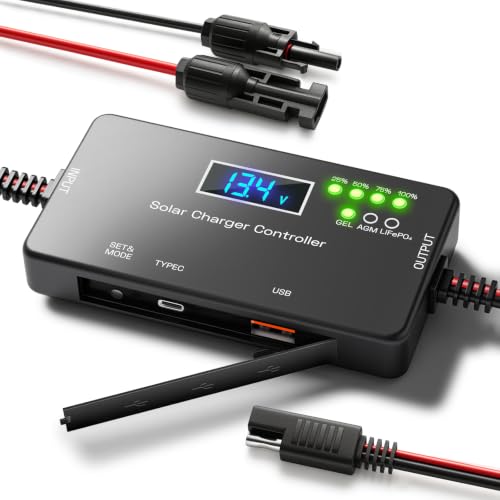
AeternaSol's 20A model targets 12V LiFePO4, AGM and gel systems with a zero-idle-drain design. The listing claims zero idle drain and reverse-current protection from an upgraded core circuit.

What works

  • Zero idle drain on the battery
  • Reverse-current protection listed
  • Type-C and USB ports for devices
  • Works with LiFePO4, AGM and gel batteries

Watch out for

  • 12V only, with no 24V option
  • 20A limits array size to a few panels
The catch
It undercuts Renogy Wanderer Li 30A on capacity but adds Type-C and USB ports that Rolokit 20A lacks.
03
Best for: Readable display

Our take

Best for owners who want to see battery status at a glance.

Why it made the shortlist

Rolokit's 20A controller pairs a bright LCD and battery level indicator with 12V LiFePO4, AGM and gel support. Rolokit's 20A model is a 12V PWM controller whose listing calls it compatible with lithium (LiFePO4), AGM and gel batteries. It pairs a bright LCD and battery level indicator with six listed protections and a stay-cool design.

Compared with HilapriSol 10A it doubles the current.

What works

  • Bright LCD with a battery level indicator
  • Listed as compatible with 12V lithium (LiFePO4)
  • Six layers of listed safety protection
  • Simple wiring with no special tools

Watch out for

  • 12V only, with no 24V option
  • Limited to a modest panel array
04

Best 12V/24V · 4 of 6

30A PWM Solar Charge Controller

30A PWM Solar Charge Controller
  • 30A PWM, 12V/24V auto
  • Dual USB, timer settings
  • Lead-acid, AGM, gel
Check price on Amazon for 30A PWM Solar Charge Controller (opens in a new tab)
Best for: 12V or 24V banks

Our take

Best for a 24V bank or a mixed 12V and 24V workshop.

Why it made the shortlist

OrinClavon's 30A controller covers both 12V and 24V lead-acid systems with a three-stage charge. OrinClavon's 30A PWM controller regulates charging in three stages (bulk, boost and float) for 12V or 24V lead-acid, AGM and gel systems. An LCD shows charging status, battery voltage and load status, with adjustable settings and dual USB ports.

It is a straightforward lead-acid unit, so lithium owners should look at the lithium-profile models in this list instead.

What works

  • Three-stage bulk, boost and float charging
  • Auto-regulates 12V or 24V lead-acid systems
  • LCD shows voltage, load status and settings
  • Overcurrent, short and reverse protection listed

Watch out for

  • Listing is aimed at lead-acid, AGM and gel only
  • PWM wastes panel voltage above battery level
05

Best Entry Level · 5 of 6

10A PWM Solar Charge Controller

10A PWM Solar Charge Controller
  • 10A PWM, 12V/24V auto
  • LCD with total power generation
  • Six built-in protections
Check price on Amazon for 10A PWM Solar Charge Controller (opens in a new tab)
Best for: Single small panel

Our take

Best for a single small panel on a pop-up camper.

Why it made the shortlist

HilapriSol's 10A model is the least expensive and smallest of the group, with an LCD and six protections. HilapriSol's 10A PWM controller runs a three-stage charge (bulk, absorption, float) with auto 12V/24V recognition. Its LCD tracks charging and discharging current, total power generation, temperature and system status, and six protections are listed.

It is a low-cost starter for a small panel, not a pick for an RV roof array.

What works

  • LCD shows current, power generated and temperature
  • Auto 12V/24V recognition
  • Six protections including reverse polarity
  • Three-stage bulk, absorption and float charging

Watch out for

  • 10A is enough only for small panels
  • Listing gives no lithium profile details
The catch
It costs less than Rolokit 20A and fits smaller panels only.
06
Best for: Budget lead-acid

Our take

Best for a budget lead-acid system where 30A of headroom is wanted.

Why it made the shortlist

Depvko's 30A PWM controller adapts automatically to 12V and 24V systems and carries an LCD with auto parameter setting.

That limits it to flooded, sealed or gel banks.

What works

  • Auto-adapts to 12V and 24V systems
  • LCD with automatic parameter setting
  • Protects against overcurrent, short and reverse

Watch out for

  • Listing says it suits lead-acid batteries only
  • No lithium profile at all
The catch
Pick it only for flooded or AGM banks, and never for a lithium battery.

Methodology

How We Built This Shortlist

Each pick was assessed across 5 criteria weighted for real-world use.

01

Fit for PWM use

This guide weighs how each unit suits panels whose voltage is close to the battery's, since that is where PWM does well.

02

Battery profile

Lithium and lead-acid support were compared, and lead-acid-only units were placed lower for RV house banks.

03

Capacity

Amp ratings were matched to typical one-to-three panel RV arrays.

04

Readout and features

LCD, USB ports and indicator lights were considered as everyday conveniences.

05

Listing detail

Missing specs such as waterproofing or warranty are noted so you can ask the seller.

Decision guide

Match a PWM Solar Charge Controller to Your RV

By Array Size on 12V

Your situationRecommended pickWhy
One panel around 100WHilapriSol 10A10A is enough for a single small panel.
Two panels, about 200WAeternaSol 20A20A with 12V lithium support.
200W to 250W with a clear display wantedRolokit 20ABright LCD and battery level icon.
300W to 400W on a lithium bankRenogy Wanderer Li 30A30A with a lithium option.
Lead-acid bank, big array, tight budgetDepvko 30A PWM30A at a very low price.

By Budget

BudgetRecommended pick
$0 to $20Depvko 30A PWM or HilapriSol 10A
$10 to $20OrinClavon 30A or Rolokit 20A
$20 to $30AeternaSol 20A or Renogy Wanderer Li 30A

Lithium-Aware vs Lead-Acid-Only

Lithium-aware

These listings name LiFePO4 or lithium in their compatibility, which avoids undercharging a modern RV house bank. Renogy Wanderer Li 30A, AeternaSol 20A and Rolokit 20A fall here.

Lead-acid only

These units are designed around flooded, AGM or gel voltages and should not be used on lithium. OrinClavon 30A and Depvko 30A PWM state lead-acid use.

Choose Renogy Wanderer Li 30A for a lithium bank, and save OrinClavon 30A or Depvko 30A PWM for flooded or AGM batteries.

By Battery Voltage

VoltageRecommended pick
12V onlyRenogy Wanderer Li 30A
12V or 24V lead-acidOrinClavon 30A
12V or 24V, small panelHilapriSol 10A
12V or 24V, big capacity, lead-acid onlyDepvko 30A PWM

For Weekend Trailer Owners Specifically

Look for

Look for modest amps, simple wiring and a display you can read without an app, since a weekend rig usually carries one or two panels.

In this comparison

AeternaSol 20A and Rolokit 20A fit a one- or two-panel trailer, while Renogy Wanderer Li 30A leaves headroom for a third panel.

When to Spend More

Spend more if

Spend more if you run a lithium house bank, where Renogy Wanderer Li 30A lists the right chemistry rather than leaving you to adjust settings.

Save if

Save if you run flooded or AGM batteries with one small panel, where HilapriSol 10A or Depvko 30A PWM covers the job.

FAQ

Before You Bring One Home

Does a PWM controller work with lithium batteries?

It can, but the controller must offer a lithium profile or adjustable voltage, and the panels need enough voltage to push past about 14V. Renogy Wanderer Li 30A and AeternaSol 20A list lithium; Depvko 30A PWM does not.

What mistake do people make with PWM controllers?

Connecting a high-voltage 24V panel to a 12V battery through a PWM unit. The extra voltage is wasted and the panel is dragged far from its best operating point.

Is PWM worth it over MPPT?

For one or two 12V-class panels, yes, because PWM is simple and costs less. Above roughly 400W or with higher-voltage panels, MPPT is the better value.

What is the safest way to wire a PWM controller?

Connect the battery first, then use the button or menu to select the correct profile, such as LFP, gel or AGM. Always match it to the battery's chemistry. On a PWM controller, double-check polarity at every terminal before powering up and use wire sized for the rated amps.

How should I maintain a PWM controller?

On a PWM controller, tighten terminals and inspect cable insulation at the start of each season, and keep vents, fans or heat-sink surfaces free of dust. Little. Tighten terminals each season and keep the case clear of dust. An LCD unit like Rolokit 20A lets you notice problems earlier by showing voltage.

Bottom line

The short version

Browse more pwm solar charge controller on Amazon →
Bowen Higgins, RV Editor at RV Gear Lab

About the author

Bowen Higgins

RV Editor at RV Gear Lab

Bowen covers RV power, water systems, towing and leveling, upkeep and interior comfort, with a focus on matching gear to the rig, the hookups and the way you actually travel.

More from Bowen →Editorial standards

Keep reading

Related guides