
Practical Camping Guide · 12 min read
How to Choose and Rig a Camping Tarp
Choose a camping tarp by size, fabric and weight, then rig it with the right knots and pitches for rain, sun and wind. Includes sizing table.

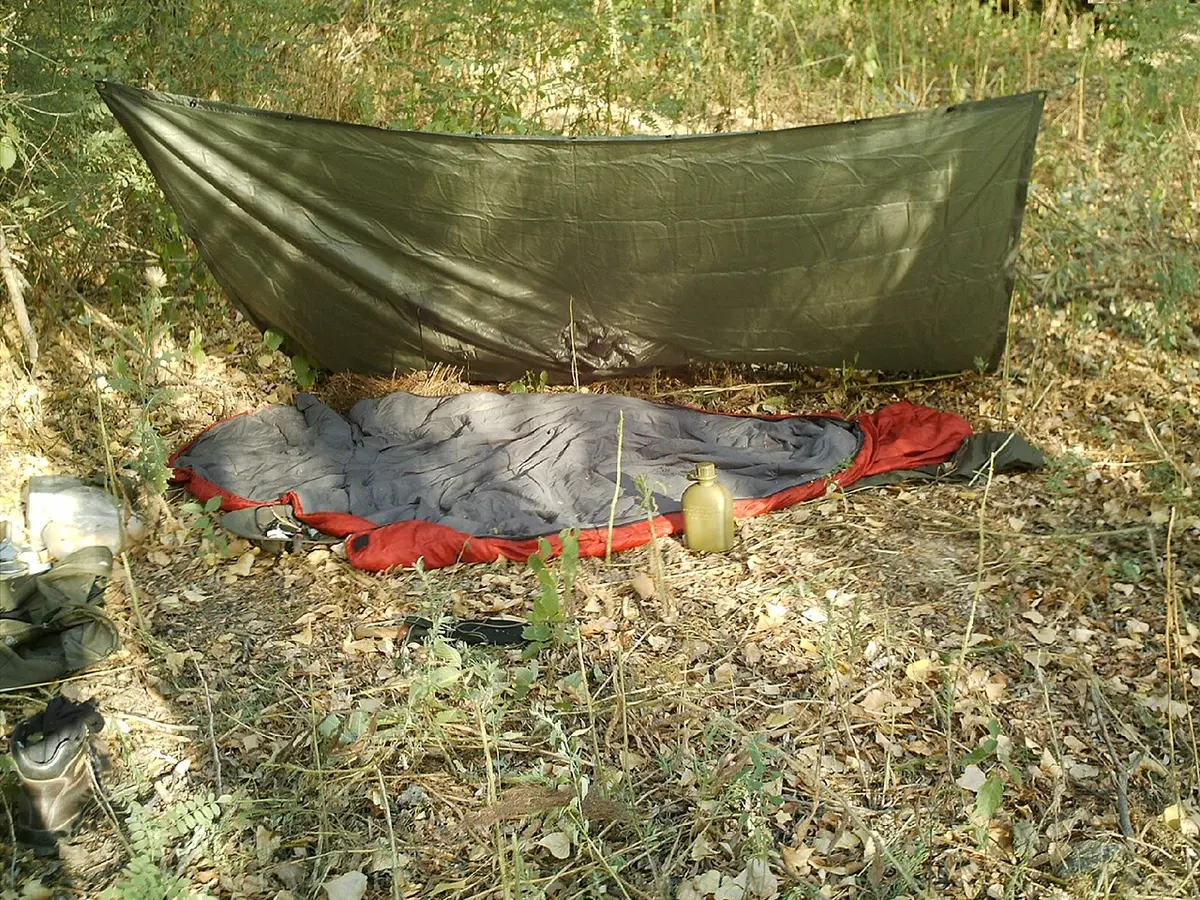
Choose a camping tarp by size, fabric and weight, then rig it low, taut and sloped so rain runs off. A 10 by 10 foot tarp shelters a small group around a picnic table, an 8 by 10 covers two sleepers, and a 12 by 16 or larger covers a camp kitchen or a family area. Polyester and nylon tarps with taped seams are light and shed rain, polyethylene tarps are cheap and rugged but heavy, and canvas is durable and breathable but very heavy.
A tarp is the most flexible shelter you can carry. It becomes a rain roof over a table, a ground cloth, a windbreak, a sun shade or a minimalist sleeping shelter, depending on how you rig it. That flexibility is also the challenge: with no fixed shape, you have to learn a few knots and pitches. This guide covers sizing, fabrics, features, the knots and rigs that matter, and how to keep a tarp dry and safe in wind.
What a tarp does well and where it falls short
A tarp gives overhead cover with open sides. That makes it airy in warm weather, quick to set up and light, but exposed to wind-driven rain, insects and ground moisture. It does not replace a tent for a night in a storm or in biting-insect country. It does shine as a camp kitchen roof, a dining shelter, a gear cover, a shade for a hot afternoon and, for experienced campers, a very light sleeping shelter when combined with a bivy or a bug net.
Think of a tarp as a tool to complement a tent rather than a competitor. Many car campers bring a large tarp over the picnic table and a small one under the tent. Backpackers who use tarp shelters accept more skill and less protection in return for weight savings of a pound or more.
Sizes and what they cover
| Size | Floor area | Typical use |
|---|---|---|
| 5 x 7 ft | 35 sq ft | Ground cloth, one-person bivy cover |
| 8 x 10 ft | 80 sq ft | Two-person shelter, small kitchen cover |
| 10 x 10 ft | 100 sq ft | Table and 4 chairs, group shade |
| 10 x 12 ft | 120 sq ft | Small family area |
| 12 x 16 ft | 192 sq ft | Large camp kitchen, group shelter |
| 20 x 20 ft and up | 400+ sq ft | Event cover, equipment cover |
Pitched at an angle, a tarp covers less area than its dimensions suggest, since the rig takes a few feet off each side to slope the roof and drop one edge. A 10 by 10 tarp pitched as a lean-to covers roughly an 8 by 8 foot floor. If you want to cover a six-foot table with four chairs, aim for 12 by 12 or larger. Look through best large camping tarps and best car camping tarps when you need coverage for family groups.
Fabrics compared
Polyethylene (poly tarps). The common blue or silver tarp, a woven polyethylene with a plastic coating. Cheap, waterproof and durable for the price, but heavy and noisy, and UV eventually makes them brittle. Weight is stated in mils or ounces per square yard. A 5 mil tarp is light duty and a 10 mil tarp is heavy duty. Look at best heavy duty camping tarps.
Coated nylon or polyester. The lightweight choice. A silicone- or polyurethane-coated ripstop tarp weighs a fraction of poly. Silnylon (silicone-coated nylon) is the standard for ultralight tarps, light and strong though it stretches when wet. Polyester stretches less and resists UV better. See the best ultralight camping tarps and best waterproof camping tarps.
Canvas. Cotton or blended canvas is breathable, quiet and long-lived, and it resists sparks better than synthetics. It is heavy, absorbs water and needs care against mildew. It suits base camps and fire-side shelters.
Dyneema composite. Ultralight and very strong, with a price to match. Mostly used by serious backpackers.
| Fabric | Weight (8x10) | Cost | Notes |
|---|---|---|---|
| Poly (5 to 10 mil) | 3 to 6 lb | Low | Cheap, tough, heavy, UV-limited |
| Coated polyester | 1.5 to 3 lb | Moderate | Good all-round, stable when wet |
| Silnylon | 1 to 1.5 lb | Moderate to high | Light, stretches when wet |
| Canvas | 8 to 15 lb | Moderate | Breathable, heavy, spark-resistant |
| Dyneema composite | under 1 lb | High | Very light and strong |
Waterproofing and seams
A waterproof tarp relies on the fabric coating and on sealed seams, if it has any. Single-piece tarps have none, which is an advantage. Larger tarps are often sewn from panels, and those seams need tape or sealer. Check the hydrostatic head of the fabric and whether seams are welded or taped, as covered in tent waterproof ratings. For a rain tarp, you want at least 1,500 to 2,000 mm for the fabric. The best camping tarps for rain covers designs built for wet weather.
For uncoated or older tarps, seam sealer and a wash-in or spray-on waterproofing treatment restore performance. The steps in how to waterproof a tent apply to tarps as well. Avoid heat near the fabric, because many tarps melt.
Features that matter
Look at the grommets and tie-out points. Metal grommets spaced every 3 to 4 feet along the edges are standard in cheap poly tarps, and they tear out under load. Reinforced corners and webbing loops are much stronger. Ultralight tarps use sewn loops or reinforced tie-outs, often with extra points in the middle of the edge. More tie-outs give you more rigging options.
Additional features include a ridgeline loop for a center pole, catenary cuts (curved edges) that tighten the fabric and reduce flapping, and mid-panel attachment points for a peak. A stuff sack is useful. If you plan to carry the tarp, check its packed size and weight. If you plan to leave it at the campsite, thickness and UV treatment matter more than weight.
Rigging basics: the three knots you need
You can rig almost any tarp with three knots.
- Taut-line hitch. An adjustable loop that slides to tighten a guyline and holds under load. It is the workhorse for tensioning.
- Bowline. A fixed loop that does not slip, good for attaching to a tree or a grommet.
- Trucker's hitch. A mechanical-advantage knot that lets you pull a line very tight, essential for a ridgeline.
Add a clove hitch or a simple overhand with a stick toggle for attaching to grommets, and learn to tie a prusik loop for adjustable tie-offs. Practice at home with a few feet of cord. Reflective cord helps with night visibility and tripping hazards.
Classic tarp pitches
A-frame. Run a ridgeline between two trees at about chest height and drape the tarp over it, then stake the sides. It sheds rain in both directions and gives good protection from wind from the ends. It uses the full tarp and needs two anchor points.
Lean-to. Tie one edge high between two trees or poles, slope the tarp down and stake the opposite edge to the ground. It gives a covered area open on one side, which is useful beside a fire, and is easy to pitch. Orient the closed side to the wind.
Flat or low-slope roof over a table. Tie the four corners to poles or trees, with one corner lower than the others so water runs off to one side. A flat tarp sags and pools water, so always pitch with a slope of at least 15 to 20 degrees.
Diamond or plow-point pitches. Used for backpacking, these use trekking poles and tension to create a low profile that handles wind. They need practice but make a stable shelter in exposed places.
For general pitching steps and wet weather tactics, see how to set up a tent, how to pitch a tent by yourself and how to set up a tent in the rain.
Rain, wind and safety
Keep the tarp low on the windward side to resist gusts and high on the lee side to shed water. Make sure no pool of water can collect: if a sag forms, push it up from underneath with a trekking pole, which also dumps water. A tarp can flap loudly and wear its tie-outs in wind, so tighten lines and reduce the area exposed. In a storm that overpowers the rig, take it down.
Fire safety is crucial. Keep a tarp at least 10 to 15 feet above any open flame, and well away from sparks, since many synthetics melt or burn quickly. Never cook under a closed tarp, and avoid stoves close to fabric. Do not tie a tarp to a tree with a rope that can girdle and damage bark; use wide straps. Avoid dead trees and limbs, which can fall in wind. In lightning, a tarp offers no protection.
Using a tarp under or over a tent
Many campers put a tarp under their tent as a groundsheet. To work, the tarp must be smaller than the tent floor so rain does not run onto it and pool between layers. Fold the edges under or cut it to size. A tarp over the tent, rigged between trees, adds shade and extra rain protection, and shelters the vestibule for cooking and storing gear. This is a good way to extend the life of a tent fly and keep the interior cool in summer.
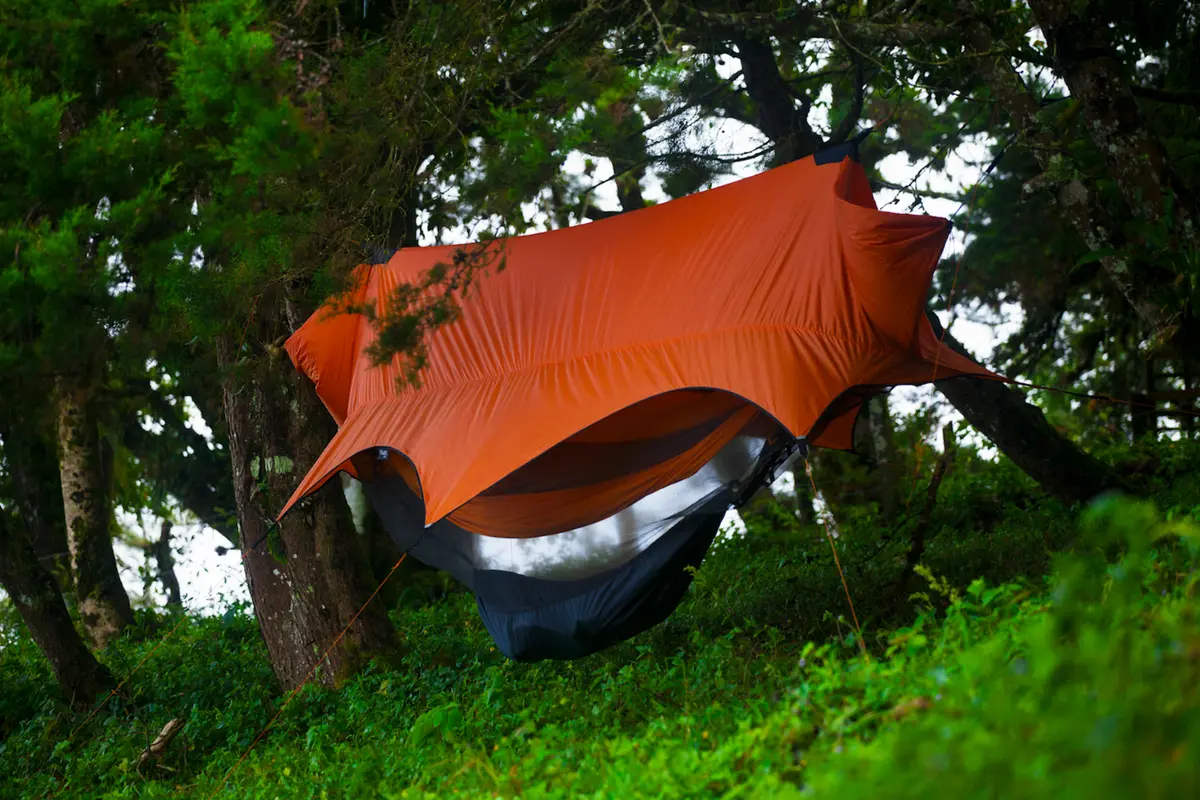
If you carry a single tarp, a 10 by 10 gives flexibility. If you carry two, an 8 by 10 for the kitchen and a smaller sheet for the floor covers most needs. For lighter loads, choose the thinnest fabric that fits your use.
Choosing cord, stakes and poles for the rig
A tarp is only as good as the lines holding it. For guylines, 2 to 3 mm braided nylon or polyester cord with a breaking strength of a few hundred pounds suits most rigs, and 550 paracord works for heavier use but stretches and is bulkier. Cord with a reflective tracer is easier to see at night. For a ridgeline, a non-stretch line such as braided polyester or a Dyneema-type cord holds a tighter pitch than nylon, which sags when wet.
For stakes, use the type that fits the ground, as described in our guide to choosing tent stakes. A tarp pulls at sharper angles than a tent and sees larger loads at the corners, so use sturdy stakes there and lighter ones along the edges. Carry a few extra, because tarp rigs use many anchor points.
For poles, a collapsible pole or a pair of trekking poles gives you an upright when trees are not conveniently spaced. A pole of 7 to 8 feet suits a lean-to or an A-frame. Make sure the top of the pole has a way to hold the tarp without tearing it: a small stuff sack or a pad of folded cloth under the grommet spreads the point load. Tie the line to the pole with a clove hitch or a lashing.
Three tarp setups worth practicing
The picnic table roof. Choose a 10 by 12 foot tarp. Tie two corners high to trees or poles about 7 feet up on the side facing away from the wind. Tie the other two corners lower, at about 5 feet, on the windward side, with the lower corners angled outward so rain sheds into the open ground and not onto the table. Pitch the ridge slightly off-center so the downwind side has a bit more overhang. This gives standing room over the table and a roof that sheds rain away from the seating area.
The two-person rain shelter. Use an 8 by 10 foot tarp as an A-frame over a ridgeline strung between two trees at chest height. Stake the sides to the ground at 45 degree angles, with the long dimension facing the wind. Place a ground sheet under the sleeping area, smaller than the tarp footprint so rain does not run onto it. Close the windward end by dropping that edge to the ground, and leave the other end open for entry and cooking away from the fabric.
The sun shade for the beach or a camp kitchen. Use a lightweight coated tarp with one side raised on poles and the other tied down at 4 feet. Face the high side toward the breeze for airflow, with the low side toward the sun. A silver coating on the underside reflects heat. Guy out each pole in two directions so a gust does not tip the whole structure.
Choosing a tarp for your most common trip
For weekend car camping, the practical default is a 10 by 12 foot coated polyester tarp with reinforced corners, used over the table and occasionally under the tent. It weighs a few pounds, which does not matter when you drive, and handles several seasons of sun. If the budget is tight, a heavy-duty polyethylene tarp does the same job for less, with a shorter life and more noise.
For backpacking, the question is whether you plan to sleep under it. A 9 by 9 foot silnylon or a smaller Dyneema tarp pitched with trekking poles covers a solo hiker with a bivy. If you only want a rain cover for the kitchen, a 5 by 8 foot tarp is enough. For group canoe and rafting trips, a large tarp covers gear and people on a river bank, and bright color makes it a landmark in the dusk. For hunting and fishing base camps, canvas or heavy poly offers durability and spark resistance near a stove, with weight as no concern.
Care and storage
Rinse mud and sap, and let the tarp dry fully before packing, since wet storage causes mildew and coating failure. Fold it loosely rather than in the same creases every time, and keep it out of hot attics. Patch small holes with adhesive repair tape. If the edges fray, trim and re-hem them or add a webbing loop. Store away from sharp objects. See how to clean a tent without damaging it and how to store a tent the right way for methods that suit tarps too.
Budget
Budget tarps are widely available, and the best camping tarps under $20 and under $30 lists show what you get at low cost: mostly polyethylene, adequate for table cover and groundsheet use. Mid-priced tarps gain coated fabrics, reinforced tie-outs and better UV resistance. Premium tarps are for backpackers who need very low weight. Match your spend to how often and how harshly you use it.
Common mistakes to avoid
- Pitching a flat tarp with no slope, letting water pool and sag.
- Using only grommets for heavy loads, which tear out.
- Cooking under a tarp or hanging it close to a flame.
- Tying to dead trees or to bark with thin cord.
- Forgetting that a tarp stretches when wet, especially nylon.
- Packing it wet.
- Choosing a size by the label instead of by how much the pitch will actually cover.
Frequently asked questions
What size tarp do I need for a camp kitchen?
A 10 by 10 foot tarp covers a small table and a stove with a sloped roof. For a family area with a table and chairs, choose 12 by 12 or 12 by 16. Remember a pitched tarp covers less than its label, so size up.
Are poly tarps good for camping?
They are cheap, tough and waterproof, which is fine for a table cover or groundsheet. They are heavy and noisy and degrade in sun. For backpacking or frequent use, a coated nylon or polyester tarp is a better choice.
How do I stop a tarp from flapping in the wind?
Pitch it taut with a slope, tighten every guyline, lower the windward side and use more tie-outs. A tarp with curved edges flaps less. In strong wind, take it down.
Can I sleep under a tarp alone?
Yes, with a bivy sack or a bug net and a good pitch. It suits experienced campers in mild weather. In bad weather or bug-heavy places, a tent is more comfortable. Practice at home first.
How do I keep water from pooling on a tarp?
Pitch it with one side lower, at least 15 to 20 degrees of slope, and push up any sag with a pole. Check after rain starts. A catenary-cut tarp helps shed water.
What knots should I learn for tarp rigging?
The taut-line hitch, bowline and trucker's hitch cover most needs. Practice them with cord before the trip, because wet fingers in the dark are a poor place to learn.
Sources & further reading
Image credits
- "Shelter" by Ak70g2 at English Wikipedia, Public domain, via Wikimedia Commons.
- "BurntOrangeNubé Small" by Best Gear Designs, CC BY-SA 3.0, via Wikimedia Commons.


Ready to buy?
Compare the gear: Tents & Shelter
3 Best Camping Tarps For Rain in 2026
Best camping tarps for rain compared on coating ratings, seams, tie-out points and coverage for staying dry at campsites in wet weather.
5 Best Car Camping Tarps in 2026
Best car camping tarps compared on vehicle mounts, coverage, fabric weight and pitch options for tailgate and campsite shelters.
3 Best Large Camping Tarps in 2026
Best large camping tarps compared on coverage in feet, group size, coating and pole options for family and group campsites.
3 Best Waterproof Camping Tarps in 2026
Best waterproof camping tarps compared on rated nylon versus poly construction, edge reinforcement and tie-down points for wet weather.
6 Best Heavy Duty Camping Tarps in 2026
Best heavy duty camping tarps compared on mil thickness, weight per square yard and grommet or webbing design, for camp shelter and ground cover.
5 Best Ultralight Camping Tarps in 2026
Best ultralight camping tarps compared on listed weight, fabric and included stakes, for backpackers and hammock campers who count ounces.
5 Best Camping Tarps Under 20 in 2026
Best camping tarps under $20, compared on thickness, grommets, finished size and weave, so a few dollars covers a campsite, firewood or a tent floor.
5 Best Camping Tarps Under 30 in 2026
Best camping tarps under $30, compared on size, mil rating, poles and grommets, so you can choose between a cover sheet and a real camp shelter kit.
Keep reading