
Practical Camping Guide · 13 min read
How to Choose Tent Stakes for Different Ground
Pick tent stakes by soil type: steel for rock, long wide stakes for sand, deadman anchors for snow. Includes lengths, materials and wind tips.


Choose tent stakes by the soil, not by the tent. Firm loam takes a simple 6 to 8 inch steel or aluminum nail stake, rocky ground needs short, thick steel or a way to anchor around rocks, sand needs long wide stakes or buried anchors, and snow needs deadman anchors. The stakes that come in the tent bag are meant for average soil and often bend or pull out in anything else.
A tent is only as stable as its anchors. A gust that lifts a stake out of loose soil can turn a pitched shelter into a kite, and a bent stake in hard ground leaves a corner flapping all night. Knowing which stake shape, length and material matches which ground lets you carry a small, targeted set instead of a pile of random metal, and it makes your tent stand in weather that would otherwise take it down.
How a stake holds
A stake resists being pulled out by two mechanisms. The first is friction along the buried surface. The second is the soil that sits in front of the stake and above it, which has to be lifted or displaced for the stake to move. A stake driven at a slant away from the tent, at about 45 degrees, uses both: the guyline pulls along the stake rather than across it, and the soil above the stake holds it down.
This is why hold depends on three things: surface area, depth and soil strength. A long stake buried deep has more soil to resist. A wide stake or a stake with ridges has more surface to grip. Dense, damp soil provides more resistance than dry, loose soil. In sand, friction is low and soil strength is poor, so you compensate with length, width or a different anchoring approach altogether.
Stake shapes and what they are good at
| Shape | Typical length | Best ground | Weak point |
|---|---|---|---|
| Wire or nail (steel) | 6 to 9 in | Firm soil, general use | Pulls out of loose soil, bends in rock |
| Y-beam or V-beam (aluminum) | 6 to 10 in | Mixed ground, mid-weight | Bends in hard rock |
| Ridged or fluted tube | 7 to 9 in | Soft to medium soil | Heavier than nails |
| Wide shepherd's hook | 7 to 12 in | Hard soil, hold with groove | Bulky, can bend |
| Plastic screw or corkscrew | 8 to 12 in | Soft soil, sand, grass | Snaps in stony ground |
| Snow stake or deadman | 8 to 12 in or fabric bag | Snow, loose sand | Needs time to bury |
Steel nails and stakes handle hard, stony ground better than aluminum, since they resist bending. Aluminum Y-beams and V-beams are light and strong enough for most soils. Plastic stakes are cheap and light but crack in cold or when struck. The right pick is often a mix: a few strong stakes for the main corners and lighter ones for the guylines.
Matching stakes to ground
Firm soil and grass. This is the easy case. Standard 7 to 9 inch nail or Y-beam stakes hold the tent. Drive them in at about 45 degrees away from the tent until only the top inch or two shows. If the ground is damp and soft after rain, go longer.
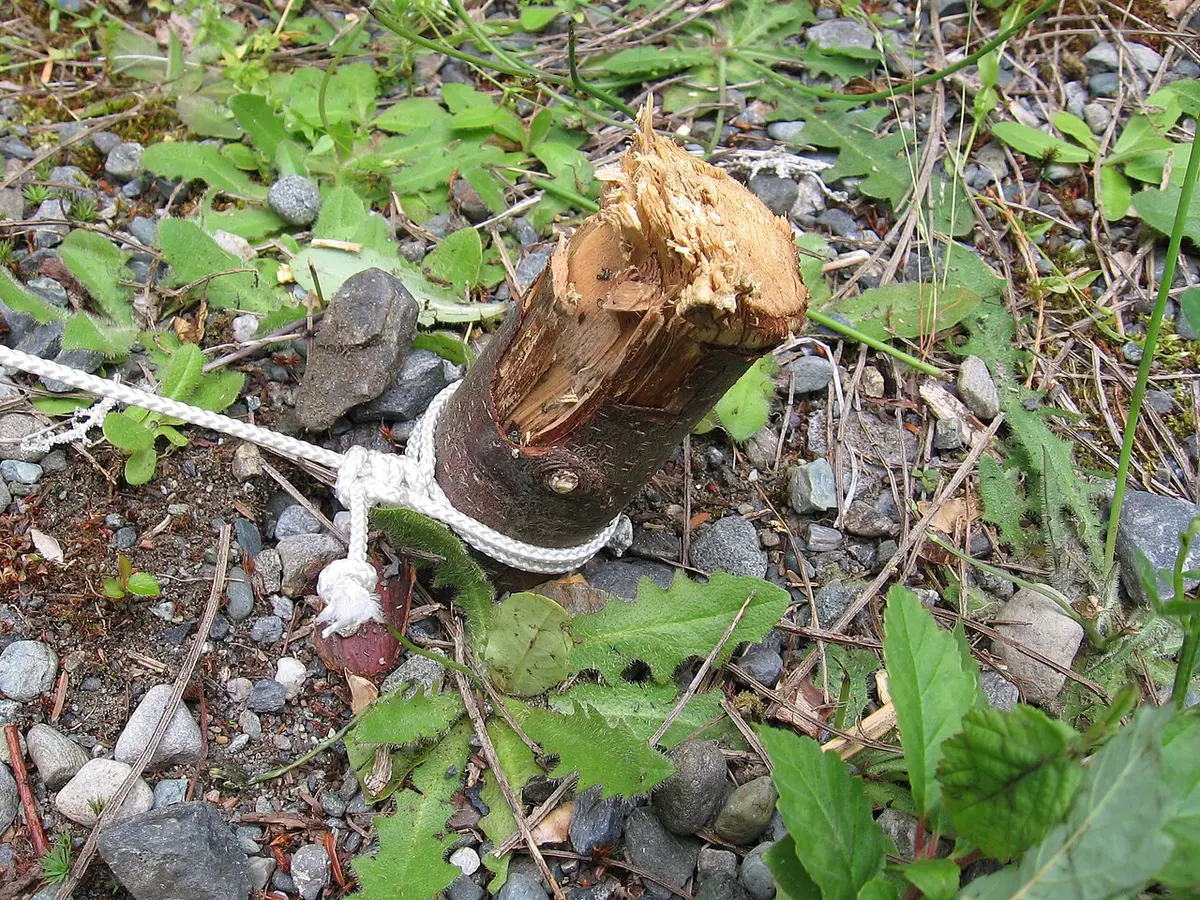
Rocky or hard-packed ground. Plastic and thin aluminum stakes bend or snap. Use thick steel stakes, around 8 to 10 inches, and a small mallet or a rock to drive them. Where stakes will not go in, use rocks to hold the guylines. Tie the line around a heavy rock or wrap it around a boulder, or lay a rock across a stake driven in at a shallow angle. Our shortlist of the best tent stakes for rocky ground focuses on stakes that survive hard strikes.
Sand. Sand has little cohesion, so short stakes slide out. Use long, wide stakes of 12 inches or more, or a corkscrew-style anchor that bites into the sand. The best approach is often a deadman: tie the line to a stake, a stick or a stuff sack filled with sand, bury it 8 to 12 inches deep and compact the sand over it. See the best tent stakes for sand list for designs that add surface area.
Snow. Standard stakes simply pull out of snow. Use deadman anchors: bury a stake, a ski pole, a stick or a bag of snow horizontally and stomp the snow over it, then let it set for a half hour so the snow sinters and hardens. Specialty snow stakes with a wide profile also work.
Wet, muddy or very soft soil. Mud holds poorly and gets worse as it saturates. Choose longer stakes of 10 to 12 inches and drive them deep. Check them at intervals and re-tension. If the ground is near saturation, move the tent to higher, firmer ground.
Length, material and weight
For most car camping, 8 to 10 inch steel stakes are the all-purpose choice. Steel is heavy but tough. Aluminum is lighter and rustproof, and fine for backpacking tents. Titanium stakes are very light and strong, though costly, and mostly used by ultralight hikers. Plastic stakes are the lightest and cheapest, and break in cold or rocky ground.
Weight matters for backpacking. A 7 inch aluminum Y stake weighs well under an ounce, so a set of six is a few ounces in total. Ultralight stakes of thin aluminum or titanium cut that further. Steel nails of 8 to 10 inches weigh several times more per stake, which is irrelevant in a car and noticeable in a pack. Look at the best ultralight tent stakes and best aluminum tent stakes lists if you carry your tent. For tough, long-term car camping, see the best heavy duty tent stakes.
How many stakes you need
A simple dome needs four corner stakes plus two to four more for the vestibule and guylines, so six to eight stakes minimum. Larger family tents use 10 to 20 stakes including guylines. In wind, double the guy points, since a tent anchored at every attachment point holds better than one with a few strong anchors.
Always carry spares. A bent or lost stake is routine, and two extra stakes weigh almost nothing. Count them when you pack and again when you break camp, because stakes disappear into grass.
Driving and removing stakes
Drive stakes at an angle away from the tent, about 45 degrees, with the hook or head facing the tent so the guyline loop can't slip off. Use a mallet or a rock, not your boot heel, which bends thin stakes. In hard ground, make a pilot hole with a rock or a larger nail first. Keep the stake straight; a stake driven crookedly weakens its hold.
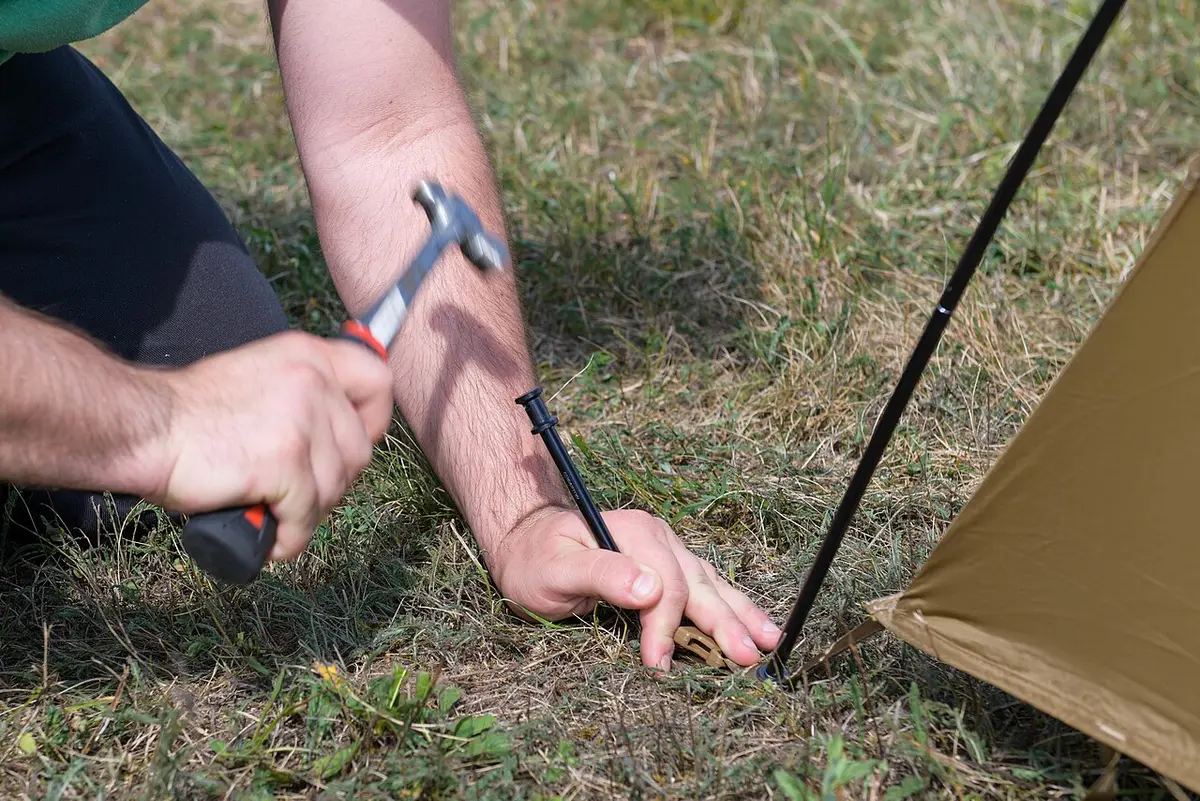
Removing stakes is easier if you pull straight up along the angle you drove. A stuck stake can be freed by tapping it sideways to loosen the soil, or by using a tool such as a stake puller or a second stake as a lever. Do not yank on the tent loop, because the fabric or cord will tear.
Guylines, tension and knots
A stake is only one half of an anchor. Guylines transfer the load from the tent to the stake, and poor tension or the wrong angle defeats a good stake. Run guylines out at about 45 degrees from the tent wall, and pull them firm but not so tight that the fabric distorts. Use a trucker's hitch or an adjustable slider to take up slack. Re-tension after the first hour, after rain and in the morning as temperatures change.
Knots matter. A taut-line hitch slides along the line to adjust tension and grips under load. A bowline makes a secure loop that does not slip. Reflective cord helps you see lines at night and avoid tripping. Check that lines are not rubbing against sharp rocks or poles, because they fray.
Wind and storm anchoring
In strong wind, anchor every guy point and use stakes appropriate to the ground. Place stakes farther out, a distance equal to roughly the height of the attachment point above the ground, to keep the angle low. Windward guylines carry the most load, so add extra stakes in a "double stake" configuration, with one stake tied to another behind it for more resistance. If the ground is poor, move the tent and use rocks and logs.
Orientation reduces load, too. Pitch with the narrow end into the wind and keep the tent low. For more on how shape affects wind, see how tents handle wind. Avoid pitching in a spot where stakes can pull a cord taut across a trail, which is a trip hazard.
A packing list for different trips
- Weekend car camping, mixed ground: 8 to 10 steel or aluminum stakes of 8 inches, a mallet and 4 spares.
- Backpacking, forest soil: 6 to 8 aluminum Y-stakes and 2 spares.
- Beach or desert: 6 to 8 long stakes or sand anchors of 12 inches, and a few stuff sacks for deadmen.
- Rocky alpine: 6 to 8 short steel stakes, 20 feet of spare cord for rock anchors.
- Winter camping: 6 to 8 snow stakes or deadman bags, a small shovel.
For help with the first setup, see how to set up a tent. To cover long stakes for loose ground, check the best extra long tent stakes, and for general picks, the best tent stakes.
Three ground types, three worked setups
Campground gravel pad. Many established sites have a compacted gravel or crushed-rock pad where a thin stake simply bounces off. The fix is a stout steel stake, a rubber mallet or a hammer, and patience. Place the stake where the gravel is thinner, at the edge of the pad, and angle it slightly more upright than usual. If a corner will not take a stake at all, run a short length of cord from the tent loop to a stake driven into the softer soil beside the pad, or loop it around a nearby tree trunk with a protective wrap so the bark is not damaged. Never use rocks from a protected area to anchor your tent, and put them back where they were.
Dry sandy beach or desert wash. Here you will fight friction. Start with the deadman: scoop a trench 8 to 12 inches deep, lay a stake, a driftwood stick or a stuff sack full of sand across the trench with the line tied to its middle, and backfill it. Pack the sand firmly by stamping. For each guy point, one buried anchor holds better than three short stakes. Add weight in the form of coolers or water jugs in the vestibule, and orient the tent so the narrowest end faces the wind. Expect to re-check anchors after the afternoon wind picks up.
Wet grass after rain. The turf looks soft but the soil beneath is often saturated and slick. Long stakes of 10 to 12 inches reach the firmer layer below, and ribbed or corkscrew designs grip the wet soil better than smooth nails. Drive the stake in as deep as it goes and check that the guyline loop sits low on the stake so the line does not slide up and lever it out. Re-tension after the first hour of rain, because the soil softens further as water works in.
Stake materials, coatings and corrosion
Material choices decide how long stakes last. Plain carbon steel is strong and cheap and rusts quickly unless it is galvanized or powder-coated. Galvanized steel, with a zinc coating, resists rust for years and is a good default for car camping. Stainless steel is more expensive and holds up near salt water. Aluminum does not rust but can corrode slightly and can bend or kink in hard ground. Titanium is the lightest of the strong options and resists corrosion entirely, with a price to match. Plastic stakes do not corrode, but UV exposure makes them brittle.
Coatings matter too. Anodized aluminum has a harder surface that resists scratches and often comes in bright colors, which makes stakes easier to find in grass. Reflective or neon tops help you see them in the dark and avoid tripping. If a stake loses its coating and starts to rust, a light coat of oil or a rub of wax slows the damage. Rust itself does not weaken a stake dramatically in a season, but it stains tent bags and fabric, so store steel stakes in their own pouch.
Buying a stake kit: what to look for
When you shop for a replacement set, look past the length and the material to the head design. A good stake has a notch, hook or hole at the top that captures a guyline loop without letting it ride up. A flat, flared or "cone" top gives a surface that you can hit with a mallet without mushrooming the metal. A ridged or grooved shaft grips soil better than a smooth round rod of the same diameter. Check the tip: a pointed, slightly chiseled end starts in hard ground more easily than a blunt one.
Think about the set, too. A well-assembled kit has two or three stake types matched to your usual sites rather than twenty identical ones. A common arrangement for a car camper is eight sturdy 9 inch steel stakes for the corners and main guylines, four 12 inch wide stakes for loose ground, and a small pouch with a few snow or sand anchors that stay in the trunk. It costs little, weighs a few pounds and covers nearly every campsite you will encounter. A backpacker's version is a bag of six light aluminum stakes plus two longer ones for the windward side, with a few meters of spare cord.
Finally, check the pouch. A bag with a stiff base and a drawstring keeps the points away from your gear and lets you count the stakes at a glance. If it did not come with one, a small canvas or nylon bag is a cheap addition that protects your tent and your hands.
Care and storage
Rinse mud off stakes and dry them to prevent rust. Straighten bent stakes with pliers if they are not too damaged, or replace them. Store them in a pouch with a drawstring so they do not poke through tent bags. Sharp stake tips can puncture bladders and fabric, so keep them separate. For routines on cleaning, see how to clean a tent without damaging it.
Related reading
Stake count and length also depend on how big the tent is, and what tent person capacity really means helps you judge the footprint and guy points you will be anchoring. Once the tent is up and secured, how to waterproof a tent covers sealing the seams so the effort you put into a good pitch is not undone by a leak.
Common mistakes to avoid
- Relying on the stakes that came with the tent in every kind of ground.
- Driving stakes straight down instead of at an angle away from the tent.
- Using short stakes in sand and soft mud.
- Forgetting to re-tension guylines after rain.
- Pulling on the tent loop to remove a stuck stake.
- Leaving stakes loose in the tent bag where they can puncture fabric.
- Ignoring windward guylines, which carry the largest load.
Frequently asked questions
What are the best tent stakes for hard ground?
Short, thick steel stakes of 8 to 10 inches survive hard strikes and resist bending. Use a mallet or a rock, and make a pilot hole if needed. When the ground is too hard, use rocks to hold the guylines instead of forcing the stakes in.
How do I stake a tent in sand?
Use long, wide stakes of 12 inches or more, or corkscrew anchors, and bury deadman anchors for the corners. Tie the guyline to a stake or a bag of sand buried 8 to 12 inches deep, then pack sand over it. Check the lines through the day.
Are aluminum stakes strong enough?
For most soils, yes. Y-beam and V-beam aluminum stakes hold well and are light. They bend in very hard or rocky ground, where steel is a better choice. Choose thicker aluminum for car camping and thinner for backpacking.
How many stakes do I need?
Six to eight for a typical dome, ten or more for a large family tent. In wind, use every guy point. Always carry two or three spares, since stakes bend or disappear.
Can I use rocks instead of stakes?
Yes. Tie the guyline around a heavy rock or wedge a stake behind a rock. Large rocks work on rocky ground and on sand. Make sure the rock is heavy and stable, and check that it does not roll if the line pulls.
How do I stake a tent in snow?
Use deadman anchors: bury a stake, stick or bag of snow horizontally, stamp the snow down and wait 20 to 30 minutes for it to harden. Standard stakes pull out of snow. Specialty snow stakes with wide profiles also work.
Sources & further reading
Image credits
- "20th century aluminium tent stake by VEB Aluminium Praezisions Armaturen Guss APAG Potsdam Brandenburg East Germany" by R. Henrik Nilsson, CC BY 4.0, via Wikimedia Commons.
- "Wooden stake holding guy rope" by User:H, Public domain, via Wikimedia Commons.
- "31 FW conducts ACE training during Agile Wyvern 210907-F-ZR251-1155" by U.S. Air Force photo by Senior Airman Brooke Moeder, Public domain, via Wikimedia Commons.


Ready to buy?
Compare the gear: Tents & Shelter
6 Best Tent Stakes For Rocky Ground in 2026
Best tent stakes for rocky ground: forged steel, drill-in and long hammer-in options that resist bending where cheap pegs fold over.
6 Best Tent Stakes For Sand in 2026
Best tent stakes for sand and beach camping, compared on length, profile and material so your shelter stays put when loose ground gives way.
5 Best Tent Stakes in 2026
Best tent stakes compared by material, length and pack count: five hook-style options from 7-inch aluminum to 9-inch galvanized steel.
6 Best Ultralight Tent Stakes in 2026
Best ultralight tent stakes compared by weight, material and pull-loop design: six lightweight stakes for backpacking and bike camping.
6 Best Aluminum Tent Stakes in 2026
Best aluminum tent stakes compared: six lightweight peg sets, from 7-inch Y-beam stakes to 9-inch pegs and hollow 7075 tubes, for car and backpack camping.
4 Best Extra Long Tent Stakes in 2026
Best extra long tent stakes at 16 inches, forged steel, carbon steel and rebar, for campers anchoring tents in loose, sandy or windy ground.
6 Best Heavy Duty Tent Stakes in 2026
Best heavy duty tent stakes compared by steel type, diameter and length, for campers pinning down tents and canopies in wind and hard soil.
5 Best Long Tent Stakes in 2026
Best long tent stakes from 12 to 16 inches in steel, carbon steel, plastic and rebar, for campers who need more grip in loose or windy ground.
Keep reading