

We research everything we recommend. When you buy through our links, we may earn a commission. Learn more

Buying guide · 11 min read · Updated October 2, 2026

6 Best Budget Solar Powered RV TPMS in 2026: A Practical RV Guide

Six solar-assisted RV tire pressure monitors compared by sensor count, pressure range, alarm types and charging, so a tire warning arrives early.

Bowen HigginsBy Bowen HigginsRV Editor at RV Gear Lab6 products comparedSpec-sheet researched

At a glance

Our top picks

At a glance · 6 picks

A trailer tire does not announce a slow leak. By the time a bulge or a thump shows up in the mirror, the tire has usually run hot and flexed for miles. A tire pressure monitor puts that information on the dash, and the solar-assisted versions here trade a cable run for a small panel on the display that keeps its battery topped up in daylight.

The mistake that matters most on this shortlist is the pressure ceiling. Several models stop near 87 or 99 PSI, and a few go to 144 PSI for dually trucks and heavy trailers. A monitor that tops out below your tire's maximum cold pressure cannot display or alarm properly, so check the sidewall before you look at price.

We weighed six monitors by sensor count, range, alarm modes and charging. Here, the entry pick comes in as a pair of near-identical four-sensor sets, the mid-pack adds customizable thresholds and a wider range, and the most expensive pick supports six sensors and 144 PSI. Prices appear only as positions.

RV Gear Lab field notes

The Rig Fit Check

Start with the job
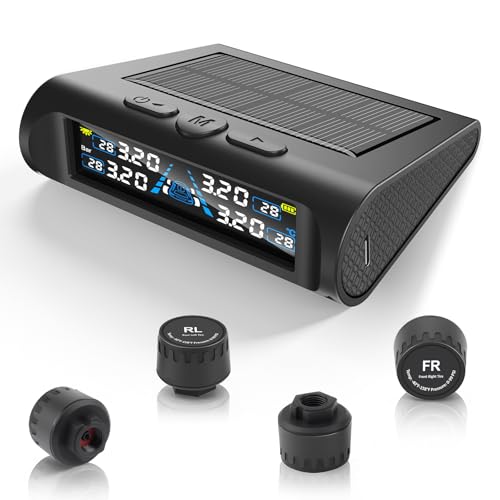
RV Tire Pressure Monitoring System, TPMS with 6 Sensors, 0-144 PSI, Solar/USB Charging leads this shortlist for Fifth wheels, dually trucks and heavy trailers that need six sensors and a high pressure range.. Use that fit as a reference point, then compare the alternatives against your own space and workload.
Specs that separate the picks
The first details to compare are Six sensors, 0 to 144 PSI, Four pre-paired sensors, Four sensors, 0 to 88 PSI. Confirm the exact model and included components before ordering.
Trade-off to plan for
Most expensive pick here

Before you buy

What Matters Before You Choose a Budget Solar Powered RV TPM

Key buying criteria so you get the right fit the first time.

  1. 01

    Pressure Range Against Your Tire

    A monitor can only report and alarm within its stated range, and one that tops out at 87 PSI is useless for a tire cold-inflated above that. Many heavy-duty trailer and dually tires run higher pressures than passenger tires. Read the maximum cold pressure on the sidewall and pick a range that clears it. Find the range in the title or spec line and treat a missing range as a risk.

  2. 02

    How Many Sensors You Need

    A single-axle trailer uses two sensors and a tandem or fifth wheel uses four, while a dually truck plus a trailer can use six or more. Buying fewer sensors than tires leaves a blind spot on the tire most likely to fail. Count every tire you want covered, spares excluded. Check the number of sensors in the kit title.

  3. 03

    Fast Leak Versus Slow Leak Alarms

    A fast leak means a blowout or a puncture, and a slow leak means a nail or a bad valve that takes hours to show. Without a slow-leak alarm, a tire can drift low and hot before a low-pressure alarm trips. A rapid-loss alert is the one that gives you seconds to react. Read the alarm list for both leak types by name.

  4. 04

    Solar Charging Reality

    A small solar panel on the display tops up the monitor on daytime drives, and USB-C is the backup for cloudy weeks. If the monitor is in a dark cab all day, solar adds little. Sensors use their own coin cells, and replacements cost little. Confirm how the display charges and what the sensor batteries are.

  5. 05

    Sensor Waterproofing and Mounting

    External sensors thread onto the valve stem, so they see rain, road spray and car washes. An IPX7 rating means brief immersion is survivable. Tool-free installation avoids tire removal. Read the sensor rating itself, not the monitor rating.

  6. 06

    Adjustable Thresholds

    Preset alerts may suit a passenger car but misfire on a loaded trailer whose correct pressure is different. Adjustable low and high thresholds let you tune the alarm to the load. Without them, an alert can trigger too early or too late. Look for customizable thresholds or adjustable PSI in the feature list.

Our standards

Why You Can Trust RV Gear Lab

At RV Gear Lab, we compare products based on rig fit and power or hookup compatibility, verified specifications, usability, setup requirements, weight, durability, and real-world trade-offs. We do not rank products purely on marketing claims or commission rates.

We have not personally tested every product listed. Where hands-on testing is not available, recommendations are based on verified manufacturer specifications, product documentation, use-case fit, and comparative research.

How we review RV gear →

Detailed reviews

The 6 best budget solar powered rv tpms, explained

01
Best for: Fifth wheels, dually trucks and heavy trailers that need six sensors and a high pressure range.

Our take

Setup takes three simple steps, with hex-nut-style sensors that thread onto the valve stems.

Why it made the shortlist

Six sensors and a 0 to 144 PSI range with 1.5 PSI accuracy cover a dually truck and a heavy tandem trailer in one system.

Six alarm types and customizable thresholds are included.

Over the four-sensor sets, the step up buys two more sensors and a pressure ceiling far above the 87 to 99 PSI of the others, which suits trucks and heavy trailers with high-pressure tires.

Solar and USB-C charging keep the monitor powered for continuous use.

An auto-dimming color LCD shows readings in sunlight and at night.

What works

  • Handles six tires on duallies
  • Range reaches 144 PSI
  • Six alarm types and thresholds
  • Auto-dimming color display

Watch out for

  • Most expensive pick here
  • More sensors to remove for storage
The catch
As ranked it is the most expensive pick here, and it is the only one that handles six tires.
02
Best for: Travel trailer and fifth wheel owners who want adjustable alert thresholds on four tires.

Our take

Owners of single-axle and tandem trailers with mid-pressure tires get a customizable system without paying for six sensors.

Why it made the shortlist

Four labeled external sensors arrive pre-paired, and alert thresholds adjust from 0 to 99 PSI to match your tire spec and load. As for price, this model sits in the upper third on price.

A bright digital color display shows pressure and temperature live while you drive.

Alongside the 4-Sensor 87 PSI set, the step up buys a higher range ceiling, pre-paired sensors and six audible and visual alarms covering high pressure, low pressure, high temperature, rapid leak, low sensor battery and lost signal.

A built-in solar panel keeps the monitor's battery up during daytime drives.

USB-C charging serves as backup in cloudy weather, and installation is simple.

What works

  • Pre-paired sensors, no setup puzzle
  • Adjustable thresholds suit your tires
  • Six useful alarm types
  • Solar plus USB-C backup

Watch out for

  • Ninety-nine PSI will not fit heavy duallies
03
Best for: Truck and SUV towing owners who want quick, tool-free sensors with customizable alerts.

Our take

Trailers with moderate-pressure tires get the full alarm set at a middle position on price.

Why it made the shortlist

External sensors thread onto the valve stems without removing a tire, so the five-step setup is done in about two minutes. The system offers 24/7 monitoring with two PSI and three degree Fahrenheit sensitivity. Judged on price, it sits mid-pack on price.

Above the 4-Sensor 99 PSI, the step down in range from 99 to 88 PSI trades coverage for a lower price, while keeping solar and USB-C dual charging with smart power management.

The listing states fit for RVs, trucks, SUVs and sedans.

A color LCD shows each tire at once.

What works

  • Quick two minute external install
  • Customizable alert thresholds
  • Full six-alarm suite
  • Works on trucks and SUVs too

Watch out for

  • Range stops at 88 PSI
  • Not suited to heavy trailer tires
04
Best for: Daily drivers who want fast and slow leak detection on a basic four-sensor kit.

Our take

Casual towers who value a quiet, automatic display find the setup practical.

Why it made the shortlist

Six alarm modes here include both fast and slow leak detection, low and high pressure and high temperature warnings. Sensors use a CR1632 coin cell and are described as low power. Ranked on price, this pick sits in the lower middle on price.

Automatic solar charging uses a durable lithium panel.

A step above the two cheapest sets, the extra spend buys explicit slow-leak warnings and automatic backlight adjustment with auto on and off modes.

Wide-range detection suits pressures below 88 PSI on cars, SUVs, pickups and light trailers.

What works

  • Slow leak warning on top of fast
  • Auto on and off display
  • Replaceable coin cells in sensors
  • Solar plus USB charging

Watch out for

  • Range stops below 88 PSI
  • Basic display styling
05
Solar Powered RV TPMS Tire Pressure Monitor 4 Sensors Auto Sleep RV Trailer
  • Four IPX7 sensors, 0 to 87 PSI
  • Auto-sleep, auto-dimming display
  • Solar and USB dual charging
Check price on Amazon for Solar Powered RV TPMS Tire Pressure Monitor 4 Sensors Auto Sleep RV Trailer (opens in a new tab)
Best for: Trailer owners who park outdoors and want IPX7 sensors with a switchable unit display.

Our take

Budget owners wanting a basic rig with water-resistant sensors will find the lowest cost entry here.

Why it made the shortlist

Four IPX7 waterproof sensors have a stated plus or minus 2 degrees Celsius and 0.1 bar accuracy, with switchable units. An auto-sleep feature and an auto-dimming color LCD show charging data too. Within this group it is the entry pick here, tied with the cheapest set.

The kit includes the monitor, sensors and accessories.

Mount quickly, drive briefly to activate each sensor, and data appears.

What works

  • IPX7 waterproof sensors
  • Auto-sleep saves the monitor battery
  • Units switch between PSI and bar

Watch out for

  • Thresholds not adjustable
  • Range stops at 87 PSI
The catch
Against the pricier sets, it keeps six alarms and dual solar and USB charging while dropping the extras such as adjustable thresholds.
06
Best for: Buyers comparing capacity, compatibility, included components and storage needs

Our take

Tire Pressure Monitoring System with Solar Charging, 4 Sensors, for RV SUV, Type-C makes the shortlist because precise three-digit readout.

Why it made the shortlist

A newly upgraded three-digit display shows pressure precisely, and a color LCD offers an improved interface flow. It is tied with the cheapest set on price at the entry of this shortlist.

Four external sensors are IPX7 waterproof with fast transmission.

Beside the Auto-Sleep TPMS, the pairing is nearly the same price, with a different strength: the higher-precision display and a smart alert set of six modes including rapid deflation and overheating.

USB and solar dual power keep the monitor charged.

A solar panel works in tandem with the battery for daytime top-ups.

What works

  • Precise three-digit readout
  • Rapid deflation alarm included
  • IPX7 waterproof sensors
  • Entry-level cost

Watch out for

  • Pressure range not clearly stated
  • Basic feature set

Methodology

How We Built This Shortlist

Each pick was assessed across 5 criteria weighted for real-world use.

01

Pressure range

We read the stated pressure range on every listing and compared it with the high-pressure tires common on trailers. A range that stops at 87 or 88 PSI fits many passenger-style tires but not heavy ones. Where a range was not stated, we noted that.

02

Sensor count

Four sensors suit a typical trailer or fifth wheel, and six suit dually trucks and tandem setups. We matched each kit to the rig it fits. A kit with spare capacity ranked better for heavy rigs.

03

Alarm quality

We compared the alarm lists, from high and low pressure to fast leak, slow leak, temperature, sensor battery and lost signal. Adjustable thresholds count as a quality feature. A system with fewer alarms ranked lower.

04

Power and display

Solar charging helps the monitor, though USB backup matters on cloudy days. We noted auto-dimming screens and sleep modes. Sensor waterproofing was compared where stated.

05

Position on price

We placed each pick relative to the group and asked what the step up buys, such as range, sensors or adjustable alerts. Picks without a reason for their position ranked lower.

Decision guide

Match a Budget Solar Powered RV TPM to Your RV

By Tire Pressure Range

Check the sidewall maximum, then match the range.

Your tiresBest pickWhy
Dually or heavy tandem, up to 144 PSI6-Sensor 144 PSISix sensors and the highest range
Mid-pressure up to 99 PSI4-Sensor 99 PSIAdjustable alerts on four tires
Moderate pressure under 88 PSI4-Sensor 88 PSITool-free install
Light trailer, under 88 PSI, leak focus4-Sensor Solar BasicFast and slow leak alarms
Light trailer, under 87 PSI, lowest costAuto-Sleep TPMSIPX7 sensors, auto-sleep

By Budget

Bands are relative to this shortlist.

BandPickWhat you get
Entry of this shortlistAuto-Sleep TPMSIPX7 sensors and six alarms
Entry of this shortlist3-Digit Display TPMSPrecise display, six alarms
Low-mid4-Sensor Solar BasicSlow-leak alarms
Mid4-Sensor 88 PSITool-free install and thresholds
Upper4-Sensor 99 PSIHigher range and pre-paired sensors
Top6-Sensor 144 PSISix sensors and 144 PSI

Four Sensors vs Six Sensors

The right count is the number of tires you want covered.

Four sensors

4-Sensor 99 PSI, 4-Sensor 88 PSI, 4-Sensor Solar Basic, Auto-Sleep TPMS and 3-Digit Display TPMS fit a tandem trailer or a fifth wheel.

Six sensors

6-Sensor 144 PSI covers a dually truck plus trailer axle and takes the highest-pressure tires.

For a standard travel trailer choose 4-Sensor 99 PSI, and for a heavy rig choose 6-Sensor 144 PSI.

By Alert Needs

Which alarms do you actually want?

NeedPickReason
Adjust alerts to your load4-Sensor 99 PSICustomizable up to 99 PSI
Slow-leak warning4-Sensor Solar BasicFast and slow leak detection
Rapid deflation focus3-Digit Display TPMSRapid deflation alarm and precise readout
Rain-exposed sensorsAuto-Sleep TPMSIPX7 waterproof sensors

For Full-Time Travel Specifically

Many miles and many tires reward range and alarms.

Look for

A range above your tires' maximum, full alarm coverage and a display that reads clearly in sun and at night.

In this comparison

6-Sensor 144 PSI suits heavy rigs, and 4-Sensor 99 PSI suits a typical fifth wheel.

When to Spend More

Spending up is justified by tires, not by features alone.

Spend more if

Your tires run above 99 PSI or you have six, so 6-Sensor 144 PSI is the only fit.

Save if

You tow a light trailer with low-pressure tires, where Auto-Sleep TPMS or 3-Digit Display TPMS covers the basics.

FAQ

Before You Bring One Home

Does a solar TPMS work without sun?

Yes, because the monitor also charges over USB-C and has its own battery. Solar tops it up on daytime drives. If the monitor sits in a shaded cab, plan to recharge it by USB occasionally. The sensors run on their own cells.

How do I choose the right pressure range?

Read the maximum cold pressure on your tire sidewall and pick a monitor that exceeds it. Several kits stop at 87, 88 or 99 PSI, while the 6-Sensor 144 PSI goes higher. A monitor under your tire's pressure cannot alarm properly.

Do I need six sensors for a travel trailer?

No. A tandem axle trailer uses four, and a single axle uses two. Six sensors are for a dually truck plus trailer or larger setups. Count the tires you want monitored.

Are external sensors safe to install myself?

Yes, they thread onto the valve stems and need no tire removal. The 4-Sensor 88 PSI lists a tool-free install in about two minutes. Check that each sensor is tight and that the monitor shows all tires after a short drive.

What is the difference between fast and slow leak alerts?

Fast leak alerts react to sudden pressure loss, such as a blowout. Slow leak alerts catch gradual loss from a nail or valve. The 4-Sensor Solar Basic lists both, and a rapid-loss alarm gives you seconds to react.

Will a budget TPMS replace checking tires by hand?

No. It warns you early, but you should still check cold pressure with a gauge before trips. A monitor shows live changes, not a substitute for inspection of tread and sidewalls. View it as an extra layer.

Bottom line

The short version

Browse more budget solar powered rv tpms on Amazon →
Bowen Higgins, RV Editor at RV Gear Lab

About the author

Bowen Higgins

RV Editor at RV Gear Lab

Bowen covers RV power, water systems, towing and leveling, upkeep and interior comfort, with a focus on matching gear to the rig, the hookups and the way you actually travel.

More from Bowen →Editorial standards

Keep reading

Related guides