

We research everything we recommend. When you buy through our links, we may earn a commission. Learn more

Buying guide · 11 min read · Updated October 2, 2026

6 Best Budget Dual Fuel Portable Generators for Camping in 2026: A Practical Camping Guide

Six budget dual fuel generators for camping, compared on propane output, fuel storage, runtime and outlets so you know what the cheaper tier gives up.

Danny WalkerBy Danny WalkerCamping Editor at RV Gear Lab6 products comparedSpec-sheet researched

At a glance

Our top picks

A dual fuel generator is really a storage decision disguised as a power decision. Gasoline goes stale in a tank and gums up a carburetor over a few idle months, while propane in a cylinder keeps for years, so a unit that burns both can sit in a garage between trips and still start on the first pull, with no fuel treatment routine to remember. That convenience is what a budget buyer is paying for, and it is why this shortlist leans on how each model handles propane rather than on raw wattage alone, and it states plainly where the cheaper tier stops.

All six accept a standard propane cylinder as well as a gas can, and the rated output falls when you switch to propane. The gap is the number to learn, because a model rated at 3500 watts on gasoline may deliver 3150 on propane, and that difference can decide whether a rooftop air conditioner keeps running on a hot afternoon. The shortlist spans entry conventional hardware up to compact inverter units that add clean power, tidy outlet panels and automatic fuel switching, so you can see the step each rung adds.

Staying near the lower end of the dual fuel market means accepting some omissions: no electric start on most listings, smaller tanks on the inverter builds, and wattage labels that run ahead of what a 30 amp RV cord can use. Listings and specs were compared rather than run on a bench, so the guide focuses on what each product states about its output on both fuels, its outlets, its safety shutdowns and its runtime, and on which camper each one fits, from a weekend tent trip to a 30 amp trailer.

RV Gear Lab field notes

The Campsite Fit Check

Start with the job
ERAYAK 4500W Dual-Fuel Portable Inverter Generator leads this shortlist for Campers who want the most propane output and automatic fuel switching in one compact unit.. Use that fit as a reference point, then compare the alternatives against your own space and workload.
Specs that separate the picks
The first details to compare are 3500 W rated gas, 3150 W propane, 2200 W gas, 1980 W propane running, 2900 W gas, 2600 W propane running. Confirm the exact model and included components before ordering.
Trade-off to plan for
Too small for a rooftop air conditioner

Before you buy

What Matters Before You Choose a Budget Dual Fuel Portable Generator for Camping

Key buying criteria so you get the right fit the first time.

  1. 01

    Rated Watts on Propane

    Propane produces less power than gasoline in the same engine, so every dual fuel generator has two ratings. A unit rated at 3500 watts on gasoline may be rated at 3150 on propane, which is a loss of about 10 percent. That loss matters when a rooftop air conditioner or microwave sits near the limit of what the generator can carry. Find the propane running watts in the listing title or bullets rather than a single headline number, and size your loads against the lower figure.

  2. 02

    Fuel Storage and Carburetor Care

    The reason most campers buy dual fuel is that propane keeps for years in a sealed cylinder while gasoline degrades in a tank in months. Stale fuel leaves varnish in the carburetor, and a generator that will not start on the first trip of the season is a common complaint. Running the tank dry on propane before storage keeps the bowl empty. A fuel shut-off valve, which some listings mention, lets the engine burn the remaining carburetor fuel before it stops.

  3. 03

    Runtime and the Load It Was Quoted At

    Runtime claims are only meaningful when you know the load behind them. A figure quoted at 25 percent load flatters a unit compared with one quoted at 50 percent, because engine speed and fuel burn rise with demand. Compare run times only when the load matches, and look for the tank size in gallons as well. A propane runtime on a 20 pound cylinder, when a listing gives one, is the most useful number for a camper.

  4. 04

    Fuel Switching Method

    Some units need you to move a selector and reconnect a hose, while others switch automatically when the running fuel is exhausted. Automatic switching protects a refrigerator or a CPAP machine overnight, but it adds a component that can fail and needs both fuels connected. A manual switch is simpler and costs less. Words such as auto switch or gas priority in a listing tell you which behavior to expect.

  5. 05

    Outlets at the Campsite

    An RV power cord ends in a TT-30 plug, which fits a TT-30R receptacle directly. A twist-lock L5-30R needs a small adapter to accept that plug, which is cheap but easy to forget at home. An outlet labeled 30 amp is not proof the unit can start an air conditioner, because the outlet only describes the shape of the plug. Count the starting watts of your largest load before trusting the receptacle.

  6. 06

    Weight, Carry and Local Compliance

    Dual fuel inverter units here range from about 47 to 54 pounds, which is manageable for one person, while an open-frame unit with a large tank is heavier and awkward. Weight matters because you lift the unit in and out of a vehicle at every trip. Most listings state EPA compliance. Campers in California should also look for a CARB statement, because California compliance governs whether a unit can be sold or shipped there.

Our standards

Why You Can Trust RV Gear Lab

At RV Gear Lab, we compare products based on campsite fit, verified specifications, usability, setup requirements, weight, durability, and real-world trade-offs. We do not rank products purely on marketing claims or commission rates.

We have not personally tested every product listed. Where hands-on testing is not available, recommendations are based on verified manufacturer specifications, product documentation, use-case fit, and comparative research.

How we review camping gear →

Detailed reviews

The 6 best budget dual fuel portable generators for camping, explained

01
ERAYAK 4500W Dual-Fuel Portable Inverter Generator
  • 3500 W rated gas, 3150 W propane
  • 54 lb, 19.9 x 16.9 x 20.3 in
  • 58 dBA at 23 ft, quarter load
Check price on Amazon for ERAYAK 4500W Dual-Fuel Portable Inverter Generator (opens in a new tab)
Best for: Campers who want the most propane output and automatic fuel switching in one compact unit.

Our take

A 58 dBA reading at 23 feet at quarter load is quoted, a figure measured at light draw rather than full power, which is how most makers publish it.

Why it made the shortlist

Top numbers on this shortlist for both fuels belong to the ERAYAK 4500W. Gasoline output is stated at 4500 peak and 3500 rated watts, and propane at 4050 peak and 3150 rated watts, so even on the cleaner-storing fuel it still has headroom for a 30 amp trailer. A pure sine wave output with total harmonic distortion listed between 0.2 and 1.2 percent protects laptops and CPAP machines.

Where it separates itself from the WEN 3600W is the automatic fuel changeover, which keeps the generator running when one fuel supply ends instead of shutting the camp down at midnight. The weight sits at 54 pounds inside a footprint of roughly 20 by 17 by 20 inches, which is compact for 3500 running watts and easy to slide into a truck bed or an RV bay.

A built-in CO sensor and parallel readiness round out the package. Buyers who want one unit to handle a 30 amp RV, a tailgate and home backup should start here.

What works

  • Highest propane output on this list
  • Switches fuels automatically mid-run
  • Pure sine wave, low distortion
  • Built-in CO sensor and parallel ready
02
Best for: Weekend tent and small trailer campers running lights, a fridge and electronics.

Our take

Total harmonic distortion stays under 3 percent, so phones, TVs and computers are safe on the circuit.

Why it made the shortlist

The iGen2800DFc is the compact dual fuel option, rated at 2800 peak and 2200 running watts on gasoline and 2520 peak and 1980 running watts on propane. That is enough for lights, a refrigerator, a laptop and a coffee maker at once, which covers a typical weekend setup without hauling a bigger engine. Its TT-30R 30 amp outlet sits beside a 5-20R household duplex.

Measured against the ERAYAK 4500W, it gives up about 1300 rated watts on gasoline in exchange for a compact, quiet inverter design with an Eco Mode that matches engine speed to demand. The quoted runtime is up to 12 hours at 25 percent load, a lighter test point than the 50 percent figures some rivals use, so line it up against the 50 percent figures before comparing.

Two Westinghouse units can pair through compatible cables to reach full 30 amp output. Pop-up campers, teardrop owners and van dwellers who never run an air conditioner will find it a sensible fit, and it stores in a small bay.

What works

  • Propane output drops by just 220 watts
  • TT-30R plugs into a 30 amp cord
  • Eco Mode trims fuel use
  • Clean power under 3% distortion

Watch out for

  • Too small for a rooftop air conditioner
  • Needs a second unit for full 30 amps
03
WEN 3600-Watt Dual Fuel RV-Ready Portable Inverter Generator (DF360iX)
  • 2900 W gas, 2600 W propane running
  • TT-30R, two 120V, 12V DC, USB
  • Tool-free LPG quick connector
Check price on Amazon for WEN 3600-Watt Dual Fuel RV-Ready Portable Inverter Generator (DF360iX) (opens in a new tab)
Best for: RV owners who want a tool-free propane connector and a CO shutdown sensor.

Our take

The surge rating on propane stays within 100 watts of the gasoline figure, which keeps short motor starts manageable on a camp circuit.

Why it made the shortlist

The WEN DF360iX is rated at 3600 surge and 2900 running watts on gasoline and 3500 surge and 2600 running watts on propane. Its tool-free LPG quick connector lets you attach a cylinder hose by hand, which matters when you are swapping tanks at a dim campsite. A fuel shut-off and a Watchdog CO shutdown sensor sit alongside the engine.

Against the Westinghouse iGen2800, it adds about 700 rated watts on gasoline and keeps a dedicated TT-30R RV receptacle, so a 30 amp cord goes straight in. The outlet layout also brings two 120V receptacles, a 12V DC port and two 5V USB ports, which cover phone charging, a small fan and other DC gear without extra adapters or a separate charger.

Quiet operation is described as comparable to normal conversation, with no decibel number or measuring distance. A mid-size travel trailer owner after a safety shutdown and propane flexibility at a middle price will like it.

What works

  • Quick connector for propane hoses
  • CO Watchdog shutdown sensor included
  • Dedicated TT-30R RV receptacle
  • Fuel shut-off protects the carburetor

Watch out for

  • No decibel figure in the listing
  • Propane running watts drop by 300
04
PowerSmart 3800 Watt Dual Fuel Portable Inverter Generator
  • 3300 W gas, 3100 W propane running
  • Up to 24 hours on 20 lb propane
  • 59 dBA at 23 ft
Check price on Amazon for PowerSmart 3800 Watt Dual Fuel Portable Inverter Generator (opens in a new tab)
Best for: Long weekends where one propane cylinder should carry the whole trip.

Our take

The quoted noise level is as low as 59 dBA at 23 feet, a distance that makes it comparable with the quietest dual fuel models in this guide.

Why it made the shortlist

PowerSmart states 3800 starting and 3300 running watts on gasoline and 3500 starting and 3100 running watts on propane, the smallest propane penalty among the larger units here at just 200 running watts. The runtime claims are what stand out: up to 8 hours on its 1.3 gallon gas tank and up to 24 hours on a standard 20 pound propane cylinder.

Beside the Sperus 4000W, it adds a digital display, an L5-30R 30 amp outlet, two 5-20R duplex outlets, a 12V 8A port, two USB ports and parallel ports in a similar footprint. Built-in low-oil shutdown, overload protection and CO auto-shutdown are listed, and the unit is described as EPA certified and tested to ANSI/PGMA G300 and UL 2201.

Swapping a tank beats refilling a gas can for many campers, and this is the cleanest answer in the group, sitting lower-mid on price against the other inverters.

What works

  • Smallest propane power loss of the big units
  • 24 hour propane runtime quoted
  • UL 2201 and CO auto-shutdown listed
  • Digital display and parallel ports

Watch out for

  • Twist-lock 30 amp outlet needs an adapter
  • Gas tank is a compact 1.3 gallons
05
Best for: Campers who lift a generator in and out of a vehicle every trip.

Our take

Parallel capability lets a second unit join later when a trip needs more watts.

Why it made the shortlist

Sperus pairs a 145cc OHV engine with pure copper windings for 4000 peak and 3200 running watts on gasoline. The headline for loading is its 47.3 pound weight, which is a full seven pounds under the ERAYAK 4500W and light enough to carry up a campsite slope with one hand free. An Economy Mode adjusts engine speed to the load.

The noise rating is as low as 62 dBA at 50 percent load from 23 feet, a more demanding test point than the quarter-load figures some rivals quote, so the number is honest about mid-load running. A 120V 20A household receptacle and an L5-30R share the panel, with built-in CO detection and automatic shutoff plus low-oil protection.

Beside the PowerSmart 3800W, the Sperus gives up the digital display and the long propane runtime claim in exchange for the lower weight and a lower price. Van campers, tailgaters and anyone who hauls the unit out of a trunk each trip will get along well with it.

What works

  • Lightest dual fuel inverter here
  • Noise quoted at half load
  • CO detection with automatic shutoff
  • Parallel capable for later growth

Watch out for

  • No digital display on the panel
06
Westinghouse 4650 Peak Watt Dual Fuel Portable Generator
  • 3600 W gas, 3240 W propane rated
  • 4 gallon tank, up to 14 hours
  • TT-30R, L5-30R and 5-20R outlets
Check price on Amazon for Westinghouse 4650 Peak Watt Dual Fuel Portable Generator (opens in a new tab)
Best for: Buyers comparing capacity, compatibility, included components and storage needs

Our take

Automatic low-oil shutdown and a CO shutdown are listed, along with EPA compliance and a three-year limited service, labor and parts warranty.

Why it made the shortlist

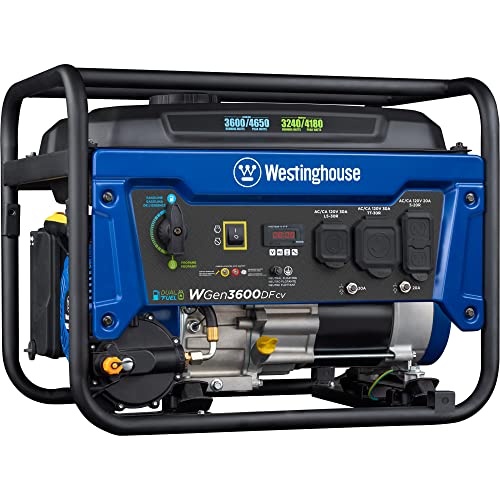
This Westinghouse is the entry point of the shortlist and the sole conventional portable listing in it, rated at 4650 peak watts with 3600 rated on gasoline and 3240 on propane. A 4 gallon tank with a fuel gauge delivers up to 14 hours per tank, the longest gasoline stretch in the group, and a 212cc four-stroke OHV engine with a cast iron sleeve drives it.

Versus the iGen2800, it brings 1400 more rated watts on gasoline for a lower price, plus a TT-30R, an L5-30R and a 5-20R duplex, all with rubber covers. Oil, a funnel, a tool kit and a manual come in the box, so the unit is ready to fill and start out of the carton without a trip to the store.

Think of it as the answer for a camper who runs a 30 amp trailer on a tight budget, wants the largest tank in the group and is happy with a conventional engine that favors raw output over refined waveform.

What works

  • Biggest tank and longest gas run
  • Both 30 amp outlet types included
  • CO and low-oil shutdowns listed

Watch out for

  • Not sold as an inverter, so noisier
  • Bulkier than the inverter picks

Methodology

How We Built This Shortlist

Each pick was assessed across 5 criteria weighted for real-world use.

01

Output on both fuels

Each model was compared on rated and peak watts for gasoline and for propane, since the propane figure is the one that limits a camper who stores the generator for months. Product specs from each listing gave the gap between fuels for every pick. A model with a small gap scored better than one with a larger gap at the same rating.

02

Runtime and tank size

Run times were read against the load they were quoted at, because a 25 percent load figure and a 50 percent load figure are not directly comparable. Tank capacity and any propane cylinder claim were weighed together. Picks that stated a clear propane runtime earned extra credit.

03

Safety shutdowns

We looked for carbon monoxide shutdown, low-oil shutdown and overload protection on each listing. Dual fuel units are often stored in garages and used beside tents, so the sensor matters more than on a gas-only unit. Certifications named in the listing, such as EPA and UL 2201, were noted.

04

Outlets and campsite fit

We compared which outlets each unit offers, especially the 30 amp receptacle type, USB ports and 12V DC. A TT-30R plugs straight into an RV cord while an L5-30R twist-lock needs an adapter. Weight and carry method were considered next.

05

Price position

Price was used to rank the shortlist and to describe what each step up buys, never to print a figure. We judged value by how much output, runtime and convenience a pick adds over the next cheaper one. Brand support and warranty terms were noted where the listing stated them.

Decision guide

Match a Budget Dual Fuel Portable Generator for Camping to Your Camp Setup

By How You Plan to Use Propane

Propane changes both output and runtime, so start with the job you want it to do on your trip.

Propane jobRecommended pickWhy
One cylinder for the whole weekendPowerSmart 3800WA 24 hour run on a 20 lb cylinder is quoted
Quick hose swaps at a dark campsiteWEN 3600WA tool-free LPG quick connector attaches by hand
Smallest power drop on propaneWestinghouse iGen2800Rated output falls by only 220 watts
Automatic changeover between fuelsERAYAK 4500WAuto switch keeps power on when a supply ends
Long gasoline run with propane as backupWestinghouse 4650A 4 gallon tank is quoted at up to 14 hours

By Budget

The shortlist is tightly grouped on cost, so each band shows what the next step adds.

Price bandRecommended pickWhat the step buys
Entry of this shortlistWestinghouse 4650The biggest tank and 3600 gas watts at the lowest cost
Lower mid of this shortlistSperus 4000WAn inverter build at 47.3 lb with CO shutoff
Mid of this shortlistPowerSmart 3800WA digital display and a 24 hour propane claim
Upper mid of this shortlistWEN 3600WA TT-30R outlet and a tool-free LPG connector
Top of this shortlistERAYAK 4500WThe highest propane watts plus automatic switching

Inverter vs Conventional Portable

Five picks are inverter designs and one is a conventional portable, which is the main structural split in this group.

Inverter designs

ERAYAK 4500W, Westinghouse iGen2800, WEN 3600W, PowerSmart 3800W and Sperus 4000W produce a clean waveform that is safe for laptops, and several quote under 3 percent distortion. Eco modes slow the engine at light load, which saves fuel and lowers noise.

Conventional portable

Westinghouse 4650 is listed as a dual fuel portable generator rather than an inverter, with a larger 212cc engine and a 4 gallon tank. It delivers more rated watts per unit of cost and a longer run per fill, at the expense of the refinements inverter models add.

Pick an inverter such as the ERAYAK 4500W if you charge electronics, and the Westinghouse 4650 if raw watts and runtime matter most.

By Campsite Outlets

The outlet panel decides whether your RV cord plugs in directly or needs an adapter.

Outlet needRecommended pickWhy
Plug a 30 amp RV cord straight inWEN 3600WA dedicated TT-30R RV receptacle is listed
Both 30 amp receptacle typesWestinghouse 4650TT-30R and L5-30R sit on the same panel
30 amp RV outlet on a compact unitWestinghouse iGen2800TT-30R sits beside a 5-20R household duplex
Twist-lock 30 amp with USB and 12VPowerSmart 3800WL5-30R, two USB ports and 12V 8A are listed
Light unit with household and 30 amp outletsSperus 4000WA 120V 20A outlet and an L5-30R at 47.3 lb

For Cold or Idle-Season Storage Specifically

If the generator sits unused for months, the way it handles fuel is the deciding factor.

Look for

A propane connection that is quick to attach, as on the WEN 3600W, a fuel shut-off that empties the carburetor, and a cylinder runtime you can plan around. These features let you store the unit with a dry bowl and start it on propane after months away.

In this comparison

WEN 3600W pairs a tool-free LPG connector with a fuel shut-off, and PowerSmart 3800W states 24 hours on a 20 lb cylinder. ERAYAK 4500W adds automatic switching for the day a supply runs out unexpectedly.

When to Spend More

A step up in price buys output, safety features and convenience, so decide which of those you actually use.

Spend more if

You run a 30 amp trailer with an air conditioner and want the headroom of ERAYAK 4500W, or you want WEN 3600W for its quick LPG connector and CO Watchdog. Both give a direct 30 amp path and stronger propane output.

Save if

You camp a few weekends a year with modest loads. Westinghouse 4650 gives the most watts and tank for the lowest cost, and Sperus 4000W is the lightest inverter way in.

FAQ

Before You Bring One Home

How much power do I lose running on propane?

All six picks are rated lower on propane than on gasoline. Take the ERAYAK 4500W, which drops from 3500 to 3150 running watts, the WEN 3600W from 2900 to 2600, and the PowerSmart 3800W from 3300 to 3100. Size your loads against the propane figure if propane is your main fuel. A model with a small gap leaves more usable headroom.

Can a dual fuel generator start my rooftop air conditioner?

It depends on the starting watts of your air conditioner, which is printed on its nameplate and varies widely between units. A soft start device lowers that surge a good deal. The 30 amp receptacle on the generator only describes the plug, not whether the engine can start the compressor. Add the A/C starting watts to your other running loads, and compare that total with the propane peak rating.

How long will a 20 pound propane cylinder last?

Only the PowerSmart 3800W states a figure, up to 24 hours on a standard 20 pound cylinder, and the listing does not give the load. Runtime falls as load rises, so a heavy load will shorten the run well below a light-load claim. Plan around a half-day to a day of light use and carry a spare cylinder for longer trips.

Is dual fuel worth it over a gas-only generator?

It earns its place if the generator sits idle for months or you want a fallback when gas is hard to find. Propane keeps in a cylinder for years and burns cleaner inside the carburetor. If you run the unit weekly and refill from a gas can, a gas-only inverter delivers more watts per unit of cost and avoids the output drop.

Can I add a second unit later for more power?

Several picks support it. ERAYAK 4500W and Sperus 4000W are listed as parallel ready or capable, the PowerSmart 3800W has parallel ports, and the Westinghouse iGen2800 pairs with a compatible Westinghouse unit using Westinghouse parallel cables. You need a matched second generator and the parallel kit, so budget for both before counting on the extra capacity.

What should I do before storing a dual fuel generator?

Close the propane cylinder valve, let the engine burn out the fuel in the carburetor, and store the unit dry and upright. A model with a fuel shut-off such as the WEN 3600W makes the last step automatic. If gasoline stays in the tank, add stabilizer, or drain it, because stale gasoline is the usual reason a stored generator will not start.

Bottom line

The short version

Browse more budget dual fuel portable generators for camping on Amazon →
Danny Walker, Camping Editor at RV Gear Lab

About the author

Danny Walker

Camping Editor at RV Gear Lab

Danny covers camping gear, campsite setup, outdoor power, sleep systems and practical camping advice, with a focus on helping campers make better gear decisions.

More from Danny →Editorial standards

Keep reading

Related guides