

We research everything we recommend. When you buy through our links, we may earn a commission. Learn more

Buying guide · 11 min read · Updated October 2, 2026

6 Best Budget Lithium Deep Cycle Batteries in 2026: A Practical Camping Guide

Six budget 12V 100Ah LiFePO4 deep cycle batteries compared on group size, BMS rating and cold-weather charging for RV and camp power banks.

Danny WalkerBy Danny WalkerCamping Editor at RV Gear Lab6 products comparedSpec-sheet researched

At a glance

Our top picks

At a glance · 6 picks

A 100Ah lithium battery and a 100Ah AGM battery share a label and very little else. Lead-acid is usually treated as about half usable before damage builds up, while LiFePO4 hands over most of its rating, so one lithium unit often replaces two AGM batteries that weigh several times as much. That usable-capacity gap is the reason budget lithium has taken over the deep cycle shelf.

Every pick here is a 12V, 100Ah, 1280Wh LiFePO4 drop-in, and the six sit within a narrow price spread. That tight spread is the point of this shortlist: the choice comes down to the box it fits, the BMS amperage printed in the listing, the cold-weather behavior and the cycle claim, not to a large jump in capability.

The budget case is easiest to make per year of use. A drop-in lithium battery costs more up front than lead-acid, yet it carries a cycle claim in the thousands, takes a charge faster and leaves the roof of a camper or the floor of a tent trailer carrying far less weight. Below, the group size and the cold-charge details do the sorting.

RV Gear Lab field notes

The Campsite Fit Check

Start with the job
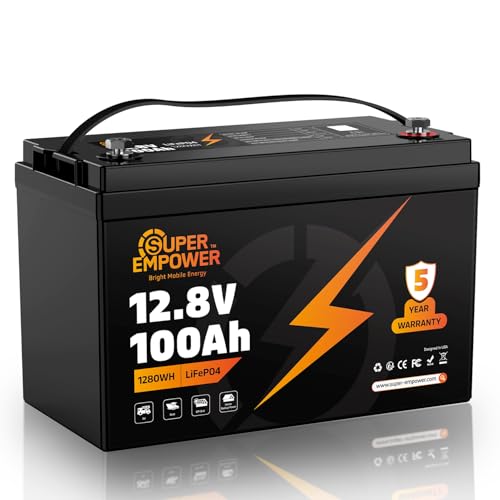
SUPER EMPOWER 12V 100Ah LiFePO4 Battery, Group 24 Deep Cycle for RVs & Trolling Motors leads this shortlist for Campers whose battery box is sized for a Group 24 and who camp in cool weather.. Use that fit as a reference point, then compare the alternatives against your own space and workload.
Specs that separate the picks
The first details to compare are Group 24, 21.6 lbs, Group 31, 13.18 inch wide, Group 24, 20.3 lbs. Confirm the exact model and included components before ordering.
Trade-off to plan for
Most expensive pick in this guide

Before you buy

What Matters Before You Choose a Budget Lithium Deep Cycle Battery

Key buying criteria so you get the right fit the first time.

  1. 01

    Usable capacity, not the nameplate

    A battery's amp-hour rating is its total storage, and how much of it you can use depends on chemistry. Lead-acid and AGM are normally treated as about 50 percent usable, while LiFePO4 delivers roughly 80 to 100 percent. That means a single 100Ah lithium battery does the work of two AGM batteries, so compare these picks to the bank you are replacing in usable amp-hours. Check the listing for the watt-hour figure, here 1280Wh, and ignore any comparison that matches nameplate to nameplate.

  2. 02

    Group size and the tray it needs

    BCI group size (24, 27, 31) describes the physical box, not the capacity, so two batteries of the same Ah can differ by inches. Moving up a group often means replacing the battery tray or box, not just the battery. Read the length, width and height in the listing and measure the tray with a tape. The Group 24 and Group 31 picks in this guide are not interchangeable in a tight compartment.

  3. 03

    Low-temperature charge cutoff

    Discharging lithium in the cold is usually fine, but charging a LiFePO4 cell below freezing can damage it permanently unless the pack stops itself. A BMS with a low-temperature cutoff, or a self-heating pack, solves that. Search the title and bullets for the exact words. A listing that does not mention the cutoff should be read as not having one, which matters for a winter trailer or an unheated storage shed.

  4. 04

    BMS amperage and what it protects

    The battery management system is the board that disconnects the cells when the current, voltage or temperature goes out of range. A 100A BMS suits a typical camper bank, while a 120A board leaves more headroom for a larger inverter surge. The listing should name overcharge, over-discharge, short circuit and overheating protection. Match the BMS rating to the largest load you plan to draw.

  5. 05

    Cycle claims and depth of discharge

    A cycle number is only meaningful with a depth of discharge attached, since a pack cycled to 60 percent lasts far longer than one run to empty. Treat a figure like 15,000 cycles as a seller claim at shallow depth. Prefer a listing that breaks the claim down by depth, and plan your own use around the 80 percent figure rather than the biggest number.

  6. 06

    Charging sources and expansion

    A drop-in lithium battery still needs a charge source set to a LiFePO4 profile, typically 14.4 to 14.6V. Converters, solar controllers and generators each have their own setting. Confirm that the source supports lithium, and check whether the battery supports series or parallel links if you plan to grow the bank later. A listing that states 4S or 4P limits is a good sign.

Our standards

Why You Can Trust RV Gear Lab

At RV Gear Lab, we compare products based on campsite fit, verified specifications, usability, setup requirements, weight, durability, and real-world trade-offs. We do not rank products purely on marketing claims or commission rates.

We have not personally tested every product listed. Where hands-on testing is not available, recommendations are based on verified manufacturer specifications, product documentation, use-case fit, and comparative research.

How we review camping gear →

Detailed reviews

The 6 best budget lithium deep cycle batteries, explained

01
Best for: Campers whose battery box is sized for a Group 24 and who camp in cool weather.

Our take

Well suited to shoulder-season campers who want the cold-charge rules written down before they buy.

Why it made the shortlist

What you get is the pick built around the Group 24 footprint, listed at 6.49 by 10.24 by 8.98 inches and 21.6 lbs with M8 terminals. Owners with a compact tray in a pop-up, teardrop or van can drop it in without cutting or rebuilding the box, which is the whole appeal of a Group 24 lithium.

Set against the Group 31 Empower, it gives up a little shelf room in the box and keeps the same 100A BMS and 1280Wh rating, so the group size is the real choice between the two. The listing spells out the low-temperature behavior: charging pauses below 32F, discharge stops near minus 4F, and normal operation resumes above 41F.

What works

  • Fits standard Group 24 battery trays
  • Cold charge behavior is spelled out
  • Expandable to a larger bank
  • Light enough to lift by hand

Watch out for

  • Most expensive pick in this guide
  • Smaller case than the Group 31 options
The catch
Its price puts it at the top of this shortlist on price, and the step up buys that cold-weather detail plus the smaller case.
02
Best for: RV owners replacing a Group 31 AGM who want a smart BMS and a stated low-temp cutoff.

Our take

It lands just under the Group 24 Empower on price, so the larger case costs nothing extra.

Why it made the shortlist

A true Group 31 drop-in, listed at 6.77 by 13.18 by 9.05 inches with M8 terminals, this one slides into the long tray that a Group 31 AGM leaves behind. The title promises a low-temperature cutoff, which is the spec that protects LiFePO4 cells from being charged in freezing weather.

Where the Group 24 Empower suits a tight box, this version fills the larger tray and adds a 100A smart BMS that handles charging, discharging, cell balancing and temperature protection. The cells are described as Grade A+, and the same 14.4 to 14.6V charging window applies to a converter, a solar controller or an alternator charger.

Ideal for a travel trailer or fifth wheel that already has a Group 31 slot and wants a like-for-like lithium swap.

What works

  • Stated low-temperature cutoff
  • Smart BMS with cell balancing
  • True Group 31 dimensions
  • Expansion up to 4P4S

Watch out for

  • Wider case needs a Group 31 tray
  • Cycle count is not given in the listing
03
Best for: Boat, trolling motor and camper users who want a bigger BMS and a weather-sealed case.

Our take

It falls in the middle of the group, it gives the most protection hardware for the money.

Why it made the shortlist

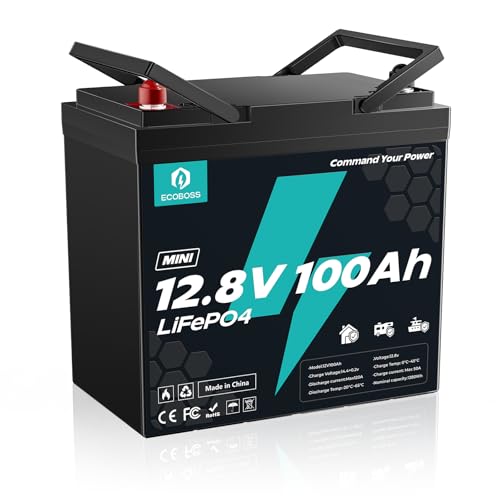
The ECOBOSS lists a 120A BMS, the highest amperage among these six, and pairs it with a 20.3 lb Group 24 body that is the lightest in the guide. A higher BMS rating means the battery can feed a larger inverter or a winch-style load before the protection board steps in.

Against the Empower G24 it adds an IP65 water-resistance rating and a 15,000-plus cycle claim, which suits wet compartments and boat lockers. A built-in cold protection feature disables charging when the pack is too cold, and the listing describes 4S4P expansion toward a 51.2V, 20.48kWh bank.

The natural buyer runs a camp kitchen, a small inverter or a trolling motor and wants spray resistance on the battery itself.

What works

  • Highest BMS amperage in this shortlist
  • Lightest case of the six
  • Cold protection stops charging when frozen

Watch out for

  • Group 24 only, no Group 31 version here
  • Long cycle claim is a seller figure
04
Best for: Indoor-mounted RV banks where the battery lives in a heated, dry compartment.

Our take

Price lands mid-pack, a small step up from the Vemdia units.

Why it made the shortlist

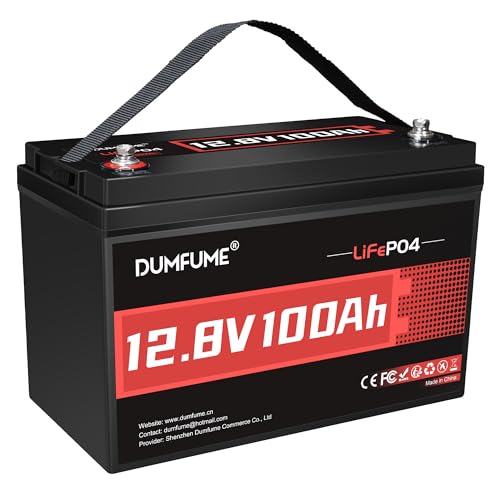
A Group 31 lithium at 21.6 lbs, the listing compares it with a 63.9 lb AGM of the same rating, which shows how much weight leaves the rig on a swap. The 100A BMS guards against overcharge, over-discharge, short circuits, overheating and overcurrent, and the claimed 1.28kWh sits in the same class as every other pick here.

Compared to the Vemdia Standard below it, the Dumfume lists the same 100A BMS and carries the same 15,000-plus cycle claim, and the two are close on specification. What separates them is the ABS casing, described as dustproof and weather resistant, and the lower weight on the scale.

A sensible choice for a bank installed inside a basement bay or under a dinette seat, where dust matters more than spray.

What works

  • Lighter than the other Group 31 picks
  • Full set of BMS protections listed
  • Dust and weather resistant case
  • Drop-in for lead-acid wiring

Watch out for

  • No low-temperature charge cutoff stated
  • Case is not waterproof
05
Best for: Buyers who want the cycle claim broken down by depth of discharge.

Our take

It is a small step down in price from the Dumfume and sits near the entry of this shortlist.

Why it made the shortlist

The listing here does something most budget lithium pages skip: it ties cycle life to depth of discharge. Roughly 6,000 cycles are claimed at 100 percent, 8,000 at 80 percent and 15,000 at 60 percent, which helps a buyer judge how much the bank will last under the way they actually use it.

At 12.9 by 6.69 by 8.5 inches and 24 lbs it matches a Group 31 box, and it carries the same 100A BMS and 1280Wh as the Dumfume above it. Series and parallel wiring is supported up to 4S or 4P, for a ceiling of 400Ah or a 51.2V bank.

A fit for an owner who plans to cycle the battery daily and wants a realistic figure to plan around.

What works

  • Cycle claim given by discharge depth
  • Fits Group 31 boxes
  • Up to 4S or 4P expansion

Watch out for

  • No low-temperature cutoff stated
  • Slightly heavier case than Dumfume G31
06
Best for: Buyers comparing capacity, compatibility, included components and storage needs

Our take

Price lands well below either Empower and gives the least expensive route to a battery that protects itself in the cold.

Why it made the shortlist

This one is the entry pick, and it still carries low-temperature protection in the title and a 100A smart BMS. Discharge is listed from minus 4F to 140F, and the 24 lb case is described as 70 percent lighter than a comparable lead-acid battery.

Beside the Vemdia Standard it is the version to buy for cold weather, because the cutoff is written into the listing. Charging with a 14.6V, 20A LiFePO4 charger is described as taking about five hours, and the 8,000 cycles at 80 percent depth claim keeps pace with its sibling.

What works

  • Low-temp protection is stated
  • Stated five-hour charge on a 20A charger

Watch out for

  • Heavier than the Dumfume G31

Methodology

How We Built This Shortlist

Each pick was assessed across 5 criteria weighted for real-world use.

01

Chemistry and rating match

We compared each listing against the title promise: a 12V, 100Ah LiFePO4 drop-in with deep cycle intent. Starter batteries and lithium-ion cells with no BMS were set aside. The six picks all state 1280Wh, so differences came from the rest of the spec sheet.

02

Group size and box fit

Group 24 and Group 31 are box dimensions, not capacity, so we noted which pick fits which tray and listed the stated inches. A battery that needs a new tray adds cost the sticker price hides. The Group 24 picks and the Group 31 picks were judged on fit, not ranked against each other.

03

BMS and cold-charge behavior

We read the stated BMS amperage and what the board protects against, then looked for a written low-temperature cutoff. A listing that names the cutoff scored higher than one that is silent about it. Based on product specs, silence on cold charging is treated as a gap.

04

Cycle claims in context

Seller cycle figures vary widely and depend on discharge depth, so we weighted a claim that names its depth above a bare number. None of these figures is a measurement from us. They are listing claims, and we compared them as claims.

05

Price position and expansion

Price was judged as a position inside this shortlist and what each step buys, such as a bigger BMS or a stated cold cutoff. We also noted whether the battery supports series or parallel growth, since a bank that cannot expand limits an RV upgrade path.

Decision guide

Match a Budget Lithium Deep Cycle Battery to Your Camp Setup

By Battery Box Size

Start with the tray, because group size decides which picks are even candidates.

TrayRecommended pickWhy
Compact Group 24 boxEmpower G24Listed at 6.49 by 10.24 by 8.98 inches, a true Group 24 fit
Water-exposed Group 24 spaceECOBOSS MiniIP65 case and Group 24 size suit a damp locker
Long Group 31 RV trayEmpower G31Group 31 dimensions with a stated low-temp cutoff
Dry indoor Group 31 bayDumfume G31Dustproof ABS case at a lighter weight
Group 31 with the price firstVemdia SmartEntry price and low-temp protection in one unit

By Budget

The six picks sit close together, so the bands show what each step adds.

Price bandRecommended pickWhat the step buys
Entry of this shortlistVemdia SmartSmart BMS and low-temp protection at the lowest cost here
Lower mid of this shortlistVemdia StandardCycle claim broken out by discharge depth
Mid of this shortlistDumfume G31Lighter case and dustproof ABS housing
Upper mid of this shortlistECOBOSS MiniA 120A BMS and an IP65 rating
Top of this shortlistEmpower G24Written cold-charge rules in a compact Group 24 case

Cold-Weather Cutoff vs No Stated Cutoff

The fork that matters most for a four-season rig is whether the listing states cold-charge protection.

Stated cutoff

Empower G24, Empower G31, ECOBOSS Mini and Vemdia Smart each name a low-temperature behavior. The mechanism is a BMS that pauses charging near freezing and resumes once the pack warms, which protects the cells in a trailer left in the cold.

No stated cutoff

Dumfume G31 and Vemdia Standard list a capable 100A BMS but say nothing on cold charging. They suit heated compartments and warm-season use, where the pack never sits below freezing while a charger is connected.

Camping below freezing points to Vemdia Smart or Empower G31, while a heated bay is fine with Dumfume G31.

By Expected Load

The BMS rating and the case set how hard each battery can be pushed.

LoadRecommended pickWhy
Lights, fans and a pumpVemdia SmartA 100A BMS is ample for light loads
Small inverter for a coffee makerECOBOSS MiniThe 120A BMS leaves the most headroom
Daily deep cycling off-gridVemdia StandardCycle claim is stated by depth of discharge
Mixed loads on a travel trailerEmpower G31Smart BMS with cell balancing and temp protection

For Winter and Shoulder-Season Camping Specifically

Cold behavior should drive the choice if the rig leaves the garage between fall and spring.

Look for

A written low-temperature charge cutoff and a stated discharge range. Vemdia Smart lists discharge from minus 4F to 140F, and Empower G24 states the 32F pause and 41F resume points.

In this comparison

Empower G24 gives the clearest cold rules in a Group 24 case, and Vemdia Smart is the least expensive way to get protection in a Group 31 case. Dumfume G31 and Vemdia Standard fit warm-weather use.

When to Spend More

The step up between these picks buys cold rules, a bigger BMS or a weather-sealed case.

Spend more if

A damp locker needs ECOBOSS Mini for its IP65 rating, or a compact Group 24 tray needs Empower G24 for its clear cold-weather rules. A larger inverter surge also favors the 120A board in ECOBOSS Mini.

Save if

The bank lives in a heated bay and sees light loads. Vemdia Standard or Vemdia Smart delivers the same 1280Wh and a 100A BMS at the lower end of the shortlist.

FAQ

Before You Bring One Home

Is a 100Ah lithium battery the same as a 100Ah AGM?

No. AGM is usually treated as about half usable, so 100Ah of AGM gives roughly 50Ah before damage builds up. LiFePO4 offers most of its rating, so one lithium battery often replaces two AGM batteries. The weight saving is large too, since the Dumfume G31 listing compares its 21.6 lbs against a 63.9 lb AGM.

Do I need a new tray for a Group 31 lithium battery?

Only if the old battery was a smaller group. Group size is a physical box, so a Group 31 lithium fits a Group 31 tray as is, such as the Empower G31 at about 13 inches wide. A Group 24 pick like the Empower G24 will fit a Group 31 tray with room to spare, but it may need a spacer so it does not slide.

Can I charge these batteries in freezing weather?

Charging below freezing can permanently damage LiFePO4 cells unless the BMS blocks it. Empower G24, Empower G31, ECOBOSS Mini and Vemdia Smart name a low-temperature behavior in their listings. Dumfume G31 and Vemdia Standard do not, so keep those in a heated space or disconnect the charger in winter.

Is the ECOBOSS Mini worth it over the Vemdia Smart?

It depends on the load and the compartment. ECOBOSS Mini adds a 120A BMS and an IP65 rating, which matter for an inverter or a damp locker. Vemdia Smart gives low-temp protection and a 100A BMS at the entry of the shortlist, so it is the better value for lights, fans and a pump.

What charger settings do these batteries need?

A LiFePO4 profile, typically 14.4 to 14.6V, from a converter, solar controller or generator charger. Empower and ECOBOSS listings describe compatibility with MPPT and PWM controllers set to lithium mode. A lead-acid profile with a long float stage is a poor match, so switch the source to lithium before connecting.

Should I trust a 15,000 cycle claim?

Treat it as a seller figure at shallow depth of discharge. The Vemdia Standard listing breaks it down: 6,000 cycles at 100 percent, 8,000 at 80 percent and 15,000 at 60 percent. Planning around the 80 percent number gives a realistic expectation for daily use.

Bottom line

The short version

Browse more budget lithium deep cycle batteries on Amazon →
Danny Walker, Camping Editor at RV Gear Lab

About the author

Danny Walker

Camping Editor at RV Gear Lab

Danny covers camping gear, campsite setup, outdoor power, sleep systems and practical camping advice, with a focus on helping campers make better gear decisions.

More from Danny →Editorial standards

Keep reading

Related guides