

We research everything we recommend. When you buy through our links, we may earn a commission. Learn more

Buying guide · 11 min read · Updated October 2, 2026

6 Best Budget Quiet RV Generators in 2026: A Practical RV Guide

Six budget quiet RV generators compared on dBA, the distance and load each noise figure is quoted at, and how they behave at campground quiet hours.

Bowen HigginsBy Bowen HigginsRV Editor at RV Gear Lab6 products comparedSpec-sheet researched

At a glance

Our top picks

Noise is the spec that gets a generator banned from the campsite next to yours, and it is also the spec manufacturers quote least consistently. By convention a decibel figure means the reading at 23 feet, yet some listings give no distance, some quote a quarter load and others a half load. A 52 dBA claim and a 62 dBA claim can describe machines that sound much alike once you line the conditions up and adjust for load, so this guide starts by reading each number for what it actually says, then asks what output you give up to get it and whether a campground would even let you run it.

Quiet at a budget price comes from two things: an inverter that slows the engine whenever demand is light, as it usually is overnight, and a small enough engine that there is little to muffle. Both choices cost output, so the quietest unit on this list is also one of the lowest-output machines in it. Buyers who need a rooftop air conditioner running through a warm night have to weigh that before shopping on decibels alone, since a bigger unit at part load can sound no louder than a tiny one working flat out.

Six inverter units were compared on listings and specs, from a lightweight 1900-watt model up to dual fuel 3800-watt machines with propane options, and ranked them by how credible and how low the noise claim reads, then by output, outlets, safety shutdowns and weight, because a quiet unit still has to be lifted into a bay. Prices sit in bands rather than figures because a printed price goes stale within days. The right pick depends on how close your neighbors sit, how much you need to run and when your campground starts its quiet hours.

RV Gear Lab field notes

The Rig Fit Check

Start with the job
PowerSmart 3800 Watt Dual Fuel Portable Inverter Generator leads this shortlist for RV owners who want a 59 dBA machine with enough output for most trailers.. Use that fit as a reference point, then compare the alternatives against your own space and workload.
Specs that separate the picks
The first details to compare are 3300 W gas, 3100 W propane running, 3200 W rated on gasoline, 52 dBA, lowest figure listed. Confirm the exact model and included components before ordering.
Trade-off to plan for
Noise listing gives no load percentage

Before you buy

What Matters Before You Choose a Budget Quiet RV Generator

Key buying criteria so you get the right fit the first time.

  1. 01

    Decibels, Distance and Load

    A decibel rating means little without two conditions: how far from the machine it was read and how hard the generator was working. The usual convention is 23 feet, and many listings quote a quarter load, which flatters the result. A figure at half load is a better predictor of an evening with a refrigerator and a fan running. Find the number, the distance and the load in the same sentence, and treat a bare dBA claim as an unverified light-load reading.

  2. 02

    What a Few Decibels Mean

    A change of 3 dBA is a doubling of sound energy, and a change of 10 dBA sounds roughly twice as loud to the ear. That makes the gap between 52 and 62 dBA far bigger than the numbers suggest, if both are measured the same way. The gap shrinks or grows once you adjust for load and distance. Compare units only when their conditions match, and discount a lower number that arrives without any conditions.

  3. 03

    Part-Load Behavior and Eco Mode

    An inverter generator lets the engine slow down when demand is light, which is where most of the noise saving comes from. At full load every unit revs up and the difference between brands narrows. Look for an Eco mode or electronic speed control in the listing and a gauge that shows load, so you can hold the draw near the quiet zone. A unit that cannot show you the load leaves you guessing.

  4. 04

    Output Versus Noise

    The quietest machines are usually the smallest, because a small engine has less to muffle. A 1900 rated watt unit can run lights, a fridge and chargers, but it cannot start a rooftop air conditioner. Add your running loads and the largest starting surge before shopping on noise, then pick the quietest unit that clears that number. Running a large unit at light load often sounds quieter than a small unit pushed to its limit.

  5. 05

    Placement and Distance

    Sound drops by about 6 dBA each time you double the distance in open ground, so a generator placed 46 feet away is roughly 6 dBA quieter than the same unit at 23 feet. A longer extension cord and a soft ground surface can do more for your neighbors than a lower rating. Keep the exhaust pointed away from tents and windows, and never place a unit in a closed bay. Weight matters because a heavy generator tends to stay near the rig.

  6. 06

    Campground Quiet Hours

    Many campgrounds enforce quiet hours at night and some restrict generator use to set daytime windows or ban it outright in certain loops. A quiet generator earns you little if the rules forbid running it at all. Read the park rules before you book, and choose a unit that can run the refrigerator through the allowed hours. A model that charges a battery bank in the afternoon lets you stay silent overnight, which no generator rating can match.

Our standards

Why You Can Trust RV Gear Lab

At RV Gear Lab, we compare products based on rig fit and power or hookup compatibility, verified specifications, usability, setup requirements, weight, durability, and real-world trade-offs. We do not rank products purely on marketing claims or commission rates.

We have not personally tested every product listed. Where hands-on testing is not available, recommendations are based on verified manufacturer specifications, product documentation, use-case fit, and comparative research.

How we review RV gear →

Detailed reviews

The 6 best budget quiet rv generators, explained

01
PowerSmart 3800 Watt Dual Fuel Portable Inverter Generator
  • 3300 W gas, 3100 W propane running
  • 59 dBA at 23 ft
  • Eco Mode, digital display, parallel ports
Check price on Amazon for PowerSmart 3800 Watt Dual Fuel Portable Inverter Generator (opens in a new tab)
Best for: RV owners who want a 59 dBA machine with enough output for most trailers.

Our take

Built-in low-oil shutdown, overload protection and CO auto-shutdown are listed, with EPA certification and testing to ANSI/PGMA G300 and UL 2201 standards.

Why it made the shortlist

The PowerSmart 3800W lists 3800 starting and 3300 running watts on gasoline and 3500 starting and 3100 running on propane, which makes it the most capable machine in this guide for a 30 amp trailer. Noise is stated as low as 59 dBA at 23 feet, a figure that puts a large-output unit in the same range as many far lower-output models, and it keeps that figure while carrying a full trailer load.

Over the Sperus 4000W, the PowerSmart adds a digital display, parallel ports and an explicit runtime claim of 8 hours on a 1.3 gallon gas tank or 24 hours on a 20 pound propane cylinder. Eco Mode lowers engine speed under light demand, which is where most overnight camping draw sits, so the real-world sound tends to sit below the headline during an evening of lights, a television and a fridge.

Outlets cover two 5-20R duplex receptacles and an L5-30R 30 amp twist-lock, plus 12V and USB. It belongs in the cart of a travel trailer owner who wants quiet and a lot of power in one machine.

What works

  • Most running watts of any quiet pick
  • Burns propane for quieter storage
  • CO shutdown and UL 2201 testing listed
  • Runtime claims for both fuels

Watch out for

  • Noise listing gives no load percentage
  • Twist-lock 30 amp outlet needs an adapter
02
Sperus 4000 Watt Quiet Dual Fuel Portable Inverter Generator
  • 3200 W rated on gasoline
  • 62 dBA at 50% load, 23 ft
  • 47.3 lb, 145cc OHV engine
Check price on Amazon for Sperus 4000 Watt Quiet Dual Fuel Portable Inverter Generator (opens in a new tab)
Best for: Buyers who want a half-load decibel figure they can trust against real use.

Our take

A 120V 20A household receptacle and an L5-30R twist-lock sit on the panel, and the listing adds built-in CO detection with automatic shutoff, low-oil protection and parallel capability for a second matched unit.

Why it made the shortlist

Sperus quotes its noise at as low as 62 dBA at 50 percent load from 23 feet, and that detail is worth more than the number itself. A half-load reading reflects a refrigerator, lights and a few chargers running together, which is closer to a typical evening than the quarter-load tests many listings use. The unit weighs 47.3 pounds and runs a 145cc OHV engine with copper windings.

Against the Genkins 4200W, it quotes a few decibels higher, and it adds dual fuel capability so propane can replace gasoline when a campground prefers cleaner exhaust and a milder smell. Gasoline output is 4000 peak and 3200 running watts, with an Economy Mode that tunes engine speed to demand and an 8 hour runtime claim that covers a long evening and a refrigerator through the night.

A camper who values a transparent measurement basis over the lowest possible headline will find this a well-explained pick at an upper-mid price, and the weight keeps it easy to load.

What works

  • Noise quoted at a realistic half load
  • Dual fuel with propane option
  • Automatic CO shutoff included
  • Parallel capable for later expansion

Watch out for

  • Propane output is hard to find in the listing
03
Best for: Campers on tight pads who run a fridge, lights and electronics overnight.

Our take

Automatic low-oil shutdown protects the engine during long overnight runs, parallel capability lets a second unit join later, and a three-year limited warranty is listed.

Why it made the shortlist

The Westinghouse 2550 carries the lowest noise figure in this guide at as low as 52 dBA, with 2550 peak and 1900 rated watts, total harmonic distortion under 3 percent and a 43 pound body. Neighbors a few feet away and a generator that must feel like background hum rather than an engine call for this model.

In place of the Oxseryn 2800W, this unit adds a dedicated TT-30R 30 amp outlet next to two 120V 20 amp receptacles and two USB outlets, so a 30 amp cord connects directly without an adapter. Economy Mode matches engine speed to demand and stretches up to 11 hours on a 1.16 gallon tank, enough for a full night.

The output suits a camper who runs lights, a refrigerator, a fan and chargers, and keeps the air conditioner off. It lands in the upper-mid band, which buys the quietest claim and the 30 amp outlet.

What works

  • Lowest noise figure on the shortlist
  • TT-30R plugs a 30 amp cord in
  • Up to 11 hours on a small tank
  • Light enough to carry one-handed

Watch out for

  • Too small for a rooftop air conditioner
  • Gas only, no propane option
  • Listing gives no measuring distance
04
Aceup Energy 4000 Watt Gas Inverter Generator
  • 4000 W peak, 3200 W rated
  • About 60 dB, Eco mode, 25% load
  • Gauge shows volts, hertz and runtime
Check price on Amazon for Aceup Energy 4000 Watt Gas Inverter Generator (opens in a new tab)
Best for: Owners who like watching load, fuel and runtime on a panel while they camp.

Our take

The panel offers a 120V 20A receptacle, an RV receptacle and a 12V DC 8.3A car charger port, and the generator is parallel ready with the kit sold separately.

Why it made the shortlist

Aceup quotes about 60 decibels in Eco mode at 23 feet with a 25 percent load, which spells out both the mode and the load behind the number, a transparency that makes the claim easy to compare. The 149cc four-stroke OHV engine delivers 4000 peak and 3200 rated watts, with total harmonic distortion below 1.5 percent for sensitive electronics, and a recoil start.

Where the Genkins 4200W gives a half-load figure, the Aceup 4000W adds an intelligent gauge that tracks voltage, runtime, fuel level, frequency and power output. That live readout helps you keep the load low enough for Eco mode to hold the engine at its quietest speed. A 5-in-1 knob combines fuel valve, engine switch and choke, and shuts the fuel off when the engine stops.

Runtime is quoted at up to 5 hours at half load on a 1.32 gallon tank. Anyone who wants visibility into their draw will like it at a mid-pack price.

What works

  • Live gauge for load and fuel
  • Fuel shuts off with the engine
  • Distortion listed under 1.5 percent
  • Parallel ready, kit sold separately

Watch out for

  • Five hours at half load per tank
  • Parallel kit is sold separately
05
Genkins 4200W Portable Inverter Generator
  • 3200 W rated, 4200 W peak
  • Below 58 dBA at 23 ft, half load
  • 46 lb, 18.5 x 10.6 x 18.5 in
Check price on Amazon for Genkins 4200W Portable Inverter Generator (opens in a new tab)
Best for: Buyers comparing capacity, compatibility, included components and storage needs

Our take

Parallel capability is listed for owners who might need more power later, and the unit sits in the lower-mid band on price.

Why it made the shortlist

The Genkins 4200W states below 58 dBA at 23 feet at half load, the lowest figure here that comes with both a distance and a realistic load attached. A 149.3cc OHV engine produces 4200 peak and 3200 rated pure sine wave watts under 2 percent distortion, with a dual-mode electronic speed control that adjusts engine speed to the load.

Beside the Aceup 4000W, it matches the rated output and adds built-in CO auto-shutdown sensing alongside low-oil and overload protection, in a 46 pound frame that is easy to lift, measuring 18.5 by 10.6 by 18.5 inches. The 1.45 gallon tank, two 120V outlets, an L5-30R twist-lock socket and a USB port cover the camping basics.

Set against the PowerSmart 3800W, it saves a noticeable amount while keeping a similar rated output. Consider it the all-round recommendation for a camper who wants quiet, safety shutdowns and a sensible price.

What works

  • CO auto-shutdown plus low-oil protection
  • Low-cost way to 3200 rated watts
  • Parallel capable and under 50 lb

Watch out for

  • Twist-lock outlet needs an RV adapter
  • Gasoline only, no propane option
06
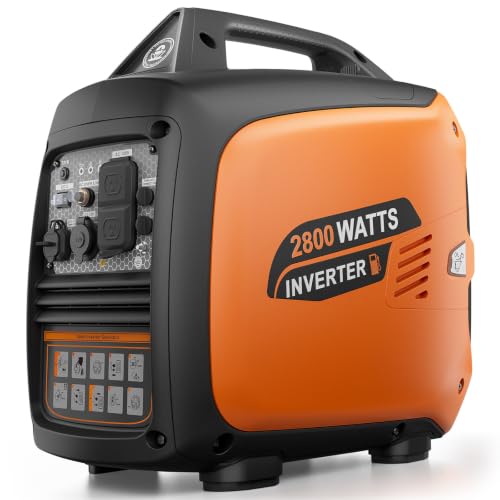
Oxseryn 2800W Portable Inverter Generator
  • 2000 W running, 2800 W peak
  • 58 dB at 23 ft
  • 40 lb, 10 hours at 25% load
Check price on Amazon for Oxseryn 2800W Portable Inverter Generator (opens in a new tab)
Best for: First-time buyers who need a light, quiet unit for lights, fridge and chargers.

Our take

The unit complies with EPA standards and is written up for camping, RVs and home backup.

Why it made the shortlist

The Oxseryn 2800W is the entry point of this guide, rated at 2800 peak and 2000 running watts with total harmonic distortion under 3 percent. The rating is 58 decibels at 23 feet, and the listing compares that to normal conversation. At 40 pounds and 18.2 by 11.3 by 19 inches, it is the lightest unit among the larger picks.

Over the Westinghouse 2550, it adds about 100 rated watts and lands at a noticeably lower price, with two 120V AC ports, a 12V DC port and a USB port. A runtime of up to 10 hours at 25 percent load is quoted, so it will run a refrigerator and lights through a night without a refill.

The 58 decibel claim arrives without a load percentage, which suggests a light-load reading and a fair figure for fridge-and-lights nights. For a buyer who wants the lowest cost way into a quiet inverter and runs no air conditioner, this is a straightforward place to stop.

What works

  • Cheapest way into this guide
  • Lightest of the larger picks
  • 58 dB at 23 ft is stated
  • Ten hours on a 25 percent load

Watch out for

  • No load given for the noise figure
  • Running watts top out near 2000

Methodology

How We Built This Shortlist

Each pick was assessed across 5 criteria weighted for real-world use.

01

Noise claim and its conditions

Each pick was read for the decibel figure and for the distance and load it is quoted at. A number with 23 feet and a half load behind it counts for more than one with neither, because the three variables together make comparisons fair. Listings and product specs were the source, and no unit was run.

02

Output behind the noise

Quiet is cheap when the engine is tiny, so we weighed the running watts each unit delivers next to its noise claim. A 3200-watt machine at 58 dBA scored higher than a 1900-watt machine at 52 for a camper with an air conditioner, and lower for one without. The score depends on the load you actually carry.

03

Part-load behavior

Eco modes, electronic speed control and live gauges were counted because they decide how often the engine sits at its quietest speed. A generator that lets you see the load can be kept in that band. Listings that describe the mechanism, rather than just naming it, earned more credit.

04

Safety and shutdowns

Quiet generators get parked close to tents and bedrooms, so CO shutdown and low-oil protection carry weight. We noted which listings name a CO sensor and which stay silent on it. Certifications such as EPA compliance and UL 2201 testing were recorded where stated.

05

Price position and weight

Price was used to order the shortlist and to describe what each step buys. Weight and footprint were weighed because a quiet unit still gets lifted in and out of a bay. Picks that combine light carry with a low price scored well.

Decision guide

Match a Budget Quiet RV Generator to Your RV

By Camping Situation

How close your neighbors sit sets how much each decibel matters, so match the pick to the pad.

SituationRecommended pickWhy
Tight pads, neighbors within a few feetWestinghouse 2550The lowest figure listed, 52 dBA, with a 43 lb body
Overnight fridge and fan within quiet hoursGenkins 4200WBelow 58 dBA at half load with CO shutdown
30 amp trailer with a hot afternoon loadPowerSmart 3800W3300 running watts at a stated 59 dBA
Spacious site, load kept lowAceup 4000WA live gauge helps keep the load inside Eco mode
Propane preferred near neighborsSperus 4000WDual fuel with noise quoted at half load

By Budget

The picks cover a modest spread, and each step up buys output or a clearer noise claim.

Price bandRecommended pickWhat the step buys
Entry of this shortlistOxseryn 2800WA 58 dB claim at the lowest cost and 40 lb
Lower mid of this shortlistGenkins 4200W3200 rated watts and CO shutdown for a modest step
Mid of this shortlistAceup 4000WA live gauge and a stated Eco mode noise reading
Upper mid of this shortlistWestinghouse 2550The quietest claim and a TT-30R outlet
Top of this shortlistPowerSmart 3800WThe most running watts and a dual fuel option

Small and Quietest vs Mid-Size and Quiet

The quietest numbers come from smaller engines, which splits the shortlist into two groups.

Small and quietest

Westinghouse 2550 and Oxseryn 2800W sit near 2000 running watts and quote 52 and 58 dB. The mechanism is a small engine with little to muffle, which suits lights, a refrigerator and chargers but cannot start a rooftop air conditioner.

Mid-size and quiet

Genkins 4200W, Aceup 4000W, Sperus 4000W and PowerSmart 3800W carry 3200 to 3300 running watts at 58 to 62 dBA. Electronic speed control keeps the engine slow at part load, so they stay close to the smaller units while holding real headroom.

Without an air conditioner, Westinghouse 2550 is the quietest choice, and with one, Genkins 4200W is the quiet value.

By How the Noise Is Quoted

Two picks can quote similar numbers under very different conditions, so rate the basis as well as the figure.

Quoted basisRecommended pickWhat the listing says
Half load at 23 feetGenkins 4200WBelow 58 dBA at half load at 23 ft
Half load at 23 feet, higher numberSperus 4000WAs low as 62 dBA at 50 percent load
Quarter load in Eco modeAceup 4000WAbout 60 decibels at 23 ft with 25 percent load
Distance given, load unstatedPowerSmart 3800WAs low as 59 dBA at 23 feet
No distance givenWestinghouse 2550As low as 52 dBA with no measuring distance

For Overnight Fridge and CPAP Use Specifically

A small steady load all night is the best case for an inverter generator running quiet.

Look for

A unit that idles slowly under light load, a runtime claim that covers the night on one tank and a CO shutdown if it sits near the rig. Westinghouse 2550 states 11 hours on a small tank, and Oxseryn 2800W states 10 hours at 25 percent load.

In this comparison

Genkins 4200W combines a half-load noise rating with CO shutdown, and PowerSmart 3800W adds a propane runtime claim of 24 hours for longer stays. Keep every unit outside and downwind, not in a bay.

When to Spend More

The step up buys either a clearer noise claim or more output to run an air conditioner quietly.

Spend more if

You need an air conditioner on the circuit at night. PowerSmart 3800W gives 3300 running watts at a stated 59 dBA, and Westinghouse 2550 gives the lowest figure for a low-draw rig.

Save if

You run lights and a refrigerator only. Oxseryn 2800W is the cheapest way in, and Genkins 4200W gives CO shutdown and half-load noise data for a small step up.

FAQ

Before You Bring One Home

What does 23 feet mean on a generator noise rating?

Twenty-three feet, about 7 meters from the machine, is the standard reading distance, used so ratings are comparable. A number quoted at a different distance, or with no distance at all, cannot be set against one quoted at 23 feet. Load matters too, since a quarter-load figure will read lower than a half-load figure for the same engine.

Is 58 dBA quiet enough for campground quiet hours?

A reading in the high 50s at 23 feet is comparable to a normal conversation, which many campers accept, but the rule that counts is the one posted at your campground. Some parks ban generators entirely at night. Measure your distance to neighbors, and place the unit as far as the cord allows, because distance reduces noise more than any rating.

Why is the quietest generator here also the smallest?

The Westinghouse 2550 has a small engine rated at 1900 watts, which gives it less sound to suppress. A larger engine can be quiet at part load but must rev up when demand rises. If your rig has no air conditioner, the small unit is a better neighbor. If you need more power, go up in size and keep the load light.

Does Eco mode make a generator quieter?

Yes, because the engine slows down when demand is light instead of holding a fixed speed. The Aceup 4000W quotes its figure in Eco mode at a quarter load, and the PowerSmart 3800W and Westinghouse 2550 describe similar modes. Push the load up and the engine speeds up, so the benefit disappears near full output.

Can a quiet generator run my RV air conditioner?

Only if the starting watts on the air conditioner nameplate fit within the generator's peak rating, which varies with the model and with any soft start. The 2000-watt class units cannot start one. The 3200 to 3300 running watt units, such as the Genkins 4200W and PowerSmart 3800W, are the realistic candidates, and a soft start improves the odds.

Will moving the generator farther away help more than a lower rating?

Often it does. Sound drops by about 6 dBA each time you double the distance in open ground, so moving a unit from 23 to 46 feet matches the gap between a mid-tier and a top-tier rating. Use a heavy-gauge extension cord rated for the load, and keep the exhaust pointed away from tents and windows.

Bottom line

The short version

Browse more budget quiet rv generators on Amazon →
Bowen Higgins, RV Editor at RV Gear Lab

About the author

Bowen Higgins

RV Editor at RV Gear Lab

Bowen covers RV power, water systems, towing and leveling, upkeep and interior comfort, with a focus on matching gear to the rig, the hookups and the way you actually travel.

More from Bowen →Editorial standards

Keep reading

Related guides