

We research everything we recommend. When you buy through our links, we may earn a commission. Learn more

Buying guide · 11 min read · Updated October 2, 2026

5 Best Budget RV Converters for Lithium Batteries in 2026: A Practical RV Guide

Five budget RV converter chargers with a lithium option, compared on profile switching, adjustable voltage and amperage for LiFePO4 upgrades.

Bowen HigginsBy Bowen HigginsRV Editor at RV Gear Lab5 products comparedSpec-sheet researched

At a glance

Our top picks

Swapping lead-acid for LiFePO4 changes what the converter has to do. The old three-stage profile ends in a long float that parks a lithium bank at a partial charge, and the usual 13.6V float setting is the wrong target for it. A converter for lithium needs a profile that finishes near 14.4 to 14.6V and then lets go, or an output you can set yourself.

The five units here all say lithium in the listing, yet they get there differently. Some have a switch that selects a LiFePO4 mode, some offer a fixed-voltage setting you dial to the battery maker's figure, and one lists a preset lead-acid sequence with a manual lithium override. How the profile changes is the detail that separates them.

Amperage matters less than usual in this guide, because the range runs from 55 to 100 amps and the right number follows the bank, not the rig. A bigger converter finishes a recharge sooner but wastes money on a small bank. Reading each listing for its voltage options is the fastest way to a sensible pick.

RV Gear Lab field notes

The Rig Fit Check

Start with the job
PowerMax PM3-75-SME 75A RV Converter Charger Adjustable Lithium leads this shortlist for Owners who want a recognized deck-mount converter with an adjustable lithium output.. Use that fit as a reference point, then compare the alternatives against your own space and workload.
Specs that separate the picks
The first details to compare are 75A regulated 12V output, 55A shared with 12V loads, 80A, 120V AC to 12V DC. Confirm the exact model and included components before ordering.
Trade-off to plan for
Most expensive pick in this guide

Before you buy

What Matters Before You Choose a Budget RV Converter for Lithium Batteries

Key buying criteria so you get the right fit the first time.

  1. 01

    Charge profile versus a lead-acid float

    A lead-acid converter finishes in a float stage near 13.2 to 13.6V, which holds a battery full. A LiFePO4 bank does not need that hold, and it is better charged to about 14.4 to 14.6V and then rested. A converter without a lithium option leaves the bank in a permanent partial state. Verify a mode named LiFePO4 or an output you can set to the maker's voltage.

  2. 02

    Mode switch versus a manual setting

    Some converters change profile with a button, some with a jumper or dip switch, and some only offer a fixed voltage you dial yourself. The button is the friendliest, and a fixed voltage is the most flexible, since it follows whatever the battery maker prints. Read the listing for the exact method. A unit that mentions only compatible with lithium has not told you how to get there.

  3. 03

    Amperage sized for the bank

    A converter's output is shared between the 12V loads running in the rig and the current going into the batteries, so only the leftover recharges the bank. Oversizing wastes money, and undersizing means the bank never finishes a charge between stops. A 55 amp unit suits a 100Ah bank, while a 300Ah bank rewards 80 to 100 amps. Check the listing for continuous output, not a peak number.

  4. 04

    Voltage window and ceiling

    A 13V to 16.5V adjustable range gives room for a lithium setting, and 14.6V is the number to find. A window that stops at 14.4V can leave a bank a few percent short. Read whether the listing offers fixed stops such as 13.0V, 14.6V and 16.5V or a continuous dial. Higher stops can overcharge a lead-acid bank, so never leave the 16.5V position selected.

  5. 05

    Deck-mount fit and wiring

    A deck-mount unit has to fit the space near the battery bank, with clearance at each end for air. The wire gauge must match the output, and 8 AWG copper is a typical minimum for the smaller units. Measure the cutout, read the dimensions in the listing and plan for a certified installer. A converter that overheats in a closed cabinet will derate or shut down.

  6. 06

    Protection and cooling behavior

    Reverse polarity, overload and thermal protection guard against a swapped wire, a short and a stalled fan. A fan that starts only at a rated temperature or ramps with load is quieter than a constant one. These features do not replace correct fusing and grounding. Verify the protections by name in the listing, not a generic safe or protected label.

Our standards

Why You Can Trust RV Gear Lab

At RV Gear Lab, we compare products based on rig fit and power or hookup compatibility, verified specifications, usability, setup requirements, weight, durability, and real-world trade-offs. We do not rank products purely on marketing claims or commission rates.

We have not personally tested every product listed. Where hands-on testing is not available, recommendations are based on verified manufacturer specifications, product documentation, use-case fit, and comparative research.

How we review RV gear →

Detailed reviews

The 5 best budget rv converters for lithium batteries, explained

01
PowerMax PM3-75-SME 75A RV Converter Charger Adjustable Lithium
  • 75A regulated 12V output
  • Adjustable output for lithium
  • Deck-mount with thermal protection
Check price on Amazon for PowerMax PM3-75-SME 75A RV Converter Charger Adjustable Lithium (opens in a new tab)
Best for: Owners who want a recognized deck-mount converter with an adjustable lithium output.

Our take

On cost it sits at the top of this shortlist on price, and the step up buys the recognizable brand and the extra amperage.

Why it made the shortlist

Seventy-five amps of regulated 12V output makes this the second-largest unit in the guide, and the listing describes an adjustable output that supports a properly configured lithium charge. That adjustability is the feature that lets one box serve a lead-acid bank today and a LiFePO4 bank later.

Put alongside the PowerMax PM4-55LK, it offers more current for a bigger bank and keeps the same deck-mount format that installs near the batteries or the electrical panel. Current limiting, reverse polarity and thermal safeguards are listed, and the multi-stage charger handles compatible lead-acid banks in the meantime.

Well suited to an owner with a 200Ah-class bank who wants a deck-mount unit from an established name.

What works

  • Brand with long RV pedigree
  • Adjustable output suits LiFePO4
  • Enough current for a mid-size bank
  • Standard protections are listed

Watch out for

  • Most expensive pick in this guide
  • Listing gives few stage voltages
02
Best for: Owners who want exact install clearances and a fixed-voltage lithium setting.

Our take

A fit for a 100Ah to 200Ah lithium bank in a rig with a roomy electrical bay and an installer who values clear numbers.

Why it made the shortlist

The listing here is the most detailed in the guide. It gives 7.8 by 9.5 by 3.5 inches for the case, one inch of free air at each end, a 120V outlet within 36 inches and 8 AWG copper as the minimum wire, so an installer can plan the whole job from the page.

Two modes cover both chemistries: a factory four-stage setting with 14.6V, 13.6V and 13.2V outputs for lead-acid, and a fixed-voltage mode adjustable from 13 to 16.5V that you set to the battery maker's charging spec. That fixed mode is the lithium path, and the voltage stays exactly where you put it.

What works

  • Install clearances spelled out
  • Fixed voltage dialed to the battery spec
  • Proportional cooling fan
  • Reverse polarity and overload protection

Watch out for

  • No automatic chemistry detection
  • 55A is shared with the 12V loads
The catch
Price lands just below the PM3-75 on price and offers the same brand with a smaller output.
03
Best for: Mid-size lithium banks that want a one-press switch between lead-acid and LiFePO4.

Our take

It lands in the middle of the shortlist on price, a clear step up from the VUFUMSY 55A and a step below the PowerMax units.

Why it made the shortlist

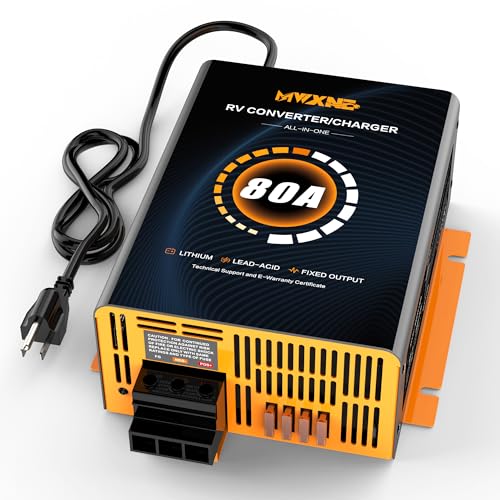
A single press of the mode switch selects a dedicated lead-acid or LiFePO4 profile, and a fixed-voltage setting adds 13.0V, 14.6V and 16.5V choices. That puts the lithium profile one button away instead of buried in a manual, which suits an owner who swaps battery types or wants a simple demonstration for the next owner.

Set against the VEVOR 100A, it gives 80 amps of output with a metal housing and a temperature-controlled fan, and it describes its automatic three stages as Boost, Normal and Trickle. Protection covers short circuit, overload, thermal shutdown, under and over voltage, and reverse polarity.

The right pick for an owner who wants a visible LiFePO4 mode with real amperage behind it.

What works

  • Dedicated LiFePO4 mode on a switch
  • Metal housing and managed fan
  • Three automatic charging stages
  • Wide set of electrical protections

Watch out for

  • Brand is new to RV converters
  • Trickle stage is a lead-acid habit
04
Best for: Buyers comparing capacity, compatibility, included components and storage needs

Our take

Price lands well below the MWXNE 80A and the PowerMax units, so the extra current comes cheap.

Why it made the shortlist

One hundred amps is the most output in the guide, and the listing pairs it with dedicated modes for lead-acid and LiFePO4 plus a fixed-voltage mode at 13.0V, 14.6V and 16.5V. A big bank gets the profile it needs and the current to recharge between stops.

Against the MWXNE 80A it adds 20 amps and six named protections: short circuit, over temperature, overload, low voltage, overvoltage and reverse polarity. An intelligent cooling fan starts when the unit passes its rated temperature, which keeps a compartment quieter than a fan that runs from the first minute.

Well suited to a 300Ah lithium bank or a rig with heavy 12V loads running while the batteries charge.

What works

  • Highest current in this shortlist
  • Dedicated lithium mode plus fixed voltage
  • Fan starts only at rated temperature

Watch out for

  • Oversized for a small 100Ah bank
  • Fewer RV-specific details in the listing
05
Best for: Small lithium banks and first upgrades where a lithium mode matters more than output.

Our take

On price it lands at the entry of this shortlist on price, so the saving is large.

Why it made the shortlist

This one is the entry pick, and it still offers a switch that selects a lead-acid or LiFePO4 charging mode, plus an adjustable 13V to 16.5V window. It gives a new lithium owner the profile that matters at the lowest cost in the guide.

At 55 amps it matches the PowerMax PM4-55LK on output while costing well under half as much, and it describes three-stage charging with heat-dissipating materials in the casing. Short circuit, overload, over-temperature and reverse polarity protections are listed.

What works

  • Lithium mode selected by a switch
  • Adjustable voltage window
  • Heat-dissipating casing

Watch out for

  • Lower amperage than most picks
  • Little detail on fan behavior
The catch
A solid fit for a 100Ah lithium bank in a smaller trailer, where 55 amps is enough to feed lights and a fridge and still top up the battery.

Methodology

How We Built This Shortlist

Each pick was assessed across 5 criteria weighted for real-world use.

01

How the lithium profile is reached

We read each listing for the method: a mode switch, a fixed-voltage dial or an automatic setting. A written LiFePO4 mode or an adjustable voltage window counted for more than a bare lithium compatible label. Based on product specs, a unit with no stated method scored lower.

02

Voltage range against a LiFePO4 profile

Lithium banks charge toward 14.4 to 14.6V, so we checked that each unit can hold that setting. Listings with a stated 14.6V option were credited. A preset four-stage sequence built for lead-acid was treated as a limit, not a feature.

03

Amperage against bank size

Output from 55 to 100 amps was matched to the bank each unit realistically serves. We compared the figure to the loads that share it, since a converter feeds the 12V circuits first. Bigger was not scored as better.

04

Install detail and fit

Deck-mount dimensions, clearance, wire gauge and outlet reach were noted where the listing gives them. A page that spells out the install saves an owner from guessing. We did not credit fit claims a listing did not make.

05

Protection and price position

Reverse polarity, overload and thermal protections were treated as the baseline across the five. Price was judged as a position within this shortlist and what each step up adds, such as brand, amperage or a mode switch.

Decision guide

Match a Budget RV Converter for Lithium Batteries to Your RV

By Lithium Bank Size

The bank sets the amperage, so start there and let the unit follow.

BankRecommended pickWhy
100Ah lithium bank, small trailerVUFUMSY 55A55 amps with a LiFePO4 mode at the lowest cost
100Ah to 200Ah bank, deck-mountPowerMax PM4-55LKDocumented install and a fixed lithium voltage
200Ah bank with a mid-size rigPowerMax PM3-7575 amps with an adjustable lithium output
200Ah to 300Ah bankMWXNE 80A80 amps and a one-press LiFePO4 mode
300Ah or larger bankVEVOR 100A100 amps of output with dedicated lithium mode

By Budget

The five picks spread across a wide band, so each step up buys something specific.

Price bandRecommended pickWhat the step buys
Entry of this shortlistVUFUMSY 55AA switchable lithium mode at the lowest cost
Lower mid of this shortlistVEVOR 100A100 amps and six named protections
Mid of this shortlistMWXNE 80AA metal housing and a temperature-managed fan
Upper mid of this shortlistPowerMax PM4-55LKDocumented install and a fixed lithium voltage
Top of this shortlistPowerMax PM3-75Brand pedigree and 75 amps of adjustable output

One-Press Mode vs Dial-In Voltage

The two ways to reach a lithium profile suit different owners.

One-press mode

MWXNE 80A, VEVOR 100A and VUFUMSY 55A use a switch that selects a LiFePO4 profile. The mechanism is a preset curve in the converter, which is quick and hard to get wrong.

Dial-in voltage

PowerMax PM4-55LK and PowerMax PM3-75 expect you to set the output to the maker's figure, with no automatic chemistry detection. The mechanism is a fixed voltage you control, which is flexible for unusual battery specs.

A new lithium owner should lean toward MWXNE 80A for the switch, and a spec-driven installer will like PowerMax PM4-55LK.

By Install Location

Heat and clearance decide how each unit behaves after it is bolted down.

LocationRecommended pickWhy
Tight cabinet near the batteriesMWXNE 80AMetal housing and a temperature-managed fan
Roomy electrical bayPowerMax PM4-55LKClearance numbers are given for an exact install
Quiet sleeping areaVEVOR 100AFan runs only when the unit reaches rated temperature
Replacing an older PowerMax deck unitPowerMax PM3-75Same format and brand as the unit it replaces

For a First Lithium Upgrade Specifically

The first swap should protect the new battery without overspending.

Look for

A named LiFePO4 mode or a settable 14.6V output. VUFUMSY 55A and MWXNE 80A offer a switch, and PowerMax PM4-55LK offers a fixed voltage.

In this comparison

VUFUMSY 55A is the cheapest way to get a lithium mode on a small bank. MWXNE 80A gives a bigger margin for a mid-size bank, and PowerMax PM3-75 keeps a familiar deck-mount format.

When to Spend More

The extra cost between these picks buys brand, amperage or install clarity.

Spend more if

A deck-mount swap needs the documented clearances of PowerMax PM4-55LK or the brand and 75 amps of PowerMax PM3-75. An installer who wants stated numbers will appreciate the extra cost.

Save if

The bank is small or the rig is simple. VUFUMSY 55A gives the lithium mode for the least, and VEVOR 100A is the better value when you need high current.

FAQ

Before You Bring One Home

Do I need a new converter for a lithium battery?

Often yes, or at least an adjustable one. A lead-acid converter floats near 13.2 to 13.6V, which leaves a LiFePO4 bank partly charged. A converter with a lithium mode or a settable 14.6V output charges it properly. If your current unit has no such setting, replacing it is usually cheaper than a battery replaced early.

What is the difference between a lithium mode and a fixed voltage?

A lithium mode is a preset curve that you select with a switch. A fixed voltage holds one number, such as 14.6V, until you change it. MWXNE 80A, VEVOR 100A and VUFUMSY 55A offer the switch, while PowerMax PM4-55LK relies on the fixed setting you dial to the battery maker's spec.

How many amps does my lithium bank need?

Match the converter to the bank, not the rig. A 55 amp unit like VUFUMSY 55A suits about 100Ah, an 80 amp unit suits a 200Ah to 300Ah bank, and a 100 amp unit suits a large 300Ah bank. Remember that the 12V loads draw from the same output, so a bigger rig needs a bigger margin.

Can I leave the 16.5V setting selected?

No. The 16.5V stop is a high setting meant for special charging needs, and it can overcharge a battery. Use 14.6V for a LiFePO4 bank unless the battery maker prints another figure, and treat 13.0V as a float-like holding value for lead-acid.

Is a deck-mount converter hard to install?

It is straightforward for a qualified installer. The PowerMax PM4-55LK listing calls for a dry, ventilated spot with one inch of free air at each end, a 120V outlet within 36 inches and 8 AWG copper wire. A certified electrician should handle the AC side, and fusing is separate from the converter's own protection.

Will a converter fix a battery that will not take a charge?

No. A converter charges within the battery's own limits, and a lithium pack with a tripped BMS or a frozen cell stays off until it recovers. Check the battery first, then the converter's voltage setting, and consider the cold-charge rules covered in our lithium battery guide before you blame the charger.

Bottom line

The short version

Browse more budget rv converters for lithium batteries on Amazon →
Bowen Higgins, RV Editor at RV Gear Lab

About the author

Bowen Higgins

RV Editor at RV Gear Lab

Bowen covers RV power, water systems, towing and leveling, upkeep and interior comfort, with a focus on matching gear to the rig, the hookups and the way you actually travel.

More from Bowen →Editorial standards

Keep reading

Related guides