

We research everything we recommend. When you buy through our links, we may earn a commission. Learn more

Buying guide · 11 min read · Updated October 2, 2026

5 Best Budget Backpacking Water Filters for Hiking in 2026: A Practical Camping Guide

Five pump and powered water filters for hiking, compared on cartridge life, weight, field cleaning and effort per liter so you buy the one that fits your miles.

Danny WalkerBy Danny WalkerCamping Editor at RV Gear Lab5 products comparedSpec-sheet researched

At a glance

Our top picks

Hikers filter water in a different rhythm from campers. You stop at a stream mid-climb, fill a bottle or a hydration reservoir, and move on within minutes, then repeat it several times a day, often with tired legs and a deadline for the next campsite or trailhead. That rhythm rewards a filter that is quick to deploy, easy to clean on the trail and honest about how many liters it will give before it needs a new cartridge. Anything that slows you down at a stream stop gets skipped by day two, and a skipped filter protects nobody.

Pump-style and powered filters suit that routine well, and they come in two broad families. A classic hand pump pushes water through a glass fiber or ceramic element, and a battery unit uses a small motor and an ultrafiltration membrane. Each has a clear failure mode, and knowing it ahead of time is half the battle: a pump tires your arm and slowly wears its seals and valves, while a battery unit needs charging and a clean membrane. Neither is hard to live with once you plan around it, and both are covered below.

The price spread between these picks is wide, and most of it comes down to how long the filter element lasts. Count cost per liter of filter life, not just the ticket price. A filter that costs several times more can still be the cheaper choice if its element lasts ten times as long, and a cheap filter with an unstated life is a gamble. Read each pick with the miles you actually hike in mind, then choose the rhythm you can sustain over a whole season, not just one trip.

RV Gear Lab field notes

The Campsite Fit Check

Start with the job
Katadyn Hiker Pro Transparent Hand Pump Water Filter | 1L Per Minute, 11.2 oz leads this shortlist for Backpackers wanting a light, proven pump with a visible cartridge.. Use that fit as a reference point, then compare the alternatives against your own space and workload.
Specs that separate the picks
The first details to compare are 0.2 micron glass fiber, carbon granules, 11 oz pump-action microfilter, 0.01 micron ultrafiltration membrane. Confirm the exact model and included components before ordering.
Trade-off to plan for
Hand pumping takes effort

Before you buy

What Matters Before You Choose a Budget Backpacking Water Filter for Hiking

Key buying criteria so you get the right fit the first time.

  1. 01

    Cartridge life per liter

    A stated life of 1,150 liters, 1,000 liters or 13,000 gallons tells you how many fills the element will deliver before replacement, and the gap between those numbers is enormous. Divide the ticket price by the stated liters to see the true running cost. A cheap pump with a short rating can cost more per liter than an expensive ceramic filter, so look for a number in the listing and plan around it. A pick with no stated life is harder to budget for.

  2. 02

    Pump effort and hand fatigue

    A hand pump needs a few minutes of steady pumping per liter, and the effort rises as the filter clogs, which matters when you refill several bottles at the end of a hot day. Fast flow ratings of around 1 liter per minute assume a clean element and a strong arm. If pumping sounds like a chore, an electric unit trades arm effort for battery management. Be honest about which chore you will tolerate.

  3. 03

    Clean-or-replace cycle

    Ceramic and some microfilter elements can be scrubbed clean in the field, restoring flow without a new part, while glass fiber cartridges are usually cleaned by backflushing or replaced. A wear indicator tells you when to act. Look for an included brush pad or a backwash function. One that can be restored on the trail is worth more than one that simply stops. Plan a cleaning stop before you need it.

  4. 04

    Micron rating and what it covers

    Glass fiber rated at 0.2 micron screens bacteria and protozoa such as giardia and cryptosporidium, while viruses are smaller and pass through. This remains the standard limit of this class. A 0.01 micron ultrafiltration membrane is a finer particle claim, and the listing wording decides whether it is a pathogen claim. Dissolved metals and chemicals are not removed by membranes, so a listing that says otherwise deserves caution.

  5. 05

    Weight against durability

    An 11 ounce plastic pump is a comfortable carry, while a 20 ounce metal pump gives up some weight for a body that survives drops and cold. Powered units add a battery and solar panel to the load. Think about how many days you hike per year. A frequent hiker amortizes the heavy durable build over many trips, and a casual hiker rarely needs it.

  6. 06

    Charging and power planning

    A battery unit is only as reliable as its charge. A 5200 mAh battery and a stated four hours of running suits a weekend, and solar or hand-crank charging stretches that on longer routes. Always carry a manual or chemical backup, and charge the unit at the trailhead. A dead battery on day three is the main way these products fail.

Our standards

Why You Can Trust RV Gear Lab

At RV Gear Lab, we compare products based on campsite fit, verified specifications, usability, setup requirements, weight, durability, and real-world trade-offs. We do not rank products purely on marketing claims or commission rates.

We have not personally tested every product listed. Where hands-on testing is not available, recommendations are based on verified manufacturer specifications, product documentation, use-case fit, and comparative research.

How we review camping gear →

Detailed reviews

The 5 best budget backpacking water filters for hiking, explained

01
Katadyn Hiker Pro Transparent Hand Pump Water Filter | 1L Per Minute, 11.2 oz
  • 0.2 micron glass fiber, carbon granules
  • 1 liter per minute, 11.2 oz
  • Up to 1,150 liters per cartridge
Check price on Amazon for Katadyn Hiker Pro Transparent Hand Pump Water Filter | 1L Per Minute, 11.2 oz (opens in a new tab)
Best for: Backpackers wanting a light, proven pump with a visible cartridge.

Our take

Quick-connect fittings and an Easy Fill adapter let you fill a bottle or a hydration pack without fiddling with hoses.

Why it made the shortlist

A transparent body is the clever idea here. You can see the cartridge, so you know at a glance whether it is clogged or due for cleaning, and that removes the guessing that makes people stop trusting their filter on the trail, which is a real benefit on long days. The element is a 0.2 micron glass fiber cartridge with activated carbon granules for taste.

Seller copy states a pumping speed of 1 liter per minute from an 11.2 ounce body and a cartridge life of up to 1,150 liters, plus a filter protector and an intake pre-filter that extend the working life of the element. Pricing places it in the middle of this shortlist on price, a small step above the Katadyn Hiker.

Opt for it when you want a dependable pump for weekend and week-long hikes and value the visible cartridge and the carbon taste stage, with the intake hose pre-filter keeping the first stage of grit out of the element.

What works

  • See-through body shows cartridge condition
  • Carbon granules improve the taste
  • Intake pre-filter protects the cartridge
  • Easy Fill adapter fits hydration packs

Watch out for

  • Hand pumping takes effort
  • 0.2 micron media is not a virus barrier
02
Best for: Weekend hikers wanting a field-cleanable pump from a known maker.

Our take

Field cleaning means you can restore flow at a trailside rock without returning to camp or a workbench, and the operation is simple enough for anyone in the group to run.

Why it made the shortlist

This is the entry pick of the shortlist and the simplest way to own a field-cleanable pump from a maker that has been in water treatment since 1928. The 11 ounce pump-action body uses a microfilter membrane that screens sediment and fine particles from streams, ponds and lakes, which is what a trail filter is for.

Because a hand pump builds its own pressure, flow stays consistent whether or not a source is high enough to hang a bag, which makes it a good fit for shallow streams and small seeps. The listing positions it as the lighter and simpler alternative to the Hiker Pro, and it costs a little less than that model.

Consider it if you hike a few times a year and want a trusted pump without paying for extras, and when a plain, repairable design appeals more than a feature list.

What works

  • Lightweight 11 ounce pump body
  • Field-cleanable on the trail
  • Simple enough for anyone to use
  • Established maker with long history

Watch out for

  • Sediment screen is not a pathogen claim
03
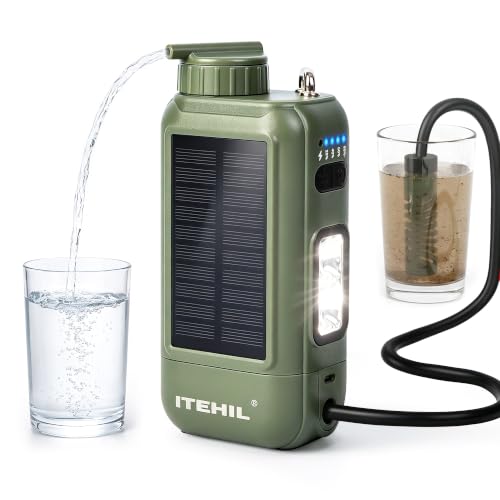
ITEHIL Portable Electric Water Filter, 0.01 Micron Camping Water Purifier with Solar
  • 0.01 micron ultrafiltration membrane
  • 700 mL per minute, 5200 mAh battery
  • USB-C and solar charging
Check price on Amazon for ITEHIL Portable Electric Water Filter, 0.01 Micron Camping Water Purifier with Solar (opens in a new tab)
Best for: Hikers who dislike pumping and can charge a battery at trailheads.

Our take

An integrated hook lets you hang it from a pack strap or a branch while it runs, which frees both hands for holding a bottle.

Why it made the shortlist

Pumping effort disappears with this one. A small motor pulls water through a pre-stage ultrafiltration element and a 0.01 micron membrane with an Ahlstrom stage at a stated 700 milliliters per minute, and the cartridge is described as good for up to 1,000 liters, a figure you can count against your trips, so replacing it becomes a planned event instead of a surprise.

The 5200 mAh battery gives about four hours of continuous running on a full charge, and it recharges by USB-C or by the built-in solar panel. Priced in the lower middle of the shortlist, just under the Greeshow, it competes on convenience and ease rather than on the long-life ceramic design of the Katadyn Pocket.

Settle on it when you hike with a power bank or a car near the trailhead and want filtering to take as little energy as possible, so a stop at a stream becomes a short, relaxed pause.

What works

  • No pumping or squeezing needed
  • Charges by USB-C or solar
  • Stated 1,000 liter cartridge life
  • Hook hangs from a pack strap

Watch out for

  • Battery can die mid-trip
  • Metal-removal claim overstates membrane limits
04
Greeshow Portable Electric Water Filter for Camping & Emergency | 0.01-Micron Water Purification
  • 0.01 micron hollow fiber, five stages
  • 700 mL per minute electric pump
  • Solar, USB-C and hand-crank charging
Check price on Amazon for Greeshow Portable Electric Water Filter for Camping & Emergency | 0.01-Micron Water Purification (opens in a new tab)
Best for: Hikers who want solar, USB-C and hand-crank charging in one small unit.

Our take

Cost-wise it falls in the upper middle of the shortlist, a small step above the ITEHIL Electric, and the step buys the hand-crank backup and the power-bank function.

Why it made the shortlist

Three charging routes give this one more resilience than any other electric unit in the guide. It runs from an integrated solar panel on the casing, a USB-C port or an emergency hand crank, and a built-in 3000 mAh power bank can charge a phone in a pinch, which makes it useful beyond the filtering job itself.

The filter is a five-stage design built around a 0.01 micron hollow fiber ultrafiltration membrane, with an automatic electric pump delivering up to 700 milliliters per minute from a compact body. The copy states a cartridge life of up to 264 gallons, about 1,000 liters, and a smart electric backwash that cleans the membrane after use, so maintenance takes almost no attention.

This one makes sense when you want one compact device that doubles as a phone charger and a filter for backpacks and emergency kits, and that works when the sun, a cable or an arm is available.

What works

  • Three ways to recharge the battery
  • Built-in power bank charges a phone
  • Smart backwash cleans the membrane
  • Stated 264 gallon cartridge life

Watch out for

  • More complex than a manual pump
  • Extra functions add weight to the pack
05
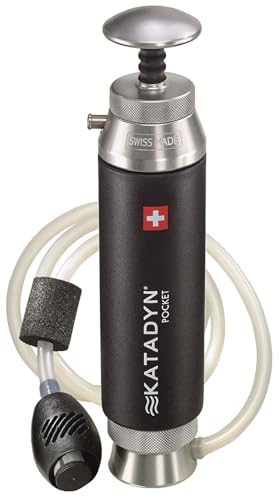
Best for: Frequent hikers and expedition users who want one filter for decades.

Our take

Over thousands of liters, the cost per liter of this filter drops well below the cheaper disposable cartridges, and the military-grade build handles drops and cold.

Why it made the shortlist

Durability is the headline. The silver-impregnated ceramic cartridge is rated for up to 13,000 gallons of filtering, comes with a brush pad for field cleaning and has a wear indicator that tells you exactly when to clean it, which keeps maintenance simple, all inside an aircraft-grade aluminum and stainless steel body built for expedition use.

The 20 ounce pump delivers about 1 liter per minute and connects directly to a bottle, and the listing carries a 20-year guarantee. Price-wise, this is the most expensive pick in this guide by a wide margin, several times the Hiker Pro, and what the money buys is a ceramic element that can be cleaned and reused indefinitely, and a body that is meant to be serviced rather than thrown away.

Lean on it when you hike often, travel internationally or want a single filter that you can repair rather than replace, accepting a few extra ounces for decades of dependable use.

What works

  • Rated for 13,000 gallons of use
  • Ceramic cleans with an included brush pad
  • Wear indicator shows when to clean
  • 20-year guarantee in the listing

Watch out for

  • Most expensive pick in this guide
  • Twenty ounces is heavy for ultralight packs

Methodology

How We Built This Shortlist

Each pick was assessed across 5 criteria weighted for real-world use.

01

Cost per liter of filter life

Each pick was evaluated by comparing price position against stated cartridge life in liters or gallons. A long-lived element can undercut a cheap one with a short rating. Where a listing gave no figure, the pick lost points for being hard to plan around.

02

Hiking rhythm

Going by product specs, we judged how quickly each filter deploys at a stream stop and how it fills a bottle or a reservoir. Fast, simple operation scored higher than a clever feature that takes a minute to set up. Weight in a pack counted heavily here. A feature you will not use is just ounces.

03

Clean or replace

Some elements clean in the field and keep going, while others are replaced when they clog. We compared those cycles and looked for a wear indicator, a brush pad or a backwash feature. A filter you can restore on the trail earns credit. A part that needs a workshop does not.

04

Effort and power

Hand pumps cost effort at every stop and electric units cost charging time, so we weighed both against the likely length of trip. Multiple charging options earned credit for resilience. A pump that never needs a battery scored well for remote routes. That is a reasonable preference for long trips.

05

Honest scope

We scored every pick on what its listing and category knowledge support. A 0.2 micron cartridge screens bacteria and protozoa but not viruses, a 0.01 micron membrane is a particle claim, and a microfilter without a stated rating was treated as a sediment and fine-particle screen. None of the claims was taken further than its listing.

Decision guide

Match a Budget Backpacking Water Filter for Hiking to Your Camp Setup

By Hiking Frequency

How often you hike changes which filter is worth the money. A weekend walker and a thru-hiker should not buy the same one.

Hiking frequencyWhat mattersRecommended pick
A few trips per yearLow cost, simple operationKatadyn Hiker
Monthly weekend hikesVisible cartridge, carbon tasteKatadyn Hiker Pro
Frequent or expedition useDecades of filter lifeKatadyn Pocket
Trips with trailhead chargingNo pumping effortITEHIL Electric

By Budget

Price bands here mean relative positions inside this shortlist, not quoted prices. Remember that cost per liter can flip the ranking.

Price bandWhat it buysRecommended pick
Entry of this shortlistA light, field-cleanable pumpKatadyn Hiker
Lower-mid of this shortlistA powered unit with 0.01 micron membraneITEHIL Electric
Mid of this shortlistA multi-power unit with a hand crankGreeshow Electric
Upper-mid of this shortlistA pump with visible cartridge and carbonKatadyn Hiker Pro
Top of this shortlistA ceramic filter with a 20-year guaranteeKatadyn Pocket

Manual Pump vs Battery Unit

The big decision is whether you power the filter with your arm or with a battery. Each has a clear failure mode.

Manual pump

No power to manage, repairable and reliable on long routes. Katadyn Hiker, Katadyn Hiker Pro and Katadyn Pocket live here, and they cost arm effort at every refill.

Battery unit

Pumps for you and filters quickly, but needs charging and a backup plan. ITEHIL Electric and Greeshow Electric are the two options, with Greeshow adding a hand-crank charge.

Pick a manual pump for remote routes and a battery unit for short trips near a charger.

By Pack Weight

Every ounce is carried for miles, so weight deserves its own look separate from price and filter life.

Weight priorityTypical tradeRecommended pick
Lightest manual pumpSimple body, no extrasKatadyn Hiker
Light pump with carbon and clear bodyA little more weightKatadyn Hiker Pro
Heavy but built to lastMetal body, ceramicKatadyn Pocket
Electric with battery and solarWeight for convenienceGreeshow Electric

For Muddy or Silty Streams Specifically

Silt clogs filters faster than anything else, so the cleaning method matters more than the micron rating.

Look for

An intake pre-filter, a cleanable element and a way to track clogging. A ceramic cartridge can be scrubbed repeatedly, and a visible cartridge shows when to clean, as on the Katadyn Hiker Pro.

In this comparison

Katadyn Pocket is scrubbed clean with its brush pad, Katadyn Hiker Pro has an intake pre-filter and a see-through body, and Greeshow Electric has a smart backwash.

When to Spend More

Paying extra should buy longer life, repairability or hands-free operation you will use.

Spend more if

You hike often or travel far from stores. Katadyn Pocket justifies the step with a 13,000 gallon ceramic element, and Greeshow Electric adds multi-power resilience.

Save if

You hike a few times a year. Katadyn Hiker and ITEHIL Electric give reliable filtering for much less up front.

FAQ

Before You Bring One Home

Is a pump filter or an electric filter better for hiking?

A pump filter is more reliable on long routes because it needs no power, while an electric unit saves effort on short trips near a charger. The Katadyn pumps cost arm effort at every stop, and the ITEHIL and Greeshow need charging. Carry a backup method either way.

How do I know when to clean or replace the cartridge?

Flow slows and pumping gets harder as the element clogs. A transparent body like the Hiker Pro shows the cartridge, and the Pocket has a wear indicator and a brush pad. Clean the element when flow drops, and replace it when cleaning no longer restores the stated pace.

Does a pump filter remove viruses?

Glass fiber at 0.2 micron stops bacteria and protozoa, not viruses, and a microfilter without a stated rating should be treated as a sediment and fine-particle screen. Viruses are mainly a concern in some international travel regions. In those places, add chemical treatment or use a purifier designed for viruses.

Is the Katadyn Pocket worth its price for a casual hiker?

Probably not. Its value comes from a 13,000 gallon ceramic element and a 20-year guarantee, which pay off only over many trips. A casual hiker does better with the Hiker or Hiker Pro and replaces the cartridge when it wears out.

How should I store a filter between trips?

Let it dry out of direct sun, then store it in a cool place. Never leave a wet filter in freezing temperatures, because trapped water can crack the element and hide the damage. If a hollow fiber or glass fiber filter freezes while wet, replace the cartridge.

Can I trust a 0.01 micron electric filter's heavy metal claim?

Be skeptical. A membrane screens particles, and dissolved metals pass through it. Some listings claim metal removal at the 0.01 micron level, but a carbon or ion-exchange stage is what would address chemicals. Use the micron rating as a particle claim, and treat metal claims with caution.

Bottom line

The short version

Browse more budget backpacking water filters for hiking on Amazon →
Danny Walker, Camping Editor at RV Gear Lab

About the author

Danny Walker

Camping Editor at RV Gear Lab

Danny covers camping gear, campsite setup, outdoor power, sleep systems and practical camping advice, with a focus on helping campers make better gear decisions.

More from Danny →Editorial standards

Keep reading

Related guides