

We research everything we recommend. When you buy through our links, we may earn a commission. Learn more

Buying guide · 11 min read · Updated October 2, 2026

5 Best Budget Gravity Water Filters for Backpacking in 2026: A Practical Camping Guide

Five hang-and-filter gravity water systems for backpacking and camp, compared on reservoir size, membrane rating, flow, replaceable parts and group fit.

Danny WalkerBy Danny WalkerCamping Editor at RV Gear Lab5 products comparedSpec-sheet researched

At a glance

Our top picks

A gravity filter is a different tool from a squeeze or pump filter, and buying one well starts with seeing why. You fill a reservoir, hang it from a branch or a tent loop, and let the weight of the water push it through the filter into a clean container. There is no squeezing, no pumping and no standing in the creek while your hands go numb, which makes it the natural choice for a long and relaxed evening at camp. It also lets one person run a long refill while another cooks dinner.

The trade-off is that a gravity bag only pays off once you are sitting still. It adds a reservoir to the pack, it needs something to hang from, and flow is slower than a pump when the bag is nearly empty. Budget versions of this system all use the same basic recipe, a 0.1 micron hollow fiber membrane, a TPU bag and a length of hose, so the meaningful differences are reservoir size, replaceable parts and how honestly the listing describes its standards. That last point matters more than it sounds.

This shortlist runs from a bare bag you pair with a filter you already own up to a full group system, so decide first whether you are carrying water for one person or six. Then look at what each listing says about replaceable parts and standards, because that is where budget gravity systems separate. Two bags with the same micron rating can differ a lot in how long they stay useful. A short, honest listing is a better sign than a long one full of superlatives, and a modest reservoir that you actually carry beats a large one that stays home.

RV Gear Lab field notes

The Campsite Fit Check

Start with the job
IRRABLY Water Filter Bag, 0.1 Micron 4-Stage Hanging Gravity-Fed, 1 Gallon leads this shortlist for Solo backpackers and pairs wanting a light, foldable gravity bag.. Use that fit as a reference point, then compare the alternatives against your own space and workload.
Specs that separate the picks
The first details to compare are 0.1 micron hollow fiber membrane, 0.1 micron six-stage filtration, 12 liter hanging reservoir. Confirm the exact model and included components before ordering.
Trade-off to plan for
Too small for a family or group camp

Before you buy

What Matters Before You Choose a Budget Gravity Water Filter for Backpacking

Key buying criteria so you get the right fit the first time.

  1. 01

    Reservoir size versus group size

    A reservoir should hold roughly what your group drinks and cooks with between refills, and no more, because every extra liter of capacity is bag weight. A 1 gallon bag suits one or two people, a 2 gallon bag a small group, and 12 liters a family at a fixed camp. Count people, then multiply by a few liters per person per day. Add a little for cooking. An oversized bag takes longer to fill and hang, and wastes pack space.

  2. 02

    Hang height and flow

    Gravity flow depends on how high the bag hangs, so a tall tree branch gives a faster stream than a low tent loop. Stated flow figures such as 0.5 liters per minute assume a good hang and a clean filter, and they drop as the bag empties and the membrane clogs. Plan on a realistic pace and consider a trekking pole or cord setup for a higher hang. Keep the clean container below the filter outlet.

  3. 03

    Membrane rating and what it covers

    A 0.1 micron hollow fiber membrane screens bacteria and protozoa such as giardia and cryptosporidium, while viruses are far smaller and pass through it. Carbon stages improve taste and remove chlorine but are not a pathogen barrier, and no membrane removes dissolved metals or chemicals. Use a purifier or tablets if viruses are a concern on your route. Call it the honest limit of this whole category.

  4. 04

    Standards wording on the listing

    Phrases like independently tested, designed to meet and certified are not interchangeable. NSF/ANSI 42 covers taste and odor, 372 covers lead-free materials and 401 covers emerging contaminants, and none of them is a microbiological claim on its own. Scan the listing for the exact numbers and treat vague wording as a statement about materials, not a pathogen guarantee. Look for the word certified.

  5. 05

    Replaceable versus sealed filter

    A modular design lets you replace the membrane or carbon when flow drops, while a sealed filter forces you to replace the whole kit. That difference can double the lifetime cost of a budget system. Look for statements about replaceable elements and a backflush option. A countdown display is a bonus, but a replaceable membrane is the real long-term saving. Ask what the spare part would cost.

  6. 06

    Bag material and seams

    Food-grade TPU is the common choice because it is light, odor-free and flexible, and the quality shows in how the seams and roll-top closure are built. A bag that leaks at a seam fails right when it is full and heavy. Look for double-welded or soldered edges, a reinforced hang strap and a wide opening for filling at shallow streams. Inspect seams before every trip.

Our standards

Why You Can Trust RV Gear Lab

At RV Gear Lab, we compare products based on campsite fit, verified specifications, usability, setup requirements, weight, durability, and real-world trade-offs. We do not rank products purely on marketing claims or commission rates.

We have not personally tested every product listed. Where hands-on testing is not available, recommendations are based on verified manufacturer specifications, product documentation, use-case fit, and comparative research.

How we review camping gear →

Detailed reviews

The 5 best budget gravity water filters for backpacking, explained

01
IRRABLY Water Filter Bag, 0.1 Micron 4-Stage Hanging Gravity-Fed, 1 Gallon
  • 0.1 micron hollow fiber membrane
  • 1 gallon food-grade TPU bag
  • Foldable, packable design
Check price on Amazon for IRRABLY Water Filter Bag, 0.1 Micron 4-Stage Hanging Gravity-Fed, 1 Gallon (opens in a new tab)
Best for: Solo backpackers and pairs wanting a light, foldable gravity bag.

Our take

The bag is sized to refill a pair of bottles quickly rather than to supply a crowd, which keeps weight and bulk low on trips of one to three days.

Why it made the shortlist

A 1 gallon reservoir hits the sweet spot for one or two hikers. The food-grade TPU bag holds about eight 500 milliliter bottles, folds flat when empty and feeds a hollow fiber straw with a 0.1 micron membrane. The listing says the filter was independently tested by NSF and SGS and designed to meet NSF/ANSI 42, 372 and 401.

Hang the bag, connect the filter straw and hose, and let gravity run while you set up camp or cook dinner. Its price falls in the lower middle of the shortlist on price, a clear step above the bare Burtrail bag and a small step below the larger Maicoceter and svsudsom systems, and the step buys an included filter.

Take it home if you want a gravity system that packs down small and works for solo trips, bikepacking or an emergency kit. Pair it with a bottle or bladder as the clean container, and the whole routine takes about a minute of attention.

What works

  • Right size for one or two hikers
  • Folds flat in the pack when empty
  • Listing states NSF and SGS testing
  • Complete bag, filter and hose

Watch out for

  • Too small for a family or group camp
  • Standards wording says designed to meet, not certified
02
Best for: Campers who want replaceable parts and a visible filter-life counter.

Our take

It packs down for camping, fishing trips and road-trip emergency kits, and the replaceable parts keep the long-term cost under control for someone who filters often, season after season, without buying a fresh kit.

Why it made the shortlist

Serviceability is the argument, and it matters most for campers who filter often.

A built-in LED display shows an operating countdown for each filtration cycle, which turns the usual guess about filter life into a number you can see at a glance. The 2 gallon bag holds about two times what the IRRABLY 1-Gallon holds, and it sits just below the svsudsom 12L on price while the extra parts justify the step up from the 1 gallon bag.

Go for it if you plan to use the system for many seasons and would like to renew the parts rather than replace the whole kit, and when a visible counter would help a group share the routine.

What works

  • Membrane and carbon replace separately
  • LED countdown shows filter progress
  • Two gallons serves a small group
  • Folds down for packing

Watch out for

  • LED display adds another part to fail
  • Bulkier than a one gallon bag
03
12L/1G Gravity Water Filter, 0.1 Micron 4 Stage Water Filtration System
  • 12 liter hanging reservoir
  • 0.1 micron hollow fiber, carbon, dual PP
  • Up to 0.5 liters per minute
Check price on Amazon for 12L/1G Gravity Water Filter, 0.1 Micron 4 Stage Water Filtration System (opens in a new tab)
Best for: Families and groups camping at one site for several nights.

Our take

The collapsible bag still folds down for storage, and the replaceable filter element keeps the system going for many trips and many seasons.

Why it made the shortlist

Capacity is what sets this one apart from every other pick here. The hanging reservoir holds 12 liters, enough to serve a family camp or a group of hikers without refilling every few minutes, and the roll-top closure with reinforced straps makes it easy to hang from a tree or a tarp ridgeline, even when the bag is full and heavy.

The four-stage filter combines a 0.1 micron hollow fiber membrane, coconut shell activated carbon and dual polypropylene pre-filters, with a stated flow of up to 0.5 liters per minute and the listing noting independent NSF and SGS testing against NSF/ANSI 42, 372 and 401. It lands at the upper end of the shortlist on price, above the Maicoceter 2-Gallon.

Choose it for base camps, scout outings and RV-side camp setups where a big clean-water reserve matters more than minimum pack weight, and where one fill supports a whole evening of cooking and washing.

What works

  • Twelve liters feeds a whole group
  • Roll-top bag hangs with reinforced straps
  • Four-stage filter includes carbon for taste
  • Replaceable filter element

Watch out for

  • Too big and heavy for solo trips
  • 0.5 liters per minute is slow for volume
04
Platypus GravityWorks Group Camping Water Filter System, 4-Liter
  • 4 liter dirty and clean reservoirs
  • Hollow fiber microfilter
  • 4 liters in about 2.5 minutes
Check price on Amazon for Platypus GravityWorks Group Camping Water Filter System, 4-Liter (opens in a new tab)
Best for: Backpackers wanting a proven hollow fiber system with fast flow.

Our take

A dedicated clean bag keeps filtered water away from the dirty side, which is a hygiene step the single-bag kits skip.

Why it made the shortlist

Here sits the established name in the group, and the listing states that it meets EPA and NSF guidelines for removal of 99.9999 percent of bacteria and 99.9 percent of protozoa, including giardia and cryptosporidium. The kit includes a 4 liter dirty reservoir, a 4 liter clean reservoir, a hollow fiber microfilter, hoses and a shutoff clamp.

The listing cites four liters filtered in about 2.5 minutes, a flow rate that no budget bag in this guide matches, and the stored kit slides into a storage sack with a PFAS-free water-resistant coating. On price alone, this ranks as the most expensive pick here, roughly three times the next system, and the step up buys the faster flow and the separate clean reservoir.

Start here when you hike with friends, cook for several people or simply value the speed of a mature system and plan to keep it for years, since the parts are standard and the design is well understood.

What works

  • Fast flow fills four liters in minutes
  • Separate clean reservoir protects filtered water
  • Shutoff clamp controls the flow
  • Established design with spare parts

Watch out for

  • Most expensive pick in this guide
  • Two reservoirs add pack weight
05
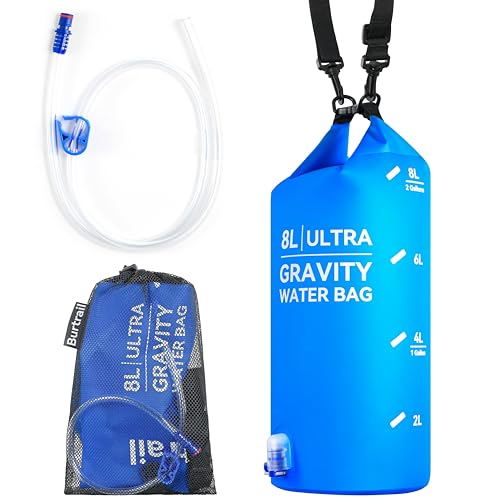
Best for: Hikers who already own a squeeze filter and want to run it by gravity.

Our take

A wide mouth speeds up filling at shallow sources, and the hose flow regulator lets you throttle the flow to match your filter.

Why it made the shortlist

What you get is a reservoir, not a filter, and it earns its place as the cheapest way into gravity filtering for hikers who already own a compatible straw. The listing names Sawyer-style Mini, Squeeze and Micro Squeeze filters as fits, so a filter you already carry becomes a hang-and-forget system for camp, and the same straw still works at a stream stop.

The 8 liter food-grade TPU bag has two-row soldered edge seams, a wide mouth for filling at a stream, an adjustable strap, a connecting hose with a flow regulator and a mesh storage bag. At the bottom of the range, this is the entry pick of this shortlist by a wide margin, and the saving comes from leaving the membrane out.

Pick it up when you already trust a hollow fiber straw and want a gravity setup without buying a second filter that duplicates it, and when a big bag at camp beats squeezing a small pouch.

What works

  • Cheapest way to go gravity
  • Wide mouth fills quickly at streams
  • Double-soldered seams for durability
  • Hose flow regulator included

Watch out for

  • Needs a separate compatible filter
  • No filter or treatment included

Methodology

How We Built This Shortlist

Each pick was assessed across 5 criteria weighted for real-world use.

01

System type fit

Every pick was assessed as a gravity system and asked whether the reservoir, hose and filter work as one unit. A kit that needs extra parts was scored on what you would still have to buy. Gravity is judged separately from pump and squeeze filters. That kept the comparison fair.

02

Reservoir and group size

From the product specs, we matched stated reservoir volume to how many people each kit can realistically serve. Solo and pair trips favored the 1 gallon bag, while group camps favored the 12 liter and 4 liter systems. Oversized bags earned no credit on a solo trip.

03

Membrane and standards wording

We read the micron rating, the stage list and any standards language for exactly what it claims. A 0.1 micron hollow fiber membrane addresses bacteria and protozoa, not viruses or dissolved chemicals. Listings that say designed to meet a standard were scored below listings that say certified.

04

Serviceability

A budget gravity system should last several seasons, so replaceable membranes, carbon and backflush options counted. The comparison looked at how each pick handles clogging and wear. A sealed unit with no spare parts lost ground to a modular design.

05

Honest scope

We scored picks on what the listing and category knowledge support, not on marketing adjectives. A bag alone is not a filter, a carbon stage improves taste but does not protect against pathogens, and a stated flow figure is a best case. Any claim that stretched beyond that was marked down.

Decision guide

Match a Budget Gravity Water Filter for Backpacking to Your Camp Setup

By Group Size

Reservoir volume is the first filter on this list. Match it to the number of people you are filtering for.

Group sizeReservoir needRecommended pick
One or two hikersAbout 1 gallonIRRABLY 1-Gallon
Small group of three to fourAbout 2 gallonsMaicoceter 2-Gallon
Family or large campAround 12 literssvsudsom 12L
Group wanting fast flow4 liters in minutesPlatypus GravityWorks
Already own a squeeze filterJust a bagBurtrail Bag

By Budget

Read each band as a relative position inside this shortlist, not a quoted price. The spread is wide because one pick is a bag alone and one is a full group system.

Price bandWhat it buysRecommended pick
Entry of this shortlistA reservoir to pair with a filter you ownBurtrail Bag
Lower-mid of this shortlistA complete one gallon systemIRRABLY 1-Gallon
Mid of this shortlistA two gallon system with replaceable partsMaicoceter 2-Gallon
Upper-mid of this shortlistA 12 liter group reservoirsvsudsom 12L
Top of this shortlistA fast two-reservoir group systemPlatypus GravityWorks

Complete System vs Bag Only

The cheapest gravity option is a bag you pair with an existing filter. The right answer depends on what is already in your kit.

Complete system

A bag, hose and filter in one box that works on arrival. IRRABLY 1-Gallon, Maicoceter 2-Gallon, svsudsom 12L and Platypus GravityWorks are in this group.

Bag only

A reservoir that uses a filter you own, which keeps cost down and avoids duplicate gear. Burtrail Bag is the pick, and it assumes a compatible squeeze or straw filter.

Buy Burtrail Bag if you own a straw filter, and a complete kit if you do not.

By Maintenance and Service Life

How the system ages matters more than how it performs on day one. Look at what you can replace and how you can track wear.

Maintenance priorityWhat to look forRecommended pick
Replaceable parts over many seasonsSeparate membrane and carbonMaicoceter 2-Gallon
Visible filter-life trackingA countdown readoutMaicoceter 2-Gallon
Replaceable element at a group scaleLarge reservoir and elementsvsudsom 12L
Established design with spare partsA mature hollow fiber systemPlatypus GravityWorks

For Base Camp Cooking Specifically

Base camps use water in volume for cooking, washing and drinking. A gravity system fits because it works while you do other chores.

Look for

A big reservoir, reinforced hang straps and a hose that reaches a clean container. A shutoff clamp or regulator helps control the flow while you cook, as the Burtrail Bag hose regulator does.

In this comparison

svsudsom 12L has the capacity, Platypus GravityWorks has the speed and the shutoff clamp, and Maicoceter 2-Gallon sits between them.

When to Spend More

Extra spend should buy speed, capacity or serviceability you will actually use.

Spend more if

You camp with groups, cook often or plan to keep the system for years. Platypus GravityWorks and svsudsom 12L justify the step with speed and capacity.

Save if

You hike solo, light and short. IRRABLY 1-Gallon or Burtrail Bag with an existing filter covers most trips for the least outlay.

FAQ

Before You Bring One Home

How high should I hang a gravity filter?

Higher is faster. Flow comes from the weight of the water column, so hang the bag as high as you comfortably can, ideally above head height. A tall branch, a trekking pole propped against a tree or a tarp ridgeline all work. If flow slows, raise the bag, backflush the filter or check the hose for a kink.

Does a 0.1 micron gravity filter remove viruses?

Not by itself. At 0.1 micron the hollow fiber stops bacteria and protozoa, yet viruses are far smaller and slip through. If viruses are a concern on your route, add chemical treatment or use a purifier designed for them. The carbon stage in some kits improves taste, not safety.

Is a gravity filter better than a squeeze filter?

They suit different moments. Gravity wins at camp, where you set it up and walk away, and it handles group volume easily. A squeeze or pump filter wins on trail stops where you fill a single bottle and keep walking. Many hikers carry a straw filter and add a bag for camp.

What does designed to meet NSF/ANSI 42, 372 and 401 mean?

Those standards cover taste and odor, lead-free materials and emerging contaminants, and the phrase designed to meet is not the same as certified. None of them is a microbiological claim on its own. Treat that listing language as a statement about materials and aesthetics, and rely on the membrane rating for bacteria and protozoa.

Can I use a bag alone like the Burtrail with any filter?

Only with filters that thread onto the bag's hose connection. The listing names Sawyer-style Mini, Squeeze and Micro Squeeze straws as compatible, so check your filter's model before you buy. If your filter uses a different thread, you may need an adapter.

How do I clean a gravity filter in the field?

Backflush the membrane when flow drops, using a syringe or clean water pushed backward through the filter. Wipe the bag opening, and let the system dry before storage so mold does not grow. Keep the filter from freezing, since trapped water can crack the fibers and leave no visible damage.

Bottom line

The short version

Browse more budget gravity water filters for backpacking on Amazon →
Danny Walker, Camping Editor at RV Gear Lab

About the author

Danny Walker

Camping Editor at RV Gear Lab

Danny covers camping gear, campsite setup, outdoor power, sleep systems and practical camping advice, with a focus on helping campers make better gear decisions.

More from Danny →Editorial standards

Keep reading

Related guides