

We research everything we recommend. When you buy through our links, we may earn a commission. Learn more

Buying guide · 11 min read · Updated October 2, 2026

5 Best Budget Water Filters for a Backpacking Trip in 2026: A Practical Camping Guide

Five budget water treatment options for a backpacking trip, from a gravity filter to tablets, compared on flow, capacity, charging and backup value.

Danny WalkerBy Danny WalkerCamping Editor at RV Gear Lab5 products comparedSpec-sheet researched

At a glance

Our top picks

Planning water for a backpacking trip is closer to packing a first-aid kit than shopping for a gadget. You want a primary method that gets you through the days between sources, plus a backup that still works if the primary clogs, freezes or runs out of battery. A single clever filter is rarely the whole answer, and the cheapest plan usually combines two cheap tools rather than one expensive one. Start by estimating how many liters you will drink and cook with each day, then work out how far apart the reliable sources sit on your route.

That is the logic behind this shortlist. It mixes a gravity system, a pocket pump-style filter, a powered purifier and a pack of chemical tablets, because each solves a different part of the trip, and each carries a different weight, effort and failure profile. A fifth pick, an RV-style inline hose filter, earns a slot as the tap filter you use at the trailhead or car camp before the miles begin, which is a job a lightweight trail filter does less well because campground taps are chlorinated rather than silty.

Read each pick for what it does to the water. A hollow fiber filter physically screens bacteria and protozoa, while tablets chemically treat water that has been strained of particles, and a carbon hose filter improves taste but is no wilderness barrier at all. Matching the method to the water is the single most useful habit on a trip, and it costs nothing to learn before you leave home. Write the plan on a card if you like: source, filter, backup, and how many liters you expect to carry between stops.

RV Gear Lab field notes

The Campsite Fit Check

Start with the job
VFX All-in-One Portable Gravity Water Filter System for Camping & Hiking leads this shortlist for Solo hikers and pairs wanting a complete, no-pumping kit for multi-day trips.. Use that fit as a reference point, then compare the alternatives against your own space and workload.
Specs that separate the picks
The first details to compare are Hollow fiber, bacteria and protozoa, 0.01 micron triple filtration, 397 mg tablets, 100 pack. Confirm the exact model and included components before ordering.
Trade-off to plan for
Bladder needs a branch or hook above

Before you buy

What Matters Before You Choose a Budget Water Filter for a Backpacking Trip

Key buying criteria so you get the right fit the first time.

  1. 01

    Liters per day and trip length

    A hiker typically needs several liters of drinking and cooking water per day, and that number climbs in heat or at altitude. Multiply it by trip length and by how far apart the sources are to learn how much capacity you must carry or treat. A 1,000 liter cartridge is plenty for one trip but may be tight on a season of group outings. Check the stated liters in the listing, not an adjective like long-lasting.

  2. 02

    Primary method plus a backup

    No single method works in every situation, so a plan with two independent methods beats a better single tool. A gravity or pump filter can clog in silty water, a battery can die in cold weather, and tablets are slow. Pair one mechanical or powered filter with a pack of tablets that weighs almost nothing. That redundancy costs little and prevents a ruined trip.

  3. 03

    What the filter actually removes

    Hollow fiber at around 0.1 or 0.2 micron screens bacteria and protozoa such as giardia and cryptosporidium, while viruses are much smaller and generally need a 0.01 micron ultrafiltration membrane, a chemical or a purifier. Carbon and KDF improve taste and chlorine but do nothing for pathogens. Dissolved metals pass through membranes entirely. Study the listing for exactly what is claimed, and treat a missing pathogen claim as no claim.

  4. 04

    Pack weight and bulk

    Every ounce is carried for miles, so the gap between a pocket filter and a bladder kit is real. A bladder collapses flat but needs a branch to hang from, while a hard pump has a fixed size. Look at the dimensions and included parts in the listing. If the kit includes a bag or hose you will not use, you are paying in weight for it.

  5. 05

    Flow rate at the source

    A stated flow of 500 milliliters or 1 liter per minute tells you how long you will stand at a stream, and the difference matters at the end of a hot day. Powered units, gravity bags and hand pumps all behave differently, and flow drops as the filter clogs. Aim for a printed number and plan for a lower real-world pace in silty water. Treat the listing figure as a best case, and carry a prefilter cloth for muddy sources.

  6. 06

    Field maintenance and freezing

    A hollow fiber filter that freezes full of water can crack its fibers invisibly, so keep it in a pocket or sleeping bag on cold nights. Backflushing with a syringe restores flow on a clogging cartridge, and a pump needs cleaning when stroke effort rises. Check the listing for a backflush tool or cleaning pad before you plan on silty streams. Carbon hose filters should be drained before storage in the cold.

Our standards

Why You Can Trust RV Gear Lab

At RV Gear Lab, we compare products based on campsite fit, verified specifications, usability, setup requirements, weight, durability, and real-world trade-offs. We do not rank products purely on marketing claims or commission rates.

We have not personally tested every product listed. Where hands-on testing is not available, recommendations are based on verified manufacturer specifications, product documentation, use-case fit, and comparative research.

How we review camping gear →

Detailed reviews

The 5 best budget water filters for a backpacking trip, explained

01
VFX All-in-One Portable Gravity Water Filter System for Camping & Hiking
  • Hollow fiber, bacteria and protozoa
  • 3 liter bladder and backflush syringe
  • Up to 1 liter per minute
Check price on Amazon for VFX All-in-One Portable Gravity Water Filter System for Camping & Hiking (opens in a new tab)
Best for: Solo hikers and pairs wanting a complete, no-pumping kit for multi-day trips.

Our take

Backflushing with the included syringe extends the life of the cartridge on dirty streams, a maintenance step that pump filters often skip.

Why it made the shortlist

A complete kit is the argument for this pick. The box includes the hollow fiber filter, a 3 liter bladder, a mesh carry bag and a backflush syringe, so you can walk out the door without sourcing compatible parts. The membrane is described as removing bacteria and protozoa, and the listing cites a flow of up to 1 liter per minute.

Gravity does the work while you set up the tent, which frees your hands during the busiest part of camp. It sits mid-pack on price, below the powered ITEHIL and above the pocket and tablet options, and the step up from those buys a bladder, a hose and a syringe in one package that attaches to a bottle, a bladder or a tap.

Select it if you want a single primary filter for trips of two to five days and prefer sitting down with a drink over pumping, with the bladder doubling as dirty-water storage while you cook.

What works

  • Complete kit with bladder, bag and syringe
  • Hands-free gravity flow at camp
  • Backflush syringe extends cartridge life
  • Fills bottles, bladders or taps

Watch out for

  • Bladder needs a branch or hook above
  • Not a virus barrier by itself
02
FS-TFC Pocket Water Filter Survival 0.01 Micron Water Purifier
  • 0.01 micron triple filtration
  • 500 mL per minute flow
  • 4,000 liter stated capacity
Check price on Amazon for FS-TFC Pocket Water Filter Survival 0.01 Micron Water Purifier (opens in a new tab)
Best for: Ultralight hikers wanting a small filter they can carry within reach.

Our take

The lifetime warranty in the listing is a practical reassurance on a low-cost filter that will live in the top of a pack.

Why it made the shortlist

Small is the selling point here. The FS-TFC is a pocket-sized filter with a collapsible handle, and the listing describes triple filtration that starts with a sediment pre-stage and ends at a 0.01 micron membrane, with a stated flow of 500 milliliters per minute and a capacity of 4,000 liters backed by SGS certification. The sediment pre-stage protects the fine membrane from grit and extends its working life.

It slots in as the second cheapest pick in the guide, noticeably less than the VFX Gravity System, and the saving comes from dropping the bladder and hose. You draw water from a stream, push it through the handle action and fill a bottle straight away, which suits fast-moving day hikes, fastpacking and anyone who wants to refill a bottle at every stream crossing without unpacking a bladder, hose or bag from the bottom of the pack.

Commit to it when weight and size matter more than convenience, and you are happy to stand at the water source and pump for each refill, since the handle design keeps the whole unit compact enough for a hip-belt pocket or the lid pouch.

What works

  • Pocket size with a collapsible handle
  • Fast 500 mL per minute flow
  • Stated 4,000 liter capacity
  • Lifetime warranty in the listing

Watch out for

  • Hand pumping gets tiring for groups
  • Brand has little track record in the field
03
Aquatabs Water Purification Tablets, 397mg 100 Pack
  • 397 mg tablets, 100 pack
  • Treats 4 gallons in 30 minutes
  • No iodine aftertaste
Check price on Amazon for Aquatabs Water Purification Tablets, 397mg 100 Pack (opens in a new tab)
Best for: Anyone who wants a featherweight backup that works when the filter fails.

Our take

Chemical treatment needs time, so you drop a tablet in, wait the stated interval and drink, which fits an overnight camp better than a quick trail refill.

Why it made the shortlist

Tablets are the lightest insurance you can carry. The product page describes 397 milligram tablets that treat 4 gallons of water in 30 minutes, with no iodine aftertaste, and the 100-tablet pack covers many trips at a very small cost per liter relative to any mechanical filter, with no cartridge to replace or backflush after each use.

Because there are no moving parts, a tablet pack survives freezing, dropping and battery failure that would sideline the ITEHIL or a clogged hollow fiber cartridge. It costs a little less than the VFX Gravity System and weighs a fraction as much, which is why it works as a backup in every kit in this guide.

Choose it as the second layer in any plan, and add a bandana or coffee filter to strain sediment before treating cloudy water. A small strip of tablets in a first-aid kit adds almost nothing to pack weight.

What works

  • Weighs almost nothing in a pack
  • No batteries, pumps or filters to clog
  • Covers many trips from one pack
  • Works after a freeze or a drop

Watch out for

  • Needs a 30 minute wait
  • Does not remove sediment or improve cloudy water
04
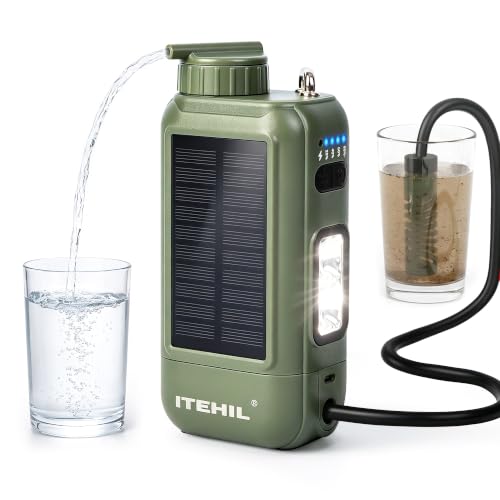
Best for: Group trips and basecamps where fast, effortless water matters most.

Our take

The listing claims removal of bacteria and viruses at the 0.01 micron level, which suits a hiker who wants more than the usual protozoa-and-bacteria barrier.

Why it made the shortlist

Electric power turns water chores into a button press. The ITEHIL pumps 700 milliliters per minute through a 0.01 micron ultrafiltration membrane with an Ahlstrom stage, and the listing states a cartridge life of up to 1,000 liters, a 5200 mAh battery good for about four hours of continuous filtering, and a hook for hanging.

Two charging routes, USB-C and solar, mean a power bank or a sunny afternoon refills it. Ranked by price, this is the most expensive pick in this guide, well above the VFX Gravity System, and the extra buys a motor, a battery and a faster flow with no pumping effort at all, plus a built-in way to recharge from the sun on longer routes.

Choose it for basecamps, family trips or any plan where multiple bottles need filling quickly and charging is easy, such as a vehicle-supported weekend with a power bank in the trunk.

What works

  • No pumping, just press a button
  • Stated 1,000 liter cartridge life
  • USB-C and solar charging options
  • Hook lets you hang it at camp

Watch out for

  • Battery adds a point of failure
  • Heavy metal claim overstates what membranes do
05
Best for: Car campers and hikers filling jugs from a campground spigot before the trail.

Our take

Because it improves taste and chlorine and leaves wilderness water treatment to the other picks, it works best as the first link in your water plan.

Why it made the shortlist

This pick belongs at the start and end of the trip, not on the trail. The listing says it carries NSF/ANSI 42 and 53 listings and uses GAC with KDF media inside a six-step Hex-Flow body, which improves the taste of campground tap water before you fill your first bottles. Starting a trip with good-tasting water also means you drink more of it on the first miles.

Bottom of the range, this is the cheapest pick in the guide and screws onto any standard hose or spigot, so you can fill a 5 gallon jug at the campground, then drive to the trailhead with water ready for the car and the first night. The flexible hose protector keeps the filter from straining an old spigot while you fill several containers in a row.

Choose this one when you car camp the night before a trip, or when your trailhead has a tap and you want to start with good-tasting water, leaving the lighter pick in your pack for the actual hike.

What works

  • Listing names NSF/ANSI 42 and 53 standards
  • Cheapest way to improve tap water taste
  • Screws onto any standard hose
  • Made in the USA

Watch out for

  • Not a trail or stream water treatment
  • Too bulky for carrying on a hike

Methodology

How We Built This Shortlist

Each pick was assessed across 5 criteria weighted for real-world use.

01

Role in a water plan

We evaluated every pick by the job it does in a backpacking water plan, whether primary treatment, backup or trailhead prep. A pick that tried to be everything lost ground to one that did its role clearly. We compared listings against that role.

02

What the listing claims

Micron ratings, flow rates, capacities and certification wording were read straight from each product listing. We separated physical filtration claims from chemical treatment and taste improvement. A claim without a stated standard was treated as marketing language.

03

Weight and packability

With product specs in hand, we weighed how much each option adds to a pack and how fragile it is. Tablets, pocket filters and a collapsible bladder scored higher here than hard-case or battery-powered options. A bulky tap filter was scored for car camp, not the trail.

04

Failure modes

A good backpacking setup survives a clog, a freeze, a dead battery or a dropped bottle. The review also asked what happens when each pick fails and whether another pick in the guide can cover it. Redundancy mattered more than any single feature.

05

Honest scope

We scored each pick on what it can reasonably do to the water, based on product specs and category knowledge. Carbon hose filters are rated for taste, hollow fiber for bacteria and protozoa, and tablets for chemical purification. Claims that stretch past that scope were flagged.

Decision guide

Match a Budget Water Filter for a Backpacking Trip to Your Camp Setup

By Trip Style

The kind of trip you are planning decides which tool goes in the pack first. Start from the trip, not the gadget.

Trip stylePrimary needRecommended pick
Solo overnight to a long weekendComplete kit, no pumpingVFX Gravity System
Fastpacking or ultralight day tripsSmallest, fastest filterFS-TFC Pocket
Group basecamp or family tripFast, effortless volumeITEHIL Electric
Any trip, as a safety netFeatherweight chemical backupAquatabs Tablets

By Budget

In the table below, a band means a relative position within this shortlist. The cheap options are strongest as parts of a combined plan.

Price bandWhat it buysRecommended pick
Entry of this shortlistTap-water taste improvement at the trailheadCamco Tastepure
Low of this shortlistA pocket filter with a stated 0.01 micron membraneFS-TFC Pocket
Lower-mid of this shortlistA pack of chemical tablets for backupAquatabs Tablets
Mid of this shortlistA complete gravity kit with bladder and syringeVFX Gravity System
Top of this shortlistA battery-powered purifier with solar chargingITEHIL Electric

Mechanical Filter vs Chemical Treatment

The two approaches fail in different ways, which is why serious hikers carry both. Pick the main one, then add the other as a net.

Mechanical filter

Physically strains water and gives instant results without waiting. VFX Gravity System, FS-TFC Pocket and ITEHIL Electric fall in this group and handle cloudy sources better than chemicals can.

Chemical treatment

Tablets weigh nearly nothing and have no parts to clog, freeze or recharge. Aquatabs Tablets is the pick here, and it works best after you strain cloudy water through a cloth.

Carry a mechanical filter as your primary and Aquatabs Tablets as the backup.

By Power and Effort

Effort at the source is the other axis that matters after a long day. Decide how much work you want at each refill.

Effort levelHow it worksRecommended pick
No effort, just waitGravity pulls water through the filterVFX Gravity System
Light effort, hand actionHandle pump pushes water throughFS-TFC Pocket
Zero effort, battery poweredMotor pumps through the membraneITEHIL Electric
Passive, no equipmentTablets treat while you do other tasksAquatabs Tablets

For Cold or Remote Trips Specifically

Cold and distance punish electronics and wet hollow fiber. Plan around them.

Look for

A method that works without batteries, a filter you can keep warm in a sleeping bag and a backup that survives freezing. Aquatabs Tablets handle all three, and a VFX Gravity System bladder keeps the cartridge inside your pack.

In this comparison

Aquatabs Tablets is the cold-proof layer, VFX Gravity System is the primary filter you keep from freezing, and ITEHIL Electric is best saved for warmer, shorter trips.

When to Spend More

Extra spend only helps when it buys speed, redundancy or convenience you will actually use.

Spend more if

You hike with a group, filter large volumes or hate pumping. ITEHIL Electric and VFX Gravity System justify the step with powered flow or hands-free gravity.

Save if

You hike solo, light and short. FS-TFC Pocket plus Aquatabs Tablets cover most trips for the least outlay.

FAQ

Before You Bring One Home

How much water should I plan to treat per day on a backpacking trip?

Most hikers drink several liters per day, more in heat or at altitude, and cooking adds to it. Multiply by your trip length and check how far apart the reliable sources are on the map. If sources are scarce, carry extra capacity and treat at each stop. Your filter's stated liter capacity should comfortably exceed the trip total.

Do I need both a filter and tablets?

Not strictly, but the pairing is cheap insurance. A filter handles cloudy water and gives instant results, while tablets weigh almost nothing and work when the filter clogs, freezes or dies. Treat tablets as a backup layer, and strain sediment out first if the water is murky.

Can an RV-style hose filter make stream water safe?

No. A carbon and KDF hose filter such as the Camco Tastepure improves taste and chlorine but is not a pathogen barrier. Use it for campground taps before the trip, and use a hollow fiber filter, an ultrafiltration unit or tablets for any wilderness source.

Does a 0.01 micron filter remove everything?

It screens bacteria, protozoa and, in ultrafiltration form, viruses, but it does not remove dissolved metals or chemicals. A listing that claims heavy metal removal from a membrane alone deserves caution. Treat the micron rating as a particle claim, and use carbon or an additional method if chemicals are a concern.

How do I keep a filter from freezing?

Water trapped inside a hollow fiber cartridge can expand and crack the fibers without leaving visible damage. On cold nights keep the filter in a pocket or inside your sleeping bag, and shake out excess water. If a filter freezes, replace it, since you cannot see the damage.

When is a battery-powered purifier worth it?

When you are filtering for several people or want zero effort at the source. A 5200 mAh battery with a stated four-hour run is plenty for a weekend, and the listing's solar and USB-C charging help on longer routes. Carry tablets as a backup, because any electronic device can fail.

Bottom line

The short version

Browse more budget water filters for a backpacking trip on Amazon →
Danny Walker, Camping Editor at RV Gear Lab

About the author

Danny Walker

Camping Editor at RV Gear Lab

Danny covers camping gear, campsite setup, outdoor power, sleep systems and practical camping advice, with a focus on helping campers make better gear decisions.

More from Danny →Editorial standards

Keep reading

Related guides