


We research everything we recommend. When you buy through our links, we may earn a commission. Learn more

Buying guide · 10 min read · Updated October 2, 2026

6 Best 100Ah RV Batteries in 2026: A Practical RV Guide

Six 12V 100Ah RV batteries, four lithium and two AGM, compared on usable watt-hours, cost per kWh, cold charging limits and case size, $143 to $320.

Bowen HigginsBy Bowen HigginsRV Editor at RV Gear Lab6 products comparedSpec-sheet researched

At a glance

Our top picks

A 100Ah label sounds like one fixed amount of power, but it is only a capacity tier, and the chemistry inside decides how much of it you can actually draw. A 12.8V lithium iron phosphate battery holds about 1,280 watt-hours and can be run down most of the way. A 12V AGM battery holds about 1,200 watt-hours on paper, yet lead-acid wears out fast when drained below half, so a sensible plan treats it as roughly 600 usable watt-hours.

We compared six 100Ah batteries, four lithium and two AGM, priced from $142.99 to $319.59. Instead of ranking them only by sticker price, we compared them by estimated cost per usable kilowatt-hour, the exact temperatures where charging stops, the case size class and how each listing handles the question of starting an engine, which none of these are built for.

RV Gear Lab field notes

The Rig Fit Check

Start with the job
BUKNUWO 12V 100Ah LiFePO4 Lithium Battery with Bluetooth leads this shortlist for budget buyers who want lithium and a phone readout. Use that fit as a reference point, then compare the alternatives against your own space and workload.
Specs that separate the picks
The first details to compare are 12.8V 100Ah, 100A BMS, 1,280Wh, BCI Group 31, Group 24, 21.6 lb. Confirm the exact model and included components before ordering.
Trade-off to plan for
Listing excerpt gives no exact cold-charging cutoff temperature

Before you buy

What Matters Before You Choose a 100Ah RV Battery

Key buying criteria so you get the right fit the first time.

  1. 01

    Usable watt-hours versus the label

    Ah is only half of the story because energy is amp-hours times voltage: 12.8V times 100Ah is 1,280Wh for lithium, while a 12V AGM is 1,200Wh. How much you can draw matters more, since lithium is routinely drained 80 percent or more while AGM lasts far longer if kept near 50 percent. Divide each price by your realistic usable kilowatt-hours, not the nameplate, and check the listing for a depth-of-discharge figure beside any cycle-life claim.

  2. 02

    Cold charging cutoff

    Lithium iron phosphate cells can be damaged by charging below freezing, so batteries with low-temperature protection simply refuse to charge near 32°F. That is safe, but it means no solar or shore charging on a cold morning. Look for the exact temperature in the listing, as the Super Empower listing gives, and for the restart temperature, since 41°F is not the same as 32°F.

  3. 03

    Group size and physical fit

    BCI group sizes such as 24 and 31 define the footprint of the tray, hold-down and cable reach. A battery that is an inch too long may not close the compartment door, and a smaller battery can slide around if the hold-down does not fit. Measure the tray, then compare it with the dimensions printed in the listing rather than relying on the group name alone.

  4. 04

    Battery management system current

    A 100A BMS can deliver about 1,280 watts at 12.8V, which is enough for a microwave on a small inverter but not for a 2,000W inverter at full draw. If you plan to run a bigger inverter, one 100Ah battery will be the limit. Read the continuous current rating, not the 3-second surge figure, and consider wiring two batteries in parallel to share the load.

  5. 05

    Charger compatibility

    Older RV converters hold a lead-acid profile that tops out near 13.6V and can leave lithium under-charged, while a lithium battery on a flooded profile may charge slowly. AGM wants a charge near 14.4 to 14.7V. Check your converter's label for a lithium or AGM mode before buying, and compare it with the battery's stated charge voltage range.

  6. 06

    Starting versus house use

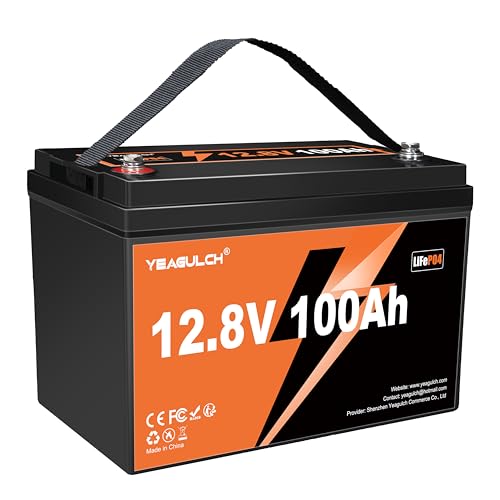
    A deep-cycle 100Ah battery is built to supply modest current for hours, not the hundreds of amps an engine starter pulls. The yeagulch listing, for example, warns against use as a starting battery. Treat these as house batteries and keep a separate cranking battery for the tow vehicle or motorhome engine, and check the listing for a CCA figure only if the seller claims dual-purpose use.

Our standards

Why You Can Trust RV Gear Lab

At RV Gear Lab, we compare products based on rig fit and power or hookup compatibility, verified specifications, usability, setup requirements, weight, durability, and real-world trade-offs. We do not rank products purely on marketing claims or commission rates.

We have not personally tested every product listed. Where hands-on testing is not available, recommendations are based on verified manufacturer specifications, product documentation, use-case fit, and comparative research.

How we review RV gear →

Detailed reviews

The 6 best 100ah rv batteries, explained

01
Best for: Budget buyers who want lithium and a phone readout

Our take

Pick this if you want lithium for the least money and like seeing charge level on your phone.

Why it made the shortlist

The Buknuwo is a 12.8V 100Ah lithium iron phosphate battery that weighs about 22 pounds, which its listing puts at roughly two thirds lighter than a comparable lead-acid unit. It has a 100A battery management system, grade A cells, an ABS case described as dustproof and weather-resistant, and Bluetooth 5.0 with an app for iOS and Android, a feature that most batteries at this price skip. It can be wired in series or parallel for larger banks.

It takes the top spot because it is the cheapest battery here at $142.99 and still includes an app, so it beats the yeagulch Group 31 by $2.30 while adding monitoring. Against the two AGM batteries it costs about the same to buy and, at an estimated 80 percent usable lithium capacity, works out near $140 per usable kilowatt-hour versus roughly $283 to $292 for AGM at 50 percent.

What works

  • Bluetooth app shows charge level without a separate monitor
  • Weighs about 22 pounds, roughly two thirds less than lead-acid
  • Series and parallel wiring allows a bigger bank later

Watch out for

  • Listing excerpt gives no exact cold-charging cutoff temperature
  • Lesser-known brand, so service history is harder to judge
02
Best for: Group 31 trays that need a lighter lithium swap

Our take

Choose it when your battery tray is a Group 31 size and you want straightforward lithium.

Why it made the shortlist

The yeagulch is a 12.8V 100Ah LiFePO4 battery rated at 1,280Wh in a BCI Group 31 case, the larger footprint many travel trailers use for their house batteries. The listing claims a lifespan up to 10 years and more than 4,000 cycles at 100 percent depth of discharge, a flat discharge curve that keeps about 95 percent of capacity available even at a 100A draw, and a weight of 21.6 pounds. Up to four units can be wired in series for 48V or in parallel for capacity.

What it offers in return is the Group 31 fit, which matters if your tray was built for a bigger lead-acid battery, plus an explicit 4,000-cycle claim at full depth of discharge.

What works

  • Fits Group 31 trays built for larger lead-acid batteries
  • Claims 4,000 plus cycles at full depth of discharge
  • Holds about 95 percent capacity even at 100A draw
  • Weighs 21.6 pounds, easy for one person to lift

Watch out for

  • No Bluetooth or screen, so charge level needs a shunt
  • Seller says not for starting or golf cart use
03
Best for: Small trailers with a Group 24 tray and cold nights

Our take

Pick it if the battery lives in a bay that can dip below freezing and you want the cutoff points in writing.

Why it made the shortlist

The Super Empower is a 12.8V 100Ah lithium battery built to BCI Group 24 dimensions, 6.49 by 10.24 by 8.98 inches, and 21.6 pounds, with M8 terminals. Its listing is unusually specific about cold behavior: charging pauses below 32°F, discharge stops at minus 4°F, and charging resumes above 41°F. It also gives charger settings, a 14.4 to 14.6 volt constant-current constant-voltage profile, and notes MPPT or PWM solar controllers can be set to a lithium profile.

What works

  • Cold limits are published: 32°F charge pause, minus 4°F discharge stop
  • Lists exact charging voltage range for chargers and solar controllers
  • Group 24 case with M8 terminals fits many small trailers
  • Costs $139.60 less than the Litime Xtra Mini

Watch out for

  • Charging resumes only above 41°F, so cold starts can lag
  • No Bluetooth, so you need a meter or shunt
The catch
What that money buys is documentation: you know exactly when it will stop charging and when it will restart, and it fits the smaller Group 24 tray found in many pop-ups and small trailers.
04
Litime 12V 100Ah Xtra Mini LiFePO4 Lithium Battery
  • 9.02 x 5.43 x 8.62 in
  • 19.13 lb, Bluetooth 5.0
  • Charge pause below 32°F
Check price on Amazon for Litime 12V 100Ah Xtra Mini LiFePO4 Lithium Battery (opens in a new tab)
Best for: Buyers comparing capacity, compatibility, included components and storage needs

Our take

Choose it for van-style installs, under-seat boxes or any bay too small for a Group 24 battery.

Why it made the shortlist

The Litime Xtra Mini measures 9.02 by 5.43 by 8.62 inches and weighs 19.13 pounds with handles, making it the smallest and lightest 100Ah battery here. The listing adds Bluetooth 5.0 through the Litime app, a 100A battery management system with more than 20 safeguards, low-temperature protection that pauses charging below 32°F, a claim of 4,000 plus deep cycles and support for up to 4P4S expansion.

The extra money buys compactness, about 29 percent less volume than the Group 24 Super Empower by our arithmetic, plus a known brand and app.

What works

  • Smallest case here: 9.02 by 5.43 by 8.62 inches
  • Lightest at 19.13 pounds including carry handles
  • Bluetooth app plus 100A BMS with 20 plus safeguards
  • Expandable to 4P4S, up to 20.48kWh

Watch out for

  • Costs $176.60 more than the cheapest lithium pick
  • Highest cost per usable kilowatt-hour in this list
05
Best for: Occasional weekend use on a lead-acid charger

Our take

Renogy 12 Volt 100Ah Deep Cycle AGM Battery makes the shortlist because works with an ordinary lead-acid converter profile.

Why it made the shortlist

The Renogy AGM is a sealed 12V 100Ah absorbent glass mat lead-acid battery that needs no watering.

It ranks fifth because lead-acid math is unkind. That works out near $292 per usable kilowatt-hour. In exchange it tolerates cold discharge better than most lithium and needs no special charge profile.

What works

  • Works with an ordinary lead-acid converter profile
  • Discharges down to minus 4°F per its listing
  • Sealed and maintenance free, no watering needed
  • Series wiring has no stated limit

Watch out for

  • Only about 600Wh usable if kept to 50 percent
  • Weight is not stated and is far above lithium
The catch
Its listing cites an upgraded electrolyte formula that discharges between minus 4 and 140°F, a 1,100A maximum discharge for 5 seconds, series connection with no stated limit and parallel connection of up to four batteries.
06
Best for: Low-use backup banks on a tight budget

Our take

This is for a low-use backup bank or a first-time buyer who wants the simplest replacement.

Why it made the shortlist

The Weize is a 12V 100Ah sealed lead-acid AGM battery measuring 12.99 by 6.73 by 8.43 inches. The listing states a 1,150A maximum discharge, a self-discharge rate of 1 to 3 percent per month, charging between 14 and 122°F, discharging between 5 and 122°F and a one-year warranty.

Against the Renogy it has a narrower stated discharge range, 5°F instead of minus 4°F at the cold end, and a short one-year warranty. Against the lithium picks it costs $27 more than the Buknuwo to deliver, by our 50 percent estimate, about 600 usable watt-hours instead of about 1,024.

What works

  • Cheapest AGM in this comparison at $169.99 each
  • Self-discharge is only 1 to 3 percent per month
  • Sealed AGM handles storage without watering
  • Charging range is stated: 14 to 122°F

Watch out for

  • One-year warranty is short for a house battery
  • Only about 600Wh usable at a 50 percent limit

Methodology

How We Built This Shortlist

Each pick was assessed across 5 criteria weighted for real-world use.

01

Usable energy, not the label

We converted every 100Ah label to watt-hours and applied an assumed usable share, 80 percent for lithium and 50 percent for AGM, to compare real energy per dollar.

02

Cold charging and discharge limits

We looked for the exact temperatures where charging pauses and discharge stops, and marked listings that do not state them.

03

Case size and weight

We compared the BCI group size or physical dimensions and the stated weight, since a 100Ah battery that does not fit your tray is the wrong battery.

04

Monitoring and protection

We checked for Bluetooth, the battery management system current rating and whether the seller limits starting or golf cart use.

05

Warranty and charger needs

We read warranty length and the stated charging voltage, because a lithium battery on a lead-acid converter profile may charge poorly.

Decision guide

Match a 100Ah RV Battery to Your RV

By Battery Size Class and Tray

Your situationRecommended pickWhy
Group 31 tray built for a large lead-acid batteryyeagulch Group 31Matches the Group 31 footprint at 21.6 lb
Group 24 tray in a small trailer or pop-upSuper Empower G24Group 24 case with M8 terminals
Van, under-seat box or very tight bayLitime Xtra Mini9.02 by 5.43 by 8.62 inches, 19.13 lb
Open, ventilated area and little weight concernWeize AGMPlain sealed AGM, 12.99 by 6.73 by 8.43 in
Want a phone readout and cheapest lithiumBuknuwo 100AhBluetooth 5.0 at $142.99

By Budget

BudgetRecommended pick
Under $150Buknuwo 100Ah or yeagulch Group 31
$150 to $180Weize AGM, Renogy AGM or Super Empower G24
Around $320Litime Xtra Mini

Lithium vs AGM at 100Ah

Lithium (LiFePO4)

About 1,280Wh nominal and designed to be drawn down by around 80 percent or more without shortening its life. It is far lighter and holds voltage under load. The Buknuwo, yeagulch, Super Empower and Litime Xtra Mini are in this group.

AGM lead-acid

About 1,200Wh nominal, but cycle life drops quickly below 50 percent depth of discharge, so plan on about 600Wh. It works with a basic lead-acid charger and tolerates cold discharge well. The Renogy AGM and Weize AGM are in this group.

At prices within about $30 of each other, lithium roughly doubles the usable energy, so default to lithium unless your charger or budget forces AGM.

By Cold-Weather Exposure

Where the battery sitsRecommended pickWhy
Unheated bay that dips below 32°FSuper Empower G24Publishes pause at 32°F and restart above 41°F
Interior cabinet, heated spaceBuknuwo 100AhCheapest lithium, cold limits not stated
Cold camping, charger is lead-acid onlyRenogy AGMDischarges to minus 4°F, no lithium profile needed
Freezing nights but charging happens by dayLitime Xtra MiniCharge pause below 32°F is stated

For Boondocking With Solar Specifically

Look for

A stated charge voltage range near 14.4 to 14.6 volts for lithium, solar controller compatibility and a cold-charge cutoff. A 100Ah lithium battery stores about 1,280Wh, so a 300Wh daily load means roughly three days of reserve at 80 percent usable.

In this comparison

The Super Empower G24 states its charging voltage and notes MPPT and PWM controllers can use a lithium profile, which makes it the clearest match. The Buknuwo adds app monitoring to see the solar charge arriving.

When to Spend More

Spend more if

You are limited by space and want an app; the Litime Xtra Mini is 29 percent smaller than the Super Empower G24, and its $319.59 price pays for that compact case.

Save if

The tray has room and the battery stays warm; the Buknuwo at $142.99 and yeagulch Group 31 at $145.29 both give 1,280Wh for under half the Litime's price.

FAQ

Before You Bring One Home

Is a 100Ah battery enough for an RV?

For a weekend with lights, a water pump and phone charging, one 100Ah lithium battery usually works, as 1,280Wh at 80 percent usable covers about 1,000Wh a day. A fridge on a compressor or an inverter-driven microwave will use more, so many owners run two batteries.

Can I replace a 100Ah AGM with lithium without changing the wiring?

Often yes if the Group size matches, but you must check the charger. A lead-acid converter may undercharge lithium, so look for a converter with a lithium mode or use a DC-DC charger. Also confirm the cable gauge handles the BMS current.

Is the Litime Xtra Mini worth the extra cost?

Only if space is the constraint. It stores the same 1,280Wh as the $142.99 Buknuwo, and its edge is a case about 29 percent smaller than a Group 24. In a roomy tray, that money is better spent on a second battery.

How do I connect two 100Ah batteries?

For 12V, wire positive to positive and negative to negative in parallel, and use identical batteries with equal-length cables so the load shares evenly. Wiring in series gives 24V and is only right if your system is 24V. Stay within the maker's limit of four units.

Can AGM and lithium batteries be mixed in one bank?

No. They need different charge voltages and have different internal resistances, so one chemistry will be overcharged or undercharged. Keep one chemistry per bank and replace all batteries at once.

How should I store a 100Ah battery over winter?

Store lithium at around half to 80 percent charge, disconnected, in a space above its low-temperature charging limit when possible. Store AGM fully charged, because the Weize listing recommends keeping it charged, and top it up every few months.

Bottom line

The short version

Browse more 100ah rv batteries on Amazon →
Bowen Higgins, RV Editor at RV Gear Lab

About the author

Bowen Higgins

RV Editor at RV Gear Lab

Bowen covers RV power, water systems, towing and leveling, upkeep and interior comfort, with a focus on matching gear to the rig, the hookups and the way you actually travel.

More from Bowen →Editorial standards

Keep reading

Related guides