

We research everything we recommend. When you buy through our links, we may earn a commission. Learn more

Buying guide · 11 min read · Updated October 2, 2026

6 Best Budget Portable Power Stations for Home Backup in 2026: A Practical RV Guide

Budget portable power stations for home backup, ranked by usable running hours, recharge speed between outages and starting surge for fridges and pumps.

Bowen HigginsBy Bowen HigginsRV Editor at RV Gear Lab6 products comparedSpec-sheet researched

At a glance

Our top picks

Home backup is an arithmetic problem before it is a shopping problem. Your outage is a number of hours, your essentials draw a number of watts, and the battery has to cover the product of the two with a margin left over. A station that looks cheap on the page but holds too few watt-hours will quit on the second night, so capacity and recharge speed matter far more here than the number of USB ports or the size of the display, and a few extra hours of runtime is worth more than any convenience feature.

This shortlist leans on large LiFePO4 stations in the roughly 1,800Wh to 2,300Wh class, with a mid-size 1,024Wh unit and a compact starter kit at the bottom. Four of the six bundle or pair with a 200W panel, which turns a one-night cushion into something that refills during a multi-day storm. All of them recharge from a standard wall outlet, which is the path most households will actually use. Because each step up the list mostly adds watt-hours, the main decision is how many hours your own essentials really need.

We compared the picks by what they can run and how long, using stated capacity, continuous and surge watts, and the recharge window between outages. Cost sits in the background as a band, because the useful question is what each step up in price adds: more hours, a faster comeback, or a panel in the box. The order below runs from the strongest overall value to the leanest entry. That framing keeps the comparison honest, since a cheaper unit that runs out in the dark is no bargain at all.

RV Gear Lab field notes

The Rig Fit Check

Start with the job
EBL 2400W Portable Power Station, 1843.2Wh LiFePO4, 12 Outlets leads this shortlist for Households wanting fridge, router and lights covered through a long outage.. Use that fit as a reference point, then compare the alternatives against your own space and workload.
Specs that separate the picks
The first details to compare are 1843.2Wh LiFePO4, 2400W AC, 1,024Wh LFP, 1,500W AC (3,000W surge). Confirm the exact model and included components before ordering.
Trade-off to plan for
55 lbs is a two-hand carry

Before you buy

What Matters Before You Choose a Budget Portable Power Station for Home Backup

Key buying criteria so you get the right fit the first time.

  1. 01

    Usable Hours, Not Headline Watt-Hours

    Watt-hours is the size of the fuel tank, but you never get all of it at the outlet. Inverter conversion and standby draw take roughly 10 to 15% off the top, so divide the load in watts into about 85% of the rated capacity. A refrigerator that averages around 100W over a day would drain a 1843Wh unit in about 15 hours, while the same fridge on a 292Wh unit lasts under three. Write down your essentials and their wattage from the nameplates before you pick a size, and buy the capacity that covers a full outage with a margin.

  2. 02

    Recharge Window Between Outages

    A big battery that takes ten hours to refill is a poor match for storms that come back to back. Wall input watts set the pace, so look for a stated time to full and the AC input rating rather than a phrase like fast charging. Units with adjustable input let you throttle the draw when you share a circuit with a space heater or a kitchen. Solar input matters just as much, since a long outage with no grid turns the panel into your only way to refill.

  3. 03

    Starting Surge for Compressors and Pumps

    The steady rating is continuous watts, while surge watts cover the brief spike when a motor starts. A refrigerator might run at 700W yet need roughly 2,200W for an instant to kick on, so a common rule is to want surge at least twice the continuous rating for compressors, pumps and power tools. Resistive loads like a kettle have no surge but need the full continuous number the entire time. Add up what runs together and make sure both ratings clear it.

  4. 04

    Solar Input Ceiling

    The maximum solar input in watts and volts sets how quickly a panel can refill the battery. In use, a 200W panel adds roughly 600 to 800Wh on a good sunny day, so a unit that accepts 500W or more of solar can refill a large battery in a couple of days. Check the voltage window too, because a panel outside it will not charge. If a listing bundles a panel, note its wattage; if it says optional, budget for a panel of your own.

  5. 05

    Calendar Life Versus Cycle Life

    A backup unit mostly sits idle, so calendar life matters as much as cycle count. Cycle life for LiFePO4 is commonly rated at 3,000 to 4,000, while older NMC cells fade after roughly 500 to 800, which is why we favor LFP for a unit that waits on a charger for years. Seek the end-of-life capacity, such as 70% or 80%, and the depth of discharge behind it, because a rating quoted at a shallow discharge flatters the number. A battery rated for ten years of service is a better fit for an emergency box than one that wins on weight.

  6. 06

    Outlet Layout and Load Spreading

    Four AC outlets matter when you want a fridge, a freezer, a router and a lamp live together. Pure sine wave output is required for laptops, CPAP machines and variable-speed fridges, so look for it by name. Total output is shared across ports, so the 2400W label is the ceiling for everything combined and not a per-outlet rating. Count the outlets you need first, then match the layout to your extension cords.

Our standards

Why You Can Trust RV Gear Lab

At RV Gear Lab, we compare products based on rig fit and power or hookup compatibility, verified specifications, usability, setup requirements, weight, durability, and real-world trade-offs. We do not rank products purely on marketing claims or commission rates.

We have not personally tested every product listed. Where hands-on testing is not available, recommendations are based on verified manufacturer specifications, product documentation, use-case fit, and comparative research.

How we review RV gear →

Detailed reviews

The 6 best budget portable power stations for home backup, explained

01
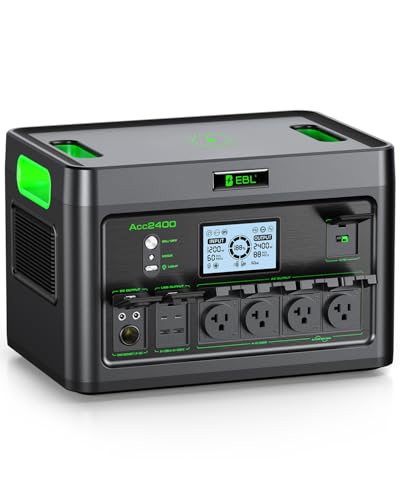
EBL 2400W Portable Power Station, 1843.2Wh LiFePO4, 12 Outlets
  • 1843.2Wh LiFePO4, 2400W AC
  • 12 outlets, 4 AC, USB-C PD 100W
  • 55 lb body with side handles
Check price on Amazon for EBL 2400W Portable Power Station, 1843.2Wh LiFePO4, 12 Outlets (opens in a new tab)
Best for: Households wanting fridge, router and lights covered through a long outage.

Our take

Cell ratings run to over 3,500 cycles and a service life above ten years, and dual-side handles make the 55 lb body manageable to move between rooms.

Why it made the shortlist

The EBL pairs a 1843.2Wh LiFePO4 battery with a 2400W AC rating spread across four AC outlets, two USB-A ports and fast-charging USB-C, for twelve outlets in total. That is enough stored energy to carry a refrigerator, a router and a handful of lights across an overnight blackout with hours to spare. The result is a backup that feels like a small appliance, not a gadget.

1,024Wh Jackery 1000 v2 makes the cleanest comparison, since EBL 1843Wh holds about 800Wh more energy, which is the difference between getting through the night and getting through a day. An emergency power mode switches to battery in 0.1 seconds, so a desktop on the same circuit keeps its session while the lights flicker. That pairing of capacity and fast switching is what makes it the anchor of this list.

EBL 1843Wh takes the top slot for a family wanting the most backup hours before the budget climbs into the upper tier. Its dual-side handles also make it easy to shift beside a kitchen counter or garage workbench.

What works

  • Big battery covers an overnight outage easily
  • Four AC outlets for fridge plus extras
  • Emergency mode switches in 0.1 seconds
  • Long-life LiFePO4 cells, 3,500+ cycles

Watch out for

  • 55 lbs is a two-hand carry
  • Solar panel is not part of the box
02
GRECELL 2400W Portable Power Station, 1843.2Wh LiFePO4, 12 Outlets
  • 1843.2Wh LiFePO4, 2400W AC
  • 10W wireless pad, 4 AC ports
  • 16.9 x 11.8 x 11 in, 55 lb
Check price on Amazon for GRECELL 2400W Portable Power Station, 1843.2Wh LiFePO4, 12 Outlets (opens in a new tab)
Best for: Buyers who plan to add a 200W panel and a wireless pad later.

Our take

Overcharge, temperature and low-battery protection are built in, and the 55 lb body measures 16.9 x 11.8 x 11 inches with a handle on each side.

Why it made the shortlist

The Grecell shares the same 1843.2Wh LiFePO4 core and 2400W continuous AC output as the EBL, and adds a 10W wireless charging pad on top for phones. Four AC ports, two USB-A, two USB-C, two DC outputs and a car charger fill out a layout that runs a working fridge and a router together. Grecell 1843Wh becomes a flexible base for a long outage kit.

Where the EBL leans on its emergency switching mode, the Grecell lists a clean input menu: wall AC, car DC and a 200W portable solar panel sold as an add-on. Grecell 1843Wh becomes a tidy foundation, since you can start with wall charging and bolt solar on later when the budget allows. Because runtime matches the leader, the choice between the two comes down to extras.

Grecell 1843Wh is built for a household that wants the same runtime as the leader and prefers to buy solar on its own schedule. The wireless pad is a small convenience when a bedside table is the sole surface free.

What works

  • Same 1843Wh runtime as the EBL
  • Wireless pad on top for phones
  • Handles on both sides for lifting
  • Accepts a 200W panel and car DC

Watch out for

  • No UPS or switchover time is listed
  • Panel must be bought separately
03
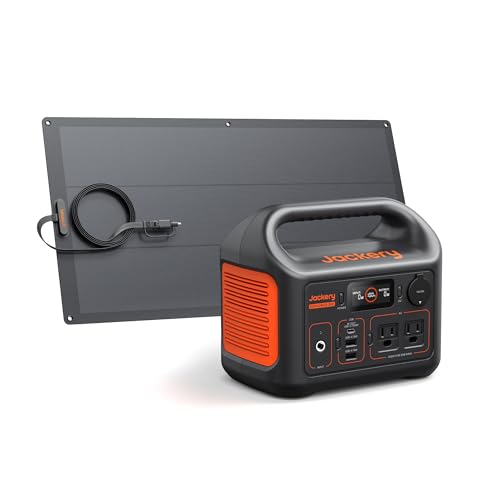
Jackery Solar Generator 1000 v2 with 200W Solar Panel, 1024Wh LiFePO4
  • 1,024Wh LFP, 1,500W AC (3,000W surge)
  • 200W solar panel in the bundle
  • 50 minute emergency full charge
Check price on Amazon for Jackery Solar Generator 1000 v2 with 200W Solar Panel, 1024Wh LiFePO4 (opens in a new tab)
Best for: People wanting a panel in the box and a quick turnaround.

Our take

The LFP battery keeps over 70% of its capacity after 4,000 cycles, which is roughly a decade of regular use.

Why it made the shortlist

The Explorer 1000 v2 pairs a 1,024Wh LFP battery with a 1,500W AC output that peaks at 3,000W, and the bundle includes a 200W solar panel. Two pure sine wave AC ports, two USB-C ports, a USB-A port and a DC car socket cover a fridge, a router and a few electronics. That mix of output and ports suits a family kitchen during a storm.

EBL 1843Wh is the yardstick, and Jackery 1000 v2 gives up some capacity and gets back speed: emergency charging in the Jackery app brings it from empty to full in 50 minutes, with a quiet 30 dB overnight mode available when noise matters more. As a rule, a 10ms UPS function protects gear on the same circuit. The fast recharge also means one battery can cover two outages in the same week.

Jackery 1000 v2 suits a home that sees short, frequent outages and wants a unit that recovers fast and ships with its own panel. Add the included panel and the unit becomes a small self-contained energy system for the yard.

What works

  • Panel included, ready to refill from the sun
  • Full recharge in 50 minutes via the app
  • Pure sine wave AC and a 10ms UPS
  • Quiet 30 dB overnight charging mode

Watch out for

  • 1,024Wh runs a fridge for one night, not two
  • Fast charging needs the app
04
SolarPlay Portable Power Station Q2501, 2160Wh, 2400W, with 200W Panel
  • 2160Wh LiFePO4, 2400W AC
  • 21.5 kg, 200W panel included
  • 14 ports, adjustable 300 to 1100W input
Check price on Amazon for SolarPlay Portable Power Station Q2501, 2160Wh, 2400W, with 200W Panel (opens in a new tab)
Best for: Multi-day storm preparedness where lifting weight still matters.

Our take

Fourteen output ports, including four AC, a 100W USB-C and a 12V car socket, run a fridge, a laptop and several small devices at once.

Why it made the shortlist

The Q2501 packs 2160Wh of LiFePO4 capacity and a 2400W inverter into a 21.5 kg body that the maker calls 23% lighter and more compact than conventional units with similar capacity. At home, a 200W solar panel comes in the bundle, so the unit can refill itself during a multi-day storm. That weight-to-capacity ratio is the standout in this size class.

Set against EBL 1843Wh, SuperPlay Q2501 holds about 300Wh more energy and charges at five adjustable input levels from 300W to 1100W, which lets you throttle wall draw to suit a shared circuit. Dual charging brings it to full in about 1.5 hours when wall and solar run together. Throttling the input also protects a shared garage circuit from tripping a breaker mid-charge.

LiFePO4 chemistry here is rated over 3,500 cycles, which makes it a sound pick for a household preparing for several days without grid power. With this many ports, the whole fridge, laptop and lighting plan fits on a single unit.

What works

  • Large 2160Wh battery with a panel included
  • Lighter body than most in this class
  • Adjustable input from 300W up to 1100W
  • Fourteen ports cover most needs

Watch out for

  • Still a two-person lift on stairs
05
SolarPlay 2500W Portable Power Station, 2304Wh, 200W Panel, 14 Ports
  • 2304Wh LFP, 2500W (5000W surge)
  • 1.5 hour full charge, 1100W AC plus solar
  • 14 ports, 0.02s UPS, 200W panel
Check price on Amazon for SolarPlay 2500W Portable Power Station, 2304Wh, 200W Panel, 14 Ports (opens in a new tab)
Best for: Whole-home essentials: fridge, freezer, router and a window AC.

Our take

Fourteen ports include four AC, three USB-C, a 100W USB-C port and an XT60, and the cells are rated for over 3,500 cycles.

Why it made the shortlist

The Cellplay is the capacity leader in this guide, with 2304Wh of LFP battery and a 2500W inverter that surges to 5000W across four AC outlets. That startup headroom suits compressors, a sump pump or a small window air conditioner that need a burst to get going. That headroom is why it tops the list for runtime and surge together.

SuperPlay Q2501 makes the cleanest comparison, since Cellplay 2304Wh adds about 140Wh of storage, a higher continuous rating and a 0.02 second UPS switchover that keeps computers and routers running through a blip. Charging at 1100W from the wall plus 500W from a panel brings it to full in 1.5 hours. The faster refill and quick switchover make it well suited to repeated storms.

Cellplay 2304Wh is built for a household that wants the longest hours and the most surge in one unit, with a 200W panel to extend the run. Its port count also lets a larger family spread phones, lights and appliances without a power strip.

What works

  • Largest battery in the shortlist
  • 5000W surge for compressor starts
  • Stated 0.02 second UPS switchover
  • Fast 1.5 hour full charge

Watch out for

  • Most expensive pick in this guide
  • Heavy enough to stay put once placed
06
Jackery Solar Generator 300 with SolarSaga 100W Light, 292Wh LiFePO4
  • 292Wh LiFePO4, 300W (600W surge)
  • 100W SolarSaga panel included
  • 7.5 lbs, 100W USB-C PD
Check price on Amazon for Jackery Solar Generator 300 with SolarSaga 100W Light, 292Wh LiFePO4 (opens in a new tab)
Best for: Apartments and renters needing phones, Wi-Fi and a CPAP for a night.

Our take

The kit ships with an AC adapter, car charger cable and user guide, and its LiFePO4 cells are rated for over 4,000 cycles before reaching 70% capacity.

Why it made the shortlist

The Explorer 300 kit is the entry pick: a 292Wh LiFePO4 battery with 300W rated AC output (600W surge) and a SolarSaga 100W Light panel in the box. At 7.5 lbs it is 17% lighter than the industry average and tucks into a closet or a go-bag. Jackery 300 kit becomes easy to stash with a go-bag.

Held to the EBL 1843Wh benchmark, Jackery 300 kit holds roughly one sixth of the energy, which is the compromise for a unit that costs a fraction as much. It covers a router, phones, laptops and a CPAP overnight, and a 100W panel brings the battery to 80% in about 2.8 hours of good sun. The compact battery refills quickly, so a single sunny afternoon restores most of it.

Jackery 300 kit is built for a renter or small household that wants a dependable essentials backup and the lowest entry cost. A kit like this suits a small apartment where a bigger box would never find a home, and the included charging cables mean there is nothing extra to buy.

What works

  • 7.5 lbs, easy to stash or carry
  • Over 4,000 cycles to 70% capacity
  • 100W USB-C charges a laptop

Watch out for

  • 292Wh cannot run a fridge through a night
  • 300W ceiling rules out most heaters

Methodology

How We Built This Shortlist

Each pick was assessed across 5 criteria weighted for real-world use.

01

Hours of Runtime

We started with stated watt-hours and divided by typical household essentials, such as a refrigerator, a router and a few lights, to see how long each unit covers them. We evaluated this from specs and applied a loss margin, so the hours are planning figures, not promises. Capacity carried the most weight in the ranking.

02

Starting Surge and Continuous Output

We read continuous and surge watts separately, since compressors and pumps need a burst to start. A fridge or sump pump can demand several times its running wattage for a moment. We favored units whose surge rating leaves real margin over their continuous rating.

03

Recharge Window

Outages repeat, so we weighed how fast each unit refills from the wall and from solar. We compared stated AC input, solar input and the time to full, and we noted which units let you adjust the draw. A fast comeback lets one battery cover two events.

04

Battery Life and Safety

All six use LiFePO4 or LFP cells, so we compared cycle ratings and the capacity they promise at end of life. We also noted built-in protections for overcharge, temperature and low battery. We based this on listing specs and brand documentation.

05

Value Within the Shortlist

We ranked each pick by band, entry through top, and asked what the step up in price buys. The answer might be more watt-hours, a panel in the box, a faster charge or a higher surge. A pick won points when the extra spend bought hours you can actually use.

Decision guide

Match a Budget Portable Power Station for Home Backup to Your RV

By Outage Length

The simplest way to pick is to decide how long you need to run, then buy the smallest unit that covers it with a margin.

Outage you plan forBest pickWhy
One night, phones, Wi-Fi, CPAPJackery 300 kit292Wh covers essentials without a fridge
One night with a fridge runningJackery 1000 v21,024Wh and 1,500W with a panel included
A full day with a fridge and lightsEBL 1843Wh1843.2Wh gives about 15 hours on a 100W load
Two to three days with solarSuperPlay Q25012160Wh plus a 200W panel to refill daily
Whole-house essentials plus a window ACCellplay 2304Wh2304Wh and 5000W surge for compressors

By Budget

Price tracks stored energy closely in this group, and the panel in the box shifts the picture for the middle tier.

Budget bandBest pickWhat it buys
Entry of this shortlistJackery 300 kit292Wh, a panel and a 7.5 lb body
Mid of this shortlistEBL 1843WhMost watt-hours per unit of spend, no panel
Mid of this shortlist, alternativeGrecell 1843WhSame battery with a wireless pad on top
Upper-mid of this shortlistJackery 1000 v2A 200W panel and 50 minute recharge
Top of this shortlistCellplay 2304WhLargest battery and the biggest surge rating

Large Reserve vs Compact Starter

The big decision is whether to carry a heavy reserve or a light unit that covers essentials only.

Large reserve (1800Wh and up)

The EBL 1843Wh, Grecell 1843Wh, SuperPlay Q2501 and Cellplay 2304Wh run a fridge and more for a day or longer, at roughly 55 lbs and up. They suit a fixed spot by the kitchen or garage.

Compact starter (under 1,100Wh)

The Jackery 300 kit and Jackery 1000 v2 are easier to lift and recover quickly. They cover phones, Wi-Fi and a fridge for a night, with the Jackery 1000 v2 adding real appliance power.

Pick the EBL 1843Wh for the best balance of hours and weight, or the Jackery 300 kit if you only need essentials.

By Recharge Source

How the battery refills decides whether a long outage is survivable, so match the unit to your power source.

Recharge sourceBest pickWhy
Wall outlet, fastestJackery 1000 v2Full in 50 minutes with emergency charging
Wall plus solar togetherCellplay 2304Wh1100W AC and 500W solar, full in 1.5 hours
Adjustable wall draw on a shared circuitSuperPlay Q2501Five input levels from 300W to 1100W
Solar only after the grid failsJackery 300 kit100W SolarSaga brings 80% in about 2.8 hours
Wall and car DC, panel bought laterGrecell 1843WhAC, DC and a 200W panel can be added

For Refrigerators and Pumps Specifically

Motor loads are the one place where a backup that looks big enough can still fail on startup.

Look for

A surge rating at least twice the continuous rating, a pure sine wave outlet and a stated UPS or emergency mode. The Cellplay 2304Wh states 5000W of surge, a strong margin for a compressor.

In this comparison

The Cellplay 2304Wh and Jackery 1000 v2 give the most startup headroom, while the EBL 1843Wh and SuperPlay Q2501 cover a standard fridge with room to spare. The Jackery 300 kit is best kept to electronics.

When to Spend More

Stepping up the shortlist buys either hours or comeback speed, so spend on whichever your outages punish.

Spend more if

Your outages last a day or more or you run a freezer and a sump pump. The SuperPlay Q2501 and Cellplay 2304Wh add hundreds of watt-hours and a panel in the box.

Save if

Outages are short and you only need Wi-Fi, a CPAP and phones. The Jackery 300 kit does that, and the EBL 1843Wh covers a fridge without paying for a bundled panel.

FAQ

Before You Bring One Home

How many watt-hours do I need to run a refrigerator overnight?

Estimate the fridge's daily draw, which you can estimate from its nameplate or energy label, then add lights and a router. Per the listing, a 1,000Wh class unit like the Jackery 1000 v2 can cover one night, and a 1843Wh unit gives margin for a second. Build in a 10 to 15% loss for the inverter.

Will a 2400W station start my refrigerator?

Usually yes, provided the surge rating clears the compressor's starting spike. The Cellplay 2304Wh lists 5000W of surge, and the Jackery 1000 v2 lists 3,000W. Keep the fridge's running watts and surge on the nameplate in mind when you add other loads.

Do I need a solar panel for home backup?

A panel is optional for short outages but valuable for multi-day ones, because it keeps the battery topping up during the day. The Jackery 1000 v2, SuperPlay Q2501, Cellplay 2304Wh and Jackery 300 kit include one, while the EBL and Grecell leave it to you. For scale, a 200W panel is a common add-on for the two larger EBL-class units.

Is a power station a replacement for a whole-house generator?

No, it covers selected circuits through extension cords rather than feeding your electrical panel. Quiet, fuel-free and safe indoors: those are things a gas generator is not. It suits essentials such as a fridge, Wi-Fi and lighting.

How should I keep a backup unit ready between storms?

Keep it topped up but not pinned at full for months, and store it somewhere cool and dry. Run it for an hour every few months so you know it works and can find the outlets in the dark. Practice pairing the app if your model uses one.

Is the EBL or the Grecell the better buy?

They share the same 1843.2Wh LiFePO4 battery and 2400W AC rating, so runtime is identical. The EBL lists a 0.1 second emergency switching mode, while the Grecell adds a 10W wireless pad on top. Pick the EBL if you want the protection for a desktop, and the Grecell if you want the pad.

Bottom line

The short version

Browse more budget portable power stations for home backup on Amazon →
Bowen Higgins, RV Editor at RV Gear Lab

About the author

Bowen Higgins

RV Editor at RV Gear Lab

Bowen covers RV power, water systems, towing and leveling, upkeep and interior comfort, with a focus on matching gear to the rig, the hookups and the way you actually travel.

More from Bowen →Editorial standards

Keep reading

Related guides