

We research everything we recommend. When you buy through our links, we may earn a commission. Learn more

Buying guide · 11 min read · Updated October 2, 2026

5 Best Budget Portable Power Stations for Boondocking in 2026: A Practical RV Guide

Five budget portable power stations for boondocking, compared by daily watt-hour budget, solar input and how many off-grid days each one stretches.

Bowen HigginsBy Bowen HigginsRV Editor at RV Gear Lab5 products comparedSpec-sheet researched

At a glance

Our top picks

Boondocking is an accounting problem before it is a gear problem. Add up what the camp uses in a day, in watt-hours, then ask how many of those days a battery holds and how much of it the sun can put back. A phone, a laptop, LED lights, a vent fan and a 12V fridge can total a few hundred watt-hours daily, and that single number matters more than any inverter rating printed on the front of the box. Once the daily figure is known, most buying decisions get easier and several expensive mistakes become obvious.

That is why this shortlist ranks off-grid usefulness, not headline watts. The CTOLITY AP1000 brings 1,024Wh and it recharges from the wall to 80 percent in about 45 minutes, which matters for a quick town stop. The Jackery arrives with a 40W solar panel in the bundle. The Bluetti accepts a very fast wall charge, and the WEN and the DaranEner 192Wh reward a lean, careful kit. A budget here buys honest storage and a way to refill it, and each section names the mechanism behind any step up. That keeps the comparison grounded in how camps really run.

What gets dropped at this price is real: no expandable battery banks, no 12V hard-wired install and, on the lower units, almost no solar capacity worth building a system around. A stay of more than two or three days with a fridge usually needs a bigger system or a generator backup. We ordered the six by how many off-grid days of ordinary camp use each can plausibly carry, using only the specs the listings state. Where a listing is silent on a figure, the pick's section says what to ask a seller instead of guessing.

RV Gear Lab field notes

The Rig Fit Check

Start with the job
CTOLITY AP1000 1800W Portable Power Station, 1024Wh LiFePO4 Battery (Peak 3600W) Solar Generator leads this shortlist for Boondockers who want a full day-and-a-half of fridge and device power.. Use that fit as a reference point, then compare the alternatives against your own space and workload.
Specs that separate the picks
The first details to compare are 1,024Wh LiFePO4, 1800W (3600W peak), 292Wh LiFePO4, 300W (600W surge), 288Wh LFP, 600W (1500W power lifting). Confirm the exact model and included components before ordering.
Trade-off to plan for
Most expensive pick in this guide

Before you buy

What Matters Before You Choose a Budget Portable Power Station for Boondocking

Key buying criteria so you get the right fit the first time.

  1. 01

    Daily Watt-Hour Budget

    Add up each device's watts multiplied by its hours of use to find a camp day's watt-hours. A phone and laptop may use 60Wh, LED lights 20Wh, a vent fan 60Wh and a 12V fridge several hundred, so a 288Wh pack covers a light day and not a fridge day. Divide a pack's capacity by that daily number and trim roughly 20 percent for conversion loss. The result is the honest figure for how many days the unit lasts.

  2. 02

    Solar Input Limits

    A power station only refills from the sun at the rate its charge controller allows. A 60W maximum solar input means a 100W panel is wasted, while a larger unit may accept several hundred watts. Look for a maximum solar watts and a voltage range in the listing. A panel that exceeds either limit will not charge the unit at full speed, or at all.

  3. 03

    Wall Recharge Speed

    Boondockers often resupply at a campground or in town, and a quick wall charge makes a short stop count as a real refill. The Bluetti Elite 30 and the CTOLITY AP1000 reach 80 percent in about 45 minutes, while smaller units take several hours. Look for an 80 percent figure with the wattage behind it. A 100W input means overnight, not a lunch break.

  4. 04

    Surge for Fridge Starts

    A 12V compressor fridge or a pump may need a starting surge well above its running draw. If the inverter's surge rating is too low, the unit trips and shuts off, and the camp goes dark. Look for a surge or peak figure of at least twice the continuous rating for motor loads, and match it to the fridge's label.

  5. 05

    UPS and Pass-Through Behavior

    Some stations switch to battery in 10ms to 20ms when the wall power drops, protecting a CPAP or a router. That is valuable for a camp that alternates between shore power and off-grid use. Look for a stated UPS switch time in the listing, since not every unit supports charging and discharging at once.

  6. 06

    Weight and Carry Plan

    A 1,024Wh unit under 25 lb is a two-handed lift, while a 5.73 lb unit slips under a seat. Think about how far the unit moves each day and who lifts it. Weight, handle design and the include-in-box cables decide whether the unit goes along or stays in the garage.

Our standards

Why You Can Trust RV Gear Lab

At RV Gear Lab, we compare products based on rig fit and power or hookup compatibility, verified specifications, usability, setup requirements, weight, durability, and real-world trade-offs. We do not rank products purely on marketing claims or commission rates.

We have not personally tested every product listed. Where hands-on testing is not available, recommendations are based on verified manufacturer specifications, product documentation, use-case fit, and comparative research.

How we review RV gear →

Detailed reviews

The 5 best budget portable power stations for boondocking, explained

01
Best for: Boondockers who want a full day-and-a-half of fridge and device power.

Our take

Chosen for a boondocker who runs a compact fridge, a fan and devices on a one to two day cycle and wants the shortest possible gap between a drained pack and a full one.

Why it made the shortlist

The CTOLITY AP1000 stores 1,024Wh in a LiFePO4 pack and drives it through an 1800W inverter with a 3600W peak, the biggest pack and the strongest inverter among the five. HyperFlash charging pulls the pack to 80 percent in about 45 minutes from a wall outlet, which turns a short town stop into a near-full recharge.

Set beside the Bluetti Elite 30, it brings roughly 3.5 times the stored energy, which is the figure that decides how many hours a 12V fridge, lights and a laptop keep running. Under 20ms UPS switching, AC, solar and car charging, and a body under 25 lb round out a unit that carries between a truck bed and a camp table.

It sits at the top of this shortlist on price, and the step up buys storage and a much stronger inverter, not a different badge.

What works

  • Largest battery here for multi-day camps
  • 80% wall recharge in about 45 minutes
  • Strong 1800W inverter handles bigger loads
  • Accepts AC, solar and car input

Watch out for

  • Most expensive pick in this guide
02
Jackery Solar Generator 300 and 40W Solar Panel, 292Wh, 300W AC, Pure Sine Wave
  • 292Wh LiFePO4, 300W (600W surge)
  • Includes 40W Air solar panel
  • 7.5 lb, 4,000+ cycles to 70%
Check price on Amazon for Jackery Solar Generator 300 and 40W Solar Panel, 292Wh, 300W AC, Pure Sine Wave (opens in a new tab)
Best for: Campers who want the station and a first panel in one box.

Our take

Recommended for a weekender who wants one purchase that covers the battery, a modest panel and the cables, and who sleeps with a CPAP, a laptop and phones as the main loads.

Why it made the shortlist

The Jackery Solar Generator 300 pairs a 292Wh LiFePO4 Explorer 300 with a 40W Air solar panel, an AC adapter and a car charger cable, so a camper can start off-grid charging the day it arrives. It delivers 300W continuous and 600W of surge, and its port list runs to six: a pair of AC outlets, a 100W USB-C PD jack, two USB-A ports and a 120W car socket.

Against the Bluetti Elite 30 it brings a stated 4,000+ cycle rating to 70 percent capacity and a 7.5 lb body, while the Bluetti brings a larger inverter. With a 100W Jackery panel the maker puts 80 percent at roughly 2.8 hours, and the included 40W panel is a tidy way to learn solar on a small scale.

Because the bundle includes the panel, it sits in the upper middle of this shortlist on price, a clear step below the CTOLITY AP1000.

What works

  • Includes a 40W solar panel in the bundle
  • States 4,000+ cycles to 70% capacity
  • Light at 7.5 lb for easy carrying
  • 100W USB-C PD port fast-charges laptops

Watch out for

  • 292Wh is a one-night battery for a fridge
  • 40W panel recharges slowly on cloudy days
03
Best for: Campers who will refill from a car, a rental or a campground outlet quickly.

Our take

Looks right for a camper who spends nights off-grid and days near an outlet, whether at a campground, a friend's driveway or a work site, and who wants a CPAP and electronics protected.

Why it made the shortlist

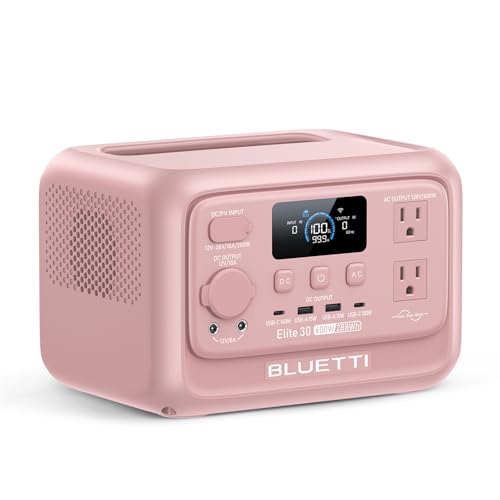
The Bluetti Elite 30 V2 stores 288Wh in LFP cells behind a 600W continuous inverter, and a Power Lifting mode raises the output to 1500W for a short burst. Wall charging runs at 380W, adjustable down to 200W, reaching 80 percent in 45 minutes and a full charge in 70, which is the fastest refill among the small packs here.

Next to the Jackery Explorer 300 it lifts the inverter rating from 300W to 600W at a similar capacity, and it adds a UPS mode that switches in 10ms, which protects a router, a laptop or a CPAP during a sudden loss of shore power and keeps a work-from-camp session alive through a breaker trip. The listing also says upgraded cell tech cuts the unit's own power consumption by half.

It sits mid-pack on price, a small step below the Jackery Explorer 300 bundle and noticeably below the CTOLITY AP1000, with the money going to inverter strength and charging speed.

What works

  • 380W wall input refills in about 70 minutes
  • Power Lifting mode reaches 1500W for short loads
  • 10ms UPS switchover protects sensitive devices

Watch out for

  • 288Wh limits a multi-day fridge plan
  • Wall charging needs a nearby outlet to shine
04
WEN 300-Watt 269Wh Lithium-Ion Power Station and Battery-Powered Inverter Generator (PP300i)
  • 269Wh lithium-ion, 300W (600W surge)
  • 9 outlets including two 12V barrels
  • Two-year warranty, LED work light
Check price on Amazon for WEN 300-Watt 269Wh Lithium-Ion Power Station and Battery-Powered Inverter Generator (PP300i) (opens in a new tab)
Best for: Campers who run lots of small 12V and USB accessories at once.

Our take

Geared toward a camper with a mixed bag of 12V gear, a car fridge and a few USB devices who values a long warranty and plenty of ports.

Why it made the shortlist

The WEN PP300i packs 269Wh of lithium-ion into a unit rated 300W continuous and 600W surge, with nine outlets: two 120V receptacles, a quick-charge 12V USB-A port, two standard USB-A ports, a 20V USB-C port, an automotive-style 12V socket and two 12V barrel jacks. A backlit display shows charge level, temperature, wattage in and out, and per-outlet status in real time.

Alongside the DaranEner 192Wh it adds more capacity and a far wider range of outputs, and the maker states it runs a 10W bulb up to 24 hours or a 45W car fridge up to six hours. A standard wall charger, a rubber-grip handle, an LED work light and a two-year warranty come with it.

It sits in the lower middle of this shortlist on price and costs less than either Bluetti listing, so the saving goes toward port variety and a long warranty period. The battery-powered inverter generator format also appeals to campers who like a familiar WEN brand label on their tools.

What works

  • Nine outlets cover most small camp accessories
  • Two-year warranty stated in the listing
  • Runs a 45W car fridge about six hours
  • Backlit display shows each outlet

Watch out for

  • Lithium-ion cells wear faster than LiFePO4
05
Best for: Light travelers keeping to phones, a laptop and a fan for a night or two.

Our take

Fits the needs of a boondocker with a lean kit, such as a phone, a laptop, a CPAP on a low setting and a light, who will rely on a car or a small panel for recharging.

Why it made the shortlist

The DaranEner 192Wh gives a 192Wh LiFePO4 pack a 300W pure sine wave inverter with 600W surge. Outputs run to two AC sockets, one 60W USB-C PD jack, a pair of 18W USB-A ports and a 12V DC connection. The listing states 3,500+ cycles, and its MPPT controller tops out at 60W of solar input, a sensible match for a single folding panel on a picnic table.

Compared with the WEN PP300i, it swaps outlet variety for a LiFePO4 pack and a lighter 5.73 lb body, at the lowest outlay in this shortlist. Wall recharge reaches its maximum at 100W, and car and solar inputs both work, so a tailgate panel can top up the battery during an afternoon or a drive can refill it on the way to the next site. Six simultaneous devices can draw at once, and a built-in LED light handles tent and cabin duty.

It is compact enough to fit in a footwell, a gear bin or a backpack side pocket, and it is the cheapest honest way into LiFePO4 off-grid power on this list.

What works

  • Lowest entry on this list with LiFePO4 cells
  • States 3,500+ cycles in the listing
  • MPPT controller accepts a 60W solar panel
  • 5.73 lb fits a footwell

Watch out for

  • 192Wh is a one-night battery
  • Wall input tops out at 100W

Methodology

How We Built This Shortlist

Each pick was assessed across 5 criteria weighted for real-world use.

01

Daily watt-hour budget

We framed every pick around how many watt-hours a typical camp day uses: phones, a laptop, lights, a vent fan and a small 12V fridge. Dividing each unit's stated watt-hours by that figure gave a realistic number of days. This is arithmetic from product specs, not a measured runtime.

02

Recharge from anywhere

We compared AC wall input, solar input range and car charging for each unit. A pack that takes a few hours of sun to refill is a different tool from one that fills in under an hour from a campground outlet. We rewarded units that state a recharge time in the listing.

03

Inverter against surge

We looked at continuous output and surge separately, since a fridge compressor starts with a surge well above its running watts. A 300W inverter handles lights and a CPAP, while the CTOLITY AP1000 and the Bluetti Elite 30 carry the headroom for motors. More detail on scoring is on the how we review page.

04

Chemistry and cycle life

We read the cell type and cycle claim in each listing. LiFePO4 and LFP are stated for five of the picks, and lithium-ion for the WEN. Cycle numbers line up only when the depth of discharge and the end-of-life point match, details that most listings leave out.

05

Weight and honesty about limits

We weighed each pick against how often a camper will actually carry it, and we stated plainly where a unit stops, such as a multi-day fridge plan on a 192Wh pack. Price position is described as a band within this shortlist, tied to what the extra money buys.

Decision guide

Match a Budget Portable Power Station for Boondocking to Your RV

By Days Off-Grid

Match the pack to how many days you plan to camp between recharges.

Days between rechargesPick
One to two days with a fridgeCTOLITY AP1000 carries a compact fridge, lights and devices.
One night of devices and a CPAPJackery Explorer 300 covers it, with a panel in the box.
One night, quick top-up at a campgroundBluetti Elite 30 refills in about 70 minutes.
One night with lots of 12V accessoriesWEN PP300i offers nine outlets on a 269Wh pack.
A lean one-night kitDaranEner 192Wh handles phones, a laptop and a light.

By Budget

Bands are positions inside this shortlist, not price quotes.

Band within this shortlistPick
Entry of this shortlistDaranEner 192Wh for the cheapest LiFePO4 option.
Low-mid of this shortlistWEN PP300i for the widest range of outlets.
Mid of this shortlistBluetti Elite 30 for the 600W inverter and fastest wall charge.
Upper-mid of this shortlistJackery Explorer 300, with its panel included.
Top of this shortlistCTOLITY AP1000 for roughly three times the stored energy.

Solar-First vs Wall-First Recharging

Where the next kilowatt-hour comes from changes which unit works.

Solar-first camps

Dispersed sites with no outlet need a unit that accepts a useful panel. Jackery Explorer 300 includes a starter panel and DaranEner 192Wh takes up to 60W of solar.

Wall-first camps

Trips that pass campgrounds and towns favor fast wall input. Bluetti Elite 30 and CTOLITY AP1000 reach 80 percent in about 45 minutes, and WEN PP300i charges from a standard wall charger.

If no outlet is within reach for three days, solar capacity matters more than any wall-charge speed.

By Load Type

Different appliances need different things from the inverter.

LoadPick
Compressor fridge with a startup surgeCTOLITY AP1000 has the 3600W peak and 1800W continuous rating.
CPAP and router that must not drop outBluetti Elite 30 switches in 10ms.
Laptop and phones onlyDaranEner 192Wh or Jackery Explorer 300 both suffice.
Many small 12V accessoriesWEN PP300i lists two 12V barrel jacks and an automotive socket.
Short bursts of 1000W or moreBluetti Elite 30 offers 1500W Power Lifting mode for a moment.

For Dispersed Camping Specifically

Remote camps reward low weight, a solar plan and a sober energy budget.

Look for

A stated solar input range, a cycle rating and a body light enough to carry. Jackery Explorer 300 and DaranEner 192Wh state all three or close to it.

In this comparison

Jackery Explorer 300 ships with its own panel, DaranEner 192Wh takes 60W via MPPT, and CTOLITY AP1000 suits a longer stay with a bigger panel array.

When to Spend More

Decide whether a bigger pack or a different class fits the plan.

Spend more if

You camp more than two nights with a fridge. CTOLITY AP1000 is the largest pack here, and beyond it a larger system makes sense.

Save if

You camp a night at a time with devices only. DaranEner 192Wh or WEN PP300i costs noticeably less than the Bluetti Elite 30 and covers the plan.

FAQ

Before You Bring One Home

How many days will a 288Wh station run a camp?

It depends on the daily watt-hour budget. A day with a phone, a laptop and a few lights uses roughly 100Wh to 150Wh, so a 288Wh pack covers about two days of that. Add a compressor fridge and it drains in under a day. The Bluetti Elite 30 holds 288Wh, and the CTOLITY AP1000 holds 1,024Wh for fridge days.

Can I run a 12V fridge from the AP1000 overnight?

Yes in principle, since the CTOLITY AP1000 has 1,024Wh and a 3600W peak rating that clears a compressor's startup surge. A compact fridge averaging a few dozen watts over a day would draw several hundred watt-hours, so the pack covers a day or two. Look at the fridge's nameplate for running watts and the duty cycle.

Can the Bluetti Elite 30 recharge while it runs devices?

Its listing describes eight charging modes and a UPS mode that switches in 10ms, so it is built to keep a CPAP or router powered while the wall or a panel feeds it. Pass-through behavior is not spelled out in detail, so ask the seller before relying on it for a continuous load.

Will a 40W panel keep a 292Wh unit charged?

A 40W panel contributes roughly 100Wh to 150Wh on a sunny day, so the Jackery Explorer 300 refills slowly alongside it. That is enough to offset a light day of phones and lights, not a fridge. A larger Jackery panel shortens the refill, since the listing states 80 percent in about 2.8 hours with a 100W panel.

What is Power Lifting mode?

Power Lifting is Bluetti's name for a mode that raises the output to 1500W for loads that need more than the 600W rating. It suits a short burst such as a kettle or a small appliance, not a sustained load, and the 288Wh pack drains quickly at that draw. Read the load's wattage before trying it.

Is lithium-ion good enough for the WEN PP300i?

For occasional trips, yes. Lithium-ion cells are commonly rated around 500 to 800 cycles, which is several seasons of weekend use. LiFePO4 units like the DaranEner 192Wh last several times longer, so a camper who goes out every weekend should favor them.

Bottom line

The short version

Browse more budget portable power stations for boondocking on Amazon →
Bowen Higgins, RV Editor at RV Gear Lab

About the author

Bowen Higgins

RV Editor at RV Gear Lab

Bowen covers RV power, water systems, towing and leveling, upkeep and interior comfort, with a focus on matching gear to the rig, the hookups and the way you actually travel.

More from Bowen →Editorial standards

Keep reading

Related guides