

We research everything we recommend. When you buy through our links, we may earn a commission. Learn more

Buying guide · 11 min read · Updated October 2, 2026

6 Best Budget Solar Panels for a Class C Motorhome in 2026: A Practical RV Guide

Budget rigid and portable solar panels for Class C motorhomes, picked for roof fit, mounting holes, wiring runs and how many you can stack on the roof.

Bowen HigginsBy Bowen HigginsRV Editor at RV Gear Lab6 products comparedSpec-sheet researched

At a glance

Our top picks

At a glance · 6 picks

A Class C roof is a puzzle before it is a power plant. The air conditioner takes the middle, vents and a skylight break up the rest, and a cab-over bunk makes the front a poor place for anything that must see the sun. What is left is a strip or two where a rigid panel can lie flat. Panel size is therefore a real-estate question first, and a wattage question second, and the answer changes with every floor plan and every aftermarket air conditioner or roof rack you may have added.

Budget builds usually start with one or two 100W panels, because that size fits the leftover strips, weighs little on a roof and can be wired in parallel as the system grows. A small RV does not need an exotic array to cover a fridge, lights and a fan overnight, but it does need panels that bolt down securely and wiring that reaches the battery without a long, thin cable run. Those two details, mounting and wiring, decide whether a cheap system works for many years or becomes an expensive roof repair.

This guide is written from the roof down. It compares panels by footprint, mounting holes, stated wind and snow loads and junction box ratings, then explains where each fits on a Class C, how to wire it, and which small panels are useful as a supplement rather than a main array. Every entry says plainly what it is good for, so you can tell a main-array panel from a supplement at a glance, and you can plan how the roof, the battery bank and the controller will fit together before you buy anything.

RV Gear Lab field notes

The Rig Fit Check

Start with the job
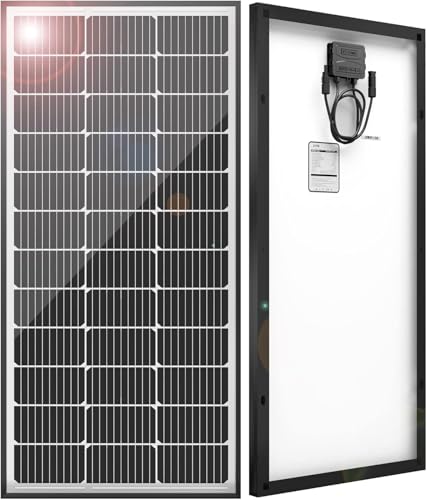
ECO-WORTHY 100 Watt Solar Panel 18 Volt Monocrystalline Solar Panel High Efficiency Module RV Marine Boat Caravan Off Grid leads this shortlist for Class C owners building a roof array one 100W panel at a time.. Use that fit as a reference point, then compare the alternatives against your own space and workload.
Specs that separate the picks
The first details to compare are 100W N-type, 25% efficiency, 100W, 182mm 10BB cells, 100W, 10BB mono cells, 23%. Confirm the exact model and included components before ordering.
Trade-off to plan for
Brackets and cables bought separately

Before you buy

What Matters Before You Choose a Budget Solar Panel for a Class C Motorhome

Key buying criteria so you get the right fit the first time.

  1. 01

    Roof area and panel footprint

    The roof of a Class C shares its space with an air conditioner, vents, a skylight and a ladder path, so the usable strips are narrow. A 100W rigid panel of about 35 by 23 inches fits most of them, while larger panels often do not. Measure the free roof area, leave a walkway and a margin from the edge, then count how many panels fit. Compare the listed dimensions with that count before ordering.

  2. 02

    Mounting holes and structural loads

    A panel bolted to a roof sees highway wind, gusts and winter snow load, and a weak frame can flex or tear brackets. Pre-drilled holes let you use Z-brackets or tilt mounts without drilling the frame. Wind and snow ratings in pascals give a number to compare, and values like 2,400 and 5,400 are common in this class. Locate the rating in the listing and match it to the weather you travel through.

  3. 03

    Wiring runs and voltage drop

    Power travels from roof to battery through cable, and every foot of thin cable loses a little energy as heat. A longer run needs thicker wire or a higher-voltage series connection to hold losses down. Panels with a printed Vmp and Imp let you size the cable and decide between series and parallel. A short, direct run through a roof entry gland is better than a long detour.

  4. 04

    Rated watts against real harvest

    A panel's rated watts are measured under standard test conditions, so the daily harvest is lower once the roof is flat, the sun is low or the cells are hot. A claim of 400Wh per day in a listing describes ideal conditions rather than a typical day. Plan a system around a conservative figure and add a panel if you boondock for long stretches. Think of the label as a size class.

  5. 05

    Junction box and connector ratings

    The weakest point of a roof panel is usually not the glass but the box and connectors on the back. An IP65 or IP68 box and IP67 or IP68 connectors resist rain, dust and washing. Cheaper units skip that detail, and water in the box ends the panel's life. Read the box and connector lines in the bullet list, not only the efficiency figure.

  6. 06

    Fixed roof panel or portable add-on

    A fixed panel charges every parked day without effort, while a portable panel can be moved out of the shade. Parked under trees, a Class C may harvest nothing from the roof, and a foldable panel can sit in a clearing. A small supplement panel keeps a start battery alive. Decide how you camp, then pick a mix of roof and portable panels.

Our standards

Why You Can Trust RV Gear Lab

At RV Gear Lab, we compare products based on rig fit and power or hookup compatibility, verified specifications, usability, setup requirements, weight, durability, and real-world trade-offs. We do not rank products purely on marketing claims or commission rates.

We have not personally tested every product listed. Where hands-on testing is not available, recommendations are based on verified manufacturer specifications, product documentation, use-case fit, and comparative research.

How we review RV gear →

Detailed reviews

The 6 best budget solar panels for a class c motorhome, explained

01
Best for: Class C owners building a roof array one 100W panel at a time.

Our take

It tops this guide because its size, N-type efficiency and flexible mounting match what Class C roofs actually offer.

Why it made the shortlist

ECO-WORTHY lists this 100W panel at 25 percent efficiency using N-type cells, and the listing says it supplies about 400Wh per day under standard conditions. The panel measures 35.63 by 23.03 by 1.18 inches, a footprint that slips into the gaps left beside an air conditioner and fits most roof strips without cutting into walkway room, which is the first test any Class C panel has to pass.

Pre-drilled holes on the back take brackets of your choosing, so you can position the panel to use the available roof area. An IP68 junction box, impact-resistant tempered glass and a corrosion-resistant aluminum frame back the 25-year life the listing describes, which suits a roof that endures sun, rain, tree debris and years of heat cycling. The glass face is the part that takes every hailstone and branch.

Two or three of them in parallel give a basic boondocking array, and each one is a manageable lift to carry up a ladder and set down on the roof, so a single owner can install the whole array across a weekend.

What works

  • Fits the gaps beside a roof AC
  • N-type cells with 25% listed efficiency
  • Pre-drilled holes for flexible brackets
  • IP68 junction box and tough glass

Watch out for

  • Brackets and cables bought separately
  • Real daily harvest sits below 400Wh
02
Best for: Motorhome owners wanting a 100W panel with a five-year product assurance.

Our take

It adds a five-year product assurance and a long performance guarantee to the specs, which makes it a sound choice for a roof you do not plan to revisit while still costing a little less than the JJN 100W.

Why it made the shortlist

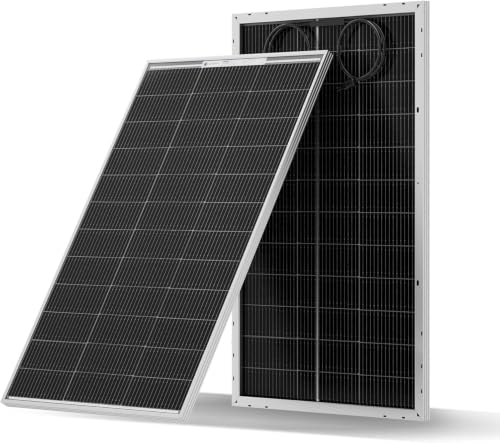
Traver Force builds this 100W panel from Grade A+ monocrystalline cells at 182mm with a 10-busbar layout, which the listing says collects current more evenly and reduces the risk of micro-cracks. The cell efficiency is stated at up to 25 percent, matching the best budget panels in this guide, which squeezes more watts out of each strip of roof than older cell designs.

Four pre-drilled mounting holes make it easy to bolt to roof brackets, and an IP65 junction box pairs with IP68 solar connectors and a corrosion-resistant aluminum frame. The combination protects the electrical parts that fail first on a motorhome roof, where weather and thermal cycling are constant, and it keeps the connections tight through years of highway vibration.

It fits owners who want mounting simplicity and the reassurance of a longer warranty, along with a panel that behaves predictably in a parallel string with a matching second panel.

What works

  • Five-year product assurance listed
  • IP68 connectors guard the weak point
  • Four holes for simple bracket mounting
  • 10BB cells cut micro-crack risk

Watch out for

  • Footprint is not given in the listing
  • Controller must be bought separately
03
Best for: Owners who park in snow country or drive in strong wind.

Our take

Among the 100W panels it lands near the entry end and costs noticeably less than the ECO-WORTHY 100W while offering a transferable 30-year power output warranty.

Why it made the shortlist

JJN uses Grade A+ monocrystalline cells with a 10-busbar layout at a stated 23 percent efficiency, wrapped in a black corrosion-resistant aluminum frame. The listing gives load ratings of 2,100 Pa for wind and 5,100 Pa for snow, specific numbers a roof owner can compare against local conditions, and the same listing describes straightforward installation.

An IP65 junction box and IP67 connectors protect the electrical parts, and pre-drilled mounting holes allow straightforward installation on brackets. The black frame blends with a dark roof line, and the 100W size matches the roof gaps beside a typical air conditioner. Four or five of them cover the kind of array a long boondocking trip needs without exotic hardware or a custom frame.

Sound choice for budget builders who plan to stack several panels and want a low cost per rated watt. Its transferable warranty also helps if the motorhome changes hands later, since the paperwork follows the panel.

What works

  • Long transferable output warranty
  • Low entry cost per rated watt
  • Black frame suits dark roofs

Watch out for

  • Slightly lower efficiency than N-type rivals
  • Warranty terms need reading in full
04
Best for: Class C owners adding a small panel to keep chassis and house batteries topped up.

Our take

It belongs on a Class C as a supplement rather than the main array, keeping a chassis battery, a generator start battery or a house battery from sagging during storage.

Why it made the shortlist

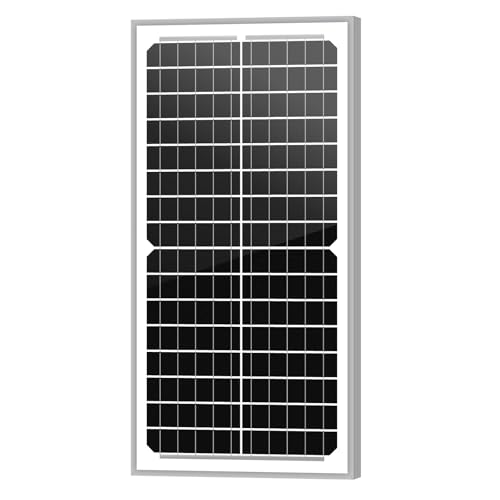
Newpowa lists this 35W panel with an Imp of 2.04A and a Vmp of 17.2V, 182mm monocrystalline cells and a listed conversion rate of 21 to 23 percent. The listing mentions a waterproof controller with an IP67 rating, and pre-attached three-foot leads with bare ends make the first connection simple, which suits an owner wiring the panel to a charge controller or a battery terminal on the same afternoon.

Pre-drilled frame holes allow quick mounting, and the warranty terms are clear: two years on materials and workmanship, output above 90 percent at ten years and above 80 percent at 25 years. Those numbers give a small panel a surprisingly long paper trail, with a stated path from 90 percent output to 80 percent over the long run, which is more detail than many small panels offer.

It costs far less than the 100W panels and fits the odd corner of roof that nothing bigger can use. A short lead run to the chassis battery keeps wiring losses low and installation quick.

What works

  • Fits tight corners of the roof
  • Clear output warranty over 25 years
  • Waterproof controller named in the listing
  • Leads attached for quick wiring

Watch out for

  • Too small to run a fridge
  • Listing is unclear on the controller type
05
Best for: Motorhome owners wanting a foldable panel for a station or a spare.

Our take

On a Class C it works as a portable addition that follows the sun around the campsite, charges a power station and keeps phones topped up.

Why it made the shortlist

SinKeu sells a 60W foldable panel with monocrystalline cells at a stated 22 percent efficiency and a 12-18V DC output rated at 3.3A maximum. Ten DC connectors come in the box, which lets it feed most portable power stations without a separate adapter hunt, so the panel is useful on the day it arrives with whichever station you already own.

Four ports cover different uses: one DC output, one USB-C port with PD profiles up to 12V and 1.5A, and two USB QC3.0 ports. The polyester pouch holds the panel when folded, and an IPX4 water resistance rating covers splashes, which suits a panel set on the ground, on a picnic table or against a tire in the sun. The polyester pouch also keeps the panel clean in a storage bay.

As the entry-level portable pick in this guide, it is a useful second source whenever shade falls across the roof.

What works

  • Ten DC connectors in the box
  • USB-C and QC3.0 ports for gadgets
  • Folds into a carry pouch
  • Follows the sun around camp

Watch out for

  • Not a fixed roof panel
06
Best for: Owners parking a Class C for months who need a standby trickle.

Our take

At the entry end of the shortlist and far cheaper than the 100W panels, its role is narrow and honest.

Why it made the shortlist

Newpowa offers a 10W monocrystalline panel measuring 17.32 by 8.46 by 0.71 inches, with a Vmp of 18.34V and an Imp of 0.55A, which is a trickle rate by design. The listing gives load ratings of 2,400 Pa for wind and 5,400 Pa for snow, and pre-attached three-foot leads with bare ends ready for a controller or a terminal block.

A 10-busbar layout and EVA encapsulation back a stated conversion range of 21 to 23 percent, and the same warranty language applies as the larger Newpowa: two years on materials and workmanship and long output guarantees. The slim 0.71 inch profile sits flat on a dash or a spare roof corner, and the weight is negligible.

It keeps a stored engine or house battery from sagging during off-season parking, which spares you a dead-battery surprise at the first trip of the year and extends the useful life of a lead-acid battery.

What works

  • Thin profile fits any flat corner
  • Cheap way to maintain a battery
  • Pre-attached leads for quick hookup

Watch out for

  • Far too small to power appliances
  • Needs a controller in most setups

Methodology

How We Built This Shortlist

Each pick was assessed across 5 criteria weighted for real-world use.

01

Roof fit and footprint

We started with listed dimensions, since a Class C roof offers strips between the air conditioner, vents and skylight. Panels with a printed footprint were ranked above those without one, because the buyer can lay a template on the roof before ordering. We also considered how many panels of each size could realistically share a roof.

02

Mounting and structural ratings

We looked for pre-drilled holes, frame material and stated wind and snow loads. A panel that is bolted to a roof sees highway wind and winter snow, so a printed load number beats a vague durability claim. We describe those ratings as listing claims.

03

Electrical parts and wiring

We read junction box and connector ratings, stated voltage and current and any included leads. Voltage and current decide how the panel fits into a parallel or series string, and connector quality decides how long the wiring survives roof weather. A panel with printed Vmp and Imp is easier to design around.

04

Warranty and stated life

We compared output warranties, product assurances and stated performance over time. These are claims from the maker, so we weigh them as support for a purchase decision, not proof. Longer, clearer terms ranked higher.

05

Role on a Class C

We asked what each panel does on a motorhome: main array, supplement or portable add-on. That framing keeps small panels from competing with 100W panels on the wrong terms. We do not print prices, because the numbers change daily, and we describe where each pick sits in the lineup instead.

Decision guide

Match a Budget Solar Panel for a Class C Motorhome to Your RV

By Roof Space Available

Start with how much clear roof you have, since that sets the panel count and size.

Free roof areaBest matchWhy
One narrow strip beside the ACECO-WORTHY 100WCompact 35.63 x 23.03 inch footprint
Two strips, dark roofJJN 100WBlack frame and low entry cost per watt
Room for brackets of your choiceTraver Force 100WFour holes and a long assurance
A small corner onlyNewpowa 35WFits tight spots as a supplement
No roof room at allSinKeu 60WFoldable and set out on the ground

By Budget

Budget panels fall into clear steps, and each one buys something specific.

Budget bandPickWhat the money buys
Entry of this shortlistNewpowa 10WA thin panel to maintain a stored battery
Entry of this shortlistNewpowa 35WA small supplement panel with long warranty terms
Mid of this shortlistTraver Force 100WFull 100W with IP68 connectors and a long assurance
Mid of this shortlistECO-WORTHY 100WN-type cells and a printed footprint
Top of this shortlistSinKeu 60WA foldable panel with ten adapters and USB ports

Fixed Roof Panels vs Portable Panels

The core decision is whether your power should sit on the roof or follow the sun.

Fixed roof panels

The ECO-WORTHY 100W, Traver Force 100W and JJN 100W charge every day you park, with no setup. They suit full-time and frequent travelers.

Portable panels

The SinKeu 60W goes where the sun is, which helps when trees shade the roof. It needs placing, aiming and packing each day.

Choose the ECO-WORTHY 100W for roof duty, and add the SinKeu 60W if you often camp in shade.

By Wiring and Weather

A second axis is how the panel handles weather and how it connects.

ConcernBest matchWhy
Snow and wind loadsJJN 100WStated 2,100 Pa wind and 5,100 Pa snow
Connector durabilityTraver Force 100WIP68 connectors and an IP65 box
Junction box ratingECO-WORTHY 100WIP68 junction box
Quick leads for first hookupNewpowa 35WPre-attached three-foot leads
Spare for a portable stationSinKeu 60WTen DC connectors in the box

For Class C Boondocking Specifically

Boondocking depends on a daily energy budget, not a single big number.

Look for

A footprint that fits roof gaps, mounting holes, stated load ratings, a printed Vmp and Imp, and a way to add panels later in parallel.

In this comparison

The ECO-WORTHY 100W and Traver Force 100W form a sound two-panel base, with the Newpowa 35W and SinKeu 60W as supplements.

When to Spend More

Budget panels build a modest system, and some owners outgrow it.

Spend more if

You run a roof air conditioner, a microwave or a residential fridge. The Traver Force 100W and ECO-WORTHY 100W panels scale up, and a larger array plus MPPT controller beat any single small panel.

Save if

You boondock lightly with lights, fans and phones. The Traver Force 100W or JJN 100W at a low cost per rated watt, or the Newpowa 10W maintainer, covers that.

FAQ

Before You Bring One Home

How many 100W panels fit on a Class C roof?

Most Class C roofs hold two to four, depending on the air conditioner, vents and skylight. Measure the clear area, leave a walkway and a margin from the edge, then compare it with each panel's listed dimensions. The ECO-WORTHY 100W at about 35.63 by 23.03 inches is a handy size for that kind of layout.

Should I wire panels in series or parallel?

Parallel keeps voltage near 12V and works with simple controllers, and shading on one panel hurts less. Series raises voltage, which cuts cable losses on a long run but needs an MPPT controller that accepts the higher input. Print the panel's Vmp and Imp, then size the cable and controller around the total.

Is the Traver Force 100W worth it over the JJN 100W?

A five-year product assurance and IP68 connectors are the reasons to choose it. The JJN 100W costs less, publishes wind and snow load ratings and carries a 30-year transferable output warranty. Pick the Traver Force for a roof you rarely touch and the JJN to stretch a budget.

Can a 35W panel run a motorhome?

No, it is too small for appliances, and the Newpowa 35W is best as a supplement or maintainer. It can keep a chassis battery, a generator battery or a spare house battery topped up. For fridge and lights use at least one 100W panel and a battery bank.

Do I need a charge controller?

Yes, for any panel wired to a battery unless the panel is a self-contained kit. The controller prevents overcharging and, with MPPT, harvests more from the same panel. A portable unit like the SinKeu 60W plugs into a power station that has its own.

How do I route wires into a Class C?

Use a roof entry gland or cable pass-through sealed with lap sealant, and keep the run short and direct. Avoid drilling through the roof membrane without sealing, since leaks cause far more damage than any solar saving. Route cables along existing channels and leave a loop at the junction box for water to drip off.

Bottom line

The short version

Browse more budget solar panels for a class c motorhome on Amazon →
Bowen Higgins, RV Editor at RV Gear Lab

About the author

Bowen Higgins

RV Editor at RV Gear Lab

Bowen covers RV power, water systems, towing and leveling, upkeep and interior comfort, with a focus on matching gear to the rig, the hookups and the way you actually travel.

More from Bowen →Editorial standards

Keep reading

Related guides