

We research everything we recommend. When you buy through our links, we may earn a commission. Learn more

Buying guide · 10 min read · Updated October 2, 2026

6 Best Dual Battery Solar Charge Controller in 2026: A Practical RV Guide

Six dual-battery solar controllers and dual-input chargers for RVs that need to charge a house and starter battery, with plain notes on what each one does.

Bowen HigginsBy Bowen HigginsRV Editor at RV Gear Lab6 products comparedSpec-sheet researched

At a glance

Our top picks

A dual-battery controller charges two batteries, typically a house bank and a starter or second bank, from one solar array. This guide compares true dual-output solar controllers with a DC-DC charger that takes solar and alternator input, because the two are easy to confuse on listings.

This guide keeps them in one list but explain what each unit actually is: a dual-output MPPT, dual-output PWM controllers with a charge priority, a programmable PWM and a dual-input DC-DC charger. Where a listing leaves out how the second output works, this guide says to check the manual.

RV Gear Lab field notes

The Rig Fit Check

Start with the job
EPEVER 30A MPPT Dual Battery Solar Charge Controller 12V/24V Auto Max. PV 100V DuoRacer 30 Amp Controller for leads this shortlist for Dual-output MPPT. Use that fit as a reference point, then compare the alternatives against your own space and workload.
Specs that separate the picks
The first details to compare are 30A MPPT, two batteries, 30A DC-DC with MPPT, 20A PWM, 12/24VDC. Confirm the exact model and included components before ordering.
Trade-off to plan for
Negative-ground design only

Before you buy

What Matters Before You Choose a Dual Battery Solar Charge Controller

Key buying criteria so you get the right fit the first time.

  1. 01

    True dual output or dual input

    A dual-battery controller charges two batteries from one array, while a dual-input charger takes two sources into one battery. Mixing them up leads to the wrong purchase. Check whether the listing says two batteries or two inputs.

  2. 02

    Charge priority control

    Some units split charge by percentage, such as 80/20 or 30/70, so the house bank fills first. Without priority, the starter battery may take current it does not need. Look for a stated priority setting.

  3. 03

    MPPT versus PWM for two banks

    MPPT recovers extra panel voltage, while PWM is simpler. Dual MPPT units like EPEVER DuoRacer 30A suit larger arrays. Pick based on array size and panel voltage.

  4. 04

    Battery chemistry per bank

    Two different chemistries rarely want the same charge voltages, so mixing lithium and lead-acid on one controller can be a problem. Check whether the listing lets you set a profile per bank. Plan the pair of batteries around the profiles the unit actually offers.

  5. 05

    Wiring and fusing

    Each battery needs its own fuse at the battery. Dual units add terminals, so measure the wire run and use correct gauge. Plan the layout before purchase.

Our standards

Why You Can Trust RV Gear Lab

At RV Gear Lab, we compare products based on rig fit and power or hookup compatibility, verified specifications, usability, setup requirements, weight, durability, and real-world trade-offs. We do not rank products purely on marketing claims or commission rates.

We have not personally tested every product listed. Where hands-on testing is not available, recommendations are based on verified manufacturer specifications, product documentation, use-case fit, and comparative research.

How we review RV gear →

Detailed reviews

The 6 best dual battery solar charge controller, explained

01
Best for: Dual-output MPPT

Our take

Best for an RV or boat with a house and starter battery.

Why it made the shortlist

EPEVER's DuoRacer is a 30A MPPT that charges two batteries at once, with tracking efficiency listed at 99.5% or better. The DuoRacer is a 30A MPPT controller that charges two batteries at once, with tracking efficiency listed at 99.5% or better. It auto-detects 12V or 24V, accepts up to 100V PV and 390W on 12V (780W on 24V), and has an LCD plus an AES control signal for a car refrigerator.

It has more capacity and tracking than the PWM EPEVER units below it and more solar focus than Renogy 30A DC-DC.

What works

  • Charges two batteries at the same time
  • Tracking efficiency listed at no less than 99.5%
  • Supports AGM, gel, flooded, LiFePO4 and Li-NiCoMn
  • Control signal for a car refrigerator

Watch out for

  • Negative-ground design only
  • 390W limit on a 12V system
02
Best for: Solar plus alternator

Our take

Best for a rig that needs alternator and solar charging.

Why it made the shortlist

Renogy's 30A is a DC-DC charger with MPPT, taking solar and the vehicle alternator rather than acting as a plain solar controller. Renogy's 30A unit is a DC-DC on-board charger with MPPT, so it charges a service battery from solar panels and the vehicle's alternator rather than acting as a plain charge controller. It measures 9.6 by 5.7 inches, weighs 3.13 pounds, is 12V with 24V compatibility, and lists eight protections.

It differs from EPEVER DuoRacer 30A by charging from the alternator while driving.

What works

  • Charges from both solar and alternator
  • Built-in MPPT with three-stage charging
  • Small at 9.6 inches and 3.13 pounds
  • Eight protections listed

Watch out for

  • A DC-DC charger, not a plain solar controller
  • Needs vehicle wiring plus a solar input
03
Victron Energy BlueSolar PWM Charge Controller
  • 20A PWM, 12/24VDC
  • LCD with two USB ports
  • Programmable light control
Check price on Amazon for Victron Energy BlueSolar PWM Charge Controller (opens in a new tab)
Best for: Programmable PWM

Our take

Best for a user who wants a programmable PWM and a known brand.

Why it made the shortlist

Victron's BlueSolar PWM DUO is a 20A controller with an LCD, USB ports and light control. Victron's BlueSolar PWM DUO is a 20A 12/24VDC controller with an LCD, two 5V USB ports, programmable light control and three-stage charging that can be fully programmed.

What works

  • Clear display and two 5V USB ports
  • Programmable lighting function
  • Three-stage charge with full programmability
  • Fully programmable charge settings

Watch out for

  • Listing does not explain the second battery output
  • PWM, so panel voltage above battery is wasted
04
Best for: Priority charging

Our take

Best for balanced charging between house and starter batteries.

Why it made the shortlist

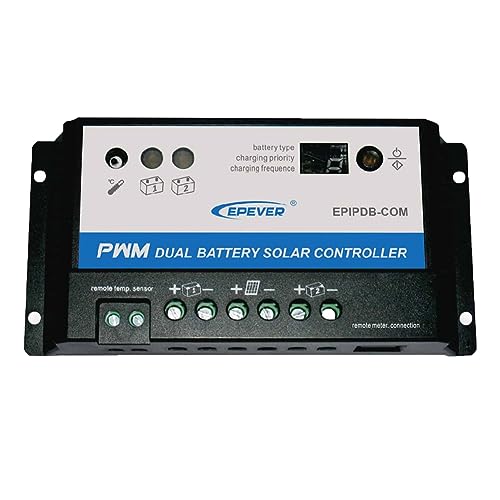
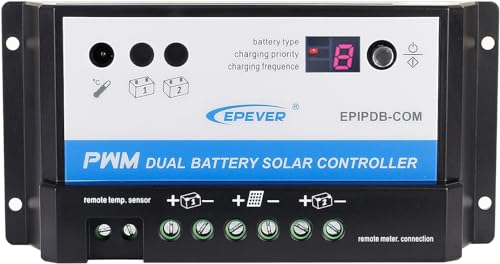
EPEVER's EPIPDB 20A charges two batteries independently with a settable priority such as 30/70. EPEVER's EPIPDB-COM 20A is a dual-battery solar controller for 12V/24V that charges two batteries independently with a settable priority such as 30/70.

It has more capacity than EPEVER EPIPDB 10A and falls back to a local temperature sensor. It is PWM, unlike EPEVER DuoRacer 30A.

It suits a rig with a house and starter battery that needs sensible priority, with a remote temperature sensor optional.

What works

  • Independent charging for two batteries
  • Adjustable priority such as 30/70
  • Falls back to a local temperature sensor
  • Four listed protections including overload

Watch out for

  • Temperature readings come from the unit without an RTS
  • 20A limits array size
05
Best for: Lead-acid dual banks

Our take

The strongest case for EVPEVER 20A Solar Charge Controller 12V/24V Auto Working Dual Battery Solar Panel Charge Controller PWM 20AMP is charges two banks independently with priority.

Why it made the shortlist

EPEVER's 20A dual PWM sets a priority split such as 80/20 for two batteries. This EPEVER 20A PWM controller charges and protects two batteries or banks independently, with a priority split such as 80/20. It auto-detects 12V or 24V, has adjustable parameters and lists sealed, gel and flooded batteries.

What works

  • Charges two banks independently with priority
  • Short, open-circuit and reverse protection
  • Adjustable parameters for tuning
  • Sealed, gel and flooded batteries supported

Watch out for

  • Lithium is not named in the listing
  • LED indicators rather than a color LCD
The catch
It matches EPEVER EPIPDB 20A on amps and price but lists fewer details on temperature handling.
06
Best for: Small second battery

Our take

Best for a small second battery on a minimal array.

Why it made the shortlist

EPEVER's 10A EPIPDB is the smallest dual-battery option here, sharing the 20A model's logic. The 10A EPEVER EPIPDB-COM shares the dual-battery design of its 20A sibling, charging two batteries independently with an adjustable priority.

It is best as a small second-battery charger.

What works

  • Same dual-battery logic as the 20A model
  • Adjustable charging priority
  • Local temp sensor fallback

Watch out for

  • 10A is small for a roof array
The catch
At 10A it only suits a small panel, so it works for a tiny second-battery job.

Methodology

How We Built This Shortlist

Each pick was assessed across 5 criteria weighted for real-world use.

01

Dual-battery function

This guide checks which listings charge two batteries independently, which use a priority split and which are dual-input chargers instead.

02

Regulation type

MPPT, PWM and DC-DC designs were compared for efficiency and wiring.

03

Battery chemistry

Lead-acid and lithium support were noted for each unit.

04

Capacity

Amp ratings and PV limits were matched to RV and boat arrays.

05

Listing clarity

Listings that are thin on the second output are flagged.

Decision guide

Match a Dual Battery Solar Charge Controller to Your RV

By Charging Source

Your situationRecommended pickWhy
Solar only, two batteries, MPPTEPEVER DuoRacer 30ACharges two batteries with MPPT.
Solar plus alternatorRenogy 30A DC-DCDual-input DC-DC with MPPT.
Programmable PWM with USBVictron DUO 20ALCD and light control.
Priority split, 20AEPEVER EPIPDB 20ASettable priority such as 30/70.
Small second batteryEPEVER EPIPDB 10A10A with priority logic.

By Budget

BudgetRecommended pick
$30 to $50EPEVER EPIPDB 10A or EPEVER EPIPDB 20A
$40 to $90EPEVER 20A Dual PWM or Victron DUO 20A
$130 to $160EPEVER DuoRacer 30A or Renogy 30A DC-DC

Dual Output vs Dual Input

Dual output

Two outputs charge two batteries from one array. EPEVER DuoRacer 30A and the EPIPDB units do this.

Dual input

Two inputs charge one battery from solar and the alternator. Renogy 30A DC-DC does this.

Choose EPEVER DuoRacer 30A for two batteries on solar, and Renogy 30A DC-DC to add alternator charging.

By Battery Chemistry

ChemistryRecommended pick
AGM, gel, flooded, LiFePO4EPEVER DuoRacer 30A
Sealed, gel, floodedEPEVER 20A Dual PWM
Settable per listingVictron DUO 20A
Lead-acid dual banksEPEVER EPIPDB 20A

For Starter-Plus-House Setups Specifically

Look for

Look for independent outputs and a priority setting so the house bank charges first.

In this comparison

EPEVER EPIPDB 20A and EPEVER 20A Dual PWM both list priority splits, and EPEVER DuoRacer 30A adds MPPT.

When to Spend More

Spend more if

Spend more for MPPT and capacity, where EPEVER DuoRacer 30A beats the PWM models.

Save if

Save if you have a small panel, where EPEVER EPIPDB 10A is enough.

FAQ

Before You Bring One Home

Is a dual-battery controller the same as a DC-DC charger?

No. A dual-battery solar controller has two outputs, while Renogy 30A DC-DC has two inputs.

What mistake do buyers make with a dual-battery controller?

Buying a dual-input DC-DC charger when you want two outputs, or the reverse.

Is MPPT worth it for dual banks?

For arrays above a few hundred watts, EPEVER DuoRacer 30A recovers more energy.

What is the safest way to wire a dual-battery controller?

Use the controller's settings to choose a split like 80/20, with the house bank highest. On a dual-battery controller, double-check polarity at every terminal before powering up and use wire sized for the rated amps.

How should I maintain a dual-battery controller?

On a dual-battery controller, tighten terminals and inspect cable insulation at the start of each season, and keep vents, fans or heat-sink surfaces free of dust. Check both battery terminals and fuses each season.

Bottom line

The short version

Browse more dual battery solar charge controller on Amazon →
Bowen Higgins, RV Editor at RV Gear Lab

About the author

Bowen Higgins

RV Editor at RV Gear Lab

Bowen covers RV power, water systems, towing and leveling, upkeep and interior comfort, with a focus on matching gear to the rig, the hookups and the way you actually travel.

More from Bowen →Editorial standards

Keep reading

Related guides