

We research everything we recommend. When you buy through our links, we may earn a commission. Learn more

Buying guide · 10 min read · Updated October 2, 2026

5 Best High Voltage MPPT Solar Charge Controller in 2026: A Practical RV Guide

Five high-voltage solar charge controllers accepting 145V to 250V of PV input for long series strings, with cold-weather Voc margins and wire-saving notes.

Bowen HigginsBy Bowen HigginsRV Editor at RV Gear Lab5 products comparedSpec-sheet researched

At a glance

Our top picks

A high-voltage MPPT controller accepts long series strings, which means thinner wire runs and less loss for the same wattage. This guide covers five controllers with PV inputs from 145V to 250V, and the practical question is how to size a string against the cap with cold-weather margin.

This guide quotes only stated caps and points out which units are for larger systems.

RV Gear Lab field notes

The Rig Fit Check

Start with the job
Epever 60A PV 250V Mppt Solar Charge Controller TEP Series 12v/24v/48v Battery System Compatible with LiFePO4 leads this shortlist for 250V PV 60A. Use that fit as a reference point, then compare the alternatives against your own space and workload.
Specs that separate the picks
The first details to compare are 60A MPPT, 12V/24V/48V, 120A MPPT, 12V to 96V, 60A MPPT, 12V to 48V. Confirm the exact model and included components before ordering.
Trade-off to plan for
36V is not listed

Before you buy

What Matters Before You Choose a High Voltage MPPT Solar Charge Controller

Key buying criteria so you get the right fit the first time.

  1. 01

    Cold Voc margin

    Open-circuit voltage rises in the cold, so a string rated 190V at 77F can exceed 200V on a frosty morning. Leave at least 20 percent margin below the cap. Add your string Voc and compare to the listing.

  2. 02

    Why high voltage helps

    Higher string voltage means lower current for the same watts, so you can use thinner wire and lose less to voltage drop. That matters on long runs. A 250V string at 60A is very different from a 60V one.

  3. 03

    Minimum start voltage

    MPPT needs panel voltage above the battery to work, and EARNMee lists 70V as the start on 48V. Too few panels in series means no charging. Check the minimum.

  4. 04

    Battery voltage range

    GUIGOOD 120A covers 12V to 96V while LiTime 60A covers 12V to 48V. Choose a range that covers your bank and any future change. Check manual versus auto selection.

  5. 05

    Fans, heat and placement

    High-power units make heat and some use fans. LiTime 60A has dual forced cooling. Mount in a ventilated, dry place.

Our standards

Why You Can Trust RV Gear Lab

At RV Gear Lab, we compare products based on rig fit and power or hookup compatibility, verified specifications, usability, setup requirements, weight, durability, and real-world trade-offs. We do not rank products purely on marketing claims or commission rates.

We have not personally tested every product listed. Where hands-on testing is not available, recommendations are based on verified manufacturer specifications, product documentation, use-case fit, and comparative research.

How we review RV gear →

Detailed reviews

The 5 best high voltage mppt solar charge controller, explained

01
Best for: 250V PV 60A

Our take

Best for long series strings and long wire runs.

Why it made the shortlist

EPEVER's TEP 60A accepts 250V PV with an MPPT range up to 180V and is built for long wire runs and larger arrays. EPEVER's TEP6425 is a 60A MPPT controller with a 250V maximum PV input and an MPPT range up to 180V, designed for long wire runs and larger arrays. It covers 12V, 24V and 48V battery systems and is listed as compatible with LiFePO4 batteries.

It has the highest PV cap here, above GUIGOOD 120A's 230V and LiTime 60A's 200V. It costs about the same as LiTime 60A and far less than Renogy Rover Lite 60A.

It is the most headroom you get at 60A in this list.

What works

  • Max PV input of 250V
  • MPPT voltage range up to 180V
  • Built for long wire runs and larger arrays
  • Listed as compatible with LiFePO4

Watch out for

  • 36V is not listed
02
Best for: 230V 120A

Our take

Best for a large off-grid build.

Why it made the shortlist

GUIGOOD's 120A MPPT accepts 230V PV Voc and 12V to 96V batteries, with up to 11,520W at 96V. GUIGOOD's 120A MPPT controller supports 12V to 96V batteries with a 230V PV Voc limit and up to 1440W at 12V and 11,520W at 96V. A user mode lets you set charging voltage, float voltage and current, and an RS485 port is included.

It is a very large, high-voltage unit for off-grid builds, not for a typical RV.

What works

  • Max PV Voc of 230V
  • Up to 1440W at 12V, 11,520W at 96V
  • User mode to set charge voltage and current
  • RS485 communication

Watch out for

  • Oversized for any single RV roof
  • Needs thick cable and big fuses
03
Best for: 200V LiFePO4 60A

Our take

Best for a 48V LiFePO4 bank with long strings.

Why it made the shortlist

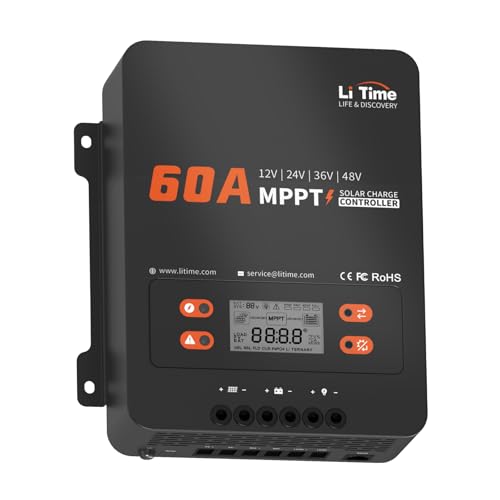
LiTime's 60A accepts 200V PV and covers 12V to 48V with a LiFePO4 mode. LiTime's 60A MPPT controller covers 12V, 24V and 48V batteries and accepts up to 200V of PV input. It adds a LiFePO4 charging mode, an LCD with LEDs and a sheet metal shell with dual forced cooling.

It costs less than Renogy Rover Lite 60A and about the same as EPEVER TEP 60A. Dual forced cooling adds a moving part.

It is the balanced 48V pick: a real 60A rating, 200V headroom and a LiFePO4 mode.

What works

  • Three selectable system voltages
  • 200V PV input suits longer strings
  • Dedicated LiFePO4 charging mode
  • Sheet metal case with dual forced cooling

Watch out for

  • Fans add noise and a moving part
  • Manual voltage selection needed
04
Best for: 150V brand 60A

Our take

Best for a Renogy ecosystem build.

Why it made the shortlist

Renogy's Rover Lite 60A accepts 150V and states it can connect up to six 200W panels. Renogy's Rover Lite 60A is an MPPT controller with 150V maximum solar input that the listing says can connect up to six Renogy 200W monocrystalline panels. It runs at full load from -31F to 113F and auto-detects 12V to 48V systems.

Budget for the BT2 module if you want phone monitoring.

What works

  • 150V maximum solar input
  • Full-load operation from -31F to 113F
  • Auto-detects 12V, 24V, 36V or 48V
  • Lists gel, sealed, flooded and lithium

Watch out for

  • Bluetooth needs a BT2 module sold separately
  • Expensive for a 60A unit
The catch
It costs more than LiTime 60A and has a lower PV cap.
05
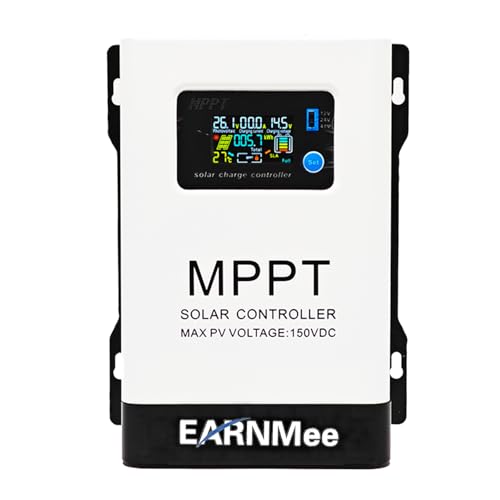
EARNMee 60A MPPT Solar Charge Controller
  • 60A MPPT, manual voltage
  • PV input to 145V
  • Fan-cooled, LCD readout
Check price on Amazon for EARNMee 60A MPPT Solar Charge Controller (opens in a new tab)
Best for: 145V budget 60A

Our take

Best for a budget long-string build.

Why it made the shortlist

EARNMee's 60A accepts 145V PV with manual 12V, 24V or 48V selection. EARNMee's 60A MPPT controller takes PV input of 18 to 145V on a 12V battery and lets you select 12V, 24V or 48V output manually. Temperature-controlled air cooling and an LCD with real-time system data round it out, and the listing names lead-acid, colloidal and lithium batteries.

It costs far less than Renogy Rover Lite 60A and is the lowest-priced here. Voltage must be set by hand.

What works

  • Handles big arrays with up to 145V PV input
  • Manual 12V, 24V or 48V battery selection
  • Temperature-controlled fan cooling under heavy load
  • LCD shows real-time system data

Watch out for

  • Battery voltage must be set by hand
  • Fan cooling adds a moving part

Methodology

How We Built This Shortlist

Each pick was assessed across 5 criteria weighted for real-world use.

01

PV cap

This guide compares stated PV inputs from 145V to 250V.

02

Cold-weather margin

This guide explains how to leave room below the cap for cold Voc.

03

Battery voltage range

12V to 96V coverage was compared.

04

Capacity

60A and 120A ratings were weighed.

05

Extras

Cooling, Bluetooth and chemistry modes were noted.

Decision guide

Match a High Voltage MPPT Solar Charge Controller to Your RV

By PV Cap Needed

Your situationRecommended pickWhy
Strings up to 250VEPEVER TEP 60A250V PV.
Strings up to 230V, big bankGUIGOOD 120A230V PV.
Strings up to 200VLiTime 60A200V PV.
Strings up to 150V, RenogyRenogy Rover Lite 60A150V PV.
Strings up to 145V, budgetEARNMee 60A145V PV.

By Budget

BudgetRecommended pick
$80 to $150EARNMee 60A or GUIGOOD 120A
$150 to $160EPEVER TEP 60A or LiTime 60A
$200 to $210Renogy Rover Lite 60A

High Cap vs Cost

High cap

A higher cap allows longer strings and thinner wire. EPEVER TEP 60A and GUIGOOD 120A lead.

Lower cap

A lower cap costs less. EARNMee 60A and Renogy Rover Lite 60A are lower.

Choose LiTime 60A for most long-string builds.

By Battery Voltage

VoltageRecommended pick
12V, 24V or 48VLiTime 60A
12V, 24V or 48V manualEARNMee 60A
12V to 48V autoRenogy Rover Lite 60A
12V to 96VGUIGOOD 120A

For Long Wire Runs Specifically

Look for

Look for a high PV cap and a start window that matches your string.

In this comparison

EPEVER TEP 60A lists an MPPT range to 180V built for long runs.

When to Spend More

Spend more if

Spend more for headroom, where EPEVER TEP 60A leads.

Save if

Save with EARNMee 60A for strings under 145V.

FAQ

Before You Bring One Home

Why use a high-voltage controller?

Longer series strings mean lower current and thinner wire for the same watts.

What mistake do buyers make with a high-voltage MPPT controller?

Forgetting cold-weather Voc against the cap.

Is a 250V unit overkill?

For a small RV, yes. EPEVER TEP 60A suits long runs.

What is the safest way to wire a high-voltage MPPT controller?

Fuse the battery and connect it first, then panels. On a high-voltage MPPT controller, double-check polarity at every terminal before powering up and use wire sized for the rated amps.

How should I maintain a high-voltage MPPT controller?

On a high-voltage MPPT controller, tighten terminals and inspect cable insulation at the start of each season, and keep vents, fans or heat-sink surfaces free of dust. Check fans and terminals.

Bottom line

The short version

Browse more high voltage mppt solar charge controller on Amazon →
Bowen Higgins, RV Editor at RV Gear Lab

About the author

Bowen Higgins

RV Editor at RV Gear Lab

Bowen covers RV power, water systems, towing and leveling, upkeep and interior comfort, with a focus on matching gear to the rig, the hookups and the way you actually travel.

More from Bowen →Editorial standards

Keep reading

Related guides