

We research everything we recommend. When you buy through our links, we may earn a commission. Learn more

Buying guide · 10 min read · Updated October 2, 2026

4 Best RV Solar Panel For Battery Charging in 2026: A Practical RV Guide

Four solar panels and kits for charging RV batteries, compared on controller type, daily watt-hours at 3 to 7 sun hours, and real cost.

Bowen HigginsBy Bowen HigginsRV Editor at RV Gear Lab4 products comparedSpec-sheet researched

At a glance

Our top picks

A panel's nameplate watts only tell you half the story when the goal is charging a house battery. What matters is how many watt-hours reach the battery on a normal day, and whether the controller can handle that current at your battery voltage. We sorted four options by that yardstick, from a 20W trickle kit to a 200W panel, and spelled out what each one realistically adds per day at 3, 5 and 7 sun hours.

RV Gear Lab field notes

The Rig Fit Check

Start with the job
Hoysicy 100W Solar Panel Kit 12V Battery Maintainer leads this shortlist for one-battery rigs that want a complete kit. Use that fit as a reference point, then compare the alternatives against your own space and workload.
Specs that separate the picks
The first details to compare are 100W monocrystalline, 200W, 18V monocrystalline, 30W monocrystalline. Confirm the exact model and included components before ordering.
Trade-off to plan for
Controller type is not stated on the listing

Before you buy

What Matters Before You Choose an RV Solar Panel For Battery Charging

Key buying criteria so you get the right fit the first time.

  1. 01

    Watts versus daily watt-hours

    Rated watts are the output in perfect sun, but a battery cares about watt-hours per day. Multiply watts by your sun hours (3 in winter, 5 typical, 7 in desert summer) and take off about 20 to 25% for heat and wiring losses. Check that the number matches your nightly use before you buy.

  2. 02

    PWM or MPPT controller

    An MPPT controller converts extra panel voltage into charging current, which helps most with cold, hazy or low light, while PWM simply connects the panel to the battery. The difference can be 20 to 30% more energy in marginal sun. Look for the words MPPT or PWM in the title or bullets, and treat silence as a warning.

  3. 03

    Panel voltage versus battery

    An 18V panel suits a 12V battery, but a 24V panel on a PWM controller will not charge a 12V bank properly. A mismatch quietly delivers a fraction of the rated power. Read the panel's voltage on the listing and make sure the controller supports that voltage input.

  4. 04

    Controller amps and limits

    A controller's amp rating caps how many watts it can pass into a 12V battery, roughly 12V times amps. A 10A controller tops out near 120W of charging, which fits 100W but not 200W of panels. Look for the rated amps on the controller and keep panel watts under that ceiling.

  5. 05

    Roof space and mounting

    A 100W panel takes roughly a square meter, and two 200W panels often will not fit around vents and AC units. Shade from even one vent cover can sharply cut the output of a string. Measure your free roof area and compare it to the dimensions on the listing before ordering.

Our standards

Why You Can Trust RV Gear Lab

At RV Gear Lab, we compare products based on rig fit and power or hookup compatibility, verified specifications, usability, setup requirements, weight, durability, and real-world trade-offs. We do not rank products purely on marketing claims or commission rates.

We have not personally tested every product listed. Where hands-on testing is not available, recommendations are based on verified manufacturer specifications, product documentation, use-case fit, and comparative research.

How we review RV gear →

Detailed reviews

The 4 best rv solar panel for battery charging, explained

01
Hoysicy 100W Solar Panel Kit 12V Battery Maintainer
  • 100W monocrystalline
  • Controller and cables included
  • 12V battery systems
Check price on Amazon for Hoysicy 100W Solar Panel Kit 12V Battery Maintainer (opens in a new tab)
Best for: One-battery rigs that want a complete kit

Our take

Against the SOLPERK 30W it adds 70W for $45.00 more.

Why it made the shortlist

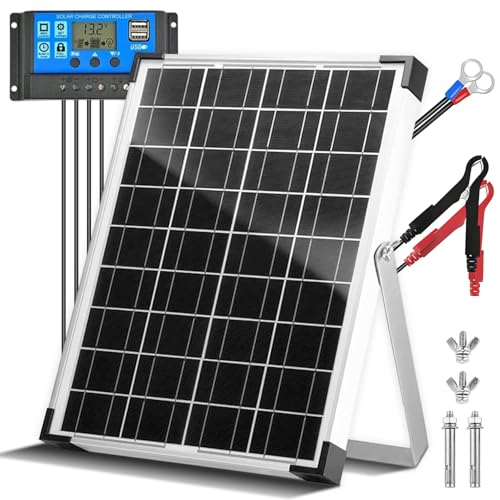
The Hoysicy 100W is a monocrystalline panel sold as a kit with a charge controller, cables, O-ring terminals and Z-brackets, so nothing extra is needed to start charging a 12V battery.

What works

  • Controller, cables and brackets all come in the box
  • Overcharge and short-circuit protection built into the controller
  • Waterproof junction box suits roof mounting year round

Watch out for

  • Controller type is not stated on the listing
  • Needs about 0.9 square meters of flat roof space
The catch
Pick this if you want one box that charges a single house battery; the caveat is that the listing does not state whether the controller is PWM or MPPT.
02
Best for: Owners who already have a controller

Our take

Pick this if you have an MPPT controller or plan to add one.

Why it made the shortlist

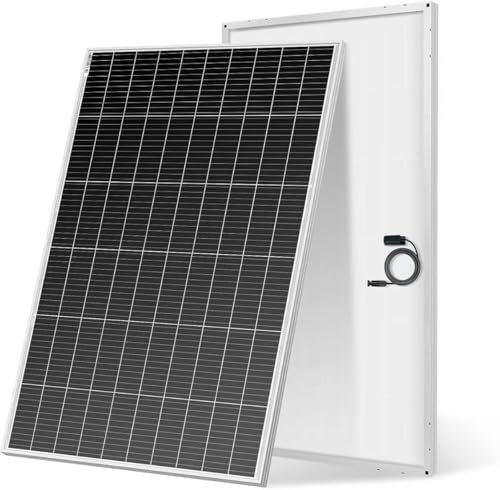
The DOKIO 200W is an 18V monocrystalline panel with MC4 connectors, made for 12V systems and pre-drilled for standard mounting brackets. At 200W it can add roughly 600Wh at 3 sun hours and 1,000Wh at 5 before wiring and heat losses, the most of any panel in this list.

What works

  • Highest wattage here, about 1,000Wh per 5 sun hours
  • MC4 connectors make adding a second panel simple
  • Pre-drilled frame mounts on standard brackets

Watch out for

  • Controller not shown on the listing, so it is extra
  • Weight and dimensions are not listed
03
Best for: Keeping a stored RV battery topped up

Our take

At $64.99 it costs $30.00 more than the Hoysicy 20W and gains 10W plus MPPT regulation.

Why it made the shortlist

The SOLPERK 30W pairs a monocrystalline panel with an MPPT controller that the listing says squeezes over 30% more from the panel than basic controllers. It also includes a bracket that swivels 360 degrees, so you can aim it at the sun while parked.

It is a maintainer, not a primary charger: 30W is about 150Wh at 5 sun hours.

What works

  • MPPT controller wrings more charge from a small panel
  • Bracket tilts and swivels toward the sun
  • Good for storage or occasional weekend top-ups

Watch out for

  • 30W adds only about 150Wh on a 5 sun hour day
  • Too small to keep up with daily camping loads
04
Hoysicy 12V Solar Battery Charger 20W Solar Panel Kit
  • 20W monocrystalline
  • Built-in 10A controller
  • Adjustable bracket included
Check price on Amazon for Hoysicy 12V Solar Battery Charger 20W Solar Panel Kit (opens in a new tab)
Best for: Trailers parked for months between trips

Our take

Twenty watts is about 100Wh at 5 sun hours, enough to offset self-drain and little more.

Why it made the shortlist

The Hoysicy 20W is a 12V monocrystalline kit with a built-in 10A charge controller and an adjustable bracket. At $34.99 it is the cheapest way here to stop a battery from self-discharging between trips.

What works

  • Overcharge protection stops it harming a full battery
  • Small enough to leave on a dashboard or roof

Watch out for

  • About 100Wh per 5 sun hours is maintenance only
  • No MPPT stage, so it wastes some panel output

Methodology

How We Built This Shortlist

Each pick was assessed across 4 criteria weighted for real-world use.

01

Daily energy

We converted each panel's rated watts into expected watt-hours at 3, 5 and 7 sun hours before any losses.

02

Controller included

We checked whether the listing includes a charge controller and whether it names PWM or MPPT.

03

Install completeness

We counted the cables, brackets and connectors listed so you know what else you will buy.

04

Cost per watt

We compared the full price against rated watts, counting any controller you must add.

Decision guide

Match an RV Solar Panel For Battery Charging to Your RV

By Daily Charging Need

Your situationRecommended pickWhy
Maintaining a stored battery (under 100Wh a day)Hoysicy 20W20W covers self-discharge at $34.99
Weekend top-ups on one battery (150Wh a day)SOLPERK 30WMPPT squeezes more from 30W on short days
One battery cycled most nights (400Wh+ a day)Hoysicy 100WAbout 500Wh at 5 sun hours before losses
Large battery bank or extended stays (800Wh+ a day)DOKIO 200WAbout 1,000Wh at 5 sun hours, add your own controller

By Budget

BudgetRecommended pick
$30 to $70Hoysicy 20W or SOLPERK 30W
$100 to $120Hoysicy 100W or DOKIO 200W

Kit vs Bare Panel

Complete kit

Hoysicy 100W, SOLPERK 30W and Hoysicy 20W ship with a controller, so wiring is plug and play but you are stuck with the controller they chose.

Bare panel

DOKIO 200W gives you the most watts per dollar and lets you pick any MPPT controller, but you must buy and size that controller yourself.

Most buyers should default to a kit unless they already own a controller.

By Controller Preference

Best fitRecommended pick
You want MPPT in a small panelSOLPERK 30W
You want a built-in 10A controller at the lowest costHoysicy 20W
You want a bundled controller plus real charging powerHoysicy 100W
You will supply your own MPPT controllerDOKIO 200W

For Storage Between Trips Specifically

Look for

Overcharge protection and a controller that stops charging at full, since the battery sits connected for months.

In this comparison

Hoysicy 20W and SOLPERK 30W both include protective controllers; SOLPERK 30W adds MPPT for $30.00 more.

When to Spend More

Spend more if

Spend more if you cycle the battery daily: Hoysicy 100W or DOKIO 200W deliver five to ten times the energy of Hoysicy 20W.

Save if

Save if the RV sits idle most of the year: Hoysicy 20W at $34.99 is enough to offset self-discharge.

FAQ

Before You Bring One Home

Can I charge an RV battery with a 20W panel?

Yes, but only to maintain it. At 5 sun hours it adds about 100Wh, which offsets self-discharge but cannot recover a battery you ran down overnight.

Do I need a charge controller?

Yes, always. Without one a panel can overcharge a battery and damage it, so choose a kit that includes one or buy a controller sized for your panel watts.

Is the DOKIO 200W worth it over the Hoysicy 100W?

It doubles the watts for $4.78 more, but you must add a controller. If you already own an MPPT controller, it is the better value.

How many sun hours should I plan for?

Use 3 for winter or cloudy trips, 5 for a typical year-round average, and 7 only for clear summer days in the Southwest.

Bottom line

The short version

Browse more rv solar panel for battery charging on Amazon →
Bowen Higgins, RV Editor at RV Gear Lab

About the author

Bowen Higgins

RV Editor at RV Gear Lab

Bowen covers RV power, water systems, towing and leveling, upkeep and interior comfort, with a focus on matching gear to the rig, the hookups and the way you actually travel.

More from Bowen →Editorial standards

Keep reading

Related guides